
State Space Models
Episodes from Latent Space about State Space Models.
5 episodes

Building Jamba 3B: the tiny Hybrid Transformer State Space Reasoning Model - Barak Lenz, CTO of AI21
Oct 11, 2025 · 45:05
Barak Lenz, CTO of AI21, presents their Jamba 3B model as a tiny hybrid transformer-state space model that brings long context capabilities to edge devices, and argues enterprises need AI systems like Maestro over standalone models. Lenz explains that the 1:8 ratio of attention to Mamba layers emerged from extensive ablations, with attention placed in the middle of the block working best. The Jamba 3B model uses a 1:12 ratio to maximize efficiency, fitting the same context length as larger models with a fraction of memory. He notes that pure Mamba underperformed on some tasks but hybrid models resolved those deficiencies, and that images quickly become long context problems (4 images can be thousands of tokens). For enterprise, Lenz advocates for model-agnostic orchestration layers treating models as "actions" with statistical properties, enabling continuous learning and cost optimization without vendor lock-in. Drawing from his algo trading background, he compares training frontier models to developing trading algorithms, emphasizing the importance of world-class engineering and avoiding brute force reasoning.

2024 in Post-Transformer Architectures: State Space Models, RWKV [Latent Space LIVE! @ NeurIPS 2024]
Dec 24, 2024 · 42:45
Dan Fu (Together AI/UCSD) and Eugene Cheah (Featherless) survey post-transformer architectures, arguing that state-space models (SSMs) like Mamba and RWKV can match transformer quality while scaling subquadratically in sequence length, enabling efficient long-context and test-time compute. Fu explains how SSMs evolved from S4 to data-dependent selection mechanisms, while Cheah details RWKV's open-source development, including Q-RWKV6—a 32B model converted from Qwen 32B with linear attention that retains 76% MMLU after just days of training. They discuss hybrid models outperforming pure transformers or SSMs, and challenge RAG's necessity: fixed-state models like RWKV may handle up to 128K context for most enterprise workloads, while truly infinite context requires the model to decide what to forget. Hot takes: long context is overhyped for most use cases, but models that can 'watch forever' could excel in time-series and video generation.

Answer.ai & AI Magic with Jeremy Howard
Aug 17, 2024 · 1:11:00
Jeremy Howard of Answer.AI argues that continuous pre-training should be treated as a continuum, not separate phases, and demonstrates how FSDP+QLoRA enables training a 70B model on just two NVIDIA 4090s. He reveals Answer’s non-hierarchical, manager-free R&D lab model that recruited unusual talent like Benjamin Warner and Ben Claviez, who independently launched BERT 24 to revive encoder-only architectures. Howard introduces FastHTML, a pure-Python web framework built on HTMX and Starlette, for creating modern SPAs without JavaScript. He previews “AI Magic,” a dialogue engineering system that moves beyond teletype-style chat interfaces and code editors, aiming to make AI-assisted development more interactive. The episode also covers Answer’s Public Benefit Corporation structure designed to resist hostile takeovers, and critiques decoder-only hype while advocating for encoder-decoder and state-space models.

Building an open AI company - with Ce and Vipul of Together AI
Feb 8, 2024 · 1:15:18
Together AI co-founders Vipul Ved Prakash and Ce Zhang explain why openness is core to their mission, detailing their journey from Apple (Vipul) and Stanford research (Ce) to building an open AI platform. They discuss RedPajama’s evolution into a modular dataset with 40 quality signals, the need for 5,000 tokens/second inference speed, and their investment in state space models like Mamba and Hyena as alternatives to transformers. The company, which runs 7,000-8,000 GPUs (mostly H100s), sees training as a larger workload than inference, with fine-tuning driving top models. They advocate for independent inference benchmarks, publish open research like FlashAttention, and keep some software proprietary. With 38 employees and 45% researchers, they are hiring across the stack, from CUDA to DevOps.
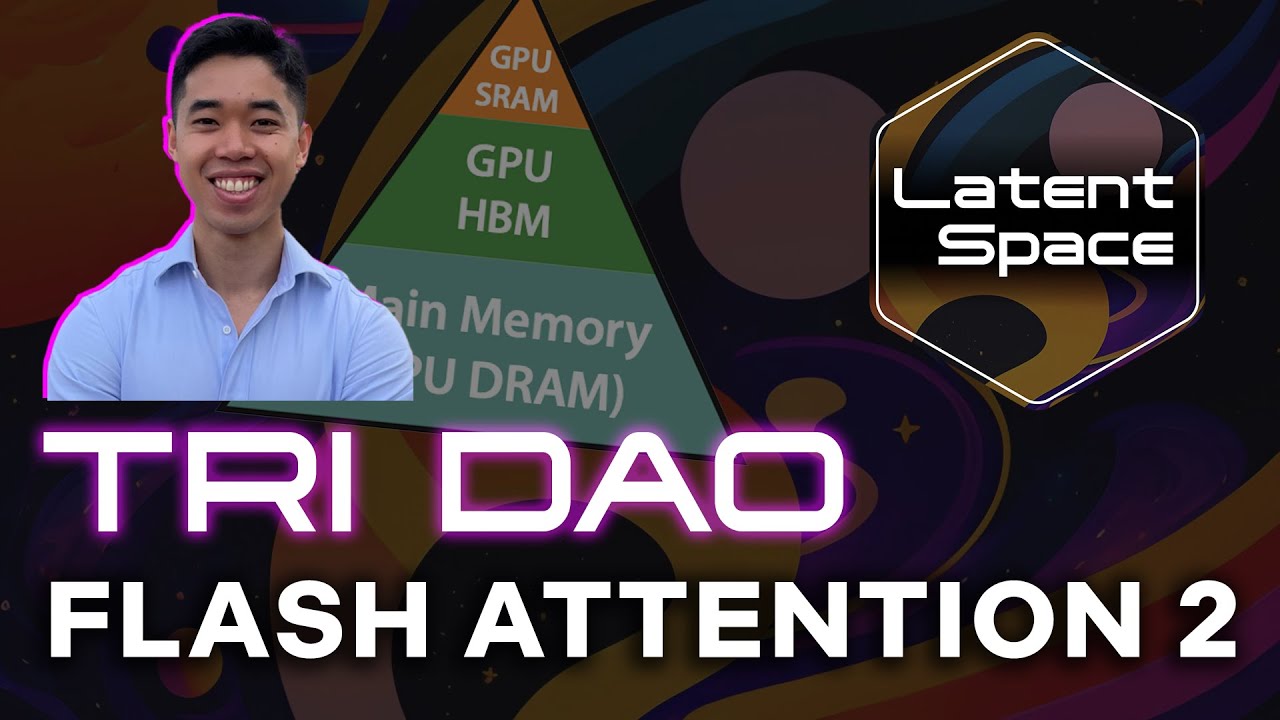
FlashAttention-2: Making Transformers 800% faster AND exact
Aug 3, 2023 · 1:04:06
Tri Dao, creator of FlashAttention and FlashAttention-2, explains how his I/O-aware algorithm makes attention 2x faster by fusing kernels and using online softmax, achieving near-matrix-multiply efficiency. He argues that transformer alternatives like state space models and RNNs (e.g., RWKV) could surpass transformers for long sequences and high-throughput generation, though attention still dominates. Dao discusses the hardware lottery, where NVIDIA's CUDA ecosystem entrenches transformers, and advocates for open-source AI, praising Meta's Llama 2 for shifting enterprise adoption despite its restrictive license. He emphasizes that understanding both algorithms and systems is key to scaling AI, and that academia should pursue risky bets that industry cannot.
Powered by PodHood