
Startups
Episodes from Latent Space about Startups.
23 episodes
🔬Max Welling: Materials Underlie Everything
Feb 25, 2026 · 34:14
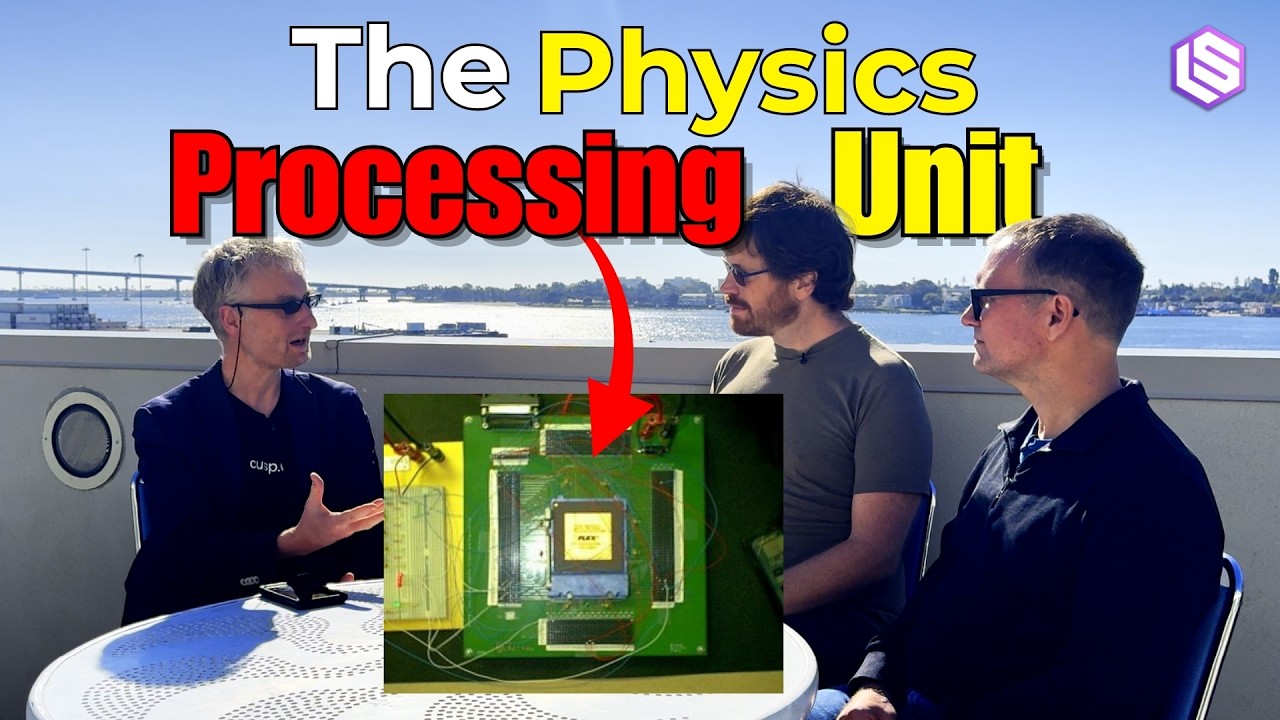
Max Welling, a pioneer in variational autoencoders and equivariant neural networks, argues that materials underlie everything from GPUs to the energy transition, and AI can turn material discovery into a search engine. He traces his career from quantum gravity with Gerard 't Hooft to climate-focused AI, founding CuspAI to accelerate carbon capture materials. CuspAI’s platform combines generative models, multi-scale digital twins, and LLM-powered agents, but Welling insists chemists remain in the loop for the foreseeable future. He explains equivariance as hardcoding symmetry into neural networks to reduce data needs, though data augmentation often works better at scale. His upcoming book reveals the identical mathematics between diffusion models and stochastic thermodynamics, promising cross-fertilization between machine learning and physics.
Inside AI’s $10B+ Capital Flywheel — Martin Casado & Sarah Wang of a16z
Feb 19, 2026 · 55:31
Martin Casado and Sarah Wang of a16z argue that AI’s capital flywheel—where model labs translate funding directly into capability gains and revenue growth in weeks—is creating a new financing playbook that blends venture and growth, with rounds acting as compute contracts. They warn that frontier labs like Anthropic can potentially raise more money than the entire app ecosystem built on their APIs, allowing them to outspend and consume those layers. The episode examines the AGI vs. product dilemma in GPU allocation, the war for talent where $10M+ packages break early-stage founder math, and Cursor as a case study of building up from the app layer while training down into its own models. They also identify “boring” enterprise software as the most underinvested opportunity and note that robotics lacks a ChatGPT moment that would justify current funding levels.

[State of Research Funding] Beyond NSF, Slingshots, Open Frontiers — Andy Konwinski, Laude Institute
Dec 31, 2025 · 22:34
Andy Konwinski, co-founder of Databricks and Perplexity, launches Laude Institute—a dual venture fund and nonprofit to accelerate the path from open research to breakout companies. At NeurIPS, he explains how Laude's Slingshot program funds projects like DSPy, Terminal Bench, and LMArena, and why the NSF's $1B/year for CS is insufficient, needing $10-100B for frontier AI. He argues Chinese labs (Moonshot, DeepSeek) now outpublish US because OpenAI and others stopped sharing; Open Frontiers, a live-streamed conference in SF, aims to unite top open researchers (Yann LeCun, François Chollet, Jan Leike) to reclaim global leadership. The episode also spotlights the emerging 'post-post-training' layer—prompt optimization, context management, RAG—and why research teams with multiple co-founders (like Databricks' eight) are the new gold standard for AI startups.

[State of AI Papers 2025] Fixing Research with Social Signals, OCR & Implementation — Team AlphaXiv
Dec 31, 2025 · 34:45
AlphaXiv founders Raj and Rayhahn describe building the go-to platform for navigating AI research by obsessing over UI and getting authors like the Laura team to comment directly on papers, then evolving from comments to feeds to benchmarks to AI assistants. They detail how they beat Hugging Face Papers by enabling direct paragraph-level commenting and early traction with high-signal authors, and how they use social signals (views, comments, Twitter) to filter the archive firehose. They discuss the broken academic review process—20% AI-generated reviews at ICLR, quality collapsing under exponential submission growth—and argue papers are becoming less important than implementations, Docker containers, and real-world usability. Their vision: making it trivial to spin up any trending paper's code directly in browser, focusing on the top 0.1% of implementable papers that applied researchers actually care about.

[State of Evals] LMArena's $1.7B Vision — Anastasios Angelopoulos, LMArena
Dec 31, 2025 · 24:02
Anastasios Angelopoulos, founder of LMArena (now Arena), discusses the platform's $100M raise at a $1.7B valuation, its spin-out from Berkeley incubation by a16z's Anjney Midha, and its mission to be the industry's north star for real-world AI evaluation. He defends against the 'leaderboard illusion' paper, citing factual errors and reaffirming that models cannot pay to be on or off the public leaderboard. Arena funds inference costs for millions of monthly users, with 25% of its 5M+ users in software, and is expanding into occupational verticals (medicine, legal, creative) and multimodal video arenas. Key challenges include consumer retention, which improved with sign-in and persistent history, and moving off Gradio to React for better development. Angelopoulos calls for top talent in ML, product, and go-to-market to join the high-performance team.

[State of AI Startups] Memory/Learning, RL Envs & DBT-Fivetran — Sarah Catanzaro, Amplify
Dec 30, 2025 · 28:43
Sarah Catanzaro of Amplify Partners argues that the DBT-Fivetran merger was not the death of the modern data stack but a path to IPO targeting $600M+ combined revenue, that data catalogs failed because they were built for humans rather than machines, and that RL environments are a fad. She notes that frontier labs use dbt and Fivetran for training data curation and agent analytics, and criticizes $100M+ seed rounds raised without near-term roadmaps. For 2026, she identifies personalization via memory and continual learning as the key retention unlock, observing that AI founders are unfamiliar with growth concepts like k-factor. She prefers real-world logs over synthetic RL environments, citing Cursor's use of user activity, and says the most exciting startups combine hard research problems (RAG, rule-following, continual learning) with applications that were previously impossible.

AI to AE's: Grit, Glean, and Kleiner Perkins' next Enterprise AI hit — Joubin Mirzadegan, Roadrunner
Dec 12, 2025 · 1:09:44
Joubin Mirzadegan, a Kleiner Perkins partner who incubated Glean and now leads its next bet, Roadrunner, argues that AI-native CPQ can fix the broken quoting workflows that plague enterprise sales. Starting the CRO-only podcast Grit as a hiring wedge, he built relationships that later helped Glean and Windsurf scale. He explains why technical founders need sales leaders with a chip on their shoulder, not just fancy logos, and why Windsurf succeeded by marrying Google-class product with Salesforce-class distribution, hitting $100M ARR in months. Roadrunner rebuilds CPQ's data model from scratch, co-develops with four hairiest design partners, and aims to use LLMs to recommend deal structures, automating the Slack-channel chaos of deal desk.

How Zyphra went all-in on AMD + Why Devs feel faster with AI but are slower — with Quentin Anthony
Nov 3, 2025 · 1:00:02
Quentin Anthony, head of model training at Zyphra and advisor at EleutherAI, explains why his company moved all training to AMD MI300X GPUs, outperforming Nvidia H100s on certain workloads thanks to 192GB VRAM and higher memory bandwidth, and describes his kernel development approach of writing directly in ROCm or GPU assembly rather than using Triton. He also shares his experience in the METR study on AI coding productivity, where he was one of the few developers with measurable speedup, and offers tips: timebox AI use, avoid the slot machine effect, maintain context hygiene, and use direct API over tools like Cursor. Additionally, he argues that open source AI research benefits from siloed focused teams with guaranteed funding over grand collaborations, and notes that kernel datasets alone won't solve GPU programming due to evaluation challenges.

⚡️No, Don't Do Palantir for AI - Brendan Falk, Hercules (AUDIO FIXED)
Sep 18, 2025 · 35:08
Brendan Falk, founder of Zeus (now Hercules), explains why he abandoned his vision to become 'Palantir for AI' after six months of enterprise AI transformations. Targeting Global 2000 companies with $5–10M contracts, he found that each use case required custom development, messy data, and high ongoing maintenance, with work scaling poorly across contract sizes. He also faced existential threats from specialized vendors like Decagon and Sierra, who could outspend and out-focus on single use cases. Falk pivoted to Hercules.app, an AI website builder that ships production apps, white-labeling payments and email. He argues the app builder market (Wix, Squarespace, Shopify) will expand with AI, and that brand and ease will sustain higher margins than developer tools like Cursor.

Better Data is All You Need — Ari Morcos, Datology
Aug 29, 2025 · 1:18:43
Ari Morcos, CEO of Datology, argues that data curation is the most impactful and underinvested area in AI, claiming models are defined by what they eat. He details his shift from focusing on inductive biases to realizing data quality is paramount, citing the DCLM study where human experts could not predict automated filtering decisions. Datology's methods combine filtering, rebalancing, curriculum, and rephrasing synthetic data to achieve baseline performance 12x faster, improve accuracy by 4–5 absolute points, and train models with fewer than half the parameters. Morcos explains how curating data bends naive scaling laws by maintaining marginal information gain, and shares results from the Arc 4.5B model, which was trained on 7 trillion tokens (down from 25 trillion) using Datology's curation. He highlights that data is a compute multiplier, making it possible for enterprises to train smaller, cheaper models for specific domains.

⚡️Accelerators @ 3x NVIDIA H200 perf, Made in the USA - Thomas Sohmers + Mitesh Agrawal, Positron AI
Aug 18, 2025 · 47:56
Thomas Sohmers and Mitesh Agrawal of Positron AI argue memory bandwidth, not compute, is the true bottleneck in AI inference, and their accelerator achieves 93% memory bandwidth utilization—triple NVIDIA's efficiency—enabling 70% faster token generation at 150W. The founders, both Lambda Labs veterans, shipped an FPGA product 15 months after founding, then raised a $51M Series A for an ASIC in late 2026. Their hardware requires no recompilation: it ingests raw binary weights from NVIDIA training and outputs an OpenAI-compatible API. Positron focuses on the decode phase of transformers, where memory-bound matrix-vector multiplication dominates, and already counts Cloudflare and Parasail as customers. The company sells systems directly, prioritizing capital efficiency and ROIC over operating its own cloud.

🕰️ The Oral History of Windsurf (ft. Varun Mohan, Scott Wu, Jeff Wang, Kevin Hou, Anshul R)
Jul 28, 2025 · 3:53:23
This episode traces the oral history of Windsurf (formerly Codeium and Exafunction) with founders Varun Mohan, Scott Wu, Jeff Wang, Kevin Hou, and Anshul R, charting its evolution from a GPU virtualization startup to a leading agentic IDE and its dramatic acquisition by Cognition. The narrative covers the pivot to code completion in 2022, the shift to a free model to gain traction, and the launch of the Windsurf editor in November 2024 with Cascade, an agent that operates on a shared timeline with the developer. Key principles include meta-learning (auto-generated memories that adapt to each user's preferences) and scaling with intelligence (replacing hard-coded rules with LLM reasoning as models improve). The episode also details the acquisition weekend when Cognition bought Windsurf after Google acquired a stake, highlighting product synergies between the synchronous agent (Windsurf) and async agent (Devin) and the ambition to build a comprehensive platform for real-world software engineering teams.

Personalized AI Language Education — with Andrew Hsu, Speak
Jul 11, 2025 · 1:04:10
Andrew Hsu, CTO of Speak, explains how the company built the "third generation" of language learning by betting on AI speech and language models before they were ready. Speak focused on South Korea early, a counterintuitive move for a San Francisco startup, and now 6% of the Korean population has tried the app. The turning point came with Whisper and GPT in 2022, which enabled Speak to evolve from a listen-and-repeat tool into a full-featured AI tutor that gives real-time feedback and adapts to learners. Speak generates over $50M ARR primarily from consumer subscriptions, and Hsu details the product decisions that made it work: abandoning a free version, building custom ASR for low latency, and emphasizing functional fluency over textbook language. He also reveals that Speak is building a real-time voice platform and a knowledge graph for personalized fluency scores, with an eye toward expanding beyond language into general AI-powered education.

[AIEWF Preview] CloudChef: Your Robot Chef - Michellin-Star food at $12/hr (w/ Kitchen tour!)
May 31, 2025 · 20:50
Nikhil Abraham, founder of CloudChef, introduces Zippy, an AI chef robot that makes Michelin-star-quality food for $12 an hour. Zippy uses one-shot demonstration learning to replicate recipes from human chefs, leveraging multimodal models and thermodynamics for culinary intelligence. The robot operates as a rental service, replacing human line cooks at 40% of the cost, with no upfront capital expenditure. CloudChef's software-first approach uses off-the-shelf hardware, focusing on proprietary culinary layers for decision-making and safety. The robot is deployed in real commercial kitchens, including Michelin-star venues, and has validated its technology through a successful delivery kitchen in Palo Alto. Abraham highlights engineering challenges like real-time perception and on-device processing, and invites engineers to join a company with a path to deploy over 100 robots within a year.

Tiny Teams: $6m ARR, 5m users with 4 employees — Sid Bendre, Oleve (Quizard AI/Unstuck AI)
Apr 23, 2025 · 42:59
Sid Bendre of Oleve (formerly Quizzer AI and Unstuck AI) explains how his four-person team built $6M ARR and 5M users across multiple consumer apps. Starting with Quizzer AI in January 2023, a viral TikTok gained 10K users in 30 hours; by August 2024, Unstuck AI hit 1M users in nine weeks. The company has been profitable since its first nine months. Bendre describes their platform engineering strategy: product engineers own individual apps while a platform team builds reusable systems, including internal shadow-org agents for growth and marketing. He shares technical hacks like using LaunchDarkly feature flags to load-balance across Azure OpenAI endpoints and a de-indexer for Azure AI Search to manage costs. The key engineering principle is deterministic LLM workflows—classifying user intent then routing to pre-built deterministic flows—rather than open-ended agent tool use.
Snipd: The AI Podcast App for Learning — with CEO Kevin Ben-Smith
Mar 14, 2025 · 1:17:46
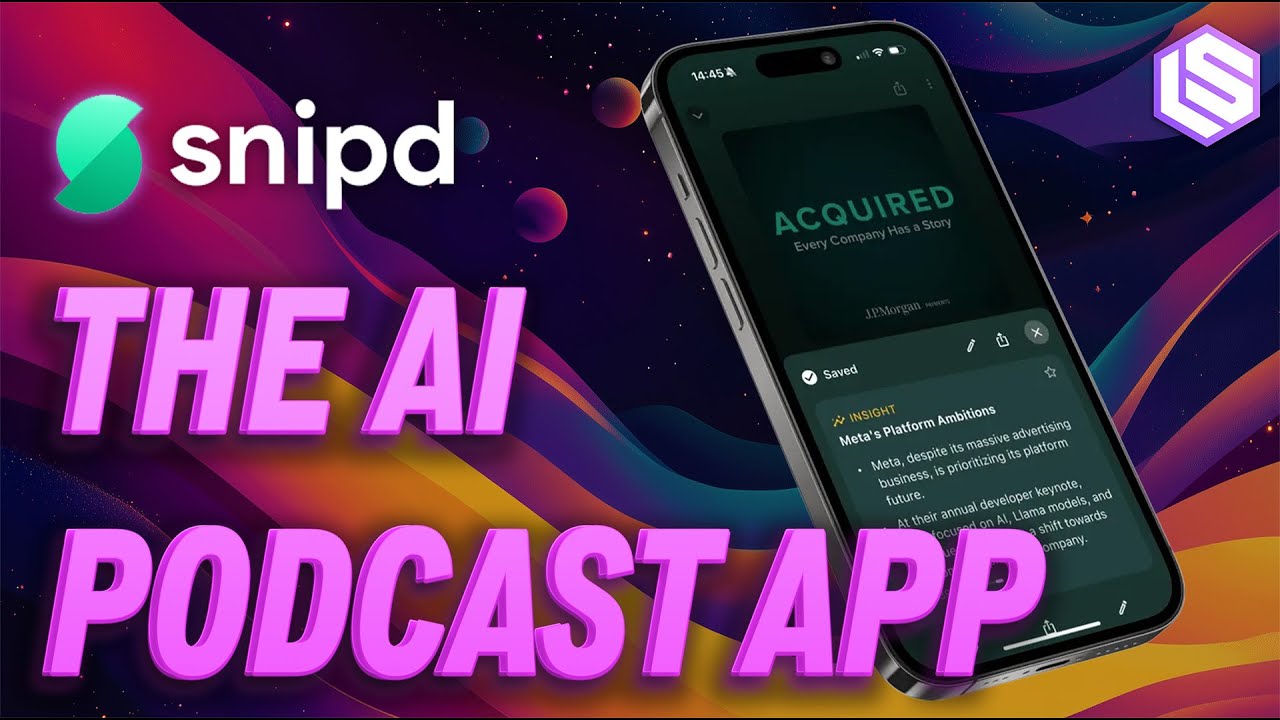
Snipd CEO Kevin Ben-Smith joins Swyx to explain how the AI-powered podcast app turns passive listening into active learning. Snipd transcribes and diarizes episodes, generates chapters, identifies mentioned books, and summarizes insights on demand — all with a four-person team. Kevin describes moving from self-hosted open-source models (Wave2vec, Pyannote) to a mix of Whisper, OpenAI, Google Gemini, and Perplexity APIs, balancing cost against the need for predictable batch processing vs. real-time user requests. He details technical hurdles like dynamic content resyncing (building a 'Shazam for podcasts') and using LLMs as judges to filter hallucinated book recommendations. The episode also covers Snipd's origin as a hackathon-winning podcast search tool, Swyx's own switch from Overcast, and Kevin's vision for voice-driven post-episode reflection and AI-assisted discovery as the next frontier.

The Agent Reasoning Interface: Claude, ChatGPT Canvas, Tasks, Operator — with Karina Nguyen, OpenAI
Feb 1, 2025 · 1:06:29
OpenAI's Karina Nguyen, who led the creation of ChatGPT Canvas and Tasks, explains how her team trains separate models for new interaction paradigms rather than prompting the core model, enabling rapid iteration on user feedback. She details the 'behavioral design' process that shapes model personality in collaborative contexts like Canvas—deciding when to rewrite vs. edit—and how that extends to defining agents as a progression from one-off actions to fully trustworthy long-horizon delegation. Drawing on her time at Anthropic building Claude.ai from scratch and co-creating Claude 3, she contrasts the product mindsets: OpenAI takes more product risks across consumer features while Anthropic focuses on enterprise. She also shares her vision for ChatGPT evolving into a 'generative OS' where UIs adapt dynamically to user intent, and argues that human creativity—not model capability—is the current bottleneck for rethinking software interfaces.

Outlasting Noam Shazeer, Crowdsourcing Chai AI w/ 1.4m DAU — with William Beauchamp, Chai Research
Jan 26, 2025 · 1:13:33
William Beauchamp, founder-CEO of Chai AI, explains how he pivoted from algorithmic trading to build a character chatbot platform before Character.ai, growing to 1.4M DAU and $22M+ revenue by crowdsourcing model improvements through Chaiverse. Starting with GPT-J in 2021, he found product-market fit with a therapist bot and shifted to user-generated content, letting users define prompts, images, and names. Competing against well-funded rivals like Character AI and Talkie, Chai ships over 100 LLMs weekly via its developer platform, spending $10M on compute in 2024 and tripling it. Beauchamp argues AI follows an S-curve, not scaling laws, and focuses on inference optimization using rejection sampling and reward models to serve better responses. He prioritizes 'insanely great' products over technology-driven features, noting that audio and image features failed to move metrics, while a data flywheel and aggressive user acquisition drove rapid growth.

The State of AI Startups in 2024 [LS Live @ NeurIPS]
Dec 21, 2024 · 26:35
Sarah Guo and Pranav Reddy argue that 2024 has become a far friendlier ecosystem for AI startups, with the model landscape shifting from OpenAI's near-monopoly to a competitive field where Google's Gemini now leads LMSys Arena and open-source models like Llama 8B score ten points higher on MMLU than Mistral 7B a year ago. They note that OpenAI's API cost has dropped 80-85% in 18 months, and total OpenAI API share fell from ~90% to ~60% as customers switch. The funding environment is rational, not a bubble, with foundation-model labs raising $30-40B but most startups seeing sane valuations; one portfolio company grew from zero to twenty million in PLG-style spending. Key startup themes include first-wave service automation (Sierra, Decagon, Harvey, EvenUp), better search and new friends (Perplexity, Glean, Character, Replica), and democratized creativity (Midjourney, HeyGen). They argue the 'GPT wrapper' narrative is false—applications capture value—and that incumbents face innovator's dilemma because AI changes business models (outcomes-based pricing) and data needs (reasoning traces rarely saved). The speed of change and new markets (legal, healthcare, defense) structurally favor…

0 to over $8M ARR in 2 months as a Claude Wrapper (Bolt.new, Qodo)
Dec 2, 2024 · 1:36:42
Eric Simons of Bolt.new/Stackblitz and Itamar Friedman of Qodo discuss Bolt.new's viral growth from $4M ARR in four weeks to over $8M ARR in two months as a Claude wrapper, driven by its in-browser WebContainer OS that eliminates local dev setup. They contrast Bolt's '0 to 1' creation for non-developers with enterprise-focused agents like Qodo's testing and code review tools, arguing that specialized agents outperform general-purpose ones. Simons details how WebContainer's unified sandbox enables error self-healing loops, while Friedman explains AlphaCodium's task-breaking that boosted o1 preview to 93rd percentile on Codeforces. The episode covers open-source strategy, pricing tiers ($20 to $200/month), and founder advice on ignoring expert doubt to ship fast, illustrated by Simons' Ironman completion while launching Bolt.

The 10,000x Yolo Researcher Metagame — with Yi Tay of Reka
Jul 5, 2024 · 2:18:43
Yi Tay, chief scientist at Reka and former Google Brain architecture co-lead on PaLM 2, recounts his journey from an NTU PhD to co-founding Reka, where a team of just 5 people pre-trained Reka Core on $60M of GPU compute—debating at #7 on the LMsys leaderboard. He explains why he believes the Noam transformer (with SwiGLU, GQA, RoPE) remains the strongest baseline, how encoder-decoder architectures offer 'free sparsity' (a 2× flop-efficiency over decoder-only), and why Chinchilla scaling laws are often misunderstood (training past the optimal compute frontier is routine). He argues that long context will eventually outperform RAG for complex reasoning, and that open-source models like Llama 3 are catching up only because Meta invested in a top-tier training stack, not due to grassroots innovation. The episode also covers his productivity habits (working backwards from a paper title, camping arXiv) and the cultural shock of moving from Singapore academia to Google's impact-driven research environment.
How AI is Eating Finance - with Mike Conover of Brightwave
Jun 11, 2024 · 1:05:06
Brightwave founder Mike Conover explains how his vertical AI startup builds a 'partner in thought' for finance professionals, using a systems-of-systems approach that decomposes problems into specialized subsystems rather than relying on large context windows or monolithic agents. He argues that the evolution from DALL-E's 1,024-token context to today's million-token models has not solved synthesis; smaller, focused reasoning units still outperform. Conover emphasizes that the real competitive edge lies in custom training data and human annotation, not pre-training, and that models are converging in capability—so value shifts to fine-tuning data that elicits specific behaviors. He details why Brightwave avoids spreadsheets in favor of conversational analysis, and predicts AI will automate idea generation and second-order derivative bets, but humans must remain the final synthesizers and deciders. The episode also covers hiring for vertical AI, the role of knowledge graphs, and the diminishing economic incentive for companies to train their own foundation models.

Generating your AI Media Empire - with Youssef Rizk of Wondercraft.ai
Sep 20, 2023 · 1:28:55
Youssef Rizk, co-founder of Wondercraft.ai, explains how his five-month-old startup uses hyperrealistic AI voices to turn blogs, newsletters, and other content into podcasts, arguing that the application layer—not the underlying API—is the real moat. He details Wondercraft's origin from a failed sports-investing startup, the rapid MVP that generated $3K in one day, and the decision to build script generation and audio production tools rather than train its own models. Rizk also announces a new AI dubbing feature for video, discusses the challenges of scaling to 28 languages, and reveals that the company runs on just four people pushing two major features per week. The conversation covers the daily Hacker News Recap podcast—which reached Spotify's top 30 tech podcasts—and Rizk's view that AI-generated content must be clearly disclosed to avoid backlash.
Powered by PodHood