
IDE & Editor Tools
Episodes from Latent Space about IDE & Editor Tools.
5 episodes

How Zyphra went all-in on AMD + Why Devs feel faster with AI but are slower — with Quentin Anthony
Nov 3, 2025 · 1:00:02
Quentin Anthony, head of model training at Zyphra and advisor at EleutherAI, explains why his company moved all training to AMD MI300X GPUs, outperforming Nvidia H100s on certain workloads thanks to 192GB VRAM and higher memory bandwidth, and describes his kernel development approach of writing directly in ROCm or GPU assembly rather than using Triton. He also shares his experience in the METR study on AI coding productivity, where he was one of the few developers with measurable speedup, and offers tips: timebox AI use, avoid the slot machine effect, maintain context hygiene, and use direct API over tools like Cursor. Additionally, he argues that open source AI research benefits from siloed focused teams with guaranteed funding over grand collaborations, and notes that kernel datasets alone won't solve GPU programming due to evaluation challenges.

The antidote to AI fatigue — Answer.ai Solveit
Oct 2, 2025 · 55:26
Jeremy Howard, Eric Ries, and Johno Whitaker join host Alessio to present Answer.ai's Solveit platform, arguing that human-in-the-loop, step-by-step AI collaboration outperforms fully autonomous agents for complex coding and writing tasks. The 12-person team built their own integrated development and deployment system, eschewing cloud vendors. Solveit provides each user a persistent Linux Docker container with a Jupyter-like interface where the AI can see all steps, enabling immediate error correction and iterative improvement. Johno demonstrates building a perfume scent search engine in under an hour; Eric shows how he uses Solveit to manage writing his book 'Incorruptible', incorporating test reader comments and fact-checking sections. Jeremy reveals they turned Andrej Karpathy's GPT tokenizer video into a polished blog post. The Solveit course launches October 20th at solve.it.com, teaching this philosophy beyond just the tool.

🕰️ The Oral History of Windsurf (ft. Varun Mohan, Scott Wu, Jeff Wang, Kevin Hou, Anshul R)
Jul 28, 2025 · 3:53:23
This episode traces the oral history of Windsurf (formerly Codeium and Exafunction) with founders Varun Mohan, Scott Wu, Jeff Wang, Kevin Hou, and Anshul R, charting its evolution from a GPU virtualization startup to a leading agentic IDE and its dramatic acquisition by Cognition. The narrative covers the pivot to code completion in 2022, the shift to a free model to gain traction, and the launch of the Windsurf editor in November 2024 with Cascade, an agent that operates on a shared timeline with the developer. Key principles include meta-learning (auto-generated memories that adapt to each user's preferences) and scaling with intelligence (replacing hard-coded rules with LLM reasoning as models improve). The episode also details the acquisition weekend when Cognition bought Windsurf after Google acquired a stake, highlighting product synergies between the synchronous agent (Windsurf) and async agent (Devin) and the ambition to build a comprehensive platform for real-world software engineering teams.
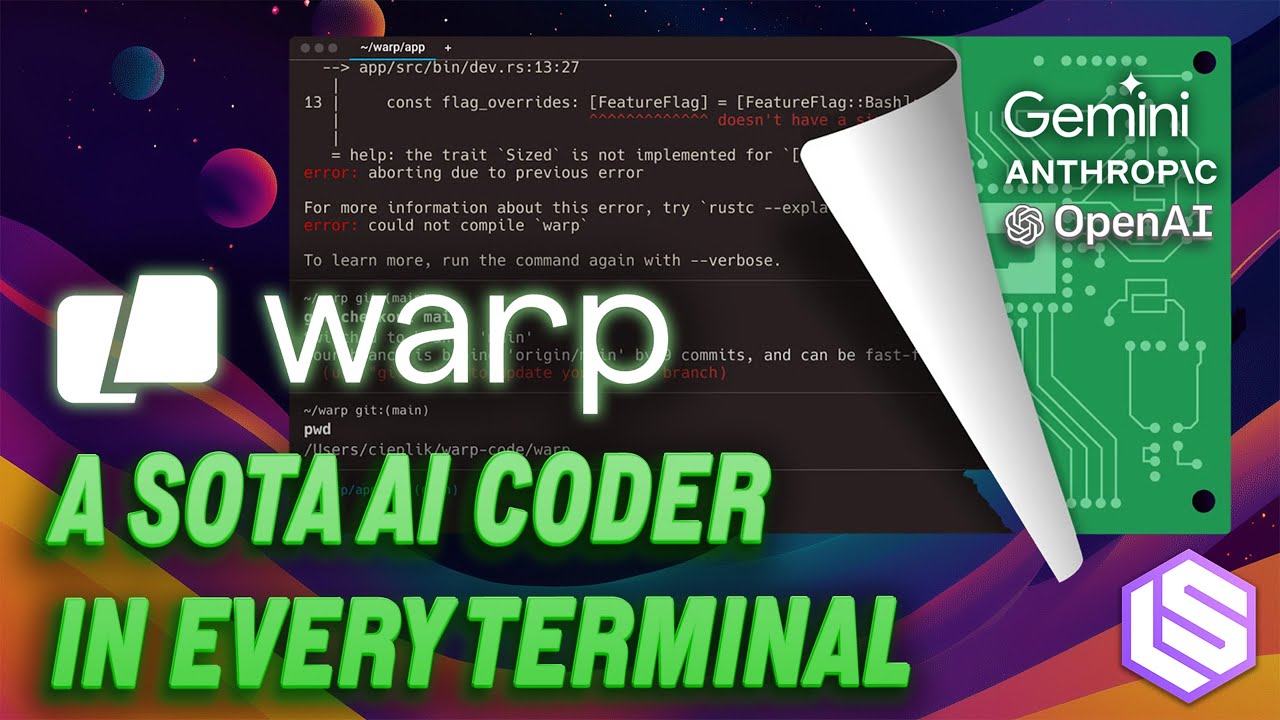
⚡️Warp 2.0: the Agentic Development Environment - Zach Lloyd and Ben Holmes
Jun 25, 2025 · 52:23
Warp CEO Zach Lloyd and engineer Ben Holmes debut Warp 2.0, rebranding from an AI terminal to an Agentic Development Environment (ADE) with a state-of-the-art coding agent that rivals Claude Code and Cursor. The episode demonstrates Warp's new universal input that auto-detects English commands and terminal input, voice-driven agent workflows, multi-threaded agents running in tabs, inline diff editing, MCP support, and REPL translations for SQL and Postgres. Lloyd explains the design philosophy of keeping a terminal-like UX while adding agent management features, and discusses pricing changes (Pro now 2,500 requests, Turbo 10,000, plus usage-based credits) and the challenge of subscription vs. usage-based models. Warp has nearly 600,000 active users with weekly revenue growth of 5–15%, and the team positions itself as a model-agnostic layer above Anthropic, Google, and OpenAI, offering deeper integration than ChatGPT or Claude desktop apps.

0 to over $8M ARR in 2 months as a Claude Wrapper (Bolt.new, Qodo)
Dec 2, 2024 · 1:36:42
Eric Simons of Bolt.new/Stackblitz and Itamar Friedman of Qodo discuss Bolt.new's viral growth from $4M ARR in four weeks to over $8M ARR in two months as a Claude wrapper, driven by its in-browser WebContainer OS that eliminates local dev setup. They contrast Bolt's '0 to 1' creation for non-developers with enterprise-focused agents like Qodo's testing and code review tools, arguing that specialized agents outperform general-purpose ones. Simons details how WebContainer's unified sandbox enables error self-healing loops, while Friedman explains AlphaCodium's task-breaking that boosted o1 preview to 93rd percentile on Codeforces. The episode covers open-source strategy, pricing tiers ($20 to $200/month), and founder advice on ignoring expert doubt to ship fast, illustrated by Simons' Ironman completion while launching Bolt.
Powered by PodHood