
Hardware
Episodes from Latent Space about Hardware.
18 episodes
Podcast Crossover: AIE, AGI, frontier lab strategy with @matthew_berman and @swyxtv
Jul 10, 2026 · 28:03
Shawn 'Swyx' Wang, founder of the AI Engineer conference, tells Matthew Berman how he seized the industry shift by buying ai.engineer and partnering with a veteran conference organizer, crediting Andrej Karpathy's early endorsement. He argues Etched's ASICs are a natural next-gen bet for transformer inference, not an NVIDIA disruptor, and that Fable 5's slowness and cost signal the end of the LLM scaling era—making model efficiency the next problem. Swyx interprets OpenAI's reported 5% equity offer to the US government as a pragmatic multi-turn negotiation, likening it to Singapore's Temasek model, but warns against premature utility regulation. He pegs his own P(doom) at ~5% over 50 years, rejecting near-term doomerism as egotistical. For founders, he advocates building 'agent labs' that solve specific customer problems (e.g., for lawyers, dentists) rather than betting on model routing, which he dismisses as a marketing line that fails to exploit a single model's full stack as deeply as frontier labs do.

Dylan Patel Explains the AI War While Cooking | In-Context Cooking
Feb 26, 2026 · 55:13
Dylan Patel, CEO of SemiAnalysis, argues hyperscalers like Google, Amazon, and Meta will sacrifice all profits to build AI infrastructure, spending $180–$200 billion in capex this year alone, because the AI adoption explosion—Claude Code driving 4% of GitHub commits in one month, Anthropic adding $2.5 billion monthly revenue—makes it a Pascal's wager: spend or die. He details how Taiwan's semiconductor geopolitics create endgame scenarios, from a KMT win placating China to full invasion, with TSMC's output critical. Patel explains Nvidia's paranoid founder Jensen Huang is responding to vertical integration threats from hyperscalers by diversifying into chips like CPX and Groq, but warns moats are shallow. The real bottleneck in AI progress? Semiconductors themselves: fabs take years to build, and no one can buy enough GPUs through 2028. He also predicts a massive AI backlash from the public and financial markets, as capital consumption outpaces revenue and labor displacement accelerates.

Claude Code for Finance + The Global Memory Shortage: Doug O'Laughlin, SemiAnalysis
Feb 24, 2026 · 2:07:40
Doug O'Laughlin, SemiAnalysis founder, explains his Claude Code awakening in December 2024: Anthropic's Opus 4.5 one-shotted tasks that used to take 24 hours, leading him to predict Claude Code will write 25–50% of all GitHub code by year-end (already 4% of commits in two weeks). He argues this marks the death of Excel and Bloomberg for analysts—'you can just do things'—but warns of a 'hygiene' crisis as junior analysts lose meta-learning. On the semiconductor side, O'Laughlin details a severe memory squeeze: HBM demand consumes 4× the DRAM capacity, DRAM prices could double again, and CXL is reviving as a workaround. He compares AI infrastructure buildout to the railroad boom (25% of U.S. gross fixed capital investment) and says Microsoft faces an innovator's dilemma—renting GPUs to 'barbarians at the gate' while its own office franchise is disrupted by Claude Code. Google's TPU v7 enjoys a temporary TCO advantage, but Nvidia's supply chain dominance (Jensen doing shots with SK and Samsung) will reassert with Rubin. O'Laughlin also reflects on his 2,800-mile Continental Divide Trail hike as essential self-mastery.

The AI Frontier: from Gemini 3 Deep Think distilling to Flash — Jeff Dean
Feb 12, 2026 · 1:23:31
Jeff Dean, Google's Chief AI Scientist, explains how the company's dual strategy of frontier "Pro" models and distilled "Flash" models, alongside co-designed TPUs and latency-optimization, keeps Gemini at the Pareto frontier. Distillation compresses high-capability large models into smaller, efficient ones, enabling Flash models to exceed earlier Pro generations. He emphasizes energy-based thinking: data movement costs thousands more picojoules than arithmetic, making batching and speculative decoding essential. TPU development requires predicting ML workloads 2–6 years out, often speculatively adding hardware features. Gemini was born after Dean wrote a one-page memo arguing that fragmented model efforts across Google Brain and DeepMind should merge into a single unified multimodal effort. Looking ahead, he predicts personalized models attending to all user data and reasoning speeds of 10,000 tokens/second will transform software engineering.

How Zyphra went all-in on AMD + Why Devs feel faster with AI but are slower — with Quentin Anthony
Nov 3, 2025 · 1:00:02
Quentin Anthony, head of model training at Zyphra and advisor at EleutherAI, explains why his company moved all training to AMD MI300X GPUs, outperforming Nvidia H100s on certain workloads thanks to 192GB VRAM and higher memory bandwidth, and describes his kernel development approach of writing directly in ROCm or GPU assembly rather than using Triton. He also shares his experience in the METR study on AI coding productivity, where he was one of the few developers with measurable speedup, and offers tips: timebox AI use, avoid the slot machine effect, maintain context hygiene, and use direct API over tools like Cursor. Additionally, he argues that open source AI research benefits from siloed focused teams with guaranteed funding over grand collaborations, and notes that kernel datasets alone won't solve GPU programming due to evaluation challenges.
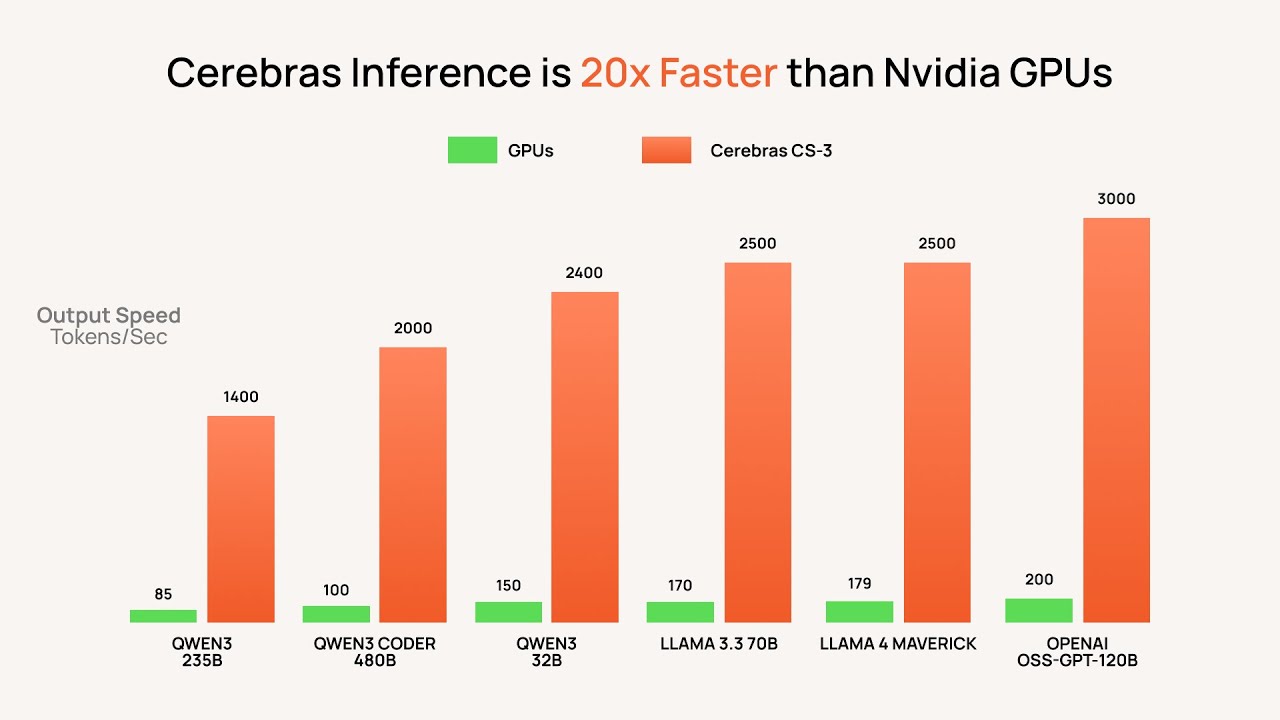
⚡️Raising $1.1b to build the fastest LLM Chips on Earth — Andrew Feldman, Cerebras
Oct 1, 2025 · 29:14
Andrew Feldman, CEO of Cerebras, joins Latent Space to discuss their $1.1B fundraise at an $8.1B valuation and their wafer-scale chip that delivers 20x faster inference than NVIDIA's B200 GPUs. He explains how their architecture uses SRAM instead of HBM, providing 2,625x more memory bandwidth by eliminating the narrow straw between compute and memory. Feldman details the decision to accelerate sparse linear algebra rather than specialized convolutions, enabling support for transformers and diffusion models unseen during design. He discusses the explosive growth in AI inference demand, the shift from closed-source to fast open-source models, and the importance of speed—citing Paul Graham's observation that ChatGPT's slowness drives users away. The conversation covers enterprise trends in the 10-30B parameter space, the complexity of building data centers that pull gigawatts of power, and the often-overlooked routing and caching systems that make AI work seamlessly.

⚡️Accelerators @ 3x NVIDIA H200 perf, Made in the USA - Thomas Sohmers + Mitesh Agrawal, Positron AI
Aug 18, 2025 · 47:56
Thomas Sohmers and Mitesh Agrawal of Positron AI argue memory bandwidth, not compute, is the true bottleneck in AI inference, and their accelerator achieves 93% memory bandwidth utilization—triple NVIDIA's efficiency—enabling 70% faster token generation at 150W. The founders, both Lambda Labs veterans, shipped an FPGA product 15 months after founding, then raised a $51M Series A for an ASIC in late 2026. Their hardware requires no recompilation: it ingests raw binary weights from NVIDIA training and outputs an OpenAI-compatible API. Positron focuses on the decode phase of transformers, where memory-bound matrix-vector multiplication dominates, and already counts Cloudflare and Parasail as customers. The company sells systems directly, prioritizing capital efficiency and ROIC over operating its own cloud.

The Shape of Compute (Chris Lattner of Modular)
Jun 13, 2025 · 1:18:18
Chris Lattner of Modular explains how his company is breaking the CUDA monopoly with Mojo and MAX, matching NVIDIA's best inference performance on AMD and NVIDIA GPUs. After three years in R&D, Modular open-sourced its stack and now delivers state-of-the-art Llama 3 serving at over 800 tokens per second. Mojo, a Python-family language, runs kernels faster than Rust and can extend Python without bindings, while MAX provides a full inference framework with automatic kernel fusion and cluster management. Unlike VLLM or SGLang, Modular's container is just a gigabyte, fully open source, and not reliant on proprietary CUDA blobs. DeepSeek's low-level PTX work validated the approach, but Lattner emphasizes that Mojo's portability avoids rewriting kernels for each new GPU architecture. He also details his daily routine, using Cursor for coding, and hiring "elite nerds" to grow the team.

SF Compute: Commoditizing Compute
Apr 11, 2025 · 1:12:02
Evan Conrad, co-founder of SF Compute, argues that GPUs behave like a real estate business, not a traditional cloud, because price-sensitive customers value every incremental GPU and will switch for a 10% margin. CoreWeave succeeded by selling locked-in long-term contracts to low-credit-risk customers like Microsoft and OpenAI, ignoring short-term demand. He predicts hyperscalers and providers like Together and DigitalOcean will lose money on GPU clusters because software margins cannot match the hardware costs. SF Compute started as an AI lab forced to sublease its cluster monthly to avoid bankruptcy, then evolved into a market where anyone can buy H100s by the hour via dynamic pricing—often below $1/hour for short bursts. Utilization stays near 100% as prices adjust. Future plans include cash-settled futures to reduce financial risk across the industry, while the brand deliberately stays anti-hype and calm.
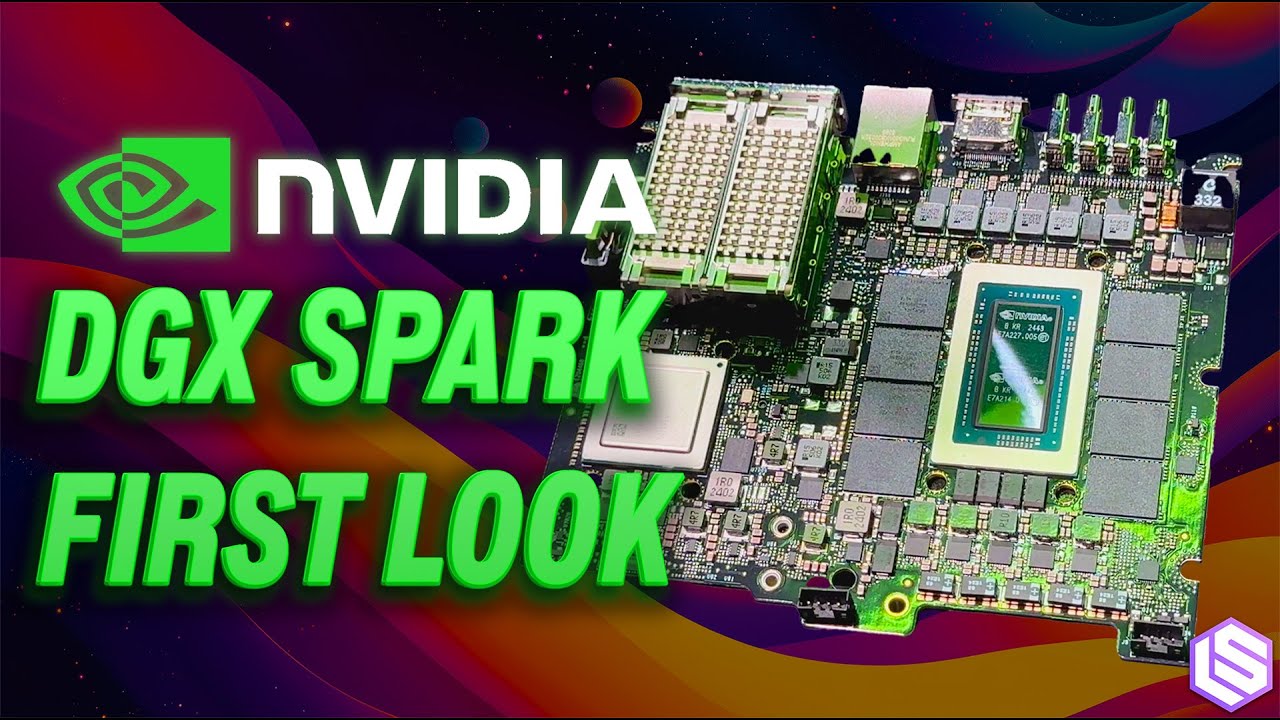
LIVE from GTC: DGX Spark Insides First Look
Mar 20, 2025 · 12:39
Israel from NVIDIA gives a first look at the DGX Spark, a $3,000–$4,000 mini AI supercomputer that fits up to 200B parameter models in FP4 with 128GB unified memory, powered by the NVIDIA GB10 Superchip. It uses the same Grace Blackwell architecture and software stack as data center systems, so code written on the Spark deploys to production without modifications. The device includes a ConnectX-7 dual-port 200Gb ethernet for clustering two units, and runs DGX OS (Ubuntu 24.04). Storage is 1TB or 4TB NVMe. Partners ASUS, HP, Dell, and Lenovo will offer their own cases. Israel stresses the Spark is a developer box, not a server, but delivers enterprise-grade networking and shared memory in a compact form.

Beating Google at Search with Neural PageRank and $5M of H200s — with Will Bryk of Exa.ai
Jan 10, 2025 · 55:54
Will Bryk, CEO of Exa.ai (formerly Metaphor), details building a neural search engine from scratch using link prediction as 'Neural PageRank' — predicting documents rather than keywords. Exa's new product offers near-perfect lists (e.g., 'startups working on hardware in SF') by scaling compute per query, from milliseconds to a day, like o1 for search. Bryk argues LLMs will become the interface to search, while Exa provides the 'super knowledge' that even AGI will need. He contrasts Exa's neural approach with Google's keyword-based system and Perplexity's reliance on Bing. The company recently purchased a $5M H200 cluster and maintains a culture of nap pods and first-principles thinking.

[Paper Club] Weight Streaming on Wafer-Scale Clusters (w/ Sarah Chieng of Cerebras)
Dec 7, 2024 · 43:54
Sarah Chieng of Cerebras presents the weight streaming technique for training giant neural networks on Cerebras wafer-scale clusters, arguing it enables near-linear scaling by separating parameter storage from primary compute. The system uses the Wafer Scale Engine (WSE-2/3) with 900,000 cores and 44 GB on-chip SRAM, avoiding off-chip memory bottlenecks that limit NVIDIA GPUs. MemoryX provides external storage for weights and optimizer states (up to 2.4 petabytes), streaming weights to compute units via the SwarmX interconnect fabric, which aggregates gradients. This design allows training models with up to 120 trillion parameters without complex hybrid parallelism. Cerebras also leverages unstructured weight sparsity to prune 90% of data during transmission and skip zero-value computations on-chip, reducing bandwidth and improving efficiency.

Answer.ai & AI Magic with Jeremy Howard
Aug 17, 2024 · 1:11:00
Jeremy Howard of Answer.AI argues that continuous pre-training should be treated as a continuum, not separate phases, and demonstrates how FSDP+QLoRA enables training a 70B model on just two NVIDIA 4090s. He reveals Answer’s non-hierarchical, manager-free R&D lab model that recruited unusual talent like Benjamin Warner and Ben Claviez, who independently launched BERT 24 to revive encoder-only architectures. Howard introduces FastHTML, a pure-Python web framework built on HTMX and Starlette, for creating modern SPAs without JavaScript. He previews “AI Magic,” a dialogue engineering system that moves beyond teletype-style chat interfaces and code editors, aiming to make AI-assisted development more interactive. The episode also covers Answer’s Public Benefit Corporation structure designed to resist hostile takeovers, and critiques decoder-only hype while advocating for encoder-decoder and state-space models.

[LLM Paper Club] Llama 3.1 Paper: The Llama Family of Models
Jul 29, 2024 · 1:23:46
This episode examines Meta's Llama 3.1 paper, detailing the 405B dense model, its scaling laws grounded on the ARC reasoning benchmark rather than perplexity, and the decision to train on 15 trillion tokens. Vibhu explains the training infrastructure: 16,000 H100s over 54 days with 419 interruptions, 78% from GPU hardware failures. Eugene Yan walks through the synthetic data pipeline—using Llama 2 for filtering, stepwise reward models, and Monte Carlo tree search to improve reasoning traces. Hassan shares building LlamaTutor.com with Together API, serving 4,000 visitors and 5,900 requests for about $12. The group also discusses quantization trade-offs (larger models degrade less), inference provider variability (Groq's non-deterministic temperature zero), and compares Llama 405B's performance to GPT-4o and Claude.

State of the Art: Training 70B LLMs on 10,000 H100 clusters
Jun 25, 2024 · 1:32:05
Josh Albrecht, CTO of Imbue, and Jon Frankle, Chief AI Scientist of Databricks, detail the challenges of training 70B models on 10,000 H100 clusters, from stolen Infiniband cables to GPUs silently returning wrong math. Imbue open-sources infrastructure scripts, health checks, the CARBS hyperparameter optimizer, and cleaned versions of 11 benchmarks plus 450,000 human judgments on ambiguity. Databricks released DBRX, a 132B-parameter mixture-of-experts model with 36B active per token, and a text-to-image model trained exclusively on Shutterstock's curated dataset. They discuss typical 3% weekly hardware failure rates, the difficulty of MoE training pushing network bandwidth, and why eval datasets need human scrutiny—most benchmarks are saturated once ambiguous examples are removed. Both emphasize that success requires deep understanding from firmware to final loss, not just fancy libraries.

Personal AI Meetup - Bee, BasedHardware, LangChain LangFriend, Deepgram EmilyAI
Apr 6, 2024 · 58:54
This episode features Damien Murphy of Deepgram, Ethan of Owl/Bee, and Harrison of LangChain demonstrating how to build personal AI with real-time voice bots, wearable life-recording devices, and memory-enhanced journaling apps. Damien shows building a voice bot with subsecond latency using Deepgram, OpenAI, and open source code, costing about 6.5 cents per five-minute call. Ethan presents his Owl wearable that continuously records audio, triggers actions via hot word 'Scarlett,' and discusses challenges in adding vision and open source adoption. Harrison introduces LangFriend, a journaling app using conversational, semantic, and knowledge graph memory, referencing the Generative Agents paper for recency and importance weighting. The episode also highlights open source projects Whomane, Friend, and ADeus, arguing that hardware, voice, and memory are all necessary components for personal AI.

The State of Silicon and the GPU Poors - with Dylan Patel of SemiAnalysis
Dec 5, 2023 · 1:07:55
Dylan Patel of SemiAnalysis argues the 'GPU poor vs GPU rich' divide defines AI, with Google's TPU ramp (millions of units) dwarfing others and Nvidia selling over a million H100s this year. He explains that training costs are irrelevant compared to inference costs, and that memory bandwidth is the key bottleneck for LLM inference (e.g., Llama 70B needs ~2.1 TB/s for human reading speed). Patel advises GPU-poor players to focus on on-device innovations like speculative decoding (Medusa), asynchronous training, or fine-tuning for edge use—not on gaming benchmarks or fine-tuning small models. He details why AI hardware startups (Cerebras, Graphcore) bet wrong on on-chip SRAM, while Google’s TPU/Broadcom partnership and Nvidia’s yearly cadence make alternatives tough. He also warns that rebuilding the semiconductor supply chain in the US is unfeasible due to its fragmentation, and that safety through obscurity doesn't work—open innovation is better.
Ep 18: Petaflops to the People — with George Hotz of tinycorp
Jun 20, 2023 · 1:23:24
George Hotz of tinycorp argues that a simplified, open-source ML framework (tinygrad) can democratize AI compute and replace NVIDIA, Google, and AMD. Tinygrad uses 25 ops (vs. XLA's 250) and fuses kernels automatically, achieving 2x speed on Qualcomm GPUs over their library. Hotz reports AMD kernel panics fixed after emailing CEO Lisa Su, but laments AMD's open-source as 'dumped on GitHub.' For hardware, tinybox is a six-GPU desktop at 350W per GPU, aiming for 5x better price-performance than NVIDIA H100 for 90% of training. He criticizes OpenAI's secrecy, revealing GPT-4 is an 8-way mixture of 220B models, and cites the Bitter Lesson. He also outlines FLOPcoin using hardware identity to prevent cheating, and his goal of an AI girlfriend as the third company, merging humans via data rather than implants.
Powered by PodHood