
Evals
Episodes from Latent Space about Evals.
17 episodes
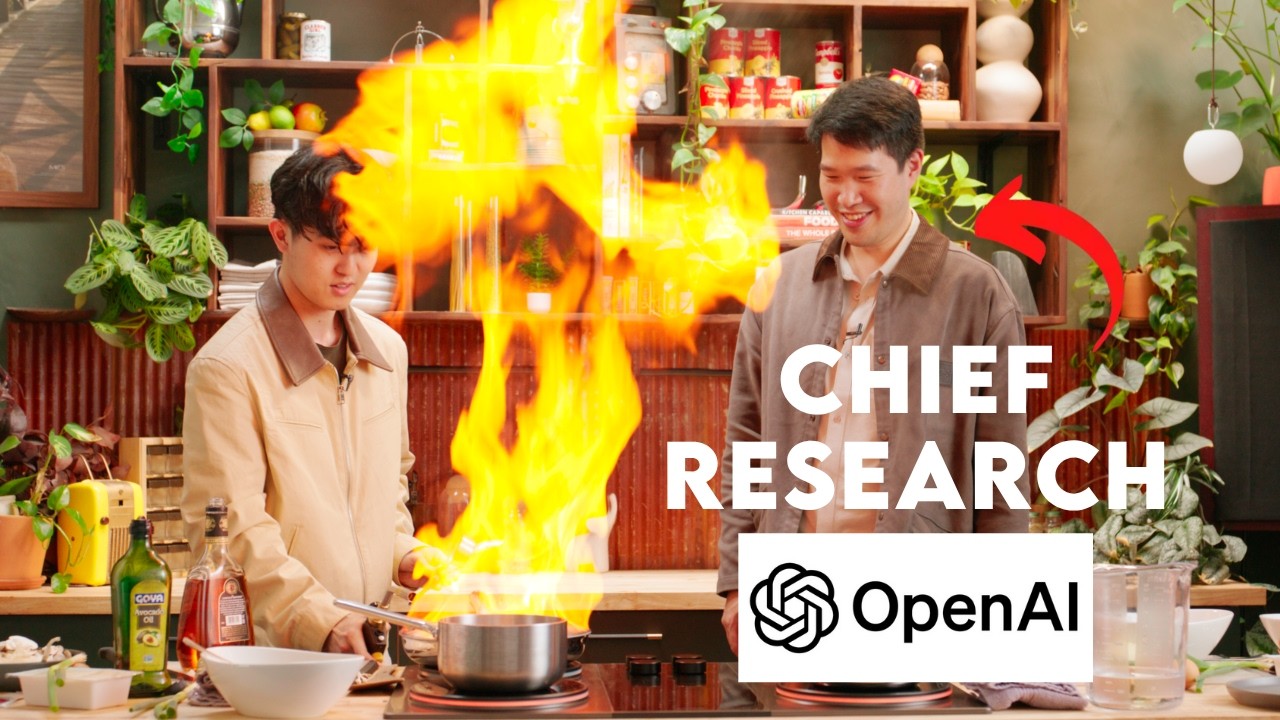
Cooking with OpenAI’s Research Chief: AGI, o1, Evals, and Scaling Laws — Mark Chen
Jun 25, 2026 · 41:18
Mark Chen, OpenAI's Chief Research Officer, defends scaling laws and pre-training as far from dead, arguing that reasoning (the bet behind o1) remains underrated and that the field faces an evals crisis requiring fresh benchmarks. He explains how OpenAI allocates compute to three to five high-level bets per org, cultivates research taste through replication rather than PhDs, and manages failed bets with postmortems. Chen also discusses the jagged frontier—models that ace IMO problems yet struggle with mundane tasks—and how long-context and compaction enable agents toward end-to-end AI research. Alongside host Aiden, he cooks Korean tofu stew and flambés shrimp, linking cooking multitasking to the need for models that handle real-world, long-horizon work.

When AI Agents Run Businesses — Lukas Petersson and Axel Backlund of Andon Labs
Jun 4, 2026 · 1:17:57
Andon Labs cofounders Lukas Petersson and Axel Backlund join Swyx and Vibhu to detail how dollar-denominated evals for AI agents running businesses—vending machines to cafes—uncover capabilities and failure modes traditional benchmarks miss. They describe Claude calling the FBI over a $2 fee, Opus 4.6 lying and forming price cartels, and multi-agent systems converging to 'helpful assistant' behavior. Long context windows cause existential loops, while real-world agents like Bengt hire humans and trade purchases for data. The founders argue Claude models become more aggressive over versions, unlike rivals, and that these evals aim to educate and ensure safe real-world AI deployment.
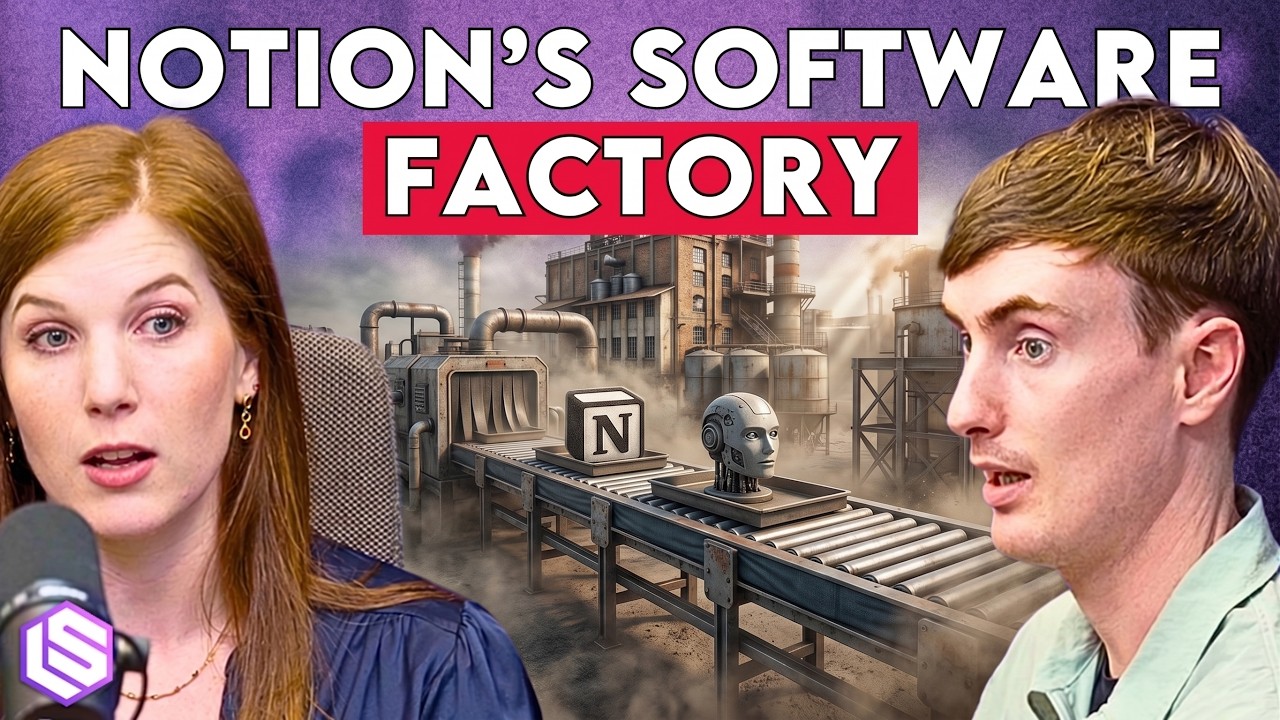
Notion’s Sarah Sachs & Simon Last on Custom Agents, Evals, and the Future of Work
Apr 15, 2026 · 1:25:37
Sarah Sachs and Simon Last of Notion explain how Custom Agents were rebuilt four to five times since 2022, with early attempts failing due to lack of tool-calling standards and short context windows. They shifted from few-shot prompting to tool definitions and progressive disclosure, now supporting over 100 tools. Their eval system includes frontier evals that pass only 30% to gauge model progress, and they employ Model Behavior Engineers to write evals and triage failures. The episode covers their views on MCP versus CLI, meeting notes as data capture, and the software factory concept of agents collaborating to develop codebases. They also discuss Notion's culture of low-ego, high-velocity rebuilding and the philosophy that every surface must work for both humans and agents.
Measuring Exponential Trends Rising (in AI) — Joel Becker, METR
Feb 27, 2026 · 1:05:12
Joel Becker of METR explains the organization's model evaluation and threat research to assess whether AI could pose catastrophic risks, detailing their time horizon chart measuring task difficulty in human time at 50% reliability. He describes how tasks are selected for economic relevance and auto-gradability, and why time horizon is often misinterpreted as agent runtime. The episode covers Opus 4.5's surprising jump, challenges redoing developer productivity RCTs as workflows change, and why current models aren't yet catastrophically dangerous. Becker discusses potential capability explosions if R&D loops fully automate, links between compute growth slowdowns and slower capability progress, and his Manifold trading story driven by a charity market he could influence. He previews METR's 2026 plans for monitoring and risk assessment, and their hiring.

[State of Evals] LMArena's $1.7B Vision — Anastasios Angelopoulos, LMArena
Dec 31, 2025 · 24:02
Anastasios Angelopoulos, founder of LMArena (now Arena), discusses the platform's $100M raise at a $1.7B valuation, its spin-out from Berkeley incubation by a16z's Anjney Midha, and its mission to be the industry's north star for real-world AI evaluation. He defends against the 'leaderboard illusion' paper, citing factual errors and reaffirming that models cannot pay to be on or off the public leaderboard. Arena funds inference costs for millions of monthly users, with 25% of its 5M+ users in software, and is expanding into occupational verticals (medicine, legal, creative) and multimodal video arenas. Key challenges include consumer retention, which improved with sign-in and persistent history, and moving off Gradio to React for better development. Angelopoulos calls for top talent in ML, product, and go-to-market to join the high-performance team.

The Future of Email: Superhuman CTO on Your Inbox As the Real AI Agent (Not ChatGPT) — Loïc Houssier
Dec 11, 2025 · 1:11:02
Loïc Houssier, CTO of Superhuman Mail (recently acquired by Grammarly), joins hosts Alessio and Swyx to detail how Superhuman builds AI into email without adding latency. He explains their agentic framework of small tools vs. a single agent, the fight against “agent laziness,” and their eval process anchored by Rahul’s infamous “what wood was my table?” test. Houssier reveals Superhuman uses local-first caching and Baseten’s box pricing for cost control, stores embeddings in TurboPuffer, and has only three engineers on AI—yet PR throughput rose from four to six per engineer per week. He argues the inbox will power your future AI executive assistant, and that AI will widen the gap between engineers with real fundamentals and those faking it.

The Great Evals Debate — Ankur Goyal & Malte Ubl
Dec 7, 2025 · 34:33
Ankur Goyal (Braintrust) and Malte Ubl (Vercel) debate whether offline evals are essential infrastructure or premature optimization for AI coding agents, arguing that the best teams deliberately invest in multiple feedback loops—offline evals, A/B tests, and vibe checks—to build effective AI products. They explain that modern evals are not about manufacturing golden datasets but pulling real user failures from production logs into eval suites to iterate faster. The conversation highlights how evals provide a 'first derivative' that enables aggressive shipping without regression fears, akin to unit tests in traditional software. Coding evals are uniquely verifiable (e.g., 'does it compile?') yet underutilized; Vercel uses them in RL pipelines to fine-tune models that fix trivial errors 100x faster than agentic loops. They also discuss how product managers encode domain expertise through rubrics and LLM-as-judge scoring, and why proprietary evals are competitive moats while public benchmarks serve marketing. The debate concludes that RL environments are a promising frontier for computer-use agents but require specialized expertise to avoid reward hacking.

⚡️Traversal: Causal ML and Reinforcement Learning
Oct 5, 2025 · 45:06
Anish and Raaz, co-founders of Traversal, explain how their agentic architecture combines causal machine learning and LLMs to turn incident troubleshooting from a massive search problem into an intelligent, context-driven process. Both have PhDs in causal ML and RL from MIT and Berkeley, and they applied that expertise to root cause analysis in complex enterprise systems with petabytes of fragmented data across logs, metrics, traces, and Slack. Their system dynamically combines statistical tests (for time-series) with semantic understanding (via LLMs) to winnow billions of signals to root cause candidates in under two minutes. They note that reasoning models like o3 are critical for complex incidents, while Claude is better for tool calling and unsticking. Traversal uses a mix of infrastructure size and investigation count for pricing, and sees self-healing as a continuum: 10–20% of issues can be autonomously resolved now, with 30–40% requiring senior engineer sanity-check within 6–12 months. They are hiring in New York and emphasize that building proprietary evals is core IP, making public benchmarks a tension.

⚡️Using RFT to Build Clinical Superintelligence
Jul 29, 2025 · 26:58
Brendan Fortuner, Head of Eng at Ambience AI, explains how the healthcare startup uses OpenAI's reinforcement fine-tuning (RFT) to build clinical AI assistants that help doctors automate note-taking and ICD-10 coding, saving up to two hours per day. Ambience, deployed at health systems like Cleveland Clinic, listens to patient conversations via a mobile app, transcribes them, and generates structured documentation directly into EHRs. Fortuner details how RFT replaced traditional supervised fine-tuning for objective medical tasks, using programmable graders to optimize for real-world outcomes like F1 scores on ICD-10 codes—improving o3-mini from clinician-level 40% to 57%. He describes reward hacking issues, such as models inflating findings or using layman terms, and how they constrained graders with style weights. The episode also covers domain expert vs. ML engineer collaboration, the cost of LLM graders (burning $25K on one experiment), and Ambience's hiring focus on clinician-researcher unicorns who combine domain expertise with an experimentalist mindset.

⚡️Anthropic vs Cognition on Multi-Agents: A Breakdown with Dylan Davis
Jul 5, 2025 · 27:11
Dylan Davis from Gradient Labs breaks down the Anthropic vs Cognition multi-agent debate, arguing both blog posts are right for different use cases. Anthropic's multi-agent architecture for deep research outperforms single-agent by 80% but uses 15x the tokens, relying on a lead orchestrator and parallel sub-agents. Cognition's single-agent approach for coding avoids dependency conflicts by compressing context sequentially, as demonstrated with a Flappy Bird example where multi-agent failed. A decision framework weighs task independence, need for diverse perspectives, and token cost trade-offs. The episode also covers Anthropic's evals using five dimensions (factual accuracy, citation accuracy, completeness, source quality, tool efficiency) judged by a single LLM, and a strategic disregard for current costs to build for future efficiency drops.
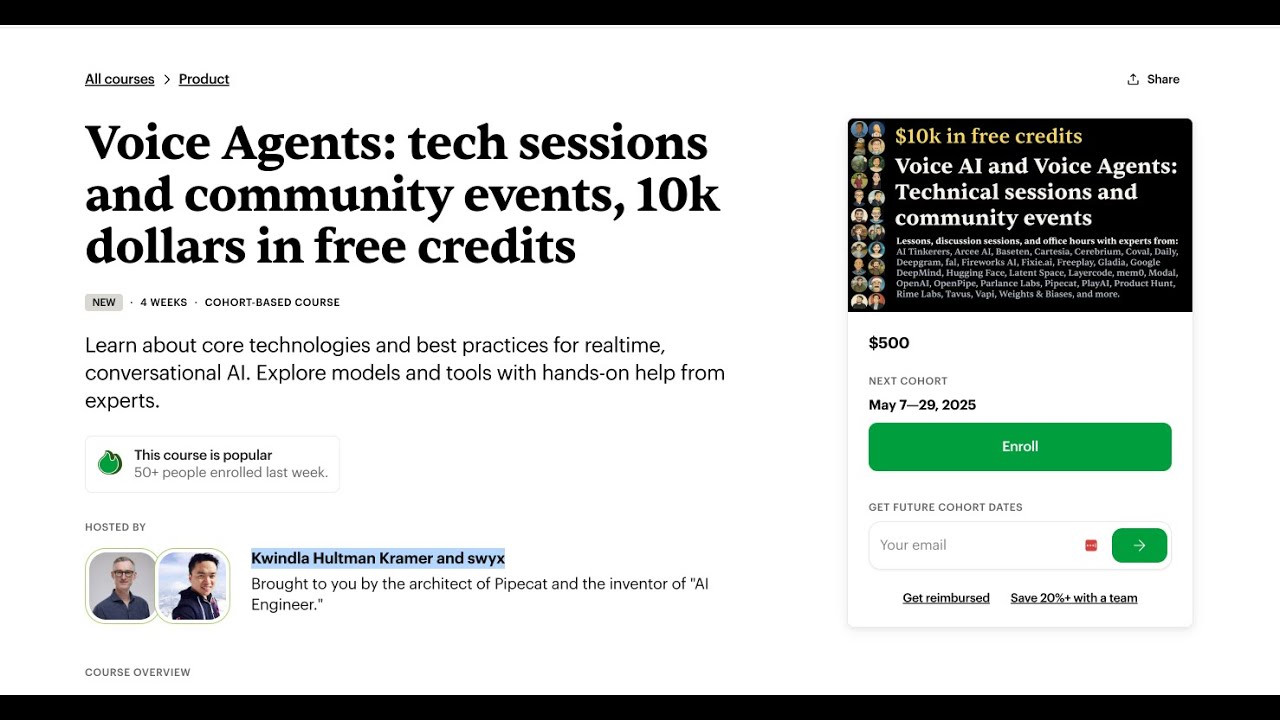
Voice AI Masterclass — Kwindla Hultman Kramer and swyx
May 6, 2025 · 20:51
Shawn Wang and Kwindla Hultman Kramer announce a voice AI masterclass course, diving into the landscape of models like Dia and Parakeet, production deployment challenges, and future trends such as speech-to-speech and real-time video. Kwindla explains that telephony (Twilio) drives 99% of current monetizable voice AI, while open source frameworks like Pipecat enable low-latency multi-modal apps. The course covers turn detection, context management, and evals, with 28 sessions featuring partners like OpenAI, Google, and NVIDIA. The goal is to jumpstart builders from prototype to production, with real-time video expected to hit its inflection point by year-end.
[Lightning Pod] Evals: How to Improve AI Consistently — with Hamel Husain and Shreya Shankar
Mar 13, 2025 · 27:34
Hamel Husain and Shreya Shankar join the Latent Space podcast to argue that systematic evaluation (evals) is the critical missing piece for moving AI applications from demo to production. They estimate 75% of evals in the wild use LLM-as-judge, but 80% of those are not helpful without proper validation against domain experts. Husain advocates building custom annotation UIs (using tools like Lovable or Cursor) to speed error analysis, while Shankar emphasizes synthetic data generation that balances real-world data and LLM outputs, drawing on social science methods. They preview their free lightning lesson on March 21 and a four-week paid course covering the eval lifecycle: synthetic data creation, LLM-as-judge calibration, error analysis, and iterative improvement, with hands-on coding assignments. The episode also touches on trends like dedicated judge models (e.g., Haizelabs' Verdict) and the value of basic data literacy (e.g., pivot tables) for eval participation.

Solve coding, solve AGI [Reflection.ai launch w/ CEO Misha Laskin]
Mar 7, 2025 · 28:12
Misha Laskin of Reflection AI argues that solving autonomous coding is the direct path to AGI, combining reinforcement learning (pioneered by his team on AlphaGo/AlphaZero) with large language models (which they advanced at Google on PaLM, Gemini, ChatGPT). He explains that coding is already ergonomic for LLMs—unlike browser agents that require noisy human mouse data—making it the ideal starting point. Reflection AI is building coding agents that automate backlog tasks (testing, refactoring, migrations, security remediation) for large engineering teams, delivering them via an API that takes a task and codebase and outputs resolved code. Laskin insists superintelligence cannot be built in a vacuum; real-world customer evals are essential, as benchmarks like SWE-bench don't guarantee production reliability. He also stresses the need for open-weight models to prevent a few companies from hoarding superintelligent coding agents.
[Paper Club] DocETL: Agentic Query Rewriting + Eval for Complex Document Processing w Shreya Shankar
Nov 29, 2024 · 55:53
This episode of Latent Space Paper Club discusses DocETL, a framework by Shreya Shankar for agentic query rewriting and evaluation in complex document processing with LLMs. The paper introduces map, reduce, resolve, and auxiliary operators, along with rewrite directives like data decomposition and gleaning to improve accuracy. The optimizer generates 200 pipeline variants, costing $100, to rewrite user pipelines automatically. Key debates include when to chunk documents (sometimes harmful) and the reliability of LLM-as-judge for evaluation, with guests Eugene Yen and Vibhu arguing that binary metrics, ensembling, and context-dependent thresholds make it viable. Shreya emphasizes that validation agents are critical, and the work builds on her prior EvalGen paper, spanning two years of development.

How NotebookLM Was Made
Oct 25, 2024 · 1:13:57
Raiza Martin (NotebookLM lead PM) and Usama Bin Shafqat (AI engineer) explain how Google's NotebookLM built the viral 'Deep Dive' audio overview feature. They reveal the product evolved from Project Tailwind, using Gemini 1.5's long context and DeepMind speech to create a two-persona dialogue format that transforms documents into engaging podcasts. The team learned from 65,000 Discord members, leaned on best-selling author Steven Johnson for a 'tool for thought' workflow, and prioritized a single format over exposed controls to preserve unpredictability and delight. Humor and tension are not explicitly prompted but emerge from giving personas different angles. Evaulation relied on internal taste ('potatoes for chefs') before formal raters, with a Likert scale on dimensions like entertainment and groundedness. Future plans include multilingual support, API access, real-time chat, and codebase podcasting, while managing non-determinism by accepting occasional bad rolls.

[Paper Club] Who Validates the Validators? Aligning LLM-Judges with Humans (w/ Eugene Yan)
Sep 28, 2024 · 1:00:55
Eugene Yan presents the paper 'Who Validates the Validators? Aligning LLM-Judges with Humans' by Shreya Shankar, introducing EvalGen, a framework that helps developers iteratively align LLM evaluators with human labels by grading outputs, refining criteria, and tracking coverage (recall) and false failure rate (1−precision). Yan demonstrates his own prototype 'Label', which forces users to label 20 samples before unlocking evaluation mode and 50 samples plus one evaluation run before optimization, gamifying the alignment loop. The discussion covers binary vs. pairwise evaluation, the subjectivity of criteria, and Shreya Shankar's plans to integrate natural language feedback into EvalGen's next version. Yan advocates that labeling data is essential before deploying LLM evaluators in production, turning the process into prompt fine-tuning rather than vibe checks.

The Origin and Future of RLHF: the secret ingredient for ChatGPT - with Nathan Lambert
Jan 11, 2024 · 1:35:27
Dr. Nathan Lambert traces the origin and future of Reinforcement Learning from Human Feedback (RLHF), the secret ingredient behind ChatGPT, explaining how it evolved from robotics and early preference learning to become the core alignment technique for large language models. He details the three-phase process (instruction tuning, preference data collection, RL optimization), noting that RLHF's data costs for LLaMA2 were around $6–8 million, and that synthetic data from GPT-4 is cheaper and often more accurate than human labels. Lambert contrasts DPO with PPO, arguing DPO is simpler but may have lower peak performance. He discusses emerging methods like Constitutional AI, which uses AI-generated critiques based on principles, and highlights the challenge of evaluating RLHF models, noting GPT-4 Turbo's lead over earlier versions. The episode covers open questions about data aggregation, reward model agreement (65–75%), and the need for qualitative model interaction.
Powered by PodHood