
Diffusion Models
Episodes from Latent Space about Diffusion Models.
7 episodes

🔬 "The Most Innovative Diffusion Research Is Happening in Drug Discovery, Not Image Generation"
Jun 30, 2026 · 1:48:40
Evan Feinberg and Sergey Edunov of Genesis Molecular AI argue that diffusion models have unlocked sub-ångström accuracy in protein-ligand structure prediction, a breakthrough that makes AI useful for real drug discovery where the field’s favored 2Å RMSD benchmark is "slop." Their PEARL model uses diffusion with physics-based guidance, synthetic training data from molecular dynamics, and inference-time scaling to predict induced fit—how a protein flexes to accommodate a ligand. On the OpenBind benchmark, PEARL zero-shot surpassed all cofolding models on the notoriously hard EV A721A protease, correctly predicting a flexible loop movement that other methods missed. They also introduce SAPPHIRE, an agentic system that orchestrates AI models for 24/7 drug design, and discuss how downstream ADMET properties (solubility, toxicity, etc.) remain equally critical. The biggest bottleneck they face is GPU availability, and they are actively hiring AI researchers interested in novel architectures beyond standard transformers.

Moonlake: Interactive, Multimodal World Models — with Chris Manning and Fan-yun Sun
Apr 2, 2026 · 1:06:48
Moonlake AI founders Chris Manning and Fan-yun Sun argue that interactive, multimodal world models require structured symbolic reasoning over pure scale, enabling indefinite multiplayer gameplay and causal consistency that video generation models like Genie and Sora cannot achieve. Their approach uses code engines and physics simulators as cognitive tools, producing reasoning traces that handle geometry, physics, and logic, while a separate diffusion model (Reverie) handles pixel fidelity. They aim to replace traditional rendering and empower creators by allowing human intent to be injected at a symbolic layer. Manning contrasts this with Yann LeCun's JEPA, emphasizing language and abstraction over pixel-level prediction. Moonlake is hiring engineers at the intersection of code generation, computer vision, and graphics.
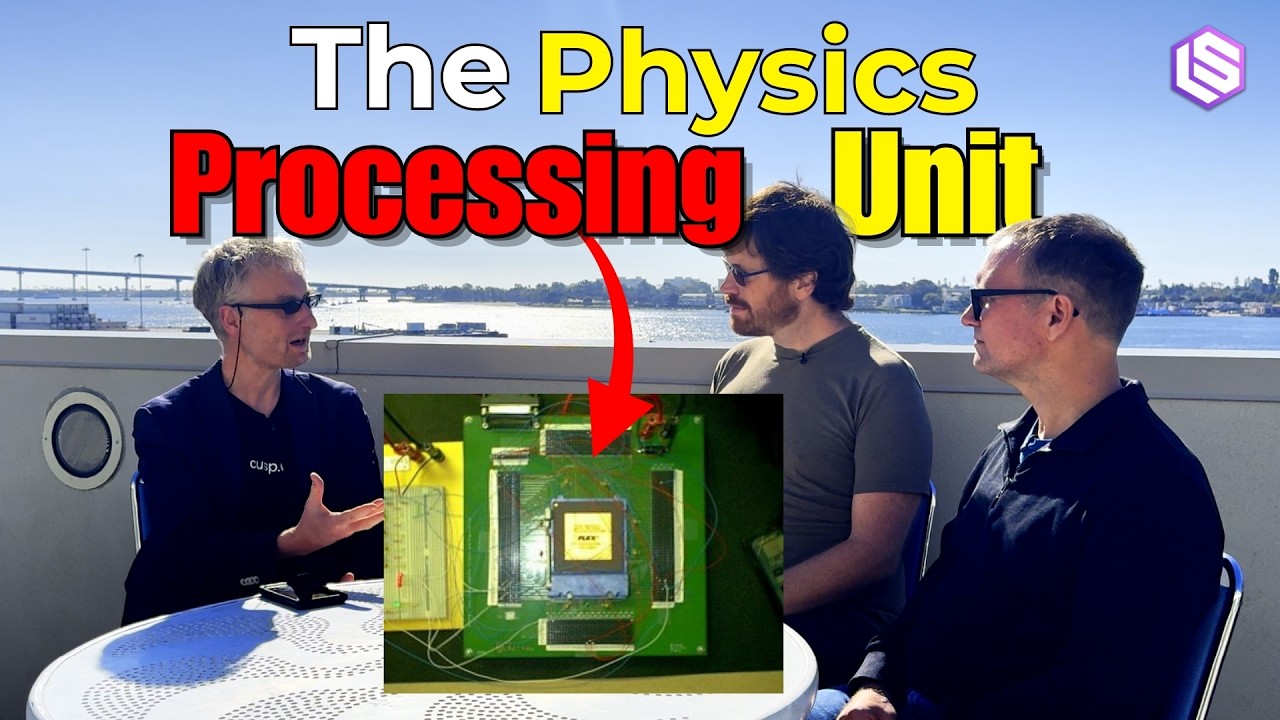
🔬Max Welling: Materials Underlie Everything
Feb 25, 2026 · 34:14
Max Welling, a pioneer in variational autoencoders and equivariant neural networks, argues that materials underlie everything from GPUs to the energy transition, and AI can turn material discovery into a search engine. He traces his career from quantum gravity with Gerard 't Hooft to climate-focused AI, founding CuspAI to accelerate carbon capture materials. CuspAI’s platform combines generative models, multi-scale digital twins, and LLM-powered agents, but Welling insists chemists remain in the loop for the foreseeable future. He explains equivariance as hardcoding symmetry into neural networks to reduce data needs, though data augmentation often works better at scale. His upcoming book reveals the identical mathematics between diffusion models and stochastic thermodynamics, promising cross-fertilization between machine learning and physics.
🔬Generating Molecules, Not Just Models
Feb 12, 2026 · 1:41:26
Gabriele Corso and Jeremy Wolwen, founders of Boltz, explain how their open-source models democratize biomolecular structure prediction and design, building on AlphaFold2's breakthrough in single-chain protein folding to model interactions with small molecules, RNA, and DNA. They recount how, after AlphaFold3 was kept closed by DeepMind, they built Boltz1 in months by training a single large model with mid-training bug fixes and limited compute. The conversation covers the shift from regression to generative diffusion models, the critical role of evolutionary multiple sequence alignments (MSAs), and the specialized pairwise triangular attention architecture that remains central. They detail Boltz2's addition of affinity prediction and BoltzGen's unified sequence-structure diffusion for designing proteins, nanobodies, and peptides, validated across 25 labs on targets with no known interactions. Boltz Lab provides an API and interface with optimized inference (10× faster small-molecule screening) and collaborative ranking tools, aiming to serve academia, startups, and enterprises while keeping core models open.

⚡️Mercury: Ultra-Fast Diffusion LLMs — Estefano Ermon, CEO Inception Labs
Aug 4, 2025 · 28:07
Stefano Ermon of Inception Labs explains why diffusion language models like their Mercury Coder can match GPT-4.1 Nano and Claude Haiku in intelligence while delivering 5–10× faster inference at 737–1109 tokens/sec on H100s, built on score-based generative model foundations he pioneered at Stanford. He details the coarse-to-fine generation process that modifies multiple tokens per network evaluation, the required end-to-end training from scratch (no fine-tuning existing LLMs), and how post-training pipelines use specialized DPO for preference alignment. Ermon identifies latency-sensitive applications—voice agents, IDEs, vibe coding—as the killer use case, acknowledges they aren't yet frontier-level but sees a future where diffusion dominates due to efficiency gains, and notes the challenge of open-sourcing given proprietary inference engines and kernels.
[Paper Club] Intro to Diffusion Models and OpenAI sCM: Simple, Stable, Scalable Consistency Models
Nov 2, 2024 · 52:22
RJ Honicky presents OpenAI's sCM paper, which introduces techniques to simplify, stabilize, and scale continuous-time consistency models for faster image generation. The paper addresses instability issues by modifying skip connections, using cosine/sine schedules, adjusting the noise embedding scale to 0.02, applying adaptive double normalization, and implementing tangent warm-up over the first 10K iterations. These innovations enable one-step generation with FID scores rivaling GANs and multi-step diffusion models, while scaling experiments demonstrate performance up to 1.5B parameters. Distillation from scratch outperforms distillation from a teacher, and the episode contrasts these continuous-time methods with discrete-time approaches, explaining the intuition behind the mathematical choices.
The AI-First Graphics Editor - with Suhail Doshi of Playground AI
Jan 2, 2024 · 1:09:23
Suhail Doshi, co-founder of Mixpanel and founder of Playground AI, argues that image generation is still in a GPT-2 moment and that training open-source foundation models from scratch is necessary to unlock real utility, exemplified by Playground v2's 2.5x preference over Stable Diffusion XL on a 1K prompt benchmark. He explains the pivot from Mighty (cloud-streamed browser) to AI, driven by the belief that shifting compute elsewhere aligns with AI's parallel computation. The episode covers Playground's unique UI—not just a prompt box but a full canvas with preview rendering, seed control, and style filters—and the difficulty of balancing safety with artistic expression, especially around NSFW content. Suhail discusses the under-investment in graphics AI compared to language, the open-source community's role, and his choice to release pre-trained weights for academic research. He also shares lessons from running GPU infrastructure (harder for training than inference) and advises founders to follow curiosity and build projects rather than relying on books.
Powered by PodHood