
Data Tools
Episodes from Latent Space about Data Tools.
13 episodes
⚡️ How to turn Documents into Knowledge: Graphs in Modern AI — Emil Eifrem, CEO Neo4J
Apr 18, 2026 · 48:53
Emil Eifrem, CEO of Neo4j, joins host Shawn Wang to argue that AI systems need more than top-K chunk retrieval—they require graph-shaped context for accuracy, explainability, and developer productivity. GraphRAG combines vector search with graph traversal, starting semantically then expanding through relationships, which he says yields higher accuracy and auditability than opaque vector spaces. Neo4j now powers production AI at companies like Pfizer (over 60 million documents), Novo Nordisk, and 20 of North America’s 20 largest banks, with a mortgage lender seeing a 20% conversion lift. Eifrem describes four data sources for agentic systems: operational databases, cloud warehouses, agentic memory, and context graphs—the latter encoding institutional decision traces. He notes a recent shift where enterprises lead with generic text-to-Cypher instead of specialized functions, and highlights Neo4j's new `create-context-graph` starter kit for 22 industries, built to bootstrap context graphs and agent memory.
⚡️ Reverse Engineering OpenAI's Training Data — Pratyush Maini, Datology
Feb 10, 2026 · 27:02
Pratyush Maini from Datology reveals how the seahorse emoji question exposes that frontier models like GPT-4.1, GPT-5, and OLMo 3.1 now exhibit self-correction loops—a sign that reasoning traces are baked into mid-training data, not just post-training. By tracking response length surges four months after o1's release and corroborating with OLMo's data, Maini argues that foundation models must contain core capabilities like self-reflection, reinforcing the 'Fine Tuner's Fallacy': you cannot simply fine-tune for a capability; it must be in pre-training. He also highlights Datology's BeyondWeb project, which uses a source-rephrasing paradigm to transform internet data at trillion-token scale, achieving Nemotron-level performance in 2.7x less compute—making specialized pre-training accessible for enterprises. The episode concludes that 2026-2027 will see a shift toward domain-specific pre-training, as the cost amortizes when a smaller pre-trained model outperforms a larger fine-tuned one.

[State of AI Startups] Memory/Learning, RL Envs & DBT-Fivetran — Sarah Catanzaro, Amplify
Dec 30, 2025 · 28:43
Sarah Catanzaro of Amplify Partners argues that the DBT-Fivetran merger was not the death of the modern data stack but a path to IPO targeting $600M+ combined revenue, that data catalogs failed because they were built for humans rather than machines, and that RL environments are a fad. She notes that frontier labs use dbt and Fivetran for training data curation and agent analytics, and criticizes $100M+ seed rounds raised without near-term roadmaps. For 2026, she identifies personalization via memory and continual learning as the key retention unlock, observing that AI founders are unfamiliar with growth concepts like k-factor. She prefers real-world logs over synthetic RL environments, citing Cursor's use of user activity, and says the most exciting startups combine hard research problems (RAG, rule-following, continual learning) with applications that were previously impossible.

⚡ Open Model Pretraining Masterclass — Elie Bakouch, HuggingFace SmolLM 3, FineWeb, FinePDF
Oct 20, 2025 · 1:03:40
Elie Bakouch, Hugging Face's pre-training lead and architect behind SmolLM, presents a five-pillar framework for model training spanning data quality, architecture, information extraction, gradient quality, and stability, while breaking down recent innovations in optimizers, Mixture of Experts, and data rephrasing. He explains that the field of optimizers is moving beyond AdamW with Muon and Shampoo, noting that speed-ups are often exaggerated due to undertuned baselines. He deep-dives into MoE architecture, showing that expert specialization requires load balancing at the global batch level, as demonstrated by Qwen's findings. He discusses the rephrasing revolution, where converting low-quality web data into QA format yields non-random MMLU performance even for small models. Elie also highlights Hugging Face's open science contributions: FinePDF (new PDF dataset), FineWeb-Edu2, and tools like Nanotron, Datahub, and Liteval.

Better Data is All You Need — Ari Morcos, Datology
Aug 29, 2025 · 1:18:43
Ari Morcos, CEO of Datology, argues that data curation is the most impactful and underinvested area in AI, claiming models are defined by what they eat. He details his shift from focusing on inductive biases to realizing data quality is paramount, citing the DCLM study where human experts could not predict automated filtering decisions. Datology's methods combine filtering, rebalancing, curriculum, and rephrasing synthetic data to achieve baseline performance 12x faster, improve accuracy by 4–5 absolute points, and train models with fewer than half the parameters. Morcos explains how curating data bends naive scaling laws by maintaining marginal information gain, and shares results from the Arc 4.5B model, which was trained on 7 trillion tokens (down from 25 trillion) using Datology's curation. He highlights that data is a compute multiplier, making it possible for enterprises to train smaller, cheaper models for specific domains.

Long Live Context Engineering - with Jeff Huber of Chroma
Aug 19, 2025 · 57:01
Jeff Huber, founder and CEO of Chroma, joins Shawn Wang and Alessio to argue that context engineering—not RAG—is the real job of AI builders, and that Chroma's modern retrieval engine is built for this new paradigm. Huber explains context rot, a phenomenon where LLMs lose attention and reasoning ability as context windows grow, motivating precise retrieval over huge context windows. Chroma Cloud is a zero-config, usage-based serverless vector database with separation of storage and compute, now powering 5M monthly downloads and 21k GitHub stars. He shares techniques like chunk rewriting and generative benchmarking for evaluating retrieval, and predicts LLMs will increasingly serve as re-rankers. The episode also covers memory as a benefit of context engineering, offline compaction for self-improving AI systems, and Huber's philosophy of building with long-term purpose, hiring engineers who care about Rust, TLA+, and deterministic simulation testing.

Quadratic: The AI Spreadsheet
Jun 10, 2025 · 28:15
David Kircos, co-founder and CEO of Quadratic, joins hosts Alessio and Swyx to demonstrate Quadratic, an AI-powered spreadsheet that natively executes Python, JavaScript, and database queries in WebAssembly for real-time performance. The product's AI assistant uses a context-aware agent loop that summarizes sheet structure rather than dumping full data, then tool-calls to read columns or peek at values only when needed, keeping costs low on large datasets. Kircos explains Quadratic's three-year technical groundwork—WebGL rendering and WebAssembly runtimes—enabled them to capitalize on AI, turning a 'technical spreadsheet' into one where users simply drop a CSV and say 'help me analyze this.' He details how they route chart images back to the model for visual feedback and predicts that formulas will yield to Python for complex analysis, though spreadsheets will remain the best interface for human–AI data collaboration. Quadratic is source-available on GitHub, supports real-time multiplayer, and has grown to nine people. The episode also covers future directions like proactive agents and form controls (sliders) for interactive models.

The Rise and Fall of the Vector DB category: Jo Kristian Bergum (ex-Chief Scientist, Vespa)
Apr 19, 2025 · 27:17
Jo Kristian Bergum argues that the vector database category is dying because vector search capabilities have converged into existing databases like Postgres' pgvector, Elasticsearch, and Vespa, making specialized vector databases unnecessary for most use cases. He traces the category's rapid rise after ChatGPT, driven by the misconception that RAG required embeddings, and notes Pinecone's high ARR and subsequent repositioning. Bergum emphasizes that embeddings remain important but should be combined with traditional retrieval methods like BM25 for effective search, and that re-ranking can add modest gains. He critiques the hype around knowledge graphs, noting the bottleneck of building them, but sees LLMs making triplet generation easier. For the future, he hopes for more domain-specific embedding models and visual language model backbones, though acknowledges the difficulty of the business model.

The Unreasonable Effectiveness of Reasoning Distillation: using DeepSeek R1 to beat OpenAI o1
Jan 24, 2025 · 23:35
Bespoke Labs founders Mahesh, Ryan, and Trung explain how they distilled DeepSeek R1 into Bespoke-Stratos-32B, a reasoning model that beats OpenAI o1-preview on math and code benchmarks using only 17,000 training examples—47 times fewer than DeepSeek's own distill. They achieved this in a 48-hour sprint leveraging their data curation library Curator. Unlike Sky-T1, which required rewriting unreliable QWQ traces, R1's coherent reasoning allowed them to skip re-annotation and simply filter for correctness. The team argues data quality matters more than quantity, and that smaller models (like their 7B variant) can also improve with better teacher data. They see this as evidence that reasoning can emerge purely from supervised fine-tuning on high-quality traces, without complex search algorithms.
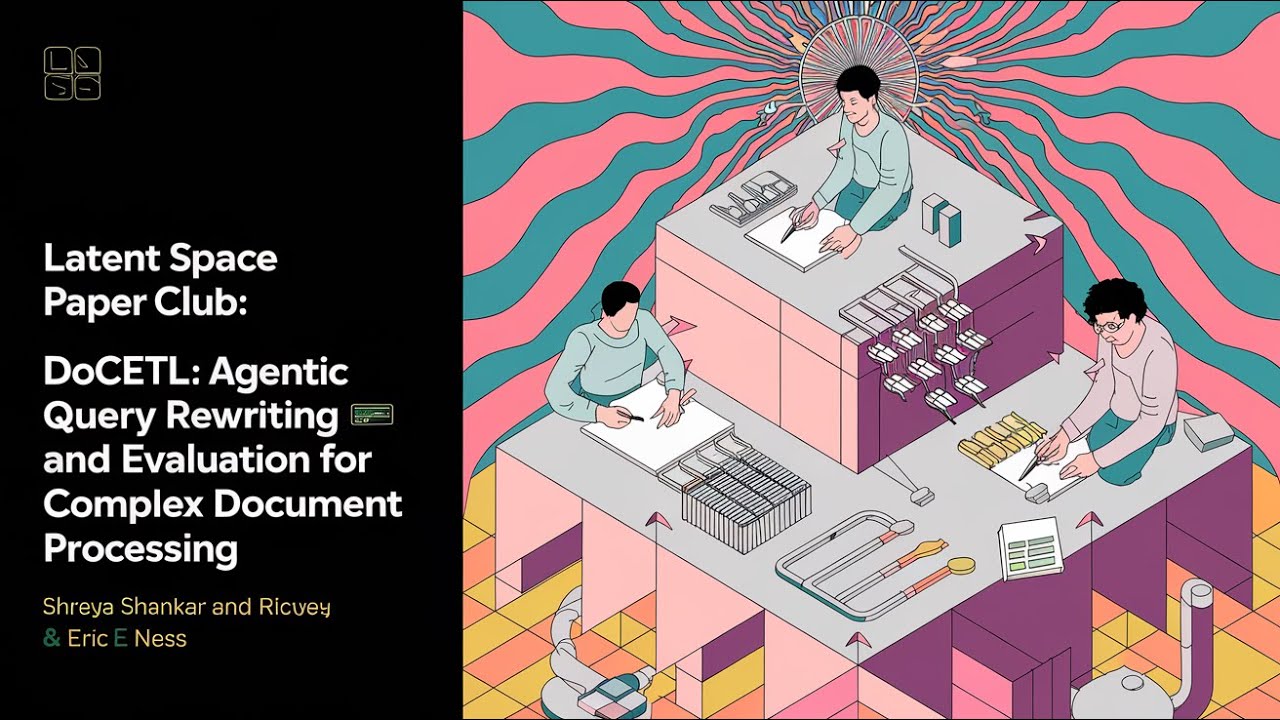
[Paper Club] DocETL: Agentic Query Rewriting + Eval for Complex Document Processing w Shreya Shankar
Nov 29, 2024 · 55:53
This episode of Latent Space Paper Club discusses DocETL, a framework by Shreya Shankar for agentic query rewriting and evaluation in complex document processing with LLMs. The paper introduces map, reduce, resolve, and auxiliary operators, along with rewrite directives like data decomposition and gleaning to improve accuracy. The optimizer generates 200 pipeline variants, costing $100, to rewrite user pipelines automatically. Key debates include when to chunk documents (sometimes harmful) and the reliability of LLM-as-judge for evaluation, with guests Eugene Yen and Vibhu arguing that binary metrics, ensembling, and context-dependent thresholds make it viable. Shreya emphasizes that validation agents are critical, and the work builds on her prior EvalGen paper, spanning two years of development.

Segment Anything 2: Memory + Vision = Object Permanence — with Nikhila Ravi and Joseph Nelson
Aug 7, 2024 · 1:00:44
Nikhila Ravi from FAIR and Joseph Nelson from Roboflow discuss Segment Anything 2 (SAM 2), which extends zero-shot object segmentation to video with memory and real-time interactive tracking. The model is one-third the size of SAM 1 (224M vs 630M parameters) and six times faster, using a novel memory attention mechanism with six-frame spatial memory and longer-term object pointers. Ravi explains the three-phase data engine that built the SA-V dataset of 51,000 videos, enabling SAM 2 to track arbitrary objects like a T-shirt or an octopus even when occluded. At Roboflow, users labeled 49 million images with SAM in its first year, saving an estimated 35 years of manual annotation time. The demo features swim lanes that show object visibility and allow refinement clicks to correct tracking mistakes, a key improvement over prior video segmentation models. SAM 2 also handles out-of-distribution domains like underwater footage, though screenshots remain challenging and may require fine-tuning.
Open Source AI is AI we can Trust — with Soumith Chintala of Meta AI
Mar 6, 2024 · 1:37:38
Soumith Chintala, creator of PyTorch and engineering lead at Meta AI, argues that open source AI is essential for distributing opportunity and trust. He details PyTorch's complexity—1,000 operators needed for generality—and explains synthetic data as a vehicle for imparting symbolic knowledge where humans already have good symbolic models. He highlights a coordination problem in open source: feedback is lost because frontends like Ooba and Ollama lack feedback buttons, and proposes a centralized sinkhole to collect high-quality feedback. Beyond text, he is excited about robotics, where hardware remains a bottleneck, and Osmo's work to digitize smell, which he compares to images in the 1800s.
Powering your Copilot for Data - with Artem Keydunov from Cube.dev
Oct 27, 2023 · 43:01
Artem Keydunov, co-founder of Cube (formerly Statsbot), explains how his early text-to-SQL Slack bot in 2016 led to the creation of Cube as a semantic layer, which he argues is now essential for grounding AI models on structured data. Statsbot failed due to the lack of LLMs, relying on regex and custom models, but the underlying Cube framework—an open-source semantic layer defining metrics and dimensions—solved the context problem. Today, semantic layers index data into text descriptions, enabling agents to generate simple queries against the layer instead of complex SQL, reducing errors. Keydunov highlights that natural language querying is becoming a commodity feature in BI tools, but the real value lies in treating metric definitions as code with version control. He advises AI engineers to use a proper warehouse, a semantic layer like Cube, and tools like LangChain, while cautioning that production systems need extra Python code for math and error handling.
Powered by PodHood