
Compute
Episodes from Latent Space about Compute.
15 episodes

The Future of AI Infra: from Kubernetes to Agent Sandboxes — Akshat Bubna, Modal CTO
Jul 8, 2026 · 59:10
Modal CTO Akshat Bubna explains how the cloud platform evolved from a serverless runtime to an AI cloud built for elastic inference, agent sandboxes, and post-training workloads. He argues that Kubernetes was never designed for bursty GPU-heavy AI workloads, so Modal built a decorator-based infrastructure that co-locates compute requirements with code. The company added GPUs a year before ChatGPT and now powers inference for custom models at Suno, Runway, and robotics firms, using GPU snapshotting to slash cold starts. Modal's new Auto Endpoints incorporate open-source DeFlash speculative decoding for frontier-level performance. For reinforcement learning rollouts, Modal provides up to 100,000 sandboxes simultaneously. The platform spans 17 cloud providers, features private IPv6 networking via eBPF, and supports serverless multi-node training with RDMA. Bubna also reveals Modal's shift from developer experience to agent experience, noting that agents benefit from the same minimalist SDK and observability tools that humans use.
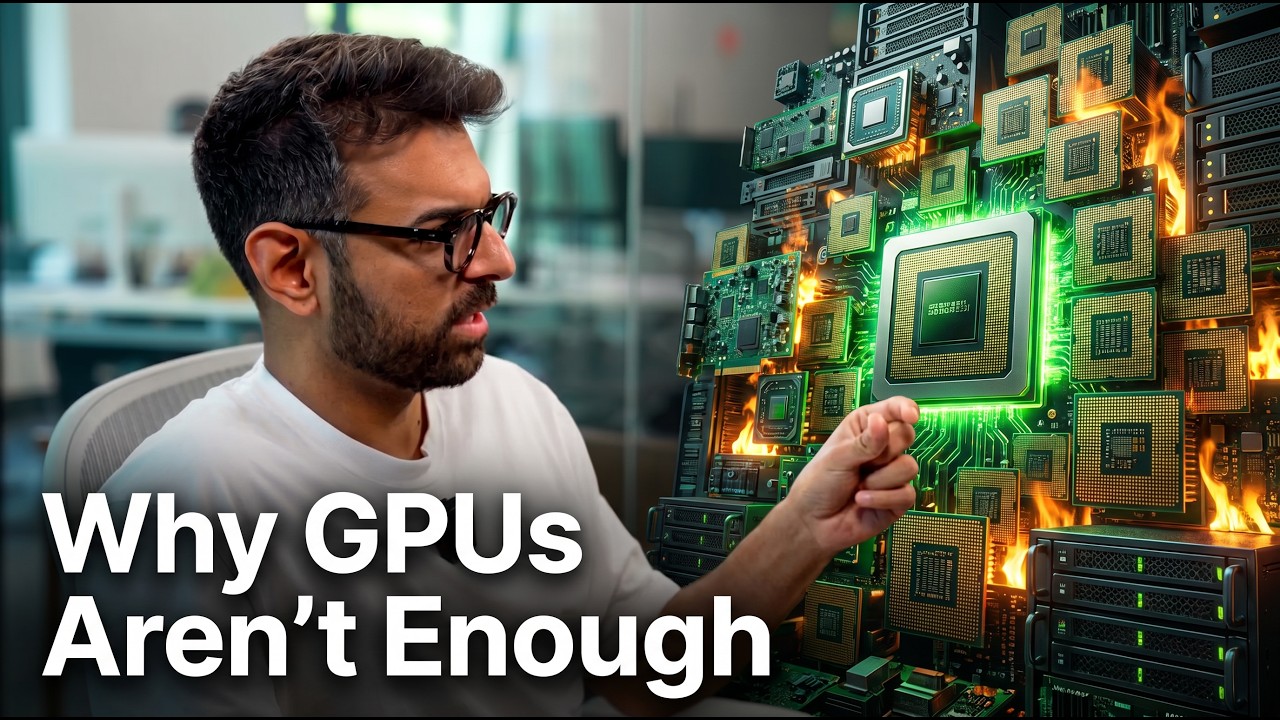
Why AI Labs With Unlimited GPUs Still Fail — Anjney Midha, AMP
Jun 18, 2026 · 1:00:37
Anjney Midha, CEO of AMP, argues that AI labs with unlimited GPUs still fail due to misaligned culture and infrastructure waste, proposing a compute grid modeled on independent system operators to pool demand and supply. At Google, 95% node utilization was considered an outage, yet most clusters today don't reach that, with waste compounding at scale. AMP’s grid, starting at scheduling, aims to make FLOPs flow like megawatts, having secured 1.3 gigawatts of demand. Midha explains Anthropic cracked coding because 'luck favors the prepared mind'—their four years of paranoia and scarcity created a culture that OpenAI’s abundance couldn't replicate. He also shares a 14-year mission in end-of-life prediction, arguing AI can reduce the 30% of Medicare/Medicaid spend on end-of-life care. He warns that too much capital too early makes labs fragile because without hardship they fail to define their P0.

Agent Inference at the "Speed of Light" — How NVIDIA moves like a $4.3 Trillion Startup
Mar 8, 2026 · 1:26:00
NVIDIA's Nader Khalil and Kyle Kranen join Swyx and Vibhu to explain how the company moves like a $4.3 trillion startup through speed-of-light (SOL) first-principles thinking, agent security boundaries, and the Dynamo inference engine. They argue agents should only do two of three things (files, internet, code) to prevent vulnerabilities, and detail Brev's acquisition to improve developer UX with one-click GPU access and DGX Spark integration. Kyle describes Dynamo as a data center scale inference engine that optimizes serving by scaling out, using prefill/decode disaggregation, Kubernetes-based scheduling, and model-hardware co-design to improve cost, latency, and quality. The episode covers SOL's role in creating urgency, long-context limits and potential 'unhobblers' like multi-head latent attention, and the shift toward CLI-first agent workflows for enterprise tools.

After LLMs: Spatial Intelligence and World Models — Fei-Fei Li & Justin Johnson, World Labs
Nov 25, 2025 · 1:00:39
World Labs co-founders Fei-Fei Li and Justin Johnson argue that spatial intelligence is the next frontier beyond LLMs, with their product Marble generating editable 3D worlds from text or images using Gaussian splats. They claim language is a lossy channel for describing the rich 3D/4D world, while spatial intelligence handles everything from picking up a mug to inferring DNA's double helix. Marble already serves gaming, VFX, and film, with precise camera control and real-time rendering on phones and VR headsets. They discuss scaling compute from AlexNet to today's million-fold increase, why world models can 'soak up' modern GPU clusters better than language alone, and the gap between pattern-fitting and causal understanding in physics. Fei-Fei worries more about under-resourced academia than open vs. closed models, advocating for national AI compute clouds and open benchmarks like the BEHAVIOR dataset. Justin notes transformers are natively set models, not sequence models, opening architectural possibilities for new spatial data.

DeepWiki: The GitHub Encyclopedia
May 21, 2025 · 32:05
Silas Alberti from Cognition (Devin) introduces DeepWiki, a free no-login product that indexes over 30,000 open-source repos and generates AI-powered wikis and deep research answers. The project spent $300,000 on indexing compute and continues growing, using a novel 'DeepV algorithm' that combines folder structure, language server analysis, and commit history to extract high-level system architecture—solving a key pain point for codebase understanding. Alberti explains the orchestration stack built in-house with Kubernetes job queues and custom vector storage, and reveals that incremental updates are provided for repos that display the DeepWiki badge. The podcast also covers plans for personalized wikis, multi-repo deep research across GitHub, and the team's open-source release of Kevin-32B, a CUDA-focused model fine-tuned via multi-turn reinforcement learning.

SF Compute: Commoditizing Compute
Apr 11, 2025 · 1:12:02
Evan Conrad, co-founder of SF Compute, argues that GPUs behave like a real estate business, not a traditional cloud, because price-sensitive customers value every incremental GPU and will switch for a 10% margin. CoreWeave succeeded by selling locked-in long-term contracts to low-credit-risk customers like Microsoft and OpenAI, ignoring short-term demand. He predicts hyperscalers and providers like Together and DigitalOcean will lose money on GPU clusters because software margins cannot match the hardware costs. SF Compute started as an AI lab forced to sublease its cluster monthly to avoid bankruptcy, then evolved into a market where anyone can buy H100s by the hour via dynamic pricing—often below $1/hour for short bursts. Utilization stays near 100% as prices adjust. Future plans include cash-settled futures to reduce financial risk across the industry, while the brand deliberately stays anti-hype and calm.

Beating Google at Search with Neural PageRank and $5M of H200s — with Will Bryk of Exa.ai
Jan 10, 2025 · 55:54
Will Bryk, CEO of Exa.ai (formerly Metaphor), details building a neural search engine from scratch using link prediction as 'Neural PageRank' — predicting documents rather than keywords. Exa's new product offers near-perfect lists (e.g., 'startups working on hardware in SF') by scaling compute per query, from milliseconds to a day, like o1 for search. Bryk argues LLMs will become the interface to search, while Exa provides the 'super knowledge' that even AGI will need. He contrasts Exa's neural approach with Google's keyword-based system and Perplexity's reliance on Bing. The company recently purchased a $5M H200 cluster and maintains a culture of nap pods and first-principles thinking.

Best of 2024: Open Models [LS LIVE! at NeurIPS 2024]
Dec 23, 2024 · 37:29
Luca Soldani of AI2 and Sophia Yang of Mistral argue that open models in 2024 have exploded in number and performance, closing the gap with closed models, but face growing compute and data-access challenges. Soldani notes 2024 saw models like Qwen and Deepseek rivaling frontier closed-model performance, and fully open models like OLMo release full recipes including data, code, and intermediate checkpoints. He points out that pre-training requires 10K+ GPUs for state-of-the-art, while post-training can be done with as few as eight. Sophia highlights Mistral's release of over a dozen models in 2024, including Pixtral multimodal and Le Chat—a free chat interface with image understanding, canvas code execution, and web search. Soldani warns of data access diminishing due to content owners blocking crawlers and lobbying efforts labeling open source AI as dangerous, emphasizing the need to protect the open ecosystem.

[Paper Club] Weight Streaming on Wafer-Scale Clusters (w/ Sarah Chieng of Cerebras)
Dec 7, 2024 · 43:54
Sarah Chieng of Cerebras presents the weight streaming technique for training giant neural networks on Cerebras wafer-scale clusters, arguing it enables near-linear scaling by separating parameter storage from primary compute. The system uses the Wafer Scale Engine (WSE-2/3) with 900,000 cores and 44 GB on-chip SRAM, avoiding off-chip memory bottlenecks that limit NVIDIA GPUs. MemoryX provides external storage for weights and optimizer states (up to 2.4 petabytes), streaming weights to compute units via the SwarmX interconnect fabric, which aggregates gradients. This design allows training models with up to 120 trillion parameters without complex hybrid parallelism. Cerebras also leverages unstructured weight sparsity to prune 90% of data during transmission and skip zero-value computations on-chip, reducing bandwidth and improving efficiency.

llm.c's Origin and the Future of LLM Compilers - Andrej Karpathy at CUDA MODE
Sep 21, 2024 · 23:29
Andrej Karpathy explains llm.c, his from-scratch C implementation of GPT-2 training that outperforms PyTorch by 20% in speed and 30% in memory, arguing that LLMs will eventually act as compilers for custom code. He recounts starting the project out of frustration with PyTorch compile errors, writing all forward and backward passes manually in C, then porting to CUDA with kernel optimizations. A community of contributors (Eric, Arun, Alex R) helped achieve 50% MFU on a single H100 node, training GPT-2 1.6B in 24 hours for $600. Ongoing work adds Llama 3.1 and FP8 support. Karpathy sees llm.c as proof that LLMs can automate such low-level optimization, making Python and PyTorch a temporary crutch.

How to train a Million Context LLM — with Mark Huang of Gradient.ai
May 31, 2024 · 1:12:14
Mark Huang of Gradient.ai explains how his team extended Llama 3 to a 1 million token context window using curriculum learning, RingAttention, and EasyContext, achieving near-perfect GPU utilization. They employed theta scaling from the RoPE paper to interpolate positional encodings, trained on carefully curated datasets including SlimPajamas and synthetic data from GPT-4, and validated with benchmarks like Ruler and needle-in-a-haystack. Huang details the trade-offs between full fine-tuning and LoRA adapters, the challenges of pushing to 4M tokens (degradation from floating-point precision limits), and why long context matters for state management across sessions and grounding multimodal inputs. He calls for community collaboration on long-context evaluations and pairwise multimodal datasets.

Truly Serverless Infra for AI Engineers - with Erik Bernhardsson of Modal
Feb 19, 2024 · 1:08:58
Erik Bernhardsson, creator of Annoy and Luigi, founded Modal to build a 'postmodern data stack' with a self-revisioning runtime that eliminates container cold starts and lets developers attach GPUs with a Python decorator. His serverless platform can fan out to thousands of GPUs within seconds, becoming a natural fit for GenAI workloads like Stable Diffusion and fine-tuning (e.g., RAMP fine-tuning 100 models in parallel). Modal differentiates from Replicate by targeting custom models and workflows, and from Modular by offering a managed cloud service rather than licensed software. Erik argues that buying hardware is inefficient for startups and that infrastructure founders must be willing to spend years on load balancing, page faults, and DNS. He shares how his IOI Gold Medal background shapes Modal's talent culture, hiring competitive programmers for complex scheduling and bin-packing problems.

Building an open AI company - with Ce and Vipul of Together AI
Feb 8, 2024 · 1:15:18
Together AI co-founders Vipul Ved Prakash and Ce Zhang explain why openness is core to their mission, detailing their journey from Apple (Vipul) and Stanford research (Ce) to building an open AI platform. They discuss RedPajama’s evolution into a modular dataset with 40 quality signals, the need for 5,000 tokens/second inference speed, and their investment in state space models like Mamba and Hyena as alternatives to transformers. The company, which runs 7,000-8,000 GPUs (mostly H100s), sees training as a larger workload than inference, with fine-tuning driving top models. They advocate for independent inference benchmarks, publish open research like FlashAttention, and keep some software proprietary. With 38 employees and 45% researchers, they are hiring across the stack, from CUDA to DevOps.
The AI-First Graphics Editor - with Suhail Doshi of Playground AI
Jan 2, 2024 · 1:09:23
Suhail Doshi, co-founder of Mixpanel and founder of Playground AI, argues that image generation is still in a GPT-2 moment and that training open-source foundation models from scratch is necessary to unlock real utility, exemplified by Playground v2's 2.5x preference over Stable Diffusion XL on a 1K prompt benchmark. He explains the pivot from Mighty (cloud-streamed browser) to AI, driven by the belief that shifting compute elsewhere aligns with AI's parallel computation. The episode covers Playground's unique UI—not just a prompt box but a full canvas with preview rendering, seed control, and style filters—and the difficulty of balancing safety with artistic expression, especially around NSFW content. Suhail discusses the under-investment in graphics AI compared to language, the open-source community's role, and his choice to release pre-trained weights for academic research. He also shares lessons from running GPU infrastructure (harder for training than inference) and advises founders to follow curiosity and build projects rather than relying on books.
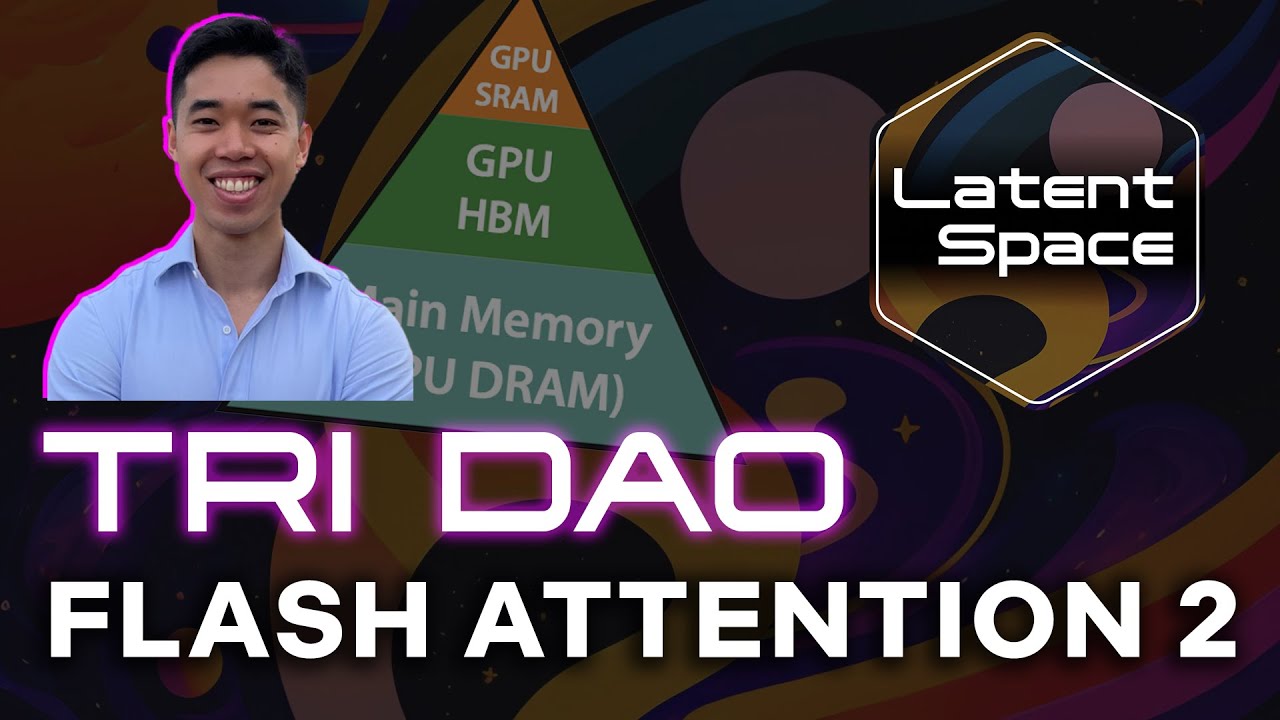
FlashAttention-2: Making Transformers 800% faster AND exact
Aug 3, 2023 · 1:04:06
Tri Dao, creator of FlashAttention and FlashAttention-2, explains how his I/O-aware algorithm makes attention 2x faster by fusing kernels and using online softmax, achieving near-matrix-multiply efficiency. He argues that transformer alternatives like state space models and RNNs (e.g., RWKV) could surpass transformers for long sequences and high-throughput generation, though attention still dominates. Dao discusses the hardware lottery, where NVIDIA's CUDA ecosystem entrenches transformers, and advocates for open-source AI, praising Meta's Llama 2 for shifting enterprise adoption despite its restrictive license. He emphasizes that understanding both algorithms and systems is key to scaling AI, and that academia should pursue risky bets that industry cannot.
Powered by PodHood