
Agent Infrastructure
Episodes from Latent Space about Agent Infrastructure.
32 episodes

The Future of AI Infra: from Kubernetes to Agent Sandboxes — Akshat Bubna, Modal CTO
Jul 8, 2026 · 59:10
Modal CTO Akshat Bubna explains how the cloud platform evolved from a serverless runtime to an AI cloud built for elastic inference, agent sandboxes, and post-training workloads. He argues that Kubernetes was never designed for bursty GPU-heavy AI workloads, so Modal built a decorator-based infrastructure that co-locates compute requirements with code. The company added GPUs a year before ChatGPT and now powers inference for custom models at Suno, Runway, and robotics firms, using GPU snapshotting to slash cold starts. Modal's new Auto Endpoints incorporate open-source DeFlash speculative decoding for frontier-level performance. For reinforcement learning rollouts, Modal provides up to 100,000 sandboxes simultaneously. The platform spans 17 cloud providers, features private IPv6 networking via eBPF, and supports serverless multi-node training with RDMA. Bubna also reveals Modal's shift from developer experience to agent experience, noting that agents benefit from the same minimalist SDK and observability tools that humans use.
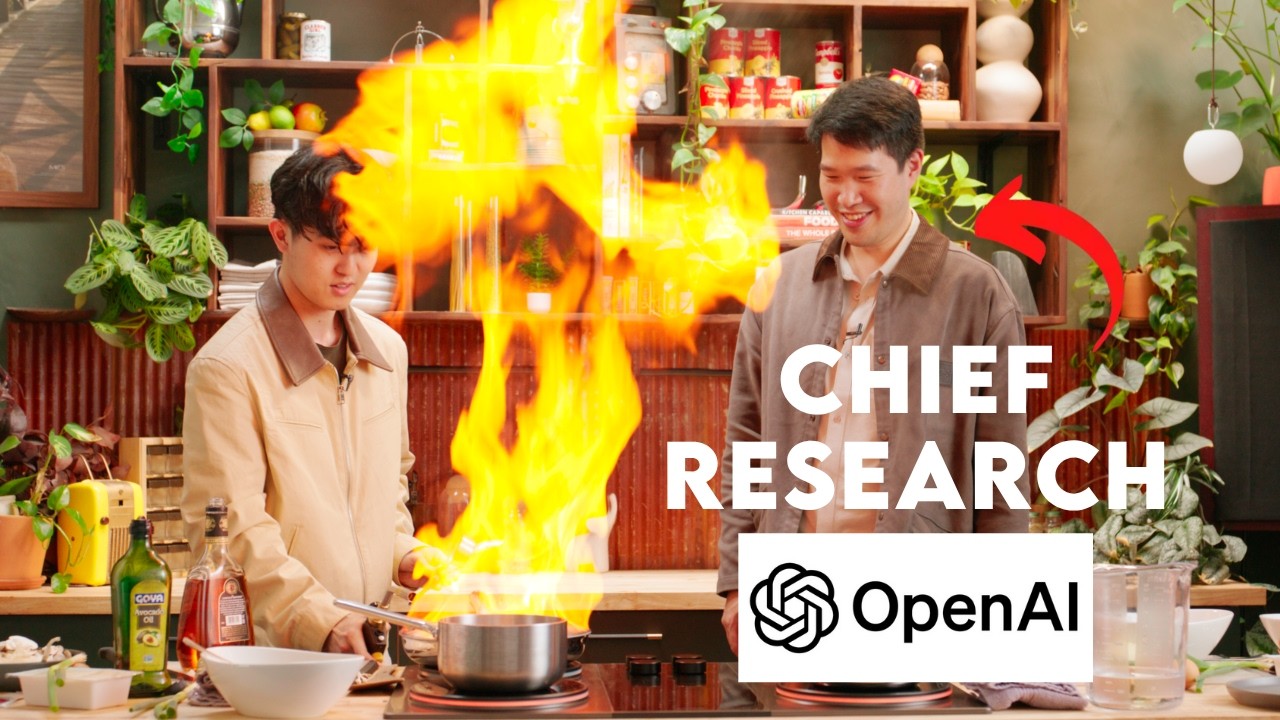
Cooking with OpenAI’s Research Chief: AGI, o1, Evals, and Scaling Laws — Mark Chen
Jun 25, 2026 · 41:18
Mark Chen, OpenAI's Chief Research Officer, defends scaling laws and pre-training as far from dead, arguing that reasoning (the bet behind o1) remains underrated and that the field faces an evals crisis requiring fresh benchmarks. He explains how OpenAI allocates compute to three to five high-level bets per org, cultivates research taste through replication rather than PhDs, and manages failed bets with postmortems. Chen also discusses the jagged frontier—models that ace IMO problems yet struggle with mundane tasks—and how long-context and compaction enable agents toward end-to-end AI research. Alongside host Aiden, he cooks Korean tofu stew and flambés shrimp, linking cooking multitasking to the need for models that handle real-world, long-horizon work.

⚡️Making DeepSeek v4 outperform Opus 4.7 with Taste — @AhmadAwais , CommandCode.ai
Jun 6, 2026 · 40:41
Ahmad Awais, CEO of CommandCodeAI, explains how his team's 'tool-input repair layer' lets open models like DeepSeek V4 Pro outperform premium models like Opus 4.7 in tool-calling reliability. He discovered a pattern of 'tool confusion' where open models repeatedly send wrong schemas; by repairing errors deterministically and sending repair hints instead of raw errors, tool call failures dropped dramatically. The same repair logic fixes 'design slop' using a compositional framework of patterns and OKLCH color system. Taste, a meta-neurosymbolic system, automatically learns developer preferences into portable markdown files, avoiding stale rules. Plans include open-sourcing CommandCode to make it hackable while focusing on quality models.

Devin’s 80% Moment: Background Agents, 7x PRs, & End of Hand-Held Coding — Walden Yan & Cole Murray
May 28, 2026 · 1:09:33
Walden Yan (Cognition CPO) and Cole Murray (creator of OpenInspect) argue that background agents are becoming critical infrastructure as Devin's merged PRs grew 7x and its share of commits jumped from 16% to 80%. They explain why architecture matters, particularly the decision to separate the agent's brain from the machine (harness out of the box) for security and permissions, and why full VMs beat Docker for running real applications. Testing, they stress, is a harder problem than computer use—requiring orchestration of services, feature flags, and multi-model coordination. Memory remains unsolved, with Devin using auto-generated 'Knowledge' and exploring file-system-like approaches. Both caution against uncontrolled vibe coding, which regresses codebases to the worst engineer's style, and advocate for hybrid frontier/sub-frontier systems to balance cost and capability.
⚡️ How to turn Documents into Knowledge: Graphs in Modern AI — Emil Eifrem, CEO Neo4J
Apr 18, 2026 · 48:53
Emil Eifrem, CEO of Neo4j, joins host Shawn Wang to argue that AI systems need more than top-K chunk retrieval—they require graph-shaped context for accuracy, explainability, and developer productivity. GraphRAG combines vector search with graph traversal, starting semantically then expanding through relationships, which he says yields higher accuracy and auditability than opaque vector spaces. Neo4j now powers production AI at companies like Pfizer (over 60 million documents), Novo Nordisk, and 20 of North America’s 20 largest banks, with a mortgage lender seeing a 20% conversion lift. Eifrem describes four data sources for agentic systems: operational databases, cloud warehouses, agentic memory, and context graphs—the latter encoding institutional decision traces. He notes a recent shift where enterprises lead with generic text-to-Cypher instead of specialized functions, and highlights Neo4j's new `create-context-graph` starter kit for 22 industries, built to bootstrap context graphs and agent memory.
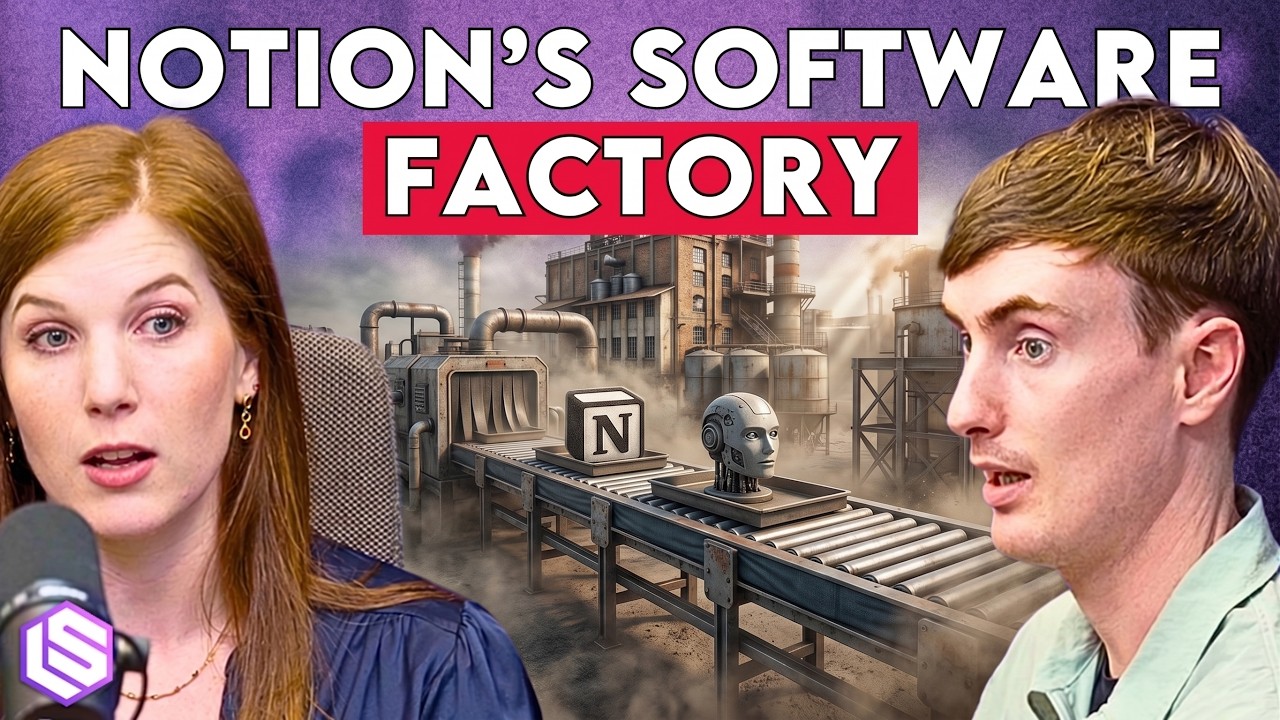
Notion’s Sarah Sachs & Simon Last on Custom Agents, Evals, and the Future of Work
Apr 15, 2026 · 1:25:37
Sarah Sachs and Simon Last of Notion explain how Custom Agents were rebuilt four to five times since 2022, with early attempts failing due to lack of tool-calling standards and short context windows. They shifted from few-shot prompting to tool definitions and progressive disclosure, now supporting over 100 tools. Their eval system includes frontier evals that pass only 30% to gauge model progress, and they employ Model Behavior Engineers to write evals and triage failures. The episode covers their views on MCP versus CLI, meeting notes as data capture, and the software factory concept of agents collaborating to develop codebases. They also discuss Notion's culture of low-ego, high-velocity rebuilding and the philosophy that every surface must work for both humans and agents.
Extreme Harness Engineering: 1M LOC, 1B toks/day, 0% human code or review — Ryan Lopopolo, OpenAI
Apr 7, 2026 · 1:17:54
Ryan Lopopolo of OpenAI's Frontier team details his team's extreme experiment in harness engineering: building a 1M LOC internal Electron app with zero human-written or reviewed code, relying instead on Codex agents that process 1B tokens daily ($2-3k/day). He argues that humans are the bottleneck and that teams should encode non-functional requirements into specs, skills, and observability tooling rather than prompting agents to 'try harder.' The result is Symphony, a ghost library spec and Elixir reference implementation that automates the entire pull-request lifecycle, including self-review and merge. Lopopolo explains how the team scales by treating software as agent-legible text, using worktrees for multi-agent collaboration, and feeding agent mistakes back into the repository via docs like core-beliefs.md. He also discusses Frontier's enterprise platform for safe agent deployment, noting that success depends on giving agents full context—even company culture and inside jokes—so they can act as full teammates.

Anthropic’s Felix Rieseberg on AI Coworkers, Local-First Agents, and the Future of Knowledge Work
Mar 17, 2026 · 1:27:34
Anthropic's Felix Rieseberg explains how Claude Cowork—a VM-based, user-friendly version of Claude Code—was built from pre-existing prototypes in ten days, and why putting AI 'where you work' on the local machine is more powerful than cloud-only approaches. He argues that Silicon Valley undervalues the local computer, comparing it to how we all use MacBooks instead of iPads. The VM gives Claude its own computer, enabling it to install tools and run scripts without constant approval, serving as both a safety boundary and a capability unlock. Rieseberg contrasts Cowork's evaluation on knowledge work tasks (e.g., mortgage management, tax filing) with Claude Code's coding evals, and explains the shift from MCPs to file-based skills—markdown files that tell the model what to do. Real use cases include organizing desktops, uploading videos, and filing taxes. He also expresses concern about the impact on junior employees and hints at future work on autonomy, multiplayer coordination, and portability.

⚡️Monty: the ultrafast Python interpreter by Agents for Agents — Samuel Colvin, Pydantic
Mar 14, 2026 · 34:02
Samuel Colvin joins Shawn Wang to introduce Monty, Pydantic's ultrafast Python interpreter built with AI for agents, positioning it as a lightweight, secure alternative to sandboxes for code execution. Monty runs inside the same process, achieving sub-microsecond latency (800 nanoseconds in a hot loop), versus over a second for cloud sandboxes. Colvin explains the inspiration came from conversations at Anthropic about type safety's critical role in AI tool calling, and how Monty fills the gap between simple tool calling and full sandboxes. Monty is not full CPython—it lacks third-party library support and some standard library modules—but covers essential built-ins, implemented largely by LLMs that Colvin calls 100x faster for tasks where internal and external APIs are well-known, unit tests are trivial, and there's no API bikeshedding. He demonstrates a Pydantic AI agent using Monty to scrape LLM pricing from websites, with type checking built into the runtime so only permitted host functions (e.g., Playwright, Beautiful Soup wrappers) can be called. Colvin also shares his workflow using Claude Code, Codex, and Gemini CLI in combination for code review and implementation, and…

Retrieval After RAG: Hybrid Search, Agents, and Database Design — Simon Eskildsen of Turbopuffer
Mar 12, 2026 · 1:00:32
Simon Eskildsen, founder of Turbopuffer, explains how his obsession with the cost of vector search at Readwise led him to build a search engine on object storage and NVMe SSDs, cutting costs by 95% for customers like Cursor. He outlines the three conditions for a major database company—a new workload (AI-driven search), a new architecture (object storage first, no consensus layer), and evolving to support every query plan. Turbopuffer's architecture uses S3's strong consistency and compare-and-swap for metadata, avoiding stateful systems. Eskildsen shares how they won Notion by absorbing latency issues with dark fiber, and discusses the shift from single RAG queries to agents making many concurrent searches. He also describes the "P99 engineer"—obsessive, trade-off minded, able to bend software to first principles. Future plans include expanding full-text search, reaching Common Crawl scale, and eventually adding simpler OLAP queries.

⚡️ OpenClaw's Memory Sucks and the fix is simple — Dhravya Shah, Supermemory
Mar 9, 2026 · 27:10
Supermemory founder Dhravya Shah argues that current memory approaches like OpenClaw's static markdown files fail because they lack freshness and agent-driven retrieval, proposing a hooks-based system that dynamically injects less than 2,000 tokens per turn. His company Supermemory uses a hybrid mode combining structured memory with RAG fallbacks, achieving costs as low as 2 cents per million tokens. Shah critiques benchmarks like LongMemEval and LoCoMo for not testing personalization or forgetfulness, and his team built the open platform MemoryBench for evaluation. Future plans include plugins for Cursor and partnerships with voice agent companies, aiming for prosumer interoperability across AI providers.

Agent Inference at the "Speed of Light" — How NVIDIA moves like a $4.3 Trillion Startup
Mar 8, 2026 · 1:26:00
NVIDIA's Nader Khalil and Kyle Kranen join Swyx and Vibhu to explain how the company moves like a $4.3 trillion startup through speed-of-light (SOL) first-principles thinking, agent security boundaries, and the Dynamo inference engine. They argue agents should only do two of three things (files, internet, code) to prevent vulnerabilities, and detail Brev's acquisition to improve developer UX with one-click GPU access and DGX Spark integration. Kyle describes Dynamo as a data center scale inference engine that optimizes serving by scaling out, using prefill/decode disaggregation, Kubernetes-based scheduling, and model-hardware co-design to improve cost, latency, and quality. The episode covers SOL's role in creating urgency, long-context limits and potential 'unhobblers' like multi-head latent attention, and the shift toward CLI-first agent workflows for enterprise tools.
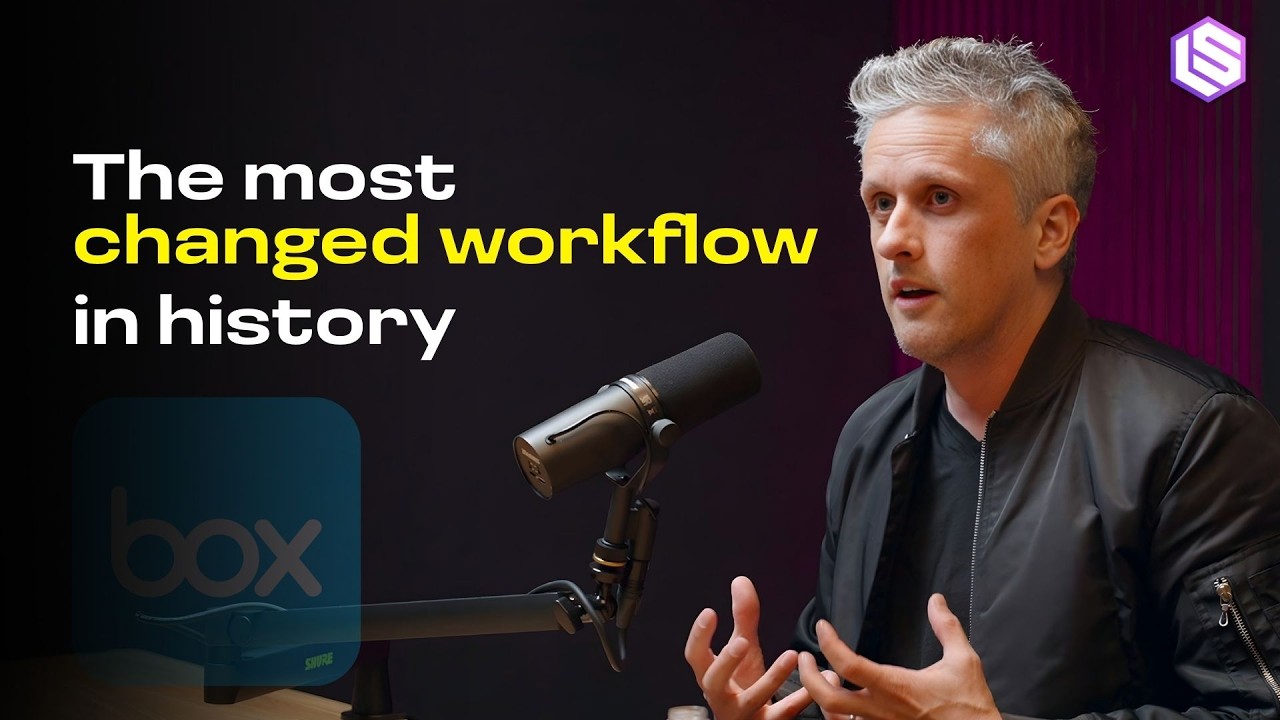
Why Every Agent Needs a Box — Aaron Levie, Box
Mar 5, 2026 · 1:16:58
Aaron Levie, CEO of Box, argues that every AI agent needs a dedicated data repository—a 'box'—to effectively access enterprise content, and that deploying autonomous agents at scale requires new infrastructure for governance, identity, and security. He contrasts the rapid adoption of coding agents, which benefit from full codebase access and technical users, with the slower enterprise rollout where access controls, messy data, and context engineering pose major hurdles. Levie details Box's internal evals showing 15-point jumps in model performance and emphasizes the need for agents to judge when to stop searching. He discusses moving from read-only to read-write agent workflows, the challenge of keeping documentation current, and his hands-on founder approach to steering a 3,000-person public company through the AI transformation.

[State of Context Engineering] Agentic RAG, Context Rot, MCP, Subagents — Nina Lopatina, Contextual
Dec 31, 2025 · 26:48
Nina Lopatina of Contextual AI discusses the state of context engineering, arguing that while the field is still in prototyping, 2025 will see true scale with full-system design patterns. She notes that agentic RAG—especially query reformulation into subqueries—has become the baseline, dramatically improving retrieval. Context rot is widely cited but industry benchmarks at real scale (100k+ documents, billions of tokens) remain rare. MCP is both a driver and a flaw: giant JSON tool definitions stuff the context window, yet MCP servers enable rapid prototyping before optimizing down to direct API calls. Sub-agents with turn limits are critical—unlimited agency degrades performance and causes hallucinations. Instruction-following re-rankers are essential for scaling retrieval across massive databases, providing more recall upfront and precision in the final context. Benchmarks are being saturated faster than ever: a Princeton benchmark from October was saturated by Claude Code in weeks, with solutions so good the gold dataset had errors. Lopatina also shares a lesson from using ChatGPT as a snowboarding coach—after several months of training for a 25-lap mogul race, she had to close…

The Future of Email: Superhuman CTO on Your Inbox As the Real AI Agent (Not ChatGPT) — Loïc Houssier
Dec 11, 2025 · 1:11:02
Loïc Houssier, CTO of Superhuman Mail (recently acquired by Grammarly), joins hosts Alessio and Swyx to detail how Superhuman builds AI into email without adding latency. He explains their agentic framework of small tools vs. a single agent, the fight against “agent laziness,” and their eval process anchored by Rahul’s infamous “what wood was my table?” test. Houssier reveals Superhuman uses local-first caching and Baseten’s box pricing for cost control, stores embeddings in TurboPuffer, and has only three engineers on AI—yet PR throughput rose from four to six per engineer per week. He argues the inbox will power your future AI executive assistant, and that AI will widen the gap between engineers with real fundamentals and those faking it.

⚡ Inside Google Labs: Building The Gemini Coding Agent — Jed Borovik, Jules + AIE CODE Preview
Nov 10, 2025 · 43:53
Jed Borovik, Product Lead at Google Labs, explains how Google builds Jules, an autonomous coding agent that runs on its own VM for long-running tasks, challenging the assumption that agents should operate locally. He reveals that as Gemini models improved, Jules' scaffolding simplified, shifting from sub-agent patterns and embedding-based RAG to attention-based search. Borovik discusses context window management for sessions lasting up to 30 days with 2 million tokens, and argues that coding agents will increase demand for software engineers (Jevons paradox), not eliminate jobs. He calls for better specification tools beyond chat, such as multimodal input and interactive planning, to move beyond 'vibe coding' toward verifiable, reliable agentic workflows.
Terminal-Bench 2.0: the most impt coding agent benchmark of 2025 gets a v2! Launch + Q&A w/ founders
Nov 8, 2025 · 35:01
Terminal-Bench co-creators Mike Merrill, Alex Shaw, and collaborators Andy Konwinski, Ludwig Schmidt, and Aatash launch Terminal-Bench 2.0, an 89-task coding benchmark with rigorous human and LM-assisted verification to test agent performance on real-world tasks like designing DNA primers and installing Windows 3.11. They reflect on Terminal-Bench 1's problems—easy tasks and reproducibility—and detail spending 300 hours manually auditing each task. They introduce Harbor, an open-source package for running sandboxed agent rollouts, standardizing task format and integrating with agents like Codex and Claude Code. Aatash shows using Harbor to generate thousands of training traces for DataComp Agent, running 1,000 parallel sandboxes. Future plans include expanding to scientific computing.

The Agents Economy Backbone - with Emily Glassberg Sands, Head of Data & AI at Stripe
Oct 30, 2025 · 1:37:13
Emily Glassberg Sands, Head of Data & AI at Stripe, explains how Stripe builds economic infrastructure for AI, processing 1.4% of global GDP. Stripe's domain-specific foundation model runs inline on the charge path, detecting card-testing attacks on large users with detection rates improving from 59% to 97%. The Agentic Commerce Protocol (ACP) with OpenAI creates a shared standard for businesses to expose products to AI agents, adopted by Walmart and Sam's Club. Stripe helps AI companies combat new fraud vectors like free trial and refund abuse, and launched token billing to let wrappers price based on real-time inference costs. Internally, 85% of Stripes use LLM tools daily, with code generation and merchant understanding as key use cases. Emily argues AI companies grow 2-3x faster than SaaS, are twice as global, and that agentic commerce will expand consumption by removing time constraints for high-income consumers.

⚡️Traversal: Causal ML and Reinforcement Learning
Oct 5, 2025 · 45:06
Anish and Raaz, co-founders of Traversal, explain how their agentic architecture combines causal machine learning and LLMs to turn incident troubleshooting from a massive search problem into an intelligent, context-driven process. Both have PhDs in causal ML and RL from MIT and Berkeley, and they applied that expertise to root cause analysis in complex enterprise systems with petabytes of fragmented data across logs, metrics, traces, and Slack. Their system dynamically combines statistical tests (for time-series) with semantic understanding (via LLMs) to winnow billions of signals to root cause candidates in under two minutes. They note that reasoning models like o3 are critical for complex incidents, while Claude is better for tool calling and unsticking. Traversal uses a mix of infrastructure size and investigation count for pricing, and sees self-healing as a continuum: 10–20% of issues can be autonomously resolved now, with 30–40% requiring senior engineer sanity-check within 6–12 months. They are hiring in New York and emphasize that building proprietary evals is core IP, making public benchmarks a tension.
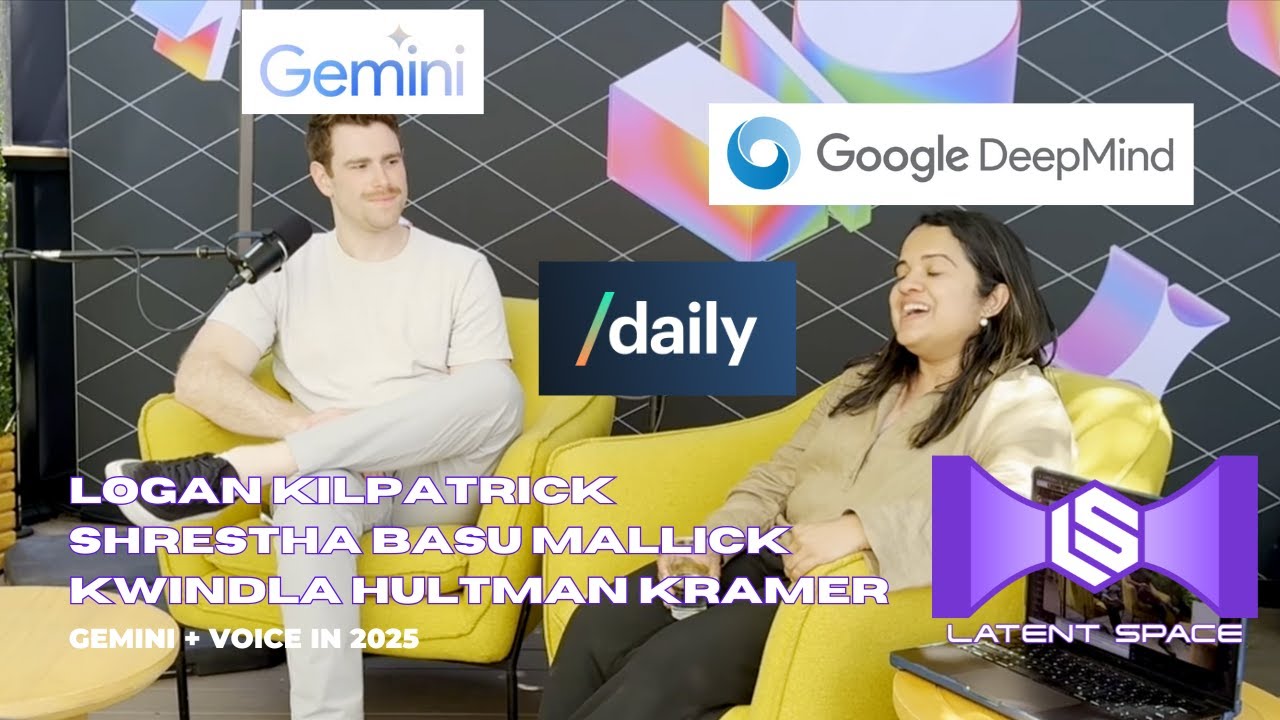
[AIEWF Preview] Gemini in 2025 and Realtime Voice AI
Jun 2, 2025 · 24:29
At Google I/O 2025, Latent Space host Swyx and TWiML's Sam Charrington speak with Logan Kilpatrick, Shrestha Basu Mallick, and Kwindla Hultman Kramer about Gemini's reasoning upgrades, real-time voice AI, and the infrastructure challenges of building production voice agents. Kilpatrick announces thinking budgets and thought summaries for 2.5 Pro, now live in Flash and coming to Pro in June, while Mallick highlights native audio output with multilingual code-switching and proactive voice activity detection. Kramer discusses the need for sub-500ms latency and WebRTC packet routing, and the team debates single-model vs. componentized architectures, with Mallick noting that eventual convergence will bring capabilities like diffusion-based generative UI into the main Gemini model. The episode also covers implicit context caching, URL context for research agents, and the Live API's session length and function calling improvements.
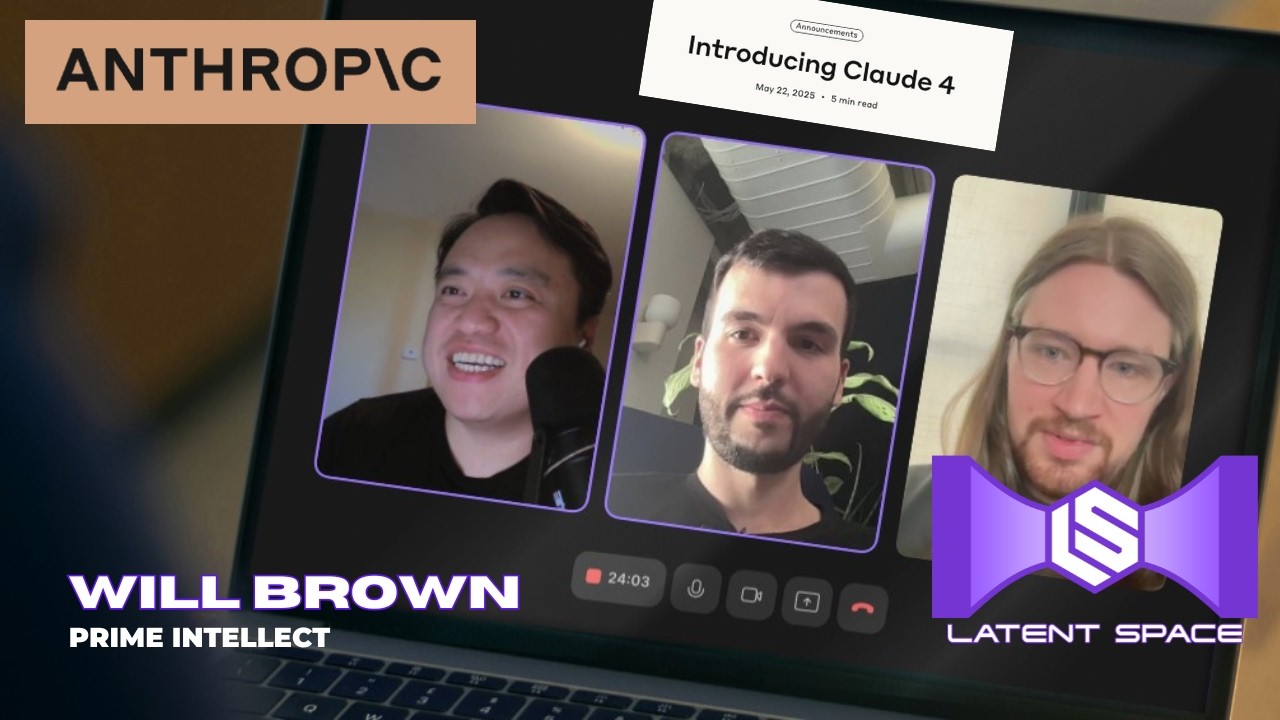
⚡️Multi-Turn RL for Multi-Hour Agents — with Will Brown, Prime Intellect
May 23, 2025 · 38:59
This episode features Will Brown of Prime Intellect discussing Claude 4's emphasis on agentic tool use over pure reasoning, the controversy around Claude's safety stress-testing results (including alleged dark web uranium searches), and his team's paper on multi-turn reinforcement learning for LLM agents. Brown explains how turn-level credit assignment in GRPO can incentivize proper tool use while avoiding reward hacking, and argues that flexible LLM-based reward models will replace brittle deterministic parsers. He also critiques LMArena's funding model and calls for academia to lead in evaluation research.

The Creators of Model Context Protocol
Apr 3, 2025 · 1:20:21
Justin Spahr-Summers and David Soria Parra, co-creators of Anthropic's Model Context Protocol (MCP), explain its origin as a solution to the M×N integration problem they experienced when copying data between Claude Desktop and IDEs. They detail MCP's design inspirations from LSP, its three core primitives (tools for model-driven actions, resources for app-controlled data, and prompts for user-initiated macros), and why they chose JSON-RPC with stateful connections. The episode contrasts MCP with OpenAPI, discusses client control and trust in servers, and outlines the future roadmap including a streamable HTTP transport and remote-server authorization via OAuth 2.1. The guests express a wish for more sampling clients and full spec support, and emphasize that MCP is an open, multi-company project with community commit access.

How Claude Plays Pokémon was made
Mar 4, 2025 · 37:38
David Hershey of Anthropic explains how he built Claude Plays Pokémon, an agent that uses Claude to play Pokémon Red, revealing both surprising capabilities and stark limitations of AI. He describes the simple tool-using agent loop: Claude sends button presses, receives screenshots and RAM state, and maintains a knowledge base and 30-message conversation history with summarization. Key challenges include Claude's poor spatial awareness—it famously walked up and down outside Oak's lab 12 times—and its tendency to hallucinate game knowledge. Hershey notes that newer models (Sonnet 3.7) required stripping away band-aid prompts, as simpler instructions yielded better performance. The project also showed emergent behaviors: nicknamed Pokémon made Claude more protective, and the model even wrote meta-commentary about its own mistakes in its knowledge base. While the current run is stuck in Mount Moon after 52 hours, the biggest hurdles remain vision and navigation, not prompting tricks.

Browserbase: Browser Infrastructure For Your AI Agents
Feb 28, 2025 · 1:01:33
Paul Klein IV, CEO of Browserbase, argues that headless browser infrastructure is a critical primitive for AI agents to automate the web. Browserbase solves the hard problem of running thousands of browsers in the cloud—too big for Lambda, requiring Firecracker microVMs—and exposes APIs via its open-source framework Stagehand (act, extract, observe). It handles proxies, CAPTCHA solving, and offers a live view iframe for human-in-the-loop control. Primary use cases include browser automation and web scraping as a heavy-hitter renderer when simpler methods fail. Paul explains his choice to go solo founder and how Browserbase's in-person, 10–5 culture enables fast execution. He predicts the future of software will involve software acting on other software via browsers.
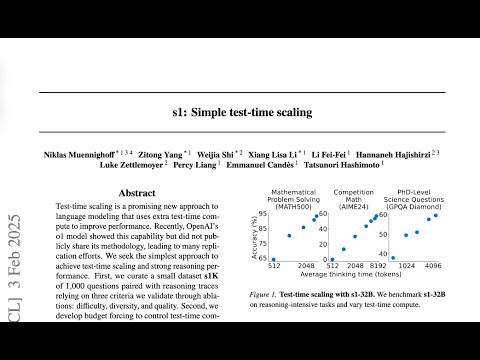
S1: the $6 DeepSeek R1 Competitor (ft. Entropix)
Feb 26, 2025 · 17:43
Tim Kellogg joins hosts Alessio and Swyx to break down his viral blog post on S1, showing how Stanford researchers cloned DeepSeek R1's reasoning for $6 by inserting a 'think token' and fine-tuning on just 1,000 examples. Kellogg argues the real innovation isn't the cost but the technique's simplicity—making advanced inference-time scaling accessible. He explains Entropix, a dynamic sampler that uses model entropy and varentropy to adjust generation on the fly, and notes its creators are starting a company. The conversation contrasts supervised fine-tuning's targeted results with RL's broader reasoning growth, using an analogy: 'RL causes a lot of growth, then SFT trims it.' Kellogg predicts that embedding introspection signals into RL training could solve agent 'doom loops' and unlock higher agency—a key challenge behind products like OpenAI's Deep Research.

Why is everyone cloning Deep Research?
Feb 18, 2025 · 1:00:10
In this episode, hosts Alessio and Swyx interview Aarush Selvan and Mukund Sridhar, the lead PM and tech lead for Gemini Deep Research, about how Google created the deep research agent category and the technical decisions behind it. They finetuned a special version of Gemini 1.5 Pro for the feature, which autonomously browses the web for about five minutes to produce a research report. The team built an asynchronous platform to handle long-running tasks and developed an ontology of research behaviors—from broad shallow exploration to deep focus—to evaluate performance. They found that users value the visible browsing process even when it takes minutes, contrary to typical latency norms. The discussion covers iterative planning, trade-offs between model memory and web grounding, and future directions including thinking models, multimodality, and personalization.
Bee AI: The Wearable Ambient Agent
Feb 17, 2025 · 1:07:40
Bee AI's Maria and Ethan explain their wearable ambient agent, arguing that personal AI with continuous context is the future, and detail its $49.99 hardware, 7-day battery, and free inference. They trace their origin from a 2016 personal AI startup to Squad (sold to Twitter) and then to Bee, emphasizing that hardware was necessary because app friction (e.g., remembering to open it) killed the ambient experience. Privacy is addressed by not storing audio, only summaries, and offering geofencing and concept fencing to block sensitive topics. The software pipeline uses voice activity detection to reduce compute, speaker identification, and custom small models for memory retrieval instead of traditional RAG or knowledge graphs. Social features are in beta, with agent-to-agent negotiation—e.g., both agents coordinating a dinner reservation based on preferences and calendars. They are hiring AI engineers and see always-on AI as inevitable.
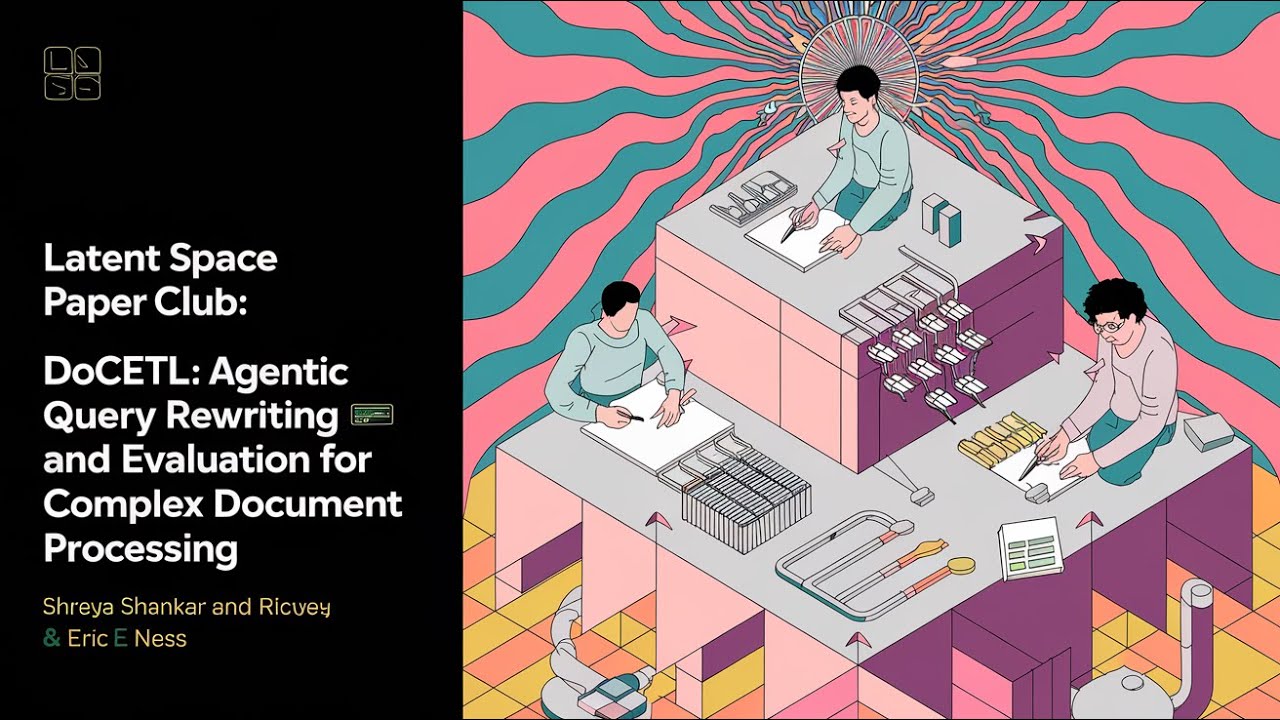
[Paper Club] DocETL: Agentic Query Rewriting + Eval for Complex Document Processing w Shreya Shankar
Nov 29, 2024 · 55:53
This episode of Latent Space Paper Club discusses DocETL, a framework by Shreya Shankar for agentic query rewriting and evaluation in complex document processing with LLMs. The paper introduces map, reduce, resolve, and auxiliary operators, along with rewrite directives like data decomposition and gleaning to improve accuracy. The optimizer generates 200 pipeline variants, costing $100, to rewrite user pipelines automatically. Key debates include when to chunk documents (sometimes harmful) and the reliability of LLM-as-judge for evaluation, with guests Eugene Yen and Vibhu arguing that binary metrics, ensembling, and context-dependent thresholds make it viable. Shreya emphasizes that validation agents are critical, and the work builds on her prior EvalGen paper, spanning two years of development.

High Agency Pydantic over VC Backed Frameworks — with Jason Liu of Instructor
Apr 24, 2024 · 1:02:59
Jason Liu, creator of the Instructor library, explains why structured outputs from LLMs are best handled by a simple requests-like wrapper rather than a VC-backed framework, arguing that Pydantic-defined schemas via function calling outperform JSON Mode for typed responses. He details his journey from being bearish on LLMs at StitchFix to building Instructor on a bullet train to Japan after GPT-3 proved him wrong. Liu advocates for workflow-based DAGs over reactive agent loops, recommends using rankers rather than cramming 60+ tools into an API call, and credits high agency—trying many experiments and documenting conditions for revisiting failures—as key to his success. He also critiques the MLE hiring hype, urging startups to empower motivated AI engineers instead.

Supervise the Process of AI Research — with Jungwon Byun and Andreas Stuhlmüller of Elicit
Apr 11, 2024 · 1:05:28
Andreas Stuhlmüller and Jungwon Byun, co-founders of Elicit (formerly the nonprofit Ought), have built an AI research assistant that automates literature review and reasoning by breaking complex tasks into transparent, step-by-step processes. Their philosophy—"supervise the process, not just the outcome"—led them to start with human simulations before GPT-3 enabled a product pivot. Elicit now uses both open-source and closed models (e.g., GPT-4, Claude Haiku) for summarization, data extraction, and uncertainty flags, and recently launched computational notebooks for scalable, reusable workflows. The company transitioned from nonprofit to a Public Benefit Corporation, reached $1M revenue in four months, and now employs 12 people, focusing on senior software engineers to build reliable orchestration from unreliable components.

Personal AI Meetup - Bee, BasedHardware, LangChain LangFriend, Deepgram EmilyAI
Apr 6, 2024 · 58:54
This episode features Damien Murphy of Deepgram, Ethan of Owl/Bee, and Harrison of LangChain demonstrating how to build personal AI with real-time voice bots, wearable life-recording devices, and memory-enhanced journaling apps. Damien shows building a voice bot with subsecond latency using Deepgram, OpenAI, and open source code, costing about 6.5 cents per five-minute call. Ethan presents his Owl wearable that continuously records audio, triggers actions via hot word 'Scarlett,' and discusses challenges in adding vision and open source adoption. Harrison introduces LangFriend, a journaling app using conversational, semantic, and knowledge graph memory, referencing the Generative Agents paper for recency and importance weighting. The episode also highlights open source projects Whomane, Friend, and ADeus, arguing that hardware, voice, and memory are all necessary components for personal AI.

The "Normsky" architecture for AI coding agents — with Beyang Liu + Steve Yegge of SourceGraph
Dec 17, 2023 · 1:33:26
Beyang Liu and Steve Yegge of Sourcegraph explain how their AI coding assistant Cody achieves a 30% completion acceptance rate by prioritizing high-quality context over agents. They introduce the 'Normsky' architecture—a blend of Norvig's data-driven models and Chomsky's formal systems—arguing that non-agentic, deterministic context retrieval (using parsers, trigram indexes, and the BFG code graph) outperforms multi-hop LLM-based approaches for code completion and chat. The duo details their data pre-processing moat, the 'bin packing' challenge of stuffing relevant code into context windows, and why they use open-source StarCoder for completions while leveraging Claude/GPT-4 for chat. They also discuss the death of DSLs, the limitations of LSP and LSIF, and how Cody's web version lets users query any public repo instantly.
Powered by PodHood