
VS Code
ProductA product discussed on Latent Space.
21 episodes
Cursor's Third Era: Cloud Agents — ft. Sam Whitmore, Jonas Nelle, Cursor
Mar 6, 2026 · 1:11:18
Cursor's Sam Whitmore and Jonas Nelle detail their Cloud Agents launch, where agents get full cloud VMs to onboard repos, run code, and test changes end-to-end before returning PRs with demo videos and remote desktop access. The model decides whether to test (with /no-test to skip and /repro for bug reproduction videos). Videos cut review time by letting humans watch 20-second clips instead of giant diffs. Cursor supports parallel model swarms via best-of-N—running multiple models head-to-head on the same prompt—and subagents for context management, plus a long-running 'grind mode' for multi-day tasks. They predict cloud agents will surpass local agents in volume by year-end, driving per-developer spend to thousands per month and creating new bottlenecks in CI/CD and production pipelines.

One Year of MCP — with David Soria Parria and AAIF leads from OpenAI, Goose, Linux Foundation
Dec 28, 2025 · 1:39:19
David Soria Parra, MCP lead at Anthropic, along with Jim Zemlin (Linux Foundation CEO), Nick Cooper (OpenAI), and Brad Howes (Block/Goose), recount the one-year evolution of the Model Context Protocol from a local experiment to the de facto standard for agentic systems, now donated to the new Agentic AI Foundation. They detail four spec releases—from local stdio to remote HTTP streaming, OAuth 2.1 authentication (and enterprise lessons learned), long-running tasks, and MCP Apps (iframes for richer UI)—and explain why internal enterprise adoption is exploding faster than expected, mostly invisible and at massive scale. The group reveals how three competitive AI labs came together to donate protocols and agents to a neutral foundation, how the foundation will balance taste-making (curating meaningful projects) with openness, and their 2025 vision: MCP as the communication layer for asynchronous, long-running agents that discover and install their own tools, unlocking another order of magnitude in AI productivity.
⚡️GPT5-Codex-Max: Training Agents with Personality, Tools & Trust — Brian Fioca + Bill Chen, OpenAI
Dec 26, 2025 · 27:46
OpenAI’s Brian Fioca and Bill Chen discuss the launch of Codex Max, a long-running coding agent designed to work 24+ hours, manage its own context, and spawn sub-agents. They reveal how GPT-5 training prioritized personality traits—communication, planning, and self-checking—to build developer trust, and how Codex develops tool habits like preferring 'rg' over 'grep'. The abstraction layer is shifting from models to full-stack agents, enabling partners to plug Codex into tools like VS Code or Zed. They highlight applied evals that measure real-world impact over academic benchmarks, and the need for multi-turn eval APIs. Their 2026 vision: coding agents trusted enough to handle the hardest refactors at any company, not just top-tier firms, and general enough to automate personal workflows like organizing desktops or email.
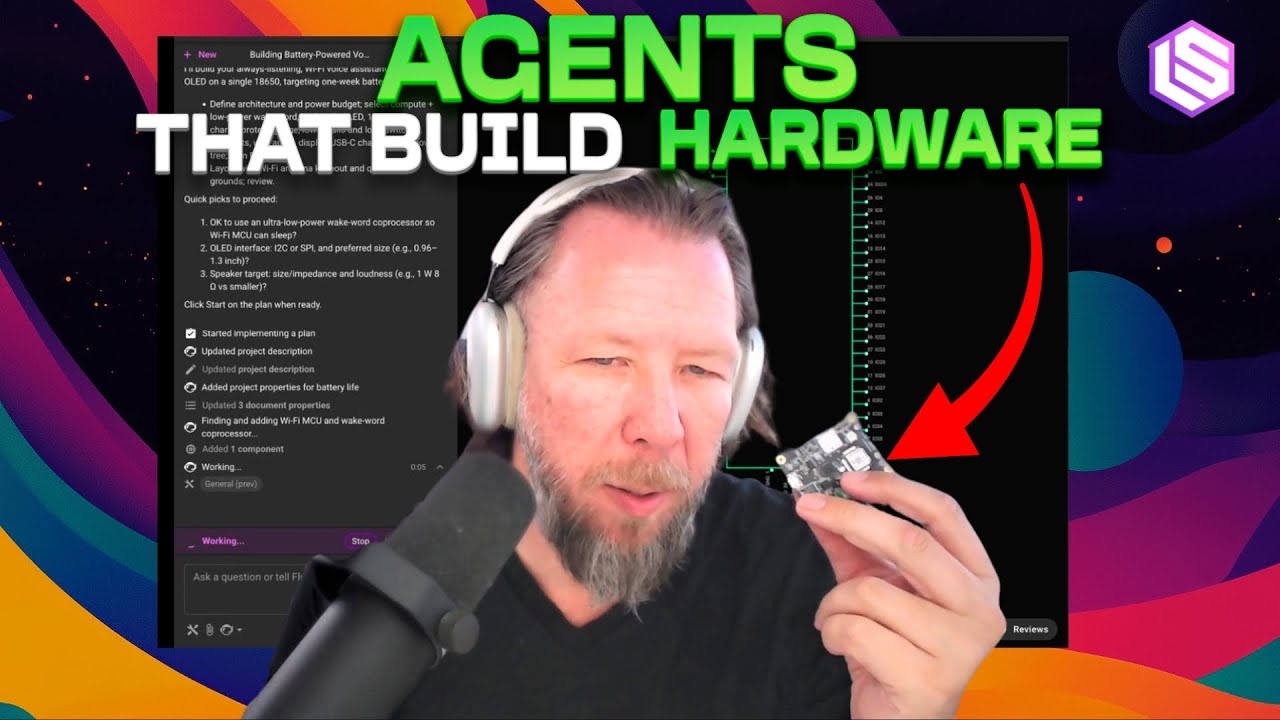
⚡️ Building the AI Hardware Engineer with Matthias Wagner, Co-founder of Flux
Nov 22, 2025 · 49:03
Matthias Wagner, CEO of Flux.ai, describes building the "AI hardware engineer" that turns product briefs into manufacturable PCB designs in under 30 minutes. After leaving Meta in 2019, Wagner built a browser-based collaborative CAD tool from scratch, designed as a reinforcement learning environment. The emergence of LLMs and reliable tool calling let Flux's agents search component libraries, check pricing and availability, and execute complex designs autonomously. In a live demo, Wagner designs a battery-powered Alexa-like device with ESP32, microphones, OLED display, and speaker in about 25 minutes. Flux now has 7,000 paying customers, growing 26x year over year, and Wagner envisions eventually letting users prompt full hardware products like smartphones into existence, claiming the cost of custom manufacturing is plummeting.

⚡ Inside GitHub’s AI Revolution: Jared Palmer Reveals Agent HQ & The Future of Coding Agents
Nov 10, 2025 · 35:52
Jared Palmer, SVP at GitHub and VP at CoreAI at Microsoft, traces his journey from building v0 at Vercel—a focused Next.js coding agent that grew from $1M ARR to millions more after adding chat—to launching Agent HQ at GitHub Universe, a collaboration hub for developers and coding agents. He explains how v0's success came from laser-focus on one stack and framework, and how GitHub's 180M developers enable scaling agent-based workflows. Palmer discusses model strategy tradeoffs (composite vs. branded models), the challenge of repo setup and infrastructure reliability, and using coding agents for non-coding tasks like automating Excel workflows. He reveals Stacked Diffs as GitHub's top feature request, with active exploration after previous attempts, and outlines his vision for seamless AI integration across GitHub, VS Code, and Actions, including features like resolving merge conflicts with AI.

⚡ Inside Google Labs: Building The Gemini Coding Agent — Jed Borovik, Jules + AIE CODE Preview
Nov 10, 2025 · 43:53
Jed Borovik, Product Lead at Google Labs, explains how Google builds Jules, an autonomous coding agent that runs on its own VM for long-running tasks, challenging the assumption that agents should operate locally. He reveals that as Gemini models improved, Jules' scaffolding simplified, shifting from sub-agent patterns and embedding-based RAG to attention-based search. Borovik discusses context window management for sessions lasting up to 30 days with 2 million tokens, and argues that coding agents will increase demand for software engineers (Jevons paradox), not eliminate jobs. He calls for better specification tools beyond chat, such as multimodal input and interactive planning, to move beyond 'vibe coding' toward verifiable, reliable agentic workflows.

Amp: The Emperor Has No Clothes
Sep 25, 2025 · 1:21:59
Quinn Slack (CEO) and Thorsten Ball (Amp Dictator) from Sourcegraph discuss Amp Code, a coding agent that ships 15x/day with no code reviews. They explain the strategic pivot from Cody to Amp, emphasizing that building the best coding agent trumps everything else. The team dogfoods Amp internally, using it to build itself, and maintains both a VS Code extension and CLI, with a 50/50 internal split. They argue that model choice is becoming less important than the harness around the model, and they reject features like prompt enhancers, custom subagents, and MCP servers as not adding value. Common failure modes include outsourcing thinking but not typing and using agents without proper context engineering. They predict async agents running 24/7 will dominate, and they target early adopters willing to adapt their codebases and workflows for maximal agent effectiveness.

⚡️Launching Ona: Coding Agent with Fully Sandboxed Cloud Environment
Sep 1, 2025 · 33:44
Gitpod co-founders Johannes Landgraf and Chris Weichel launch Ona, a coding agent platform with fully sandboxed cloud environments, arguing that the future of development is parallel agent-driven work rather than mono-focused IDEs. They explain their rebrand from Gitpod to Ona, driven by their product outgrowing the technical name. Ona provides reproducible dev environments via dev containers and automations YAML, runs any Linux workload, and by default gives agents full autonomy (Yolo mode) since environments are ephemeral and risk-free. They dogfood heavily—75% of their PRs are co-authored by Ona. Key challenges include file edits (they settled on Anthropic's string replace tool) and underspecification by users. Pricing follows a credit model blending compute and token usage, with enterprise VPC deployment and $100 in credits for new self-serve users. They envision IDEs shifting to interfaces supporting parallel tracks, but currently offer one-click transitions to desktop editors like Cursor.

Long Live Context Engineering - with Jeff Huber of Chroma
Aug 19, 2025 · 57:01
Jeff Huber, founder and CEO of Chroma, joins Shawn Wang and Alessio to argue that context engineering—not RAG—is the real job of AI builders, and that Chroma's modern retrieval engine is built for this new paradigm. Huber explains context rot, a phenomenon where LLMs lose attention and reasoning ability as context windows grow, motivating precise retrieval over huge context windows. Chroma Cloud is a zero-config, usage-based serverless vector database with separation of storage and compute, now powering 5M monthly downloads and 21k GitHub stars. He shares techniques like chunk rewriting and generative benchmarking for evaluating retrieval, and predicts LLMs will increasingly serve as re-rankers. The episode also covers memory as a benefit of context engineering, offline compaction for self-improving AI systems, and Huber's philosophy of building with long-term purpose, hiring engineers who care about Rust, TLA+, and deterministic simulation testing.

🕰️ The Oral History of Windsurf (ft. Varun Mohan, Scott Wu, Jeff Wang, Kevin Hou, Anshul R)
Jul 28, 2025 · 3:53:23
This episode traces the oral history of Windsurf (formerly Codeium and Exafunction) with founders Varun Mohan, Scott Wu, Jeff Wang, Kevin Hou, and Anshul R, charting its evolution from a GPU virtualization startup to a leading agentic IDE and its dramatic acquisition by Cognition. The narrative covers the pivot to code completion in 2022, the shift to a free model to gain traction, and the launch of the Windsurf editor in November 2024 with Cascade, an agent that operates on a shared timeline with the developer. Key principles include meta-learning (auto-generated memories that adapt to each user's preferences) and scaling with intelligence (replacing hard-coded rules with LLM reasoning as models improve). The episode also details the acquisition weekend when Cognition bought Windsurf after Google acquired a stake, highlighting product synergies between the synchronous agent (Windsurf) and async agent (Devin) and the ambition to build a comprehensive platform for real-world software engineering teams.

Cline: The Collaborative AI Coder
Jul 16, 2025 · 1:15:44
Saoud Rizwan and Pash from Cline join to explain why their open-source coding agent uses a Plan + Act paradigm — having models explore and plan before executing — pioneered before competitors like Claude Code. They argue that "RAG is a mind virus" and "Fast Apply got bitter lesson'd" as frontier models now achieve sub-5% diff edit failure rates, making layered workarounds obsolete. Cline's bring-your-own-API-key model avoids inference markups, with enterprise features driven by Fortune 5 companies asking for security and ROI insights. The MCP ecosystem grew via Cline's marketplace (150+ servers, top ones with hundreds of thousands of downloads), though monetization and security remain open questions. They detail how Plan mode extracts user intent and Act mode auto-approves, how context engineering prioritizes agentic file exploration over retrieval, and why they stayed a VS Code extension rather than fork — to focus solely on the agentic loop.

DeepWiki: The GitHub Encyclopedia
May 21, 2025 · 32:05
Silas Alberti from Cognition (Devin) introduces DeepWiki, a free no-login product that indexes over 30,000 open-source repos and generates AI-powered wikis and deep research answers. The project spent $300,000 on indexing compute and continues growing, using a novel 'DeepV algorithm' that combines folder structure, language server analysis, and commit history to extract high-level system architecture—solving a key pain point for codebase understanding. Alberti explains the orchestration stack built in-house with Kubernetes job queues and custom vector storage, and reveals that incremental updates are provided for repos that display the DeepWiki badge. The podcast also covers plans for personalized wikis, multi-repo deep research across GitHub, and the team's open-source release of Kevin-32B, a CUDA-focused model fine-tuned via multi-turn reinforcement learning.

Zed Agents — with Zed Cofounders Nathan Sobo & Antonio Scandurra
May 7, 2025 · 35:50
Zed co-founders Nathan Sobo and Antonio Scandurra explain how their high-performance code editor is launching Zed Agents, aiming to make AI an integrated collaborator rather than just a tool. Built from scratch in Rust for 120fps performance and real-time collaboration via CRDTs, Zed previously open-sourced Xeta, an edit prediction model fine-tuned on Qwen 2.5. Now they introduce an agentic mode that lets LLMs call tools in a loop, surfacing changes in a multi-buffer for easy review. The agent can run shell commands, install MCP servers via an extension store, and be used with bring-your-own-key or a $20/month plan for 500 requests. Sobo and Scandurra stress that vertical integration gives them control to wire AI into debugging, git, and multi-agent workflows where multiple agents collaborate via CRDTs, treating agents as always-available teammates.

The #1 SWE-Bench Verified Agent
Apr 2, 2025 · 31:46
Guy Gur-Ari, co-founder of Augment Code, explains how their coding agent achieved the #1 spot on SWE-Bench Verified without fine-tuning, using off-the-shelf models with techniques like sequential thinking, ensembling, and code base understanding. He shares that orientation and memories help the agent learn codebase conventions, and that MCP support allows extensibility. Gur-Ari contrasts Augment's IDE-first approach with competitors like Devin and Factory, emphasizing meeting developers where they are. He also discusses the future of IDEs, the role of custom models, and recommends the SWE-RL paper for reinforcement learning in coding. The episode features a live demo of the agent implementing a feature from a Linear ticket and creating a PR.

Building Manus AI (first ever Manus Meetup)
Mar 27, 2025 · 48:59
Tao Zhang, co-founder of Manus, explains how Manus gives LLMs 'hands' to take real-world actions, inspired by MIT's 'mens et manus' (mind and hand). Manus assigns each task its own cloud virtual machine via E2B, provides pre-paid data APIs (stock, social media), and a knowledge system to remember user preferences. Their previous product, Monica.im, grew to 20M monthly active users and $50M ARR before they pivoted from a failed AI browser project to Manus. On the GAIA benchmark, Manus achieves a per-task cost of ~$2, far cheaper than OpenAI's Deep Research (~$20) and prior SOTA. Zhang emphasizes a 'less structure, more intelligence' philosophy, opting not to predefine workflows but to give the model rich context and tools. He also discusses plans to partner with Cloudflare, pay paywalls on behalf of users, and integrate more APIs based on usage patterns, while ruling out building their own foundation model.

OpenAI o1 isn’t a chat model (and that’s the point)
Jan 17, 2025 · 31:59
Ben Hylak and Dan McAteer explain why OpenAI’s o1 is not a chat model and how mastering its prompting turned Ben from a skeptic into a proponent. Ben’s prompt structure—goal, return format, warnings, context dump—emphasizes describing what you want rather than how to think, a shift from earlier models. Dan uses o1 for coding by feeding it full code context, achieving one-shot implementations that reach 100% where previous models maxed out at 95%. Ben notes o1 is the most capable but hardest model to use, with experiments costing $20 per try, and argues model routing will let humans or systems trade off cost, speed, and intelligence. Dan also applies o1 to scientific research, feeding it papers from multiple fields to find novel connections that humans would miss.

Windsurf: The Enterprise AI IDE
Dec 13, 2024 · 1:06:36
Varun Mohan and Anshul of Codeium explain why they built Windsurf, a new AI IDE, arguing that VS Code's API limitations prevented them from delivering the best agentic experience. They detail how Cascade, their agentic system, uses proprietary retrieval and planning models alongside third-party LLMs, and describe their evaluation method that masks commits and tests incomplete code states. The duo also reveals that over 800,000 developers use Codeium extensions, that they still support JetBrains and Eclipse for enterprise customers, and that they intentionally avoided a waitlist launch. They discuss the trade-offs of building first-party vs. third-party models, the importance of 'go slow to go fast' in enterprise infrastructure, and their belief that individual developer profits should come after building switching costs through superior product.

0 to over $8M ARR in 2 months as a Claude Wrapper (Bolt.new, Qodo)
Dec 2, 2024 · 1:36:42
Eric Simons of Bolt.new/Stackblitz and Itamar Friedman of Qodo discuss Bolt.new's viral growth from $4M ARR in four weeks to over $8M ARR in two months as a Claude wrapper, driven by its in-browser WebContainer OS that eliminates local dev setup. They contrast Bolt's '0 to 1' creation for non-developers with enterprise-focused agents like Qodo's testing and code review tools, arguing that specialized agents outperform general-purpose ones. Simons details how WebContainer's unified sandbox enables error self-healing loops, while Friedman explains AlphaCodium's task-breaking that boosted o1 preview to 93rd percentile on Codeforces. The episode covers open-source strategy, pricing tiers ($20 to $200/month), and founder advice on ignoring expert doubt to ship fast, illustrated by Simons' Ironman completion while launching Bolt.
Building the Silicon Brain - Drew Houston of Dropbox
Oct 18, 2024 · 1:11:40
Drew Houston, CEO of Dropbox, details his hands-on AI engineering journey and the company's strategic pivot to AI-first products like Dropbox Dash for universal search and access control. Having spent over 400 hours coding with LLMs, he built personal tools that seeded Dropbox AI, including a file question-answering system. He advocates 'rent, don't buy' for AI infrastructure, relying on open-source models and keeping options open as costs drop 10-100x yearly. Houston explains Dropbox's advantage in trust and data privacy, positioning it as a neutral platform that integrates with Google Drive and OneDrive. He discusses staying relevant through constant learning and founder mode, and advises founders to systematically train skills ahead of their company's growth.

Is finetuning GPT4o worth it?
Aug 22, 2024 · 1:01:16
Ali Pullen, founder of Cosine, discusses Genie, an AI software engineering colleague that achieved 30% on SWE-Bench and 43.8% on SWE-Bench Verified via fine-tuning GPT-4o on billions of tokens of synthetic data. Cosine built Genie by training on the process of software engineering—not just working code—using synthetic runtime errors and a self-improvement loop. The agent follows a four-stage workflow: code retrieval (66% accuracy), planning, writing diffs, and running CI tests. Pullen reveals that model performance degrades linearly beyond 60K tokens in the context window, and that OpenAI dynamically sizes LoRA adapters to handle Cosine's massive dataset. He explains why Genie isn't on the SWE-Bench leaderboard (refusing to publish trajectories to prevent distillation) and outlines plans to scale the dataset and fine-tune on customer codebases for personalized performance.

Beating GPT-4 with Open Source Models - with Michael Royzen of Phind
Nov 3, 2023 · 1:18:54
Michael Royzen, co-founder and CEO of Phind, explains how his company built a GPT-4-beating open-source model for developer Q&A. Royzen recounts founding SmartLens in high school, shifting to NLP after a Hugging Face demo, and creating an internet-scale LLM-powered RAG system in January 2022. He details Phind’s pivot to programmers, the Hacker News launch that gave it 1,500 points, and Paul Graham’s role in naming the company and introducing Ron Conway, who then connected Phind to NVIDIA for GPU access. Royzen argues that Phind’s model, fine-tuned from Code Llama 34B with extra data, closes the gap with proprietary models—especially on code reasoning—and that open-source will win the enterprise because the delta to GPT-5 will be small. He shares how Phind handles multi-step conversations via a pair programmer mode where users can pin messages, and reveals plans for reinforcement learning to reduce hallucination and improve correctness.
Powered by PodHood