
Triton
ProductA product discussed on Latent Space.
3 episodes

How Zyphra went all-in on AMD + Why Devs feel faster with AI but are slower — with Quentin Anthony
Nov 3, 2025 · 1:00:02
Quentin Anthony, head of model training at Zyphra and advisor at EleutherAI, explains why his company moved all training to AMD MI300X GPUs, outperforming Nvidia H100s on certain workloads thanks to 192GB VRAM and higher memory bandwidth, and describes his kernel development approach of writing directly in ROCm or GPU assembly rather than using Triton. He also shares his experience in the METR study on AI coding productivity, where he was one of the few developers with measurable speedup, and offers tips: timebox AI use, avoid the slot machine effect, maintain context hygiene, and use direct API over tools like Cursor. Additionally, he argues that open source AI research benefits from siloed focused teams with guaranteed funding over grand collaborations, and notes that kernel datasets alone won't solve GPU programming due to evaluation challenges.
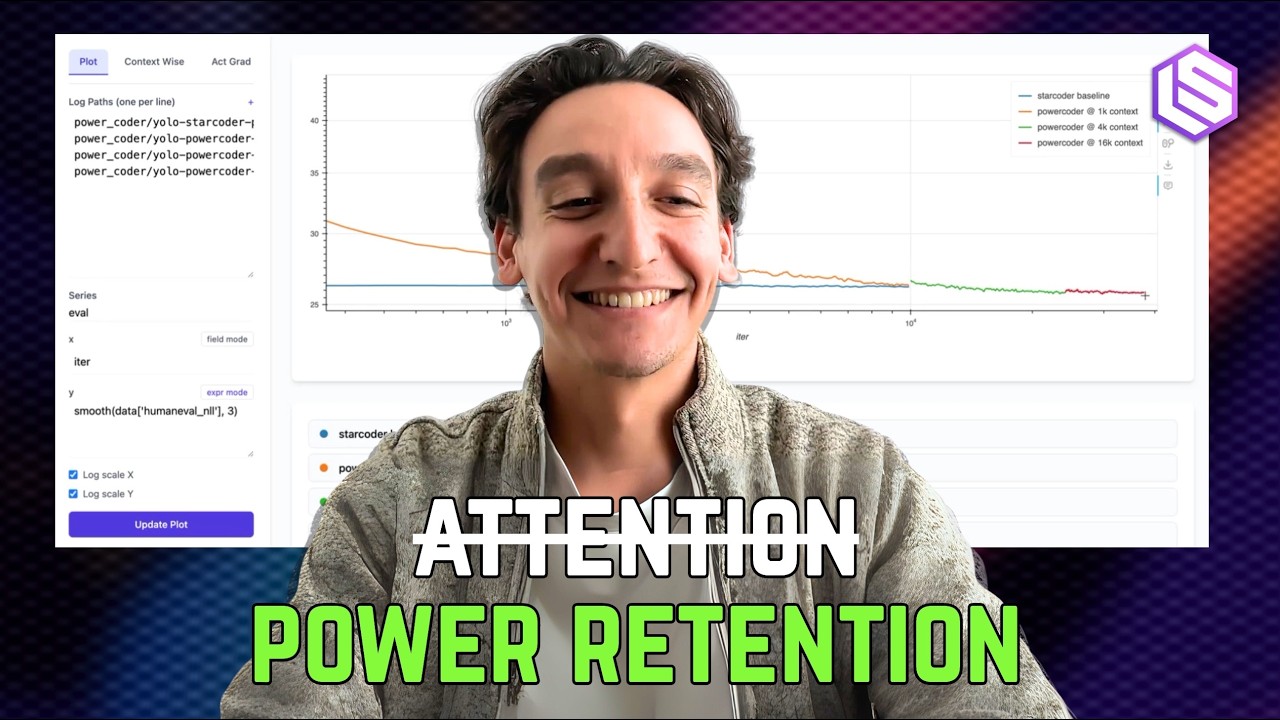
⚡️ Beyond Transformers with Power Retention
Sep 23, 2025 · 32:59
Jacob Buckman, CEO of Manifest AI, discusses their solution to AI's expensive computational bottleneck: the ever-growing KV cache for long context inference. Power Retention replaces attention in transformers with a fixed-size memory, achieving 10X training speedup at 64K tokens and 100X inference speedup over FlashAttention. Manifest releases Vidrial, a just-in-time CUDA kernel framework that finds optimal configurations, and Metamorphosis, a process to convert existing transformers like StarCoder-3B into Power Retention models in just two hours of mid-training. Buckman demonstrates PowerCoder, a 3B code model that matches baseline loss after 10K steps and handles contexts up to 32K and beyond. The open-source release includes kernels and tools, aiming to build community trust and encourage adoption by inference providers. He also highlights the need for genuinely long-context datasets beyond internet text, such as human trajectories.

The State of Silicon and the GPU Poors - with Dylan Patel of SemiAnalysis
Dec 5, 2023 · 1:07:55
Dylan Patel of SemiAnalysis argues the 'GPU poor vs GPU rich' divide defines AI, with Google's TPU ramp (millions of units) dwarfing others and Nvidia selling over a million H100s this year. He explains that training costs are irrelevant compared to inference costs, and that memory bandwidth is the key bottleneck for LLM inference (e.g., Llama 70B needs ~2.1 TB/s for human reading speed). Patel advises GPU-poor players to focus on on-device innovations like speculative decoding (Medusa), asynchronous training, or fine-tuning for edge use—not on gaming benchmarks or fine-tuning small models. He details why AI hardware startups (Cerebras, Graphcore) bet wrong on on-chip SRAM, while Google’s TPU/Broadcom partnership and Nvidia’s yearly cadence make alternatives tough. He also warns that rebuilding the semiconductor supply chain in the US is unfeasible due to its fragmentation, and that safety through obscurity doesn't work—open innovation is better.
Powered by PodHood