
TikTok
ProductA product discussed on Latent Space.
4 episodes

AI Video Is Eating The World — Olivia and Justine Moore, a16z
Jul 9, 2025 · 49:28
Alessio and Shawn (hosts of Latent Space) talk with a16z partners Justine and Olivia Moore about the explosion of AI-generated video on TikTok, Instagram, and YouTube. The Moores trace how trends moved from Reddit to consumer platforms, with examples like Italian Brainrot, Kim the Gorilla, and fruit-slicing ASMR. They detail their own hands-on creation: Olivia used Veo 3 and MiniMax to make viral clips (gold bar squishing, Tide Pod consumption), spending up to 8 generations per usable video and hitting Veo 3’s $125/month plan limits. They explain monetization paths—creator fund payouts (~$20 per million views), merch (Breadclump sweatshirts), consulting, and licensing to Netflix—and recommend tools like Overlap (clips 30–140 seconds) and ComfyUI for control. The episode closes with prompt theory: AI characters questioning their existence, and a bet that Gen Alpha’s brainrot consumption will reshape long-form content.

Tiny Teams: $6m ARR, 5m users with 4 employees — Sid Bendre, Oleve (Quizard AI/Unstuck AI)
Apr 23, 2025 · 42:59
Sid Bendre of Oleve (formerly Quizzer AI and Unstuck AI) explains how his four-person team built $6M ARR and 5M users across multiple consumer apps. Starting with Quizzer AI in January 2023, a viral TikTok gained 10K users in 30 hours; by August 2024, Unstuck AI hit 1M users in nine weeks. The company has been profitable since its first nine months. Bendre describes their platform engineering strategy: product engineers own individual apps while a platform team builds reusable systems, including internal shadow-org agents for growth and marketing. He shares technical hacks like using LaunchDarkly feature flags to load-balance across Azure OpenAI endpoints and a de-indexer for Azure AI Search to manage costs. The key engineering principle is deterministic LLM workflows—classifying user intent then routing to pre-built deterministic flows—rather than open-ended agent tool use.
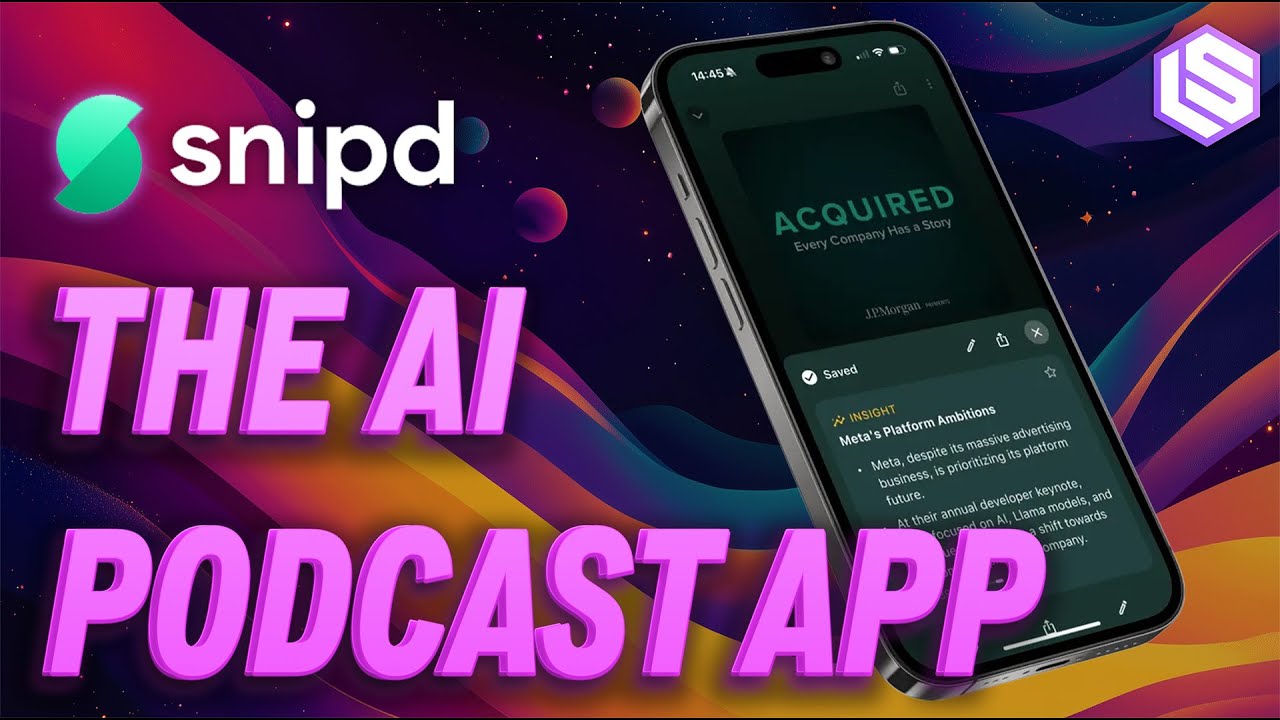
Snipd: The AI Podcast App for Learning — with CEO Kevin Ben-Smith
Mar 14, 2025 · 1:17:46
Snipd CEO Kevin Ben-Smith joins Swyx to explain how the AI-powered podcast app turns passive listening into active learning. Snipd transcribes and diarizes episodes, generates chapters, identifies mentioned books, and summarizes insights on demand — all with a four-person team. Kevin describes moving from self-hosted open-source models (Wave2vec, Pyannote) to a mix of Whisper, OpenAI, Google Gemini, and Perplexity APIs, balancing cost against the need for predictable batch processing vs. real-time user requests. He details technical hurdles like dynamic content resyncing (building a 'Shazam for podcasts') and using LLMs as judges to filter hallucinated book recommendations. The episode also covers Snipd's origin as a hackathon-winning podcast search tool, Swyx's own switch from Overcast, and Kevin's vision for voice-driven post-episode reflection and AI-assisted discovery as the next frontier.

Making Transformers Sing - with Mikey Shulman of Suno
Mar 14, 2024 · 58:58
In this episode of Latent Space, hosts Alessio and Shawn Wang interview Mikey Shulman, CEO of Suno, about making transformers sing. Suno uses transformers to predict audio tokens end-to-end, avoiding baked-in musical knowledge, with a tokenization secret sauce that also includes non-music audio for better vocal realism. Their models are relatively small (far below 175B parameters) due to latency needs, and they prioritize scaling research over brute-force size. Over half of Suno users employ expert mode, tweaking lyrics and style prompts, rather than easy mode. Shulman argues Suno is not the 'Midjourney of music' because music is inherently social and synchronous, unlike images. He demoed live generation, showing control via tokens like [beat drop] and style modifiers, and revealed future plans for collaborative concerts, continuous DJ modes, and personalized models. He also advocates for hiring economists to avoid Goodhart's law pitfalls in ML benchmarks, especially in audio where aesthetics matter most.
Powered by PodHood