
TensorFlow
ProductA product discussed on Latent Space.
4 episodes

The Shape of Compute (Chris Lattner of Modular)
Jun 13, 2025 · 1:18:18
Chris Lattner of Modular explains how his company is breaking the CUDA monopoly with Mojo and MAX, matching NVIDIA's best inference performance on AMD and NVIDIA GPUs. After three years in R&D, Modular open-sourced its stack and now delivers state-of-the-art Llama 3 serving at over 800 tokens per second. Mojo, a Python-family language, runs kernels faster than Rust and can extend Python without bindings, while MAX provides a full inference framework with automatic kernel fusion and cluster management. Unlike VLLM or SGLang, Modular's container is just a gigabyte, fully open source, and not reliant on proprietary CUDA blobs. DeepSeek's low-level PTX work validated the approach, but Lattner emphasizes that Mojo's portability avoids rewriting kernels for each new GPU architecture. He also details his daily routine, using Cursor for coding, and hiring "elite nerds" to grow the team.

A Comprehensive Overview of Large Language Models - Latent Space Paper Club
Mar 15, 2024 · 54:30
Brian presents a detailed walkthrough of the survey paper 'A Comprehensive Overview of Large Language Models,' which systematically covers the evolution of LLMs from early attention mechanisms to modern transformer architectures. He explains the shift from sequential RNNs to parallelizable transformers, the three dominant architectures (encoder-only like BERT, encoder-decoder like T5, decoder-only like GPT), and key training objectives (masked language modeling, full language modeling, prefix language modeling). The paper also reviews fine-tuning techniques (instruction tuning, alignment tuning via RLHF), prompting strategies (zero-shot, chain-of-thought), efficient adaptation methods (LoRA, quantization), evaluation benchmarks (GLUE, MMLU), and challenges such as bias, memorization, and privacy leaks. This episode serves as a comprehensive primer for anyone seeking to understand the foundational concepts and latest trends in large language model research.

The End of Finetuning — with Jeremy Howard of Fast.ai
Oct 20, 2023 · 1:24:48
Jeremy Howard of Fast.ai argues that fine-tuning language models is essentially continued pre-training, not a separate process, and that the common practice of fine-tuning on a single task causes catastrophic forgetting. He recounts the discovery of single-shot memorization in LLMs, where models memorize entire datasets after one epoch, a phenomenon many practitioners ignore. Howard criticizes the current focus on zero-shot and few-shot learning, advocating for transfer learning and small models. He shares his journey from philosophy to founding Fast.ai, the creation of ULMFit (which inspired GPT), and his ongoing work on making AI accessible. He also discusses his involvement with Modular's Mojo language and the importance of democratizing AI technology.
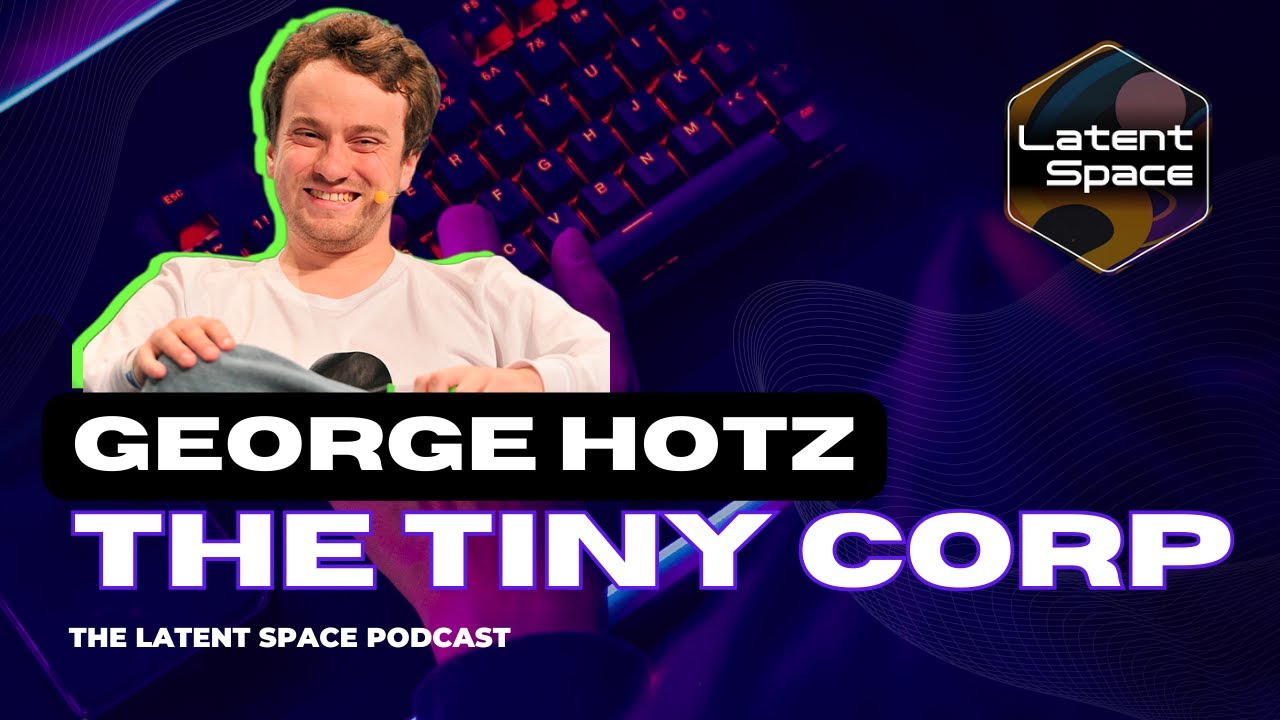
Ep 18: Petaflops to the People — with George Hotz of tinycorp
Jun 20, 2023 · 1:23:24
George Hotz of tinycorp argues that a simplified, open-source ML framework (tinygrad) can democratize AI compute and replace NVIDIA, Google, and AMD. Tinygrad uses 25 ops (vs. XLA's 250) and fuses kernels automatically, achieving 2x speed on Qualcomm GPUs over their library. Hotz reports AMD kernel panics fixed after emailing CEO Lisa Su, but laments AMD's open-source as 'dumped on GitHub.' For hardware, tinybox is a six-GPU desktop at 350W per GPU, aiming for 5x better price-performance than NVIDIA H100 for 90% of training. He criticizes OpenAI's secrecy, revealing GPT-4 is an 8-way mixture of 220B models, and cites the Bitter Lesson. He also outlines FLOPcoin using hardware identity to prevent cheating, and his goal of an AI girlfriend as the third company, merging humans via data rather than implants.
Powered by PodHood