
Streamlit
ProductA product discussed on Latent Space.
2 episodes

⚡️The Future of Notebooks - with Akshay Agrawal of Marimo
Jul 18, 2025 · 28:14
Akshay Agrawal introduces Marimo, an open-source reactive Python notebook built from scratch for AI and data work, emphasizing its lack of Jupyter dependencies and features like reactive execution, built-in UI elements, and pure Python storage for Git versioning. Marimo has surpassed 300k monthly PyPI downloads and more GitHub stars than Jupyter Notebook, used at OpenAI, Hugging Face, and Cloudflare. Agrawal demos interactive data exploration, including a PS5 controller for data annotation, and AI-native code generation with context-aware cell completion. He explains Marimo's UV package integration for inline dependency management and the upcoming MoLab cloud-hosted service on Modal, free for community use, addressing demand for a Colab-like experience. Marimo notebooks can be run as scripts or deployed as data apps, with a fork exploring agent cells for generative analysis.
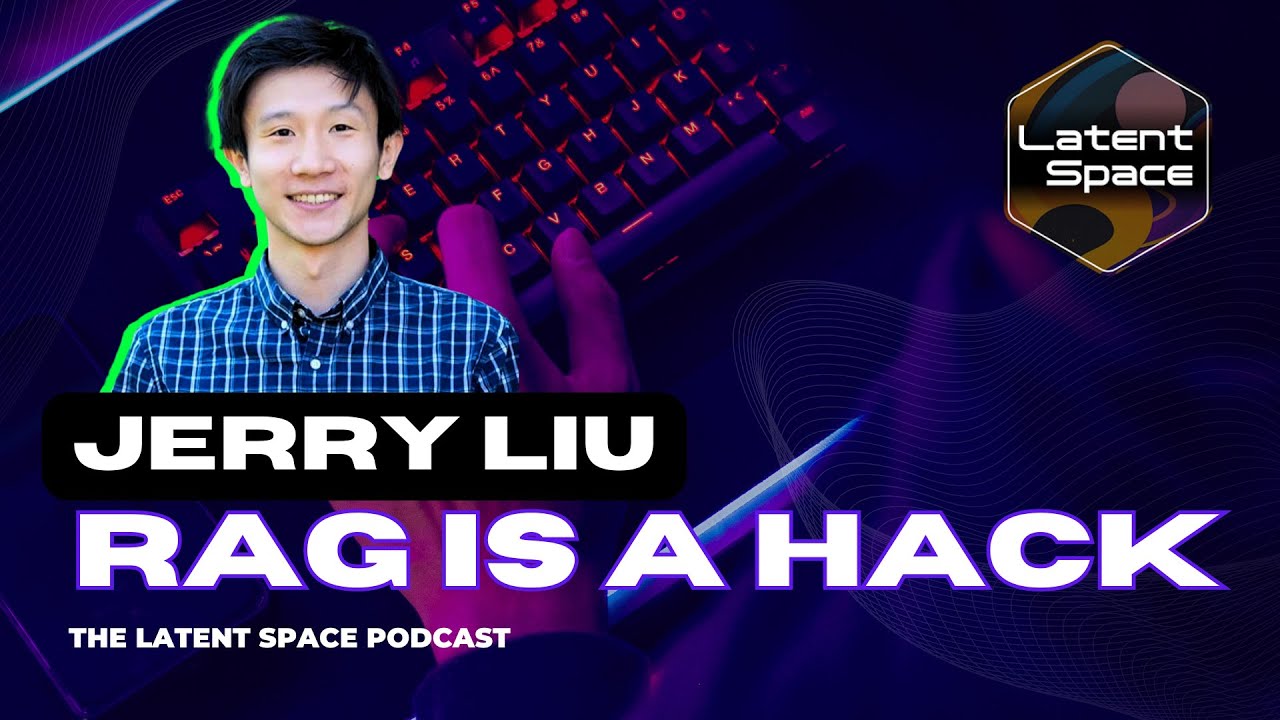
RAG is a hack - with Jerry Liu of LlamaIndex
Oct 12, 2023 · 1:13:25
In this episode of Latent Space, Jerry Liu of LlamaIndex argues that while RAG is fundamentally a hack, it remains the most practical approach for grounding LLMs with external data, and his open-source framework now serves 600,000 monthly downloads. Liu recounts how LlamaIndex originated from a hackathon at Robust Intelligence, evolving from an experimental tree-index to a modular toolkit spanning data loading, retrieval, synthesis, and agent loops. He explains the trade-offs between RAG and fine-tuning, noting that context window limits force algorithmic rather than learned optimizations, but RAG offers transparency and access control that fine-tuning cannot. Liu details the company’s $8.5M Greylock raise, the launch of LlamaHub for community-contributed data loaders, and the open-source SEC Insights app as a production-grade template. Looking ahead, he emphasizes the need for better retrieval benchmarks and predicts that future personalization will move beyond vector stores into model-internal memory architectures.
Powered by PodHood