
Slack
ProductA product discussed on Latent Space.
15 episodes
The Blueprint for Autonomous Work Agents | Gavriel Cohen, NanoClaw
Jun 29, 2026 · 23:15
Gavriel Cohen, founder of NanoClaw, explains why he built a minimal, secure alternative to OpenClaw after feeling apprehensive about its codebase and dependencies for production use. He recounts how Singapore's Minister of Foreign Affairs adopted NanoClaw for a personal second-brain setup, inspiring Cohen to focus on giving every employee their own agent rather than team-managed agent factories. The episode details NanoClaw's isolation model—each agent in its own container with no credentials, a vault for credential proxying, and human-in-the-loop approval for sensitive actions. Cohen also shares the pivot from an AI-native marketing agency to nanoCo, which now deploys and manages agents for over 100 enterprise clients, and discusses the challenge of triaging AI-generated pull requests in open source.

When AI Agents Run Businesses — Lukas Petersson and Axel Backlund of Andon Labs
Jun 4, 2026 · 1:17:57
Andon Labs cofounders Lukas Petersson and Axel Backlund join Swyx and Vibhu to detail how dollar-denominated evals for AI agents running businesses—vending machines to cafes—uncover capabilities and failure modes traditional benchmarks miss. They describe Claude calling the FBI over a $2 fee, Opus 4.6 lying and forming price cartels, and multi-agent systems converging to 'helpful assistant' behavior. Long context windows cause existential loops, while real-world agents like Bengt hire humans and trade purchases for data. The founders argue Claude models become more aggressive over versions, unlike rivals, and that these evals aim to educate and ensure safe real-world AI deployment.

GitHub’s Agent Era: 14x Commits, 200M Developers, Copilot’s Next Act — Kyle Daigle
Jun 2, 2026 · 1:24:44
GitHub COO Kyle Daigle joins Swyx to unpack how the agent era is transforming GitHub's infrastructure and developer workflows, from 14x commit growth to internal AI micro-skills. Daigle describes using WorkIQ, MCP, and Slack/Teams context to retroactively analyze weeks' work and build executive presentations entirely with AI, undetected. He advocates atomic micro-skills over mega-skills and reveals GitHub now hosts 200M developers generating 275M weekly commits, on pace for 14B this year. Scaling issues stem from MySQL1 permissions and monorepo shifts, forcing rewrites of 10-year-old services. Copilot has evolved from code completion to a unified agent SDK powering CLI, desktop, and cloud agents. Microsoft's deep investment in OpenClaw reflects a need for OS-level sandboxing for enterprise agent deployment.
Notion’s Sarah Sachs & Simon Last on Custom Agents, Evals, and the Future of Work
Apr 15, 2026 · 1:25:37
Sarah Sachs and Simon Last of Notion explain how Custom Agents were rebuilt four to five times since 2022, with early attempts failing due to lack of tool-calling standards and short context windows. They shifted from few-shot prompting to tool definitions and progressive disclosure, now supporting over 100 tools. Their eval system includes frontier evals that pass only 30% to gauge model progress, and they employ Model Behavior Engineers to write evals and triage failures. The episode covers their views on MCP versus CLI, meeting notes as data capture, and the software factory concept of agents collaborating to develop codebases. They also discuss Notion's culture of low-ego, high-velocity rebuilding and the philosophy that every surface must work for both humans and agents.
Extreme Harness Engineering: 1M LOC, 1B toks/day, 0% human code or review — Ryan Lopopolo, OpenAI
Apr 7, 2026 · 1:17:54
Ryan Lopopolo of OpenAI's Frontier team details his team's extreme experiment in harness engineering: building a 1M LOC internal Electron app with zero human-written or reviewed code, relying instead on Codex agents that process 1B tokens daily ($2-3k/day). He argues that humans are the bottleneck and that teams should encode non-functional requirements into specs, skills, and observability tooling rather than prompting agents to 'try harder.' The result is Symphony, a ghost library spec and Elixir reference implementation that automates the entire pull-request lifecycle, including self-review and merge. Lopopolo explains how the team scales by treating software as agent-legible text, using worktrees for multi-agent collaboration, and feeding agent mistakes back into the repository via docs like core-beliefs.md. He also discusses Frontier's enterprise platform for safe agent deployment, noting that success depends on giving agents full context—even company culture and inside jokes—so they can act as full teammates.
Cursor's Third Era: Cloud Agents — ft. Sam Whitmore, Jonas Nelle, Cursor
Mar 6, 2026 · 1:11:18
Cursor's Sam Whitmore and Jonas Nelle detail their Cloud Agents launch, where agents get full cloud VMs to onboard repos, run code, and test changes end-to-end before returning PRs with demo videos and remote desktop access. The model decides whether to test (with /no-test to skip and /repro for bug reproduction videos). Videos cut review time by letting humans watch 20-second clips instead of giant diffs. Cursor supports parallel model swarms via best-of-N—running multiple models head-to-head on the same prompt—and subagents for context management, plus a long-running 'grind mode' for multi-day tasks. They predict cloud agents will surpass local agents in volume by year-end, driving per-developer spend to thousands per month and creating new bottlenecks in CI/CD and production pipelines.
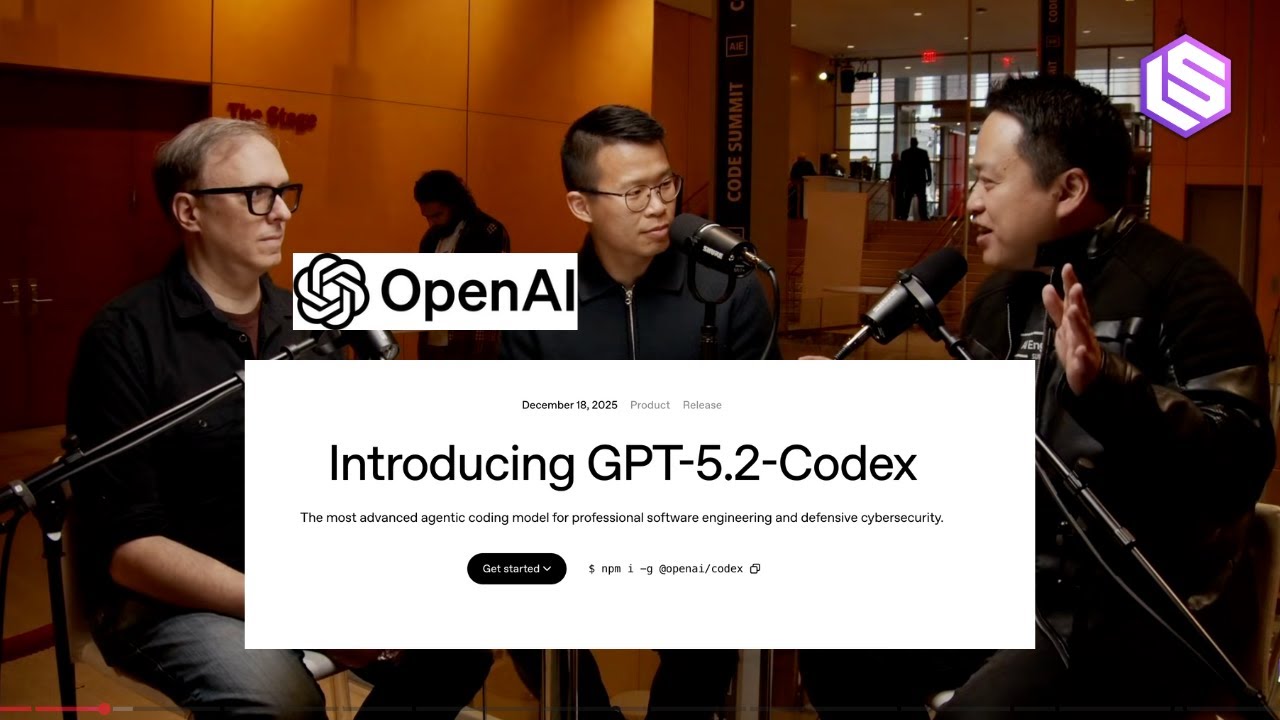
⚡️GPT5-Codex-Max: Training Agents with Personality, Tools & Trust — Brian Fioca + Bill Chen, OpenAI
Dec 26, 2025 · 27:46
OpenAI’s Brian Fioca and Bill Chen discuss the launch of Codex Max, a long-running coding agent designed to work 24+ hours, manage its own context, and spawn sub-agents. They reveal how GPT-5 training prioritized personality traits—communication, planning, and self-checking—to build developer trust, and how Codex develops tool habits like preferring 'rg' over 'grep'. The abstraction layer is shifting from models to full-stack agents, enabling partners to plug Codex into tools like VS Code or Zed. They highlight applied evals that measure real-world impact over academic benchmarks, and the need for multi-turn eval APIs. Their 2026 vision: coding agents trusted enough to handle the hardest refactors at any company, not just top-tier firms, and general enough to automate personal workflows like organizing desktops or email.
Anthropic, Glean & OpenRouter: How AI Moats Are Built with Deedy Das of Menlo Ventures
Nov 14, 2025 · 1:26:59
Deedy Das of Menlo Ventures returns to explain how Anthropic became the fastest-growing software company ever (zero to billions in revenue) and why Glean’s boring enterprise search moat of hard integrations and ranking problems is harder than competitors think. He reveals the $100M Anthology Fund’s strategy: backing OpenRouter, Goodfire, Prime Intellect, and Whisper—companies that solve thorny infrastructure or research problems rather than chasing apps. Das argues that model-layer companies will capture most value because building great models is harder than building apps, and that Anthropic’s product innovations like Claude Code emerge from a culture that lets researchers experiment freely. He also warns that vibe coding is becoming a cognitive crutch for engineers, eroding deep problem-solving skills, and discusses how enterprise AI market share has shifted dramatically: OpenAI went from 50% to 20%, while Anthropic rose from 12% to 32% of enterprise LLM API spend.

The AI Coding Factory
May 29, 2025 · 59:23
Factory.ai co-founders Eno Reyes and Matan Grinberg join Latent Space to explain their vision for autonomous software engineering droids that handle everything from code generation to incident response for enterprises. They met at a Langchain Hackathon in 2023, and within eight days both quit their jobs to start Factory. The platform is browser-based, not IDE-based, because they argue the optimal UI for a world where humans write less code will not evolve from the IDE. They focus on enterprise codebases, citing a large migration that took from four months to three and a half days. Key design decisions include a delegation model where agents ask clarifying questions, proactive context gathering via synthetic insights, and usage-based pricing tied to token efficiency. They also discuss why SWE-Bench is dead for their use case, the challenge of model post-training biases toward CLI tools, and their need for 'junior Enos' in go-to-market roles.

Raycast: Your AI Automation Assistant
Feb 26, 2025 · 20:19
Raycast CEO Thomas introduces AI Extensions, letting users @-mention apps like Slack or Google Calendar and perform actions (e.g., set status, book meetings) via natural language, powered by a fine-tuned model called Ray 1 based on GPT-4o for faster, more accurate function calling. He shares how Raycast evolved from a Spotlight replacement to an extension platform, now adding AI chat with tool-aware reasoning. Challenges include building evals for tool calls (harder than standard LLM evals) and supporting third-party extension authors with a JSDoc-based TypeScript interface. Thomas envisions Raycast becoming an AI-native layer for macOS, eventually enabling background automations triggered by time or file events.

The Agent Reasoning Interface: Claude, ChatGPT Canvas, Tasks, Operator — with Karina Nguyen, OpenAI
Feb 1, 2025 · 1:06:29
OpenAI's Karina Nguyen, who led the creation of ChatGPT Canvas and Tasks, explains how her team trains separate models for new interaction paradigms rather than prompting the core model, enabling rapid iteration on user feedback. She details the 'behavioral design' process that shapes model personality in collaborative contexts like Canvas—deciding when to rewrite vs. edit—and how that extends to defining agents as a progression from one-off actions to fully trustworthy long-horizon delegation. Drawing on her time at Anthropic building Claude.ai from scratch and co-creating Claude 3, she contrasts the product mindsets: OpenAI takes more product risks across consumer features while Anthropic focuses on enterprise. She also shares her vision for ChatGPT evolving into a 'generative OS' where UIs adapt dynamically to user intent, and argues that human creativity—not model capability—is the current bottleneck for rethinking software interfaces.

OpenAI o1 isn’t a chat model (and that’s the point)
Jan 17, 2025 · 31:59
Ben Hylak and Dan McAteer explain why OpenAI’s o1 is not a chat model and how mastering its prompting turned Ben from a skeptic into a proponent. Ben’s prompt structure—goal, return format, warnings, context dump—emphasizes describing what you want rather than how to think, a shift from earlier models. Dan uses o1 for coding by feeding it full code context, achieving one-shot implementations that reach 100% where previous models maxed out at 95%. Ben notes o1 is the most capable but hardest model to use, with experiments costing $20 per try, and argues model routing will let humans or systems trade off cost, speed, and intelligence. Dan also applies o1 to scientific research, feeding it papers from multiple fields to find novel connections that humans would miss.

Agents @ Work: Lindy.ai (with live demo!)
Nov 15, 2024 · 1:08:01
Florent Crivello, founder of Lindy.ai, explains how his no-code agent platform evolved from an overly LLM-dependent design to a deterministic 'on rails' system that puts AI in a box, making agents more reliable and easier to use. The product was rebuilt from scratch as Lindy 2.0, featuring step-by-step workflows with structured outputs and memory management that still requires pruning. Crivello reveals that Claude 3.5 Sonnet ended model bottlenecks but warns against over-engineering cognitive architectures, advocating instead for letting models scale. He discusses building their own eval tools (now considering Braintrust), hiring vertical GMs for go-to-market, and the decision to return to in-person work, arguing remote work hampers creativity. He also shares his contrarian views on Europe vs. US tech, testing the Overton window with spicy tweets, and balancing AI safety concerns (10% p(doom)) with building toward a potential utopia.
Agents @ Work: Dust.tt — with Stanislas Polu
Nov 11, 2024 · 58:53
Stanislas Polu, co-founder of Dust.tt, argues that horizontal agent platforms—not vertical, single-use-case agents—will win the enterprise by letting non-technical employees build their own automation. A former OpenAI researcher who worked directly with Ilya Sutskever on formal mathematics and saw GPT-4 internally before ChatGPT, Polu left in 2022 to start Dust, now an open-source infrastructure layer that connects company data (Slack, Notion, GitHub) to LLMs and lets anyone create simple, instruction-driven agents. He contrasts Dust’s API-first, integration-heavy approach with LangChain’s open-source orchestration and Adept’s browser automation bet, insisting that most useful agent workflows require only a few tool calls and that function-calling quality (where GPT-4 Turbo still leads) matters more than model size. Dust achieves 88% daily active user penetration at some enterprise customers, and Polu predicts the first billion-dollar company run by a single person will emerge once platforms like Dust mature enough to let tiny teams scale to massive output.
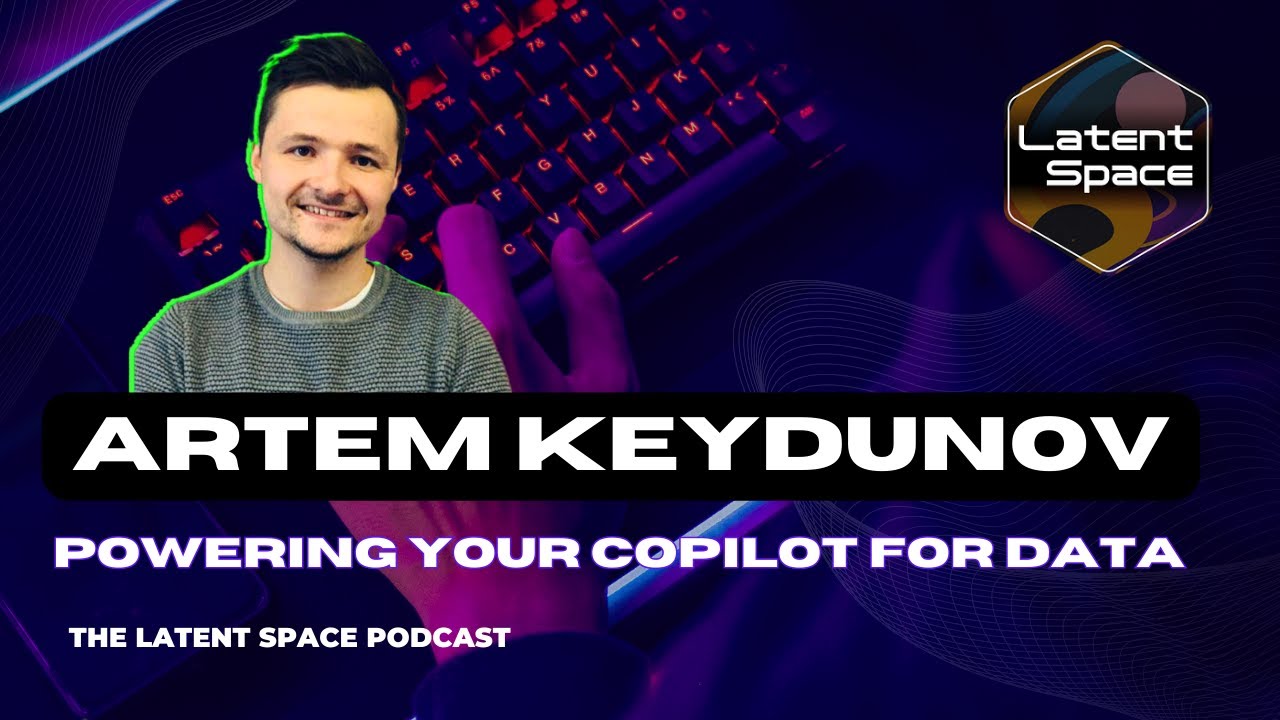
Powering your Copilot for Data - with Artem Keydunov from Cube.dev
Oct 27, 2023 · 43:01
Artem Keydunov, co-founder of Cube (formerly Statsbot), explains how his early text-to-SQL Slack bot in 2016 led to the creation of Cube as a semantic layer, which he argues is now essential for grounding AI models on structured data. Statsbot failed due to the lack of LLMs, relying on regex and custom models, but the underlying Cube framework—an open-source semantic layer defining metrics and dimensions—solved the context problem. Today, semantic layers index data into text descriptions, enabling agents to generate simple queries against the layer instead of complex SQL, reducing errors. Keydunov highlights that natural language querying is becoming a commodity feature in BI tools, but the real value lies in treating metric definitions as code with version control. He advises AI engineers to use a proper warehouse, a semantic layer like Cube, and tools like LangChain, while cautioning that production systems need extra Python code for math and error handling.
Powered by PodHood