
RWKV
ProductA product discussed on Latent Space.
3 episodes

2024 in Post-Transformer Architectures: State Space Models, RWKV [Latent Space LIVE! @ NeurIPS 2024]
Dec 24, 2024 · 42:45
Dan Fu (Together AI/UCSD) and Eugene Cheah (Featherless) survey post-transformer architectures, arguing that state-space models (SSMs) like Mamba and RWKV can match transformer quality while scaling subquadratically in sequence length, enabling efficient long-context and test-time compute. Fu explains how SSMs evolved from S4 to data-dependent selection mechanisms, while Cheah details RWKV's open-source development, including Q-RWKV6—a 32B model converted from Qwen 32B with linear attention that retains 76% MMLU after just days of training. They discuss hybrid models outperforming pure transformers or SSMs, and challenge RAG's necessity: fixed-state models like RWKV may handle up to 128K context for most enterprise workloads, while truly infinite context requires the model to decide what to forget. Hot takes: long context is overhyped for most use cases, but models that can 'watch forever' could excel in time-series and video generation.

RWKV: Reinventing RNNs for the Transformer Era
Aug 31, 2023 · 1:56:51
Eugene, CTO of UILicious, introduces RWKV, a recurrent neural network that matches transformer-level performance while scaling linearly with context length, solving the quadratic cost of attention. He explains how RWKV uses Attention-Free Transformer layers and parallelizable training, achieving competitive results on 7B and 14B models. The community-driven project prioritizes multilingual support, with a tokenizer that handles languages without spaces. Eugene recounts his journey from GPU.js to finding RWKV, and highlights use cases like long HTML analysis where transformers fail. He also discusses the token crisis, diffusion models for text, and how the AI waifu community drives optimization and alignment research. Finally, he advises AI engineers to focus on practical prompting and data curation, noting that deep architecture knowledge is optional.
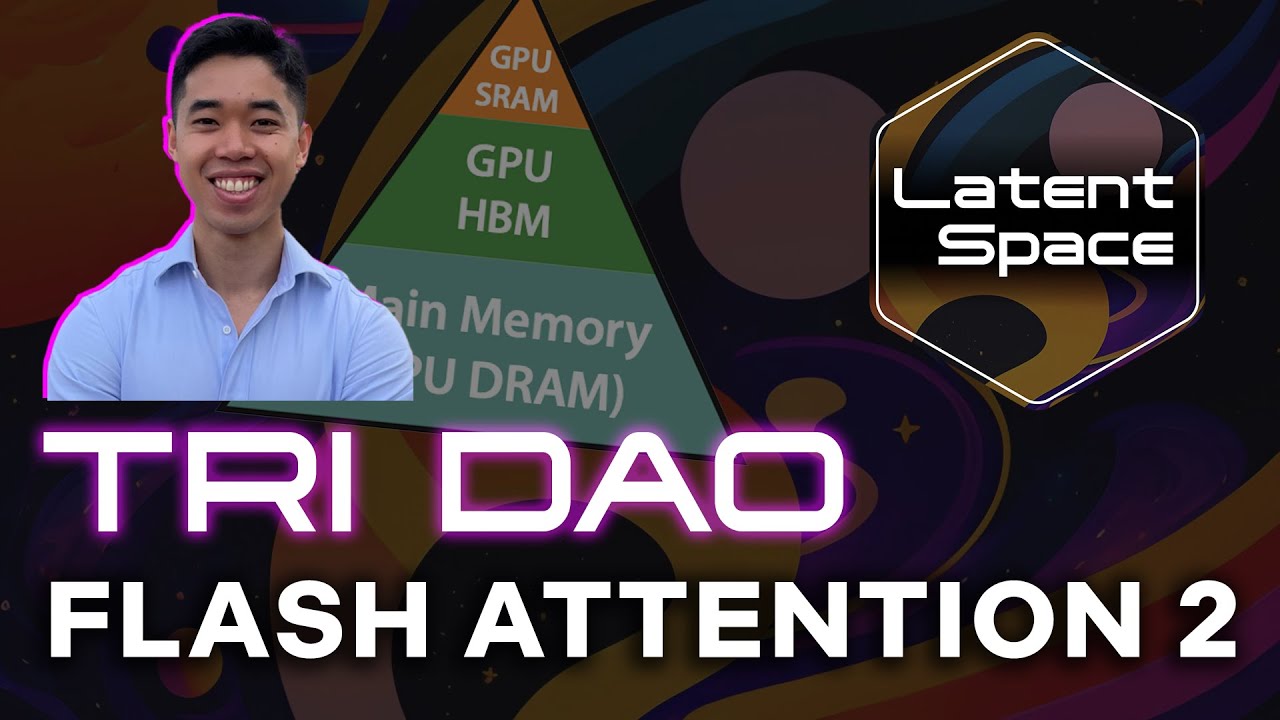
FlashAttention-2: Making Transformers 800% faster AND exact
Aug 3, 2023 · 1:04:06
Tri Dao, creator of FlashAttention and FlashAttention-2, explains how his I/O-aware algorithm makes attention 2x faster by fusing kernels and using online softmax, achieving near-matrix-multiply efficiency. He argues that transformer alternatives like state space models and RNNs (e.g., RWKV) could surpass transformers for long sequences and high-throughput generation, though attention still dominates. Dao discusses the hardware lottery, where NVIDIA's CUDA ecosystem entrenches transformers, and advocates for open-source AI, praising Meta's Llama 2 for shifting enterprise adoption despite its restrictive license. He emphasizes that understanding both algorithms and systems is key to scaling AI, and that academia should pursue risky bets that industry cannot.
Powered by PodHood