
Replit
ProductA product discussed on Latent Space.
3 episodes
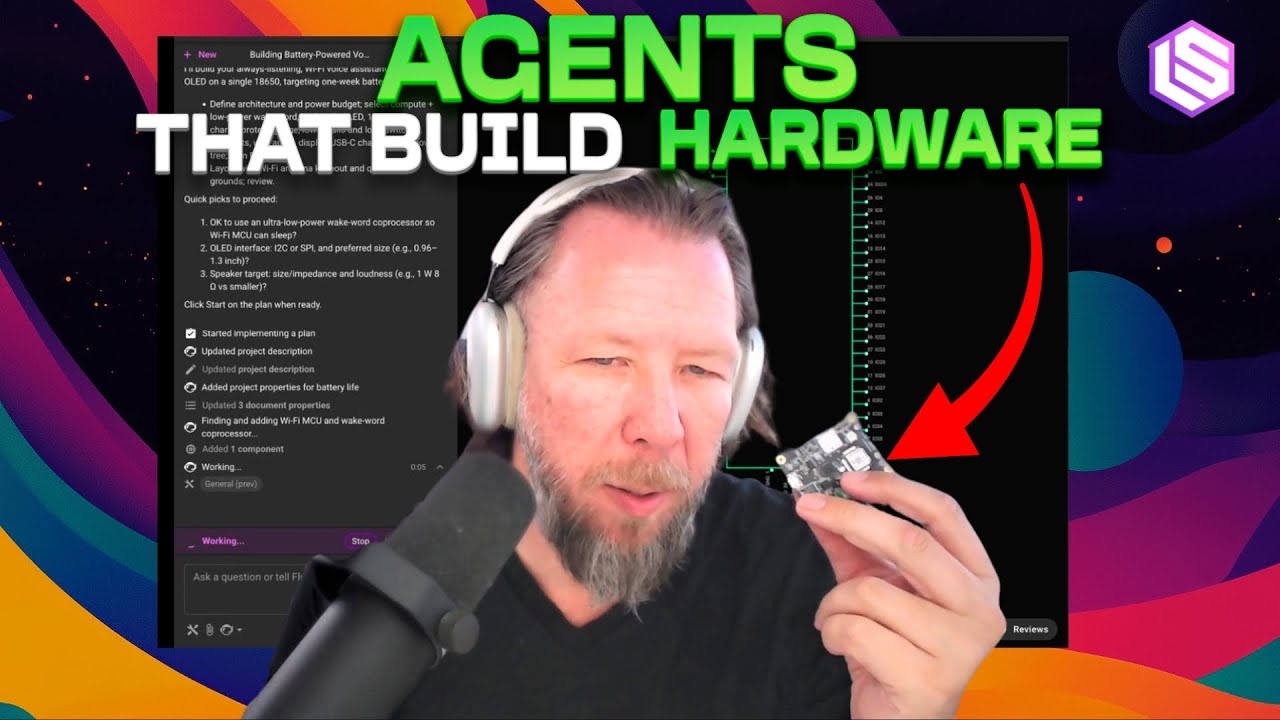
⚡️ Building the AI Hardware Engineer with Matthias Wagner, Co-founder of Flux
Nov 22, 2025 · 49:03
Matthias Wagner, CEO of Flux.ai, describes building the "AI hardware engineer" that turns product briefs into manufacturable PCB designs in under 30 minutes. After leaving Meta in 2019, Wagner built a browser-based collaborative CAD tool from scratch, designed as a reinforcement learning environment. The emergence of LLMs and reliable tool calling let Flux's agents search component libraries, check pricing and availability, and execute complex designs autonomously. In a live demo, Wagner designs a battery-powered Alexa-like device with ESP32, microphones, OLED display, and speaker in about 25 minutes. Flux now has 7,000 paying customers, growing 26x year over year, and Wagner envisions eventually letting users prompt full hardware products like smartphones into existence, claiming the cost of custom manufacturing is plummeting.

⚡️No, Don't Do Palantir for AI - Brendan Falk, Hercules (AUDIO FIXED)
Sep 18, 2025 · 35:08
Brendan Falk, founder of Zeus (now Hercules), explains why he abandoned his vision to become 'Palantir for AI' after six months of enterprise AI transformations. Targeting Global 2000 companies with $5–10M contracts, he found that each use case required custom development, messy data, and high ongoing maintenance, with work scaling poorly across contract sizes. He also faced existential threats from specialized vendors like Decagon and Sierra, who could outspend and out-focus on single use cases. Falk pivoted to Hercules.app, an AI website builder that ships production apps, white-labeling payments and email. He argues the app builder market (Wix, Squarespace, Shopify) will expand with AI, and that brand and ease will sustain higher margins than developer tools like Cursor.

Beating GPT-4 with Open Source Models - with Michael Royzen of Phind
Nov 3, 2023 · 1:18:54
Michael Royzen, co-founder and CEO of Phind, explains how his company built a GPT-4-beating open-source model for developer Q&A. Royzen recounts founding SmartLens in high school, shifting to NLP after a Hugging Face demo, and creating an internet-scale LLM-powered RAG system in January 2022. He details Phind’s pivot to programmers, the Hacker News launch that gave it 1,500 points, and Paul Graham’s role in naming the company and introducing Ron Conway, who then connected Phind to NVIDIA for GPU access. Royzen argues that Phind’s model, fine-tuned from Code Llama 34B with extra data, closes the gap with proprietary models—especially on code reasoning—and that open-source will win the enterprise because the delta to GPT-5 will be small. He shares how Phind handles multi-step conversations via a pair programmer mode where users can pin messages, and reveals plans for reinforcement learning to reduce hallucination and improve correctness.
Powered by PodHood