
Raspberry Pi
ProductA product discussed on Latent Space.
4 episodes
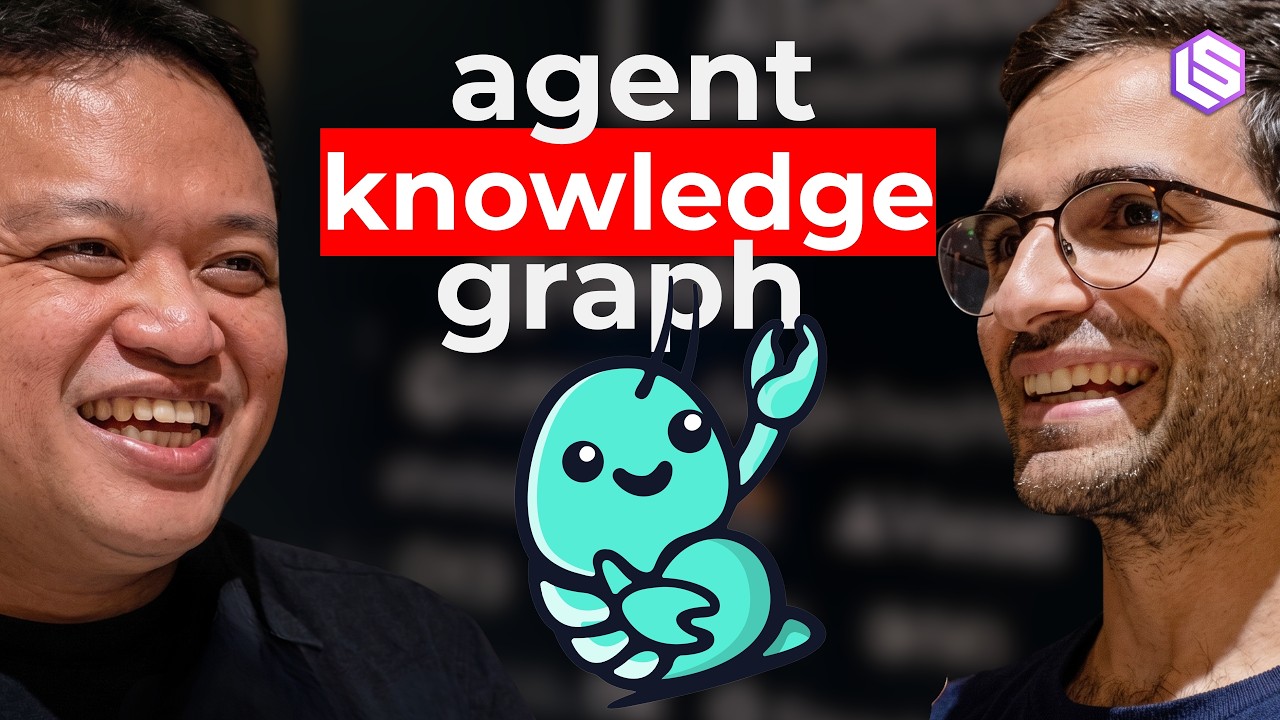
The Blueprint for Autonomous Work Agents | Gavriel Cohen, NanoClaw
Jun 29, 2026 · 23:15
Gavriel Cohen, founder of NanoClaw, explains why he built a minimal, secure alternative to OpenClaw after feeling apprehensive about its codebase and dependencies for production use. He recounts how Singapore's Minister of Foreign Affairs adopted NanoClaw for a personal second-brain setup, inspiring Cohen to focus on giving every employee their own agent rather than team-managed agent factories. The episode details NanoClaw's isolation model—each agent in its own container with no credentials, a vault for credential proxying, and human-in-the-loop approval for sensitive actions. Cohen also shares the pivot from an AI-native marketing agency to nanoCo, which now deploys and manages agents for over 100 enterprise clients, and discusses the challenge of triaging AI-generated pull requests in open source.

⚡️ 10x AI Engineers with $1m Salaries — Alex Lieberman & Arman Hezarkhani, Tenex
Nov 19, 2025 · 27:11
Tenex co-founders Alex Lieberman and Arman Hezarkhani explain how they compensate AI engineers by story points instead of hours, enabling some to earn over $1 million annually while delivering 10x productivity gains. The model emerged after Arman downsized his previous company Parthian's engineering team by 90% yet saw a 10x increase in production-ready software output by re-architecting with AI. They avoid gaming by hiring engineers who are long-term selfish or love coding, and pair them with technical strategists incentivized on account retention. Example projects include building a retail camera prototype in two weeks and a trivia app that hit #20 on the App Store in a month. Their default stack is TypeScript with React and Express, and they switch between coding agents like Claude Code and Codex based on daily performance. They identify human capital as their main constraint and context engineering or entropy reduction as the core challenge for autonomous AI engineers.

Training Llama 2, 3 & 4: The Path to Open Source AGI — with Thomas Scialom of Meta AI
Jul 23, 2024 · 1:04:34
Thomas Scialom, Llama 2 lead and Llama 3 post-training lead at Meta AI, explains why scaling laws must go beyond Chinchilla—training models longer on more tokens yields better inference efficiency than bigger models, a lesson that drove Llama 3's 15 trillion token pre-training. He details how synthetic data from Llama 2 bootstrapped Llama 3's post-training, eliminating human-written SFT data, and why RLHF outperforms imitation learning: humans are better discriminators than generators, enabling superhuman outputs. Scialom defends the dense 405B architecture over MoE, calls tokenizer vocab size underrated (128k tokens vs Llama 2's 32k), and reveals Llama 4's focus on agentic capabilities—tool use, multi-step reasoning—as the path to open-source AGI. Meta AI is hiring researchers with rigorous first-principles thinking.

RWKV: Reinventing RNNs for the Transformer Era
Aug 31, 2023 · 1:56:51
Eugene, CTO of UILicious, introduces RWKV, a recurrent neural network that matches transformer-level performance while scaling linearly with context length, solving the quadratic cost of attention. He explains how RWKV uses Attention-Free Transformer layers and parallelizable training, achieving competitive results on 7B and 14B models. The community-driven project prioritizes multilingual support, with a tokenizer that handles languages without spaces. Eugene recounts his journey from GPU.js to finding RWKV, and highlights use cases like long HTML analysis where transformers fail. He also discusses the token crisis, diffusion models for text, and how the AI waifu community drives optimization and alignment research. Finally, he advises AI engineers to focus on practical prompting and data curation, noting that deep architecture knowledge is optional.
Powered by PodHood