
Quadratic
ProductA product discussed on Latent Space.
2 episodes

Quadratic: The AI Spreadsheet
Jun 10, 2025 · 28:15
David Kircos, co-founder and CEO of Quadratic, joins hosts Alessio and Swyx to demonstrate Quadratic, an AI-powered spreadsheet that natively executes Python, JavaScript, and database queries in WebAssembly for real-time performance. The product's AI assistant uses a context-aware agent loop that summarizes sheet structure rather than dumping full data, then tool-calls to read columns or peek at values only when needed, keeping costs low on large datasets. Kircos explains Quadratic's three-year technical groundwork—WebGL rendering and WebAssembly runtimes—enabled them to capitalize on AI, turning a 'technical spreadsheet' into one where users simply drop a CSV and say 'help me analyze this.' He details how they route chart images back to the model for visual feedback and predicts that formulas will yield to Python for complex analysis, though spreadsheets will remain the best interface for human–AI data collaboration. Quadratic is source-available on GitHub, supports real-time multiplayer, and has grown to nine people. The episode also covers future directions like proactive agents and form controls (sliders) for interactive models.
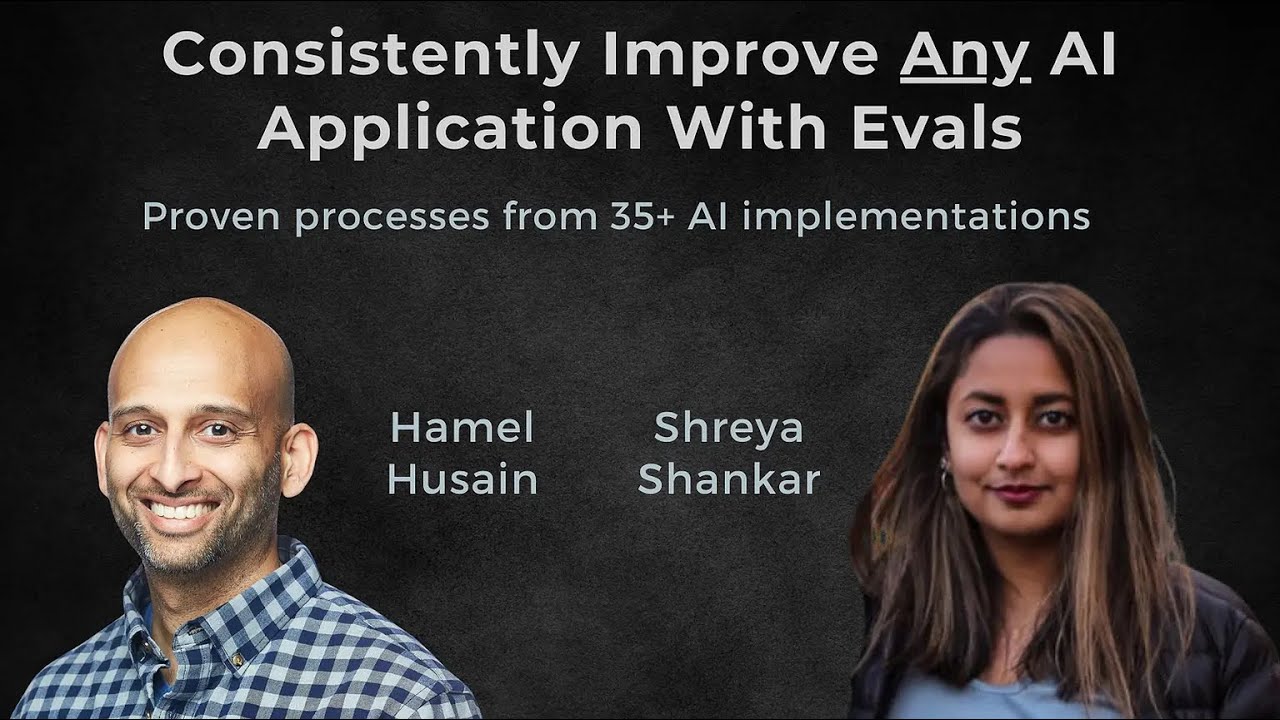
[Lightning Pod] Evals: How to Improve AI Consistently — with Hamel Husain and Shreya Shankar
Mar 13, 2025 · 27:34
Hamel Husain and Shreya Shankar join the Latent Space podcast to argue that systematic evaluation (evals) is the critical missing piece for moving AI applications from demo to production. They estimate 75% of evals in the wild use LLM-as-judge, but 80% of those are not helpful without proper validation against domain experts. Husain advocates building custom annotation UIs (using tools like Lovable or Cursor) to speed error analysis, while Shankar emphasizes synthetic data generation that balances real-world data and LLM outputs, drawing on social science methods. They preview their free lightning lesson on March 21 and a four-week paid course covering the eval lifecycle: synthetic data creation, LLM-as-judge calibration, error analysis, and iterative improvement, with hands-on coding assignments. The episode also touches on trends like dedicated judge models (e.g., Haizelabs' Verdict) and the value of basic data literacy (e.g., pivot tables) for eval participation.
Powered by PodHood