
Next.js
ProductA product discussed on Latent Space.
8 episodes

Senior Dev: This "Grill Me" Prompt Is Going Viral Among Top Engineers
May 7, 2026 · 22:03
Matt Pocock — the TypeScript educator turned AI engineering teacher who created the viral "Grill Me" prompt and runs AI Hero — argues that classic software engineering fundamentals are more critical than ever in the AI coding era. He explains how Domain-Driven Design's ubiquitous language and deep module patterns let developers contain complexity and delegate implementation to AI. His free "Grill Me" skill (part of his 13,000-star skills repo) forces AI to relentlessly interview humans until reaching shared understanding. He contrasts Claude Code's ease-of-use against Pie's transparent primitives, predicting a shift toward developer observability. The episode also covers his two-month course creation process, why TypeScript is overtaking Python in AI engineering, and why traditional lectures still dominate learning.
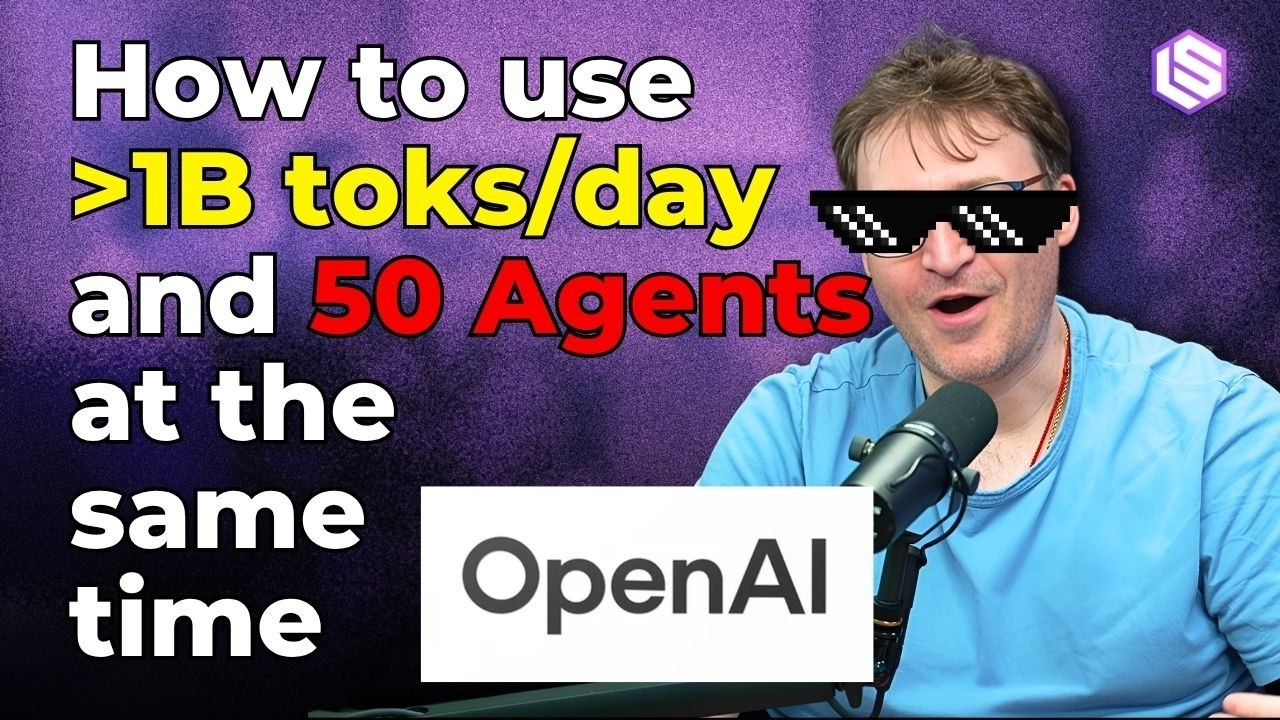
Extreme Harness Engineering: 1M LOC, 1B toks/day, 0% human code or review — Ryan Lopopolo, OpenAI
Apr 7, 2026 · 1:17:54
Ryan Lopopolo of OpenAI's Frontier team details his team's extreme experiment in harness engineering: building a 1M LOC internal Electron app with zero human-written or reviewed code, relying instead on Codex agents that process 1B tokens daily ($2-3k/day). He argues that humans are the bottleneck and that teams should encode non-functional requirements into specs, skills, and observability tooling rather than prompting agents to 'try harder.' The result is Symphony, a ghost library spec and Elixir reference implementation that automates the entire pull-request lifecycle, including self-review and merge. Lopopolo explains how the team scales by treating software as agent-legible text, using worktrees for multi-agent collaboration, and feeding agent mistakes back into the repository via docs like core-beliefs.md. He also discusses Frontier's enterprise platform for safe agent deployment, noting that success depends on giving agents full context—even company culture and inside jokes—so they can act as full teammates.

[State of Evals] LMArena's $1.7B Vision — Anastasios Angelopoulos, LMArena
Dec 31, 2025 · 24:02
Anastasios Angelopoulos, founder of LMArena (now Arena), discusses the platform's $100M raise at a $1.7B valuation, its spin-out from Berkeley incubation by a16z's Anjney Midha, and its mission to be the industry's north star for real-world AI evaluation. He defends against the 'leaderboard illusion' paper, citing factual errors and reaffirming that models cannot pay to be on or off the public leaderboard. Arena funds inference costs for millions of monthly users, with 25% of its 5M+ users in software, and is expanding into occupational verticals (medicine, legal, creative) and multimodal video arenas. Key challenges include consumer retention, which improved with sign-in and persistent history, and moving off Gradio to React for better development. Angelopoulos calls for top talent in ML, product, and go-to-market to join the high-performance team.

The Great Evals Debate — Ankur Goyal & Malte Ubl
Dec 7, 2025 · 34:33
Ankur Goyal (Braintrust) and Malte Ubl (Vercel) debate whether offline evals are essential infrastructure or premature optimization for AI coding agents, arguing that the best teams deliberately invest in multiple feedback loops—offline evals, A/B tests, and vibe checks—to build effective AI products. They explain that modern evals are not about manufacturing golden datasets but pulling real user failures from production logs into eval suites to iterate faster. The conversation highlights how evals provide a 'first derivative' that enables aggressive shipping without regression fears, akin to unit tests in traditional software. Coding evals are uniquely verifiable (e.g., 'does it compile?') yet underutilized; Vercel uses them in RL pipelines to fine-tune models that fix trivial errors 100x faster than agentic loops. They also discuss how product managers encode domain expertise through rubrics and LLM-as-judge scoring, and why proprietary evals are competitive moats while public benchmarks serve marketing. The debate concludes that RL environments are a promising frontier for computer-use agents but require specialized expertise to avoid reward hacking.

⚡ Inside GitHub’s AI Revolution: Jared Palmer Reveals Agent HQ & The Future of Coding Agents
Nov 10, 2025 · 35:52
Jared Palmer, SVP at GitHub and VP at CoreAI at Microsoft, traces his journey from building v0 at Vercel—a focused Next.js coding agent that grew from $1M ARR to millions more after adding chat—to launching Agent HQ at GitHub Universe, a collaboration hub for developers and coding agents. He explains how v0's success came from laser-focus on one stack and framework, and how GitHub's 180M developers enable scaling agent-based workflows. Palmer discusses model strategy tradeoffs (composite vs. branded models), the challenge of repo setup and infrastructure reliability, and using coding agents for non-coding tasks like automating Excel workflows. He reveals Stacked Diffs as GitHub's top feature request, with active exploration after previous attempts, and outlines his vision for seamless AI integration across GitHub, VS Code, and Actions, including features like resolving merge conflicts with AI.

⚡️ Ship AI recap: Agents, Workflows, and Python — w/ Vercel CTO Malte Ubl
Nov 1, 2025 · 42:02
Vercel CTO Malte Ubl discusses the company's AI strategy, centered on the new Workflow Development Kit that enables durable, resumable serverless functions with infinite idle time at no cost. He explains how the AI SDK was extracted from v0 and remains deliberately low-level to accommodate emerging patterns, with a direct agent abstraction now stable in version six. Ubl details Vercel's internal agents—including a DevOps agent that investigates production anomalies by querying observability data and logs, solving the recall-precision problem in alerting—and the 'Agent on Every Desk' program that helps large companies build their first three agents. He also covers zero-config Python support for Flask and FastAPI, and a security model that assumes developers cannot be trusted, extracting auth and data access from application code.

AI is Eating Search
Jul 23, 2025 · 56:22
Robert McCloy of Scrunch AI argues that AI is replacing web browsing, not just search, as consumers prefer ChatGPT and similar tools over traditional browsing. He explains that AI search platforms still rely on traditional search under the hood, but re-rank results based on metadata clarity—so clickbait titles fail while descriptive content wins. Prompt injection works currently but is a temporary tactic; the durable strategy is clear, structured content with server-side rendered HTML because AI tools don't execute JavaScript. Scrunch helps brands optimize for platforms like ChatGPT, Perplexity, and Meta AI; customer Clerk saw a 6x traffic increase and 9x conversion lift from AI-referred visitors. Robert predicts the future is about 'agent experience'—optimizing how AI systems interact with your content to serve end users directly.

[Paper Club] Who Validates the Validators? Aligning LLM-Judges with Humans (w/ Eugene Yan)
Sep 28, 2024 · 1:00:55
Eugene Yan presents the paper 'Who Validates the Validators? Aligning LLM-Judges with Humans' by Shreya Shankar, introducing EvalGen, a framework that helps developers iteratively align LLM evaluators with human labels by grading outputs, refining criteria, and tracking coverage (recall) and false failure rate (1−precision). Yan demonstrates his own prototype 'Label', which forces users to label 20 samples before unlocking evaluation mode and 50 samples plus one evaluation run before optimization, gamifying the alignment loop. The discussion covers binary vs. pairwise evaluation, the subjectivity of criteria, and Shreya Shankar's plans to integrate natural language feedback into EvalGen's next version. Yan advocates that labeling data is essential before deploying LLM evaluators in production, turning the process into prompt fine-tuning rather than vibe checks.
Powered by PodHood