
NanoGPT
ProductA product discussed on Latent Space.
2 episodes
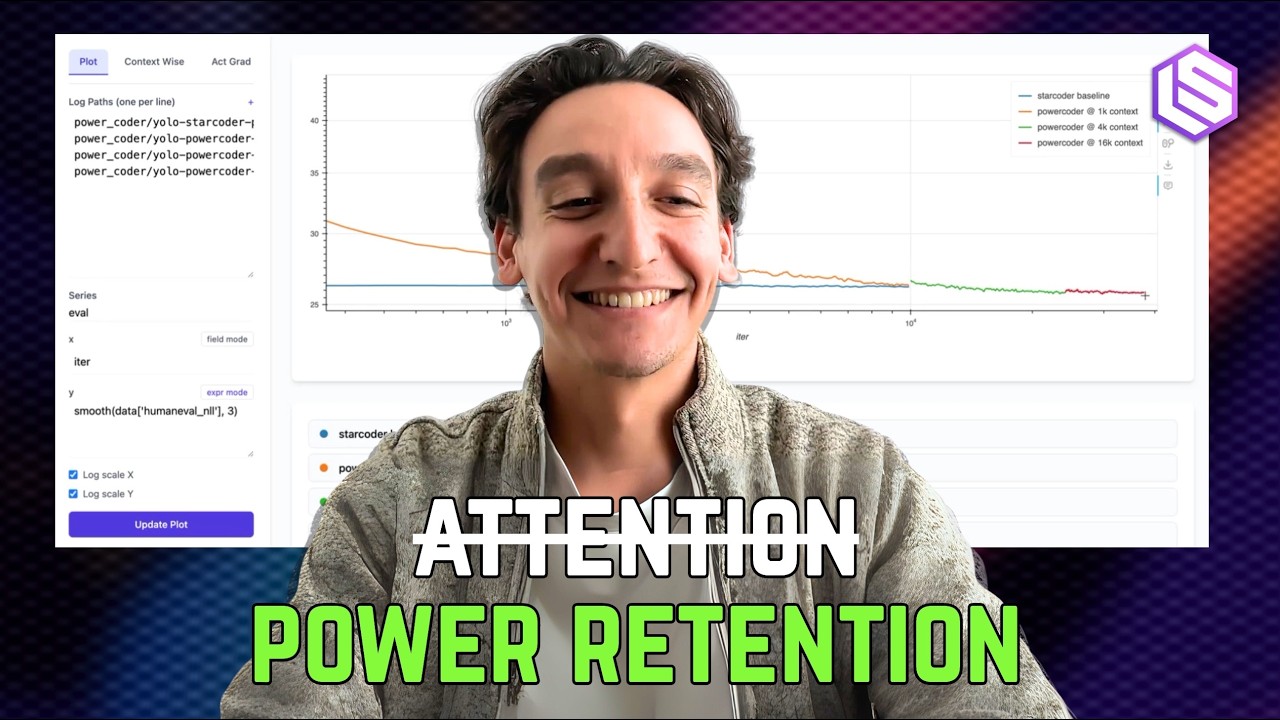
⚡️ Beyond Transformers with Power Retention
Sep 23, 2025 · 32:59
Jacob Buckman, CEO of Manifest AI, discusses their solution to AI's expensive computational bottleneck: the ever-growing KV cache for long context inference. Power Retention replaces attention in transformers with a fixed-size memory, achieving 10X training speedup at 64K tokens and 100X inference speedup over FlashAttention. Manifest releases Vidrial, a just-in-time CUDA kernel framework that finds optimal configurations, and Metamorphosis, a process to convert existing transformers like StarCoder-3B into Power Retention models in just two hours of mid-training. Buckman demonstrates PowerCoder, a 3B code model that matches baseline loss after 10K steps and handles contexts up to 32K and beyond. The open-source release includes kernels and tools, aiming to build community trust and encourage adoption by inference providers. He also highlights the need for genuinely long-context datasets beyond internet text, such as human trajectories.

Making Transformers Sing - with Mikey Shulman of Suno
Mar 14, 2024 · 58:58
In this episode of Latent Space, hosts Alessio and Shawn Wang interview Mikey Shulman, CEO of Suno, about making transformers sing. Suno uses transformers to predict audio tokens end-to-end, avoiding baked-in musical knowledge, with a tokenization secret sauce that also includes non-music audio for better vocal realism. Their models are relatively small (far below 175B parameters) due to latency needs, and they prioritize scaling research over brute-force size. Over half of Suno users employ expert mode, tweaking lyrics and style prompts, rather than easy mode. Shulman argues Suno is not the 'Midjourney of music' because music is inherently social and synchronous, unlike images. He demoed live generation, showing control via tokens like [beat drop] and style modifiers, and revealed future plans for collaborative concerts, continuous DJ modes, and personalized models. He also advocates for hiring economists to avoid Goodhart's law pitfalls in ML benchmarks, especially in audio where aesthetics matter most.
Powered by PodHood