
Lean
ProductA product discussed on Latent Space.
5 episodes

Scaling Past Informal AI - Carina Hong, Axiom Math
Jun 3, 2026 · 1:33:04
Carina Hong, founder and CEO of Axiom Math, argues that formal verification, not informal RL, is the path to superintelligence, following her company's $200M Series A at a $1.6B valuation and a perfect 120/120 on the 2024 Putnam exam. Axiom's system uses Lean theorem prover data and reinforcement learning to produce verified proofs, achieving a 99% pass rate on the Verina code-with-proof benchmark (187 of 189 problems). Hong contends verification is about 'scaling brilliance' — not fixing hallucinations — and that only verified generation can compound AI reasoning. She explains Axiom's open-source Axle API for Lean at scale, addresses why frontier labs like OpenAI have deprioritized formal math (team departures, strategy shifts), and outlines a vision where verified reasoning transfers from math to code, hardware, and eventually AGI through self-improvement. She also discusses the Earth sciences challenge of autoformalization, the difficulty of search in mathematical literature (citing the Erdos controversy), and why fragmentation in the AI math field is a bottleneck.
🔬How GPT‑5 derived new results in theoretical physics and quantum gravity — Alex Lupsasca, OpenAI
May 5, 2026 · 1:31:51
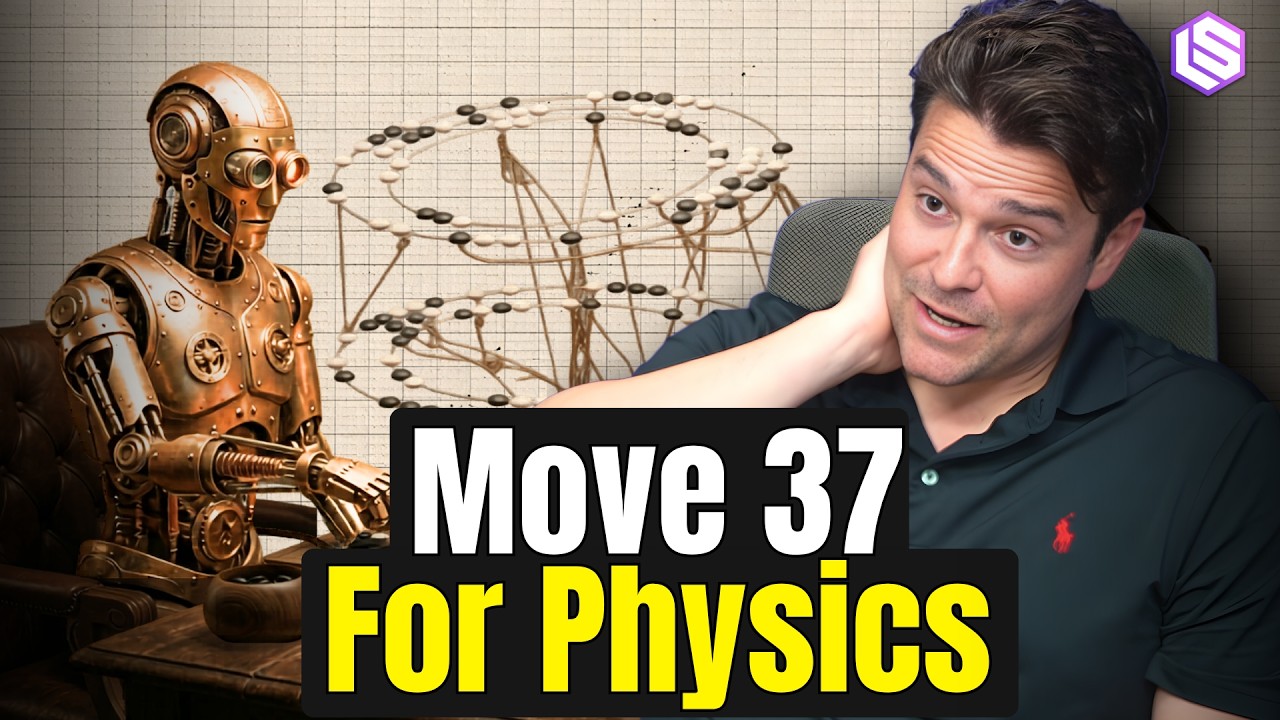
Alex Lupsasca, a theoretical physicist at OpenAI and recipient of the 2024 New Horizons Breakthrough Prize, details how GPT-5 and subsequent models derived new results in quantum field theory and quantum gravity, solving problems that had stumped experts for over a year. The work focused on 'single minus' gluon tree amplitudes, long believed to be zero, but which humans discovered might be non-zero in a special kinematic region. GPT-5.2 Pro conjectured a simplified formula for these amplitudes, and an internal OpenAI model later proved it, reducing a factorial number of Feynman diagram terms to a linear number. The AI then autonomously extended the result to graviton amplitudes using the gluon paper as a seed, producing a complete paper draft in under an hour. Lupsasca argues this marks a threshold where AI is superhuman on certain physics tasks, accelerating research by acting as a 'scout' that reduces confusion and suggests next questions. He also discusses challenges including AI slop on arXiv and the need for better verification methods.

Mistral: Voxtral TTS, Forge, Leanstral, & Mistral 4 — w/ Pavan Kumar Reddy & Guillaume Lample
Mar 30, 2026 · 54:02
Mistral releases Voxtral TTS, a 3B-parameter speech generation model using a novel autoregressive flow matching architecture and a 12.5 Hz neural audio codec developed in-house. Pavan Kumar Reddy and Guillaume Lample explain how the model achieves high quality and efficiency by predicting audio latents as a continuous distribution, enabling real-time voice agent applications. The episode details Mistral's stepwise multimodal strategy, starting with transcription and now speech generation, with full duplex voice agents as the next goal. Enterprise deployment via Mistral Forge allows fine-tuning on proprietary data, exemplified by training on rare languages or domain-specific jargon. Guillaume discusses merging capabilities (Mistral Small merging coding, reasoning, vision), commitment to open science through technical reports, and reasoning transfer from formal proofs in Lean. The episode also covers AI for science partnerships and hiring for research and forward-deployed engineering roles.

Captaining IMO Gold, Deep Think, On-Policy RL, Feeling the AGI in Singapore — Yi Tay
Jan 23, 2026 · 1:32:05
Yi Tay, who leads Google DeepMind's Reasoning and AGI team in Singapore, explains how Gemini Deep Think achieved IMO Gold by abandoning symbolic AlphaProof for an end-to-end RL-trained model. He details the on-policy RL philosophy—models learn from their own generated outputs rather than imitating others—and the critical role of self-consistency through parallel sampling and internal verification. Tay describes the IMO effort: four co-captains in different time zones, a one-week training sprint, a live competition in Australia where researchers punched in problems as they were released, and the tension of waiting for human scores to determine the gold threshold. He discusses why the team believes one model must subsume everything for AGI, the data efficiency gap compared to humans, and his hiring focus on raw talent and research taste. Tay also shares his personal fitness transformation—losing 23 kilos and improving HRV—as integral to research productivity.

⚡️Math Olympiad gold medalist explains OpenAI and Google DeepMind IMO Gold Performances
Jul 24, 2025 · 33:07
Dr. Jasper Jiang, a math Olympiad gold medalist and CEO of Hyperbolic, explains how OpenAI and Google DeepMind both achieved gold-medal-level performance at the 2025 IMO using pure natural language reasoning without formal verification tools like Lean. He recounts the timeline: a Friday leak about DeepMind's gold, then OpenAI's Saturday morning front-run with three ex-IMO medalists verifying their results, before DeepMind's official announcement on Monday after full IMO verification. Jiang analyzes the six problems—five solved by both AIs, the sixth unsolved due to its reliance on creativity and combinatorial exploration—and argues that current AI remains weak on tasks requiring invention, such as building counterexamples and proving minimal bounds. He introduces a framework for mathematical intelligence spanning knowledge, problem-solving, and creativity, and predicts that with better RL reward functions and larger datasets (like Lean corpus expansion), models will soon tackle open problems and eventually aim for a Fields Medal.
Powered by PodHood