
LangGraph
ProductA product discussed on Latent Space.
5 episodes

Brex’s AI Hail Mary — With CTO James Reggio (acquired for $5B by Capital One!)
Jan 17, 2026 · 1:13:27
Brex CTO James Reggio details the company's three-pillar AI strategy—corporate, operational, and product AI—arguing that SOP-driven agents outperform overengineered RL in finance ops like underwriting, KYC, and fraud. He explains why Brex built an internal AI platform (LLM gateway, prompt/version management, evals) before adopting Mastra for TypeScript-based multi-agent networks, where an EA-style orchestrator coordinates specialist agents via multi-turn conversations rather than single tool calls. The audit agent pattern separates detection, judgment, and follow-up to reduce false negatives. Brex also lets employees build their own AI stack (ChatGPT, Claude, Gemini) and runs agentic coding interviews internally, with the company growing 5X and cutting burn 99% in 18 months without adding engineers.
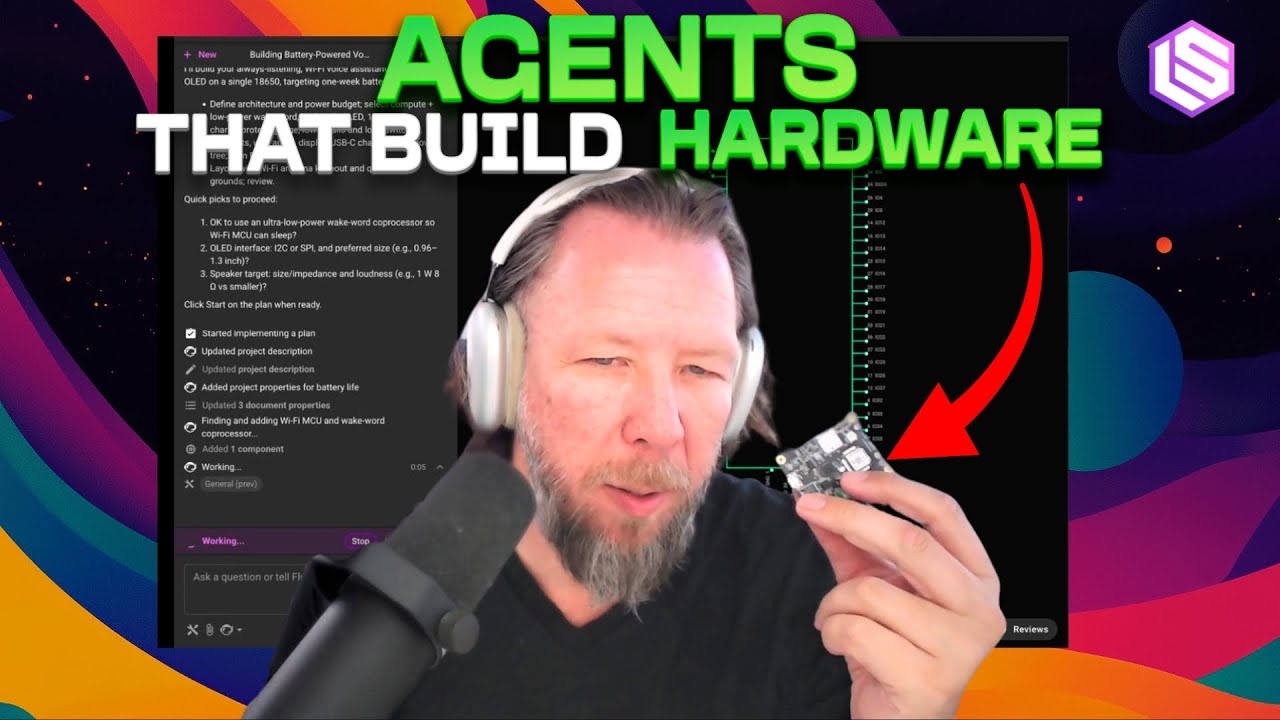
⚡️ Building the AI Hardware Engineer with Matthias Wagner, Co-founder of Flux
Nov 22, 2025 · 49:03
Matthias Wagner, CEO of Flux.ai, describes building the "AI hardware engineer" that turns product briefs into manufacturable PCB designs in under 30 minutes. After leaving Meta in 2019, Wagner built a browser-based collaborative CAD tool from scratch, designed as a reinforcement learning environment. The emergence of LLMs and reliable tool calling let Flux's agents search component libraries, check pricing and availability, and execute complex designs autonomously. In a live demo, Wagner designs a battery-powered Alexa-like device with ESP32, microphones, OLED display, and speaker in about 25 minutes. Flux now has 7,000 paying customers, growing 26x year over year, and Wagner envisions eventually letting users prompt full hardware products like smartphones into existence, claiming the cost of custom manufacturing is plummeting.
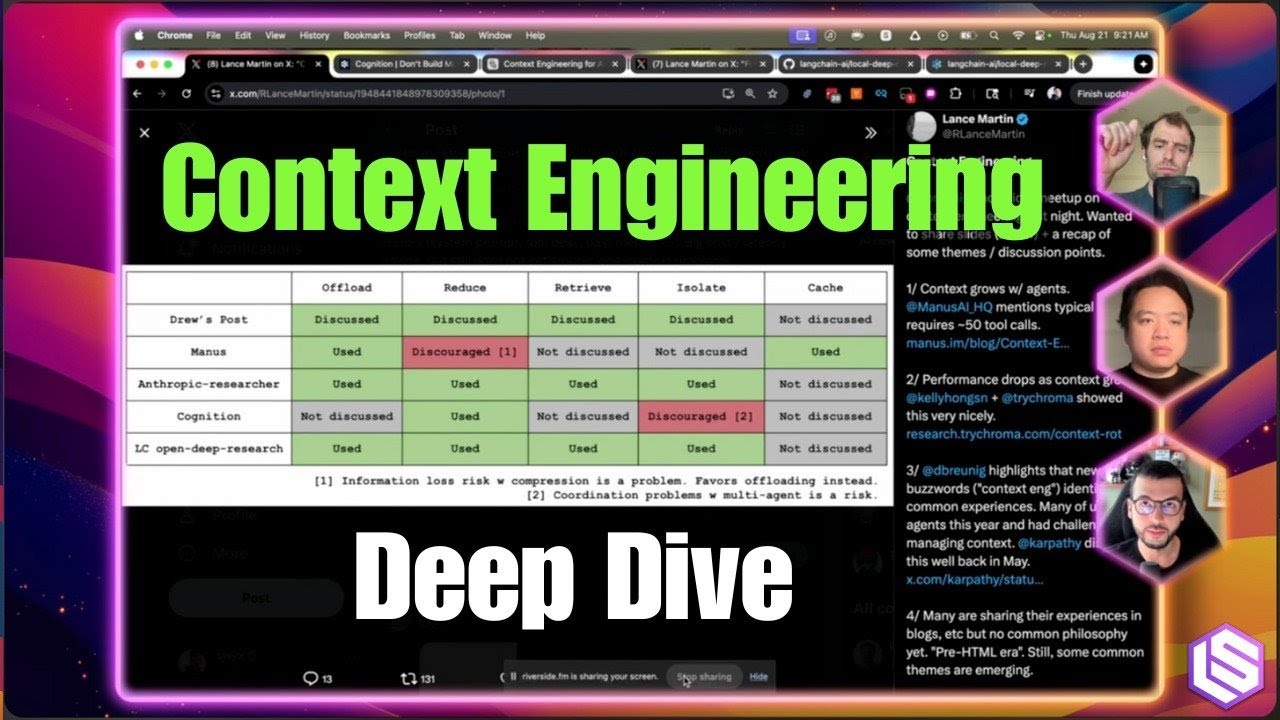
Context Engineering for Agents - Lance Martin, LangChain
Sep 11, 2025 · 1:03:18
Lance Martin from LangChain discusses context engineering for AI agents, arguing that managing context from tool calls is the key challenge and introducing five techniques: offloading, reducing, retrieval, caching, and context isolation. Offloading saves raw tool call outputs to disk and passes only summaries, drastically cutting token usage—Martin's deep research agent went from 500,000 tokens per run to much less. Manus uses file system offloading and warns that irreversible pruning risks information loss, while Cognition advocates fine-tuned summarization for agent-agent boundaries. For retrieval, Martin contrasts Windsurf's multi-step indexing with Claude Code's agentic search using grep and llms.txt, finding the latter more effective. He applies the Bitter Lesson to agent engineering: his own Open Deep Research evolved from a highly structured workflow to a simple agent loop as models improved, and he warns against rigid abstractions that hinder adaptation.

The Agent Network — Dharmesh Shah, Agent.ai + CTO of HubSpot
Mar 28, 2025 · 1:42:28
Dharmesh Shah, founder of Agent.ai and co-founder of HubSpot, defines an AI agent broadly as AI-powered software that accomplishes a goal, and argues that the next frontier is multi-agent systems and shared memory across agents. He reveals Agent.ai has 1.3M users and 3,000 published agents, positioning it as a professional network where agents have profiles, post release notes, and can be composed via MCP servers. Shah contrasts work as a service (paying for the work done) versus results as a service (paying for outcomes), warning that results-based pricing only works for objectively measurable, low-variance tasks like customer support tickets. He advocates for MCP as the standard for agent-tool discovery, and shares his personal engineering philosophy of preferring under-engineering over over-engineering because the cost to fix later trends toward zero with AI code generation. Shah also discusses his domain investing strategy (owning chat.com, prompt.com, crew.ai), his rule against competing with Sam Altman, and the 'Sorry Must Pass' framework for managing overwhelm by defaulting to no.

Language Agents: From Reasoning to Acting — with Shunyu Yao of OpenAI, Harrison Chase of LangGraph
Sep 27, 2024 · 1:26:33
Shunyu Yao of OpenAI and Harrison Chase of LangChain discuss the evolution of language agents, arguing that combining reasoning and acting through techniques like ReAct remains foundational, while tool design and cognitive architectures like CoALA will shape the next wave. Shunyu traces his work from text games to ReAct, showing how thinking as an action improves reliability; Harrison explains LangChain's adoption and the shift to LangGraph for stateful orchestration. They emphasize agent-computer interfaces (ACI) as a neglected area, noting that SWE-Agent's success came from optimizing tools for models, not humans. The conversation covers memory types (semantic, episodic, procedural) and applies CoALA's three dimensions to current systems. They highlight promising applications: customer support, coding agents, and spreadsheet-style UX for batch operations. Shunyu stresses that better benchmarks like SWE-Bench (which solved 30% of GitHub issues) and TauBench (best model 48%) are critical, and that data—not architecture—will drive future model improvements.
Powered by PodHood