
LangChain
ProductA product discussed on Latent Space.
21 episodes
⚡️ Competing with ChatGPT and Sierra, building a $10M ARR company — Yasser Elsaid, Founder, Chatbase
May 2, 2026 · 1:00:26
Yasser Elsaid, founder of bootstrapped AI chatbot company Chatbase, discusses how he grew from a side project to $10M ARR in three years, reaching $1M in just 117 days. He explains why he never raised VC, relying instead on product-led growth, self-serve signups, and a content-driven go-to-market strategy. Elsaid shares specific tactics like warm outbound to signed-up users, leveraging LinkedIn virality in early AI days, and now moving toward outcome-based pricing for enterprise customers. He details Chatbase's evolution from a simple RAG chatbot into a 'chief customer officer' that handles support, sales, and onboarding while surfacing business insights from conversations. The episode also covers his transition from Toronto to San Francisco, his hiring philosophy favoring results-oriented engineers, and his daily use of both Claude Code and Codex for development.

⚡️Context Graphs: according to the authors — Jaya Gupta, Ashu Garg, Foundation Capital
Feb 4, 2026 · 33:44
Jaya Gupta and Ashu Garg of Foundation Capital introduce Context Graphs—the institutional memory of the 'why' behind business decisions, captured through decision traces of exceptions, overrides, and precedents that AI models often miss. They argue these graphs will become the defensible moat for the next generation of applied AI companies and Systems of Agents, citing early implementations at Player Zero, Olive, and Tesserae. The hosts distinguish Context Graphs from mere metadata or data meshes, emphasizing they emerge organically from automating specific workflows rather than as universal enterprise schemas. They predict that by 2026, hundreds of Context Graphs will be in production, a standard enabling stack will emerge, and the industry will shift from debating definitions to extracting value from the captured decision traces.

Brex’s AI Hail Mary — With CTO James Reggio (acquired for $5B by Capital One!)
Jan 17, 2026 · 1:13:27
Brex CTO James Reggio details the company's three-pillar AI strategy—corporate, operational, and product AI—arguing that SOP-driven agents outperform overengineered RL in finance ops like underwriting, KYC, and fraud. He explains why Brex built an internal AI platform (LLM gateway, prompt/version management, evals) before adopting Mastra for TypeScript-based multi-agent networks, where an EA-style orchestrator coordinates specialist agents via multi-turn conversations rather than single tool calls. The audit agent pattern separates detection, judgment, and follow-up to reduce false negatives. Brex also lets employees build their own AI stack (ChatGPT, Claude, Gemini) and runs agentic coding interviews internally, with the company growing 5X and cutting burn 99% in 18 months without adding engineers.

[State of Research Funding] Beyond NSF, Slingshots, Open Frontiers — Andy Konwinski, Laude Institute
Dec 31, 2025 · 22:34
Andy Konwinski, co-founder of Databricks and Perplexity, launches Laude Institute—a dual venture fund and nonprofit to accelerate the path from open research to breakout companies. At NeurIPS, he explains how Laude's Slingshot program funds projects like DSPy, Terminal Bench, and LMArena, and why the NSF's $1B/year for CS is insufficient, needing $10-100B for frontier AI. He argues Chinese labs (Moonshot, DeepSeek) now outpublish US because OpenAI and others stopped sharing; Open Frontiers, a live-streamed conference in SF, aims to unite top open researchers (Yann LeCun, François Chollet, Jan Leike) to reclaim global leadership. The episode also spotlights the emerging 'post-post-training' layer—prompt optimization, context management, RAG—and why research teams with multiple co-founders (like Databricks' eight) are the new gold standard for AI startups.
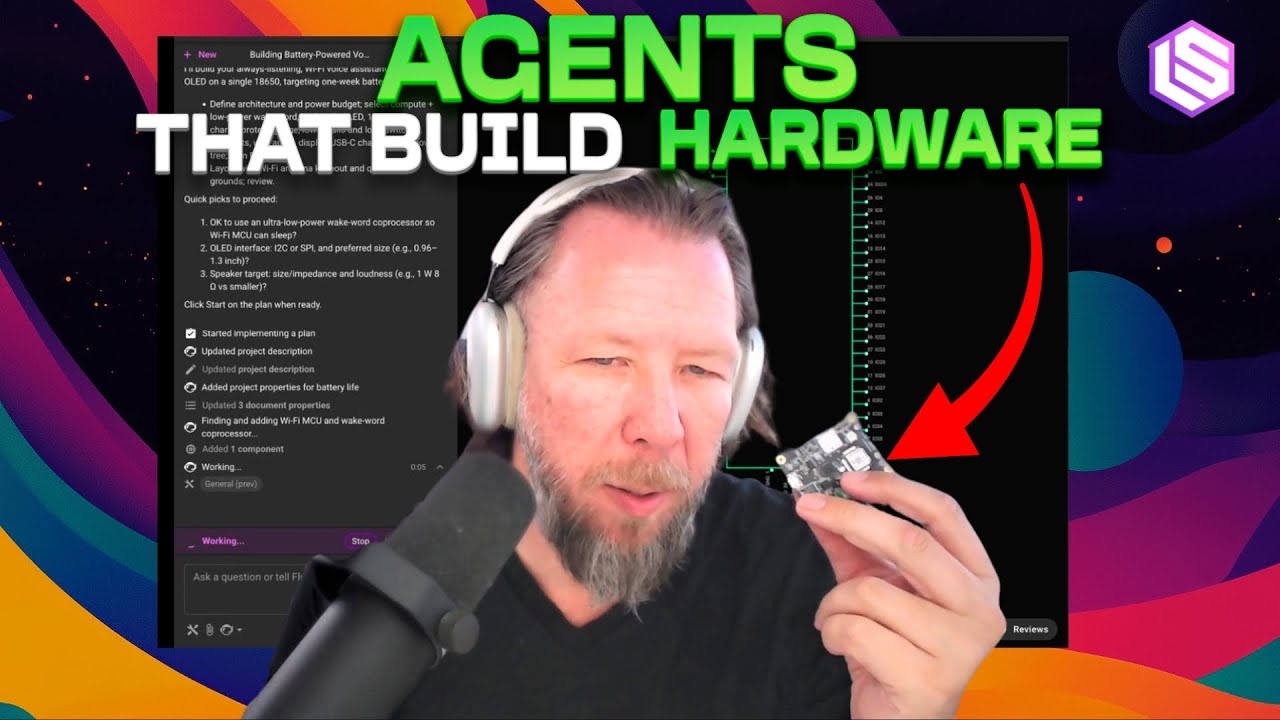
⚡️ Building the AI Hardware Engineer with Matthias Wagner, Co-founder of Flux
Nov 22, 2025 · 49:03
Matthias Wagner, CEO of Flux.ai, describes building the "AI hardware engineer" that turns product briefs into manufacturable PCB designs in under 30 minutes. After leaving Meta in 2019, Wagner built a browser-based collaborative CAD tool from scratch, designed as a reinforcement learning environment. The emergence of LLMs and reliable tool calling let Flux's agents search component libraries, check pricing and availability, and execute complex designs autonomously. In a live demo, Wagner designs a battery-powered Alexa-like device with ESP32, microphones, OLED display, and speaker in about 25 minutes. Flux now has 7,000 paying customers, growing 26x year over year, and Wagner envisions eventually letting users prompt full hardware products like smartphones into existence, claiming the cost of custom manufacturing is plummeting.

⚡️ Ship AI recap: Agents, Workflows, and Python — w/ Vercel CTO Malte Ubl
Nov 1, 2025 · 42:02
Vercel CTO Malte Ubl discusses the company's AI strategy, centered on the new Workflow Development Kit that enables durable, resumable serverless functions with infinite idle time at no cost. He explains how the AI SDK was extracted from v0 and remains deliberately low-level to accommodate emerging patterns, with a direct agent abstraction now stable in version six. Ubl details Vercel's internal agents—including a DevOps agent that investigates production anomalies by querying observability data and logs, solving the recall-precision problem in alerting—and the 'Agent on Every Desk' program that helps large companies build their first three agents. He also covers zero-config Python support for Flask and FastAPI, and a security model that assumes developers cannot be trusted, extracting auth and data access from application code.

Building Jamba 3B: the tiny Hybrid Transformer State Space Reasoning Model - Barak Lenz, CTO of AI21
Oct 11, 2025 · 45:05
Barak Lenz, CTO of AI21, presents their Jamba 3B model as a tiny hybrid transformer-state space model that brings long context capabilities to edge devices, and argues enterprises need AI systems like Maestro over standalone models. Lenz explains that the 1:8 ratio of attention to Mamba layers emerged from extensive ablations, with attention placed in the middle of the block working best. The Jamba 3B model uses a 1:12 ratio to maximize efficiency, fitting the same context length as larger models with a fraction of memory. He notes that pure Mamba underperformed on some tasks but hybrid models resolved those deficiencies, and that images quickly become long context problems (4 images can be thousands of tokens). For enterprise, Lenz advocates for model-agnostic orchestration layers treating models as "actions" with statistical properties, enabling continuous learning and cost optimization without vendor lock-in. Drawing from his algo trading background, he compares training frontier models to developing trading algorithms, emphasizing the importance of world-class engineering and avoiding brute force reasoning.

Long Live Context Engineering - with Jeff Huber of Chroma
Aug 19, 2025 · 57:01
Jeff Huber, founder and CEO of Chroma, joins Shawn Wang and Alessio to argue that context engineering—not RAG—is the real job of AI builders, and that Chroma's modern retrieval engine is built for this new paradigm. Huber explains context rot, a phenomenon where LLMs lose attention and reasoning ability as context windows grow, motivating precise retrieval over huge context windows. Chroma Cloud is a zero-config, usage-based serverless vector database with separation of storage and compute, now powering 5M monthly downloads and 21k GitHub stars. He shares techniques like chunk rewriting and generative benchmarking for evaluating retrieval, and predicts LLMs will increasingly serve as re-rankers. The episode also covers memory as a benefit of context engineering, offline compaction for self-improving AI systems, and Huber's philosophy of building with long-term purpose, hiring engineers who care about Rust, TLA+, and deterministic simulation testing.

Why Every Agent needs Open Source Cloud Sandboxes
Apr 24, 2025 · 1:06:39
Vasek Mlejnsky, CEO of E2B, explains how his company grew from 40,000 sandboxes in March 2024 to 15 million in March 2025 by providing cloud sandboxes for AI agents. Originally built from DevBook's interactive docs playground, E2B now serves use cases from code interpreting and data analysis to Computer Use and reinforcement learning with Hugging Face's Open R1. The sandboxes are general Linux VMs with fast startup, security isolation, and persistence, handling untrusted code and allowing forking/checkpoints for parallel agent execution. Mlejnsky discusses the LLMOS landscape, pricing challenges (moving from token-based to value-based), MCPs as higher-order tools, and why he relocated from Prague to San Francisco to be closer to users. E2B is hiring across engineering and customer success as it aims to become full-lifecycle infrastructure for LLMs.
Agent Engineering with Pydantic + Graphs — with Samuel Colvin, CEO of Pydantic Logfire
Feb 6, 2025 · 1:02:15
Samuel Colvin, CEO of Pydantic Logfire, argues that Pydantic AI offers a production-ready agent framework with type-safe graphs, unlike most agent frameworks that sacrifice engineering quality. He explains Pydantic's shift from a validation library to an AI tool, noting 300M monthly downloads and a 20% reduction in time-to-first-token for a major model company after upgrading to Pydantic V2. Colvin details Logfire's use of DataFusion over ClickHouse for better JSON support and control, and why Pydantic AI resists an LLM gateway, favoring OpenAI-aligned APIs. He defends graphs for complex workflows, reveals agents now use graphs internally, and shares that Pydantic.run enables browser-based demos. The episode covers OpenTelemetry's emerging GenAI semantic conventions, the need for self-hosted observability due to PII in LLM data, and Colvin's investment in Marimo as a text-based Jupyter replacement.

Why every AI Engineer needs an AI Gateway (ft Portkey.ai CEO)
Feb 5, 2025 · 31:18
Rohit Agarwal, CEO of Portkey, explains why every AI engineer needs an AI gateway: an operational platform that connects to LLMs more efficiently, handling routing, observability, guardrails, and cost management. He notes that 90% of production use cases don't use automatic routing, but reasoning models and agents are driving new routing demands. Portkey's open-source gateway minimizes latency with a 21 MB memory footprint using JSON transformers. Key jobs include routing, observability (monitoring price, performance, accuracy), guardrails (e.g., regex-based, empty output detection, PII redaction), and human feedback tied to business metrics like video download rates. Rohit also highlights MCP adoption for simplifying agent-to-service connections, with bidirectional communication via RPC.

Agents @ Work: Lindy.ai (with live demo!)
Nov 15, 2024 · 1:08:01
Florent Crivello, founder of Lindy.ai, explains how his no-code agent platform evolved from an overly LLM-dependent design to a deterministic 'on rails' system that puts AI in a box, making agents more reliable and easier to use. The product was rebuilt from scratch as Lindy 2.0, featuring step-by-step workflows with structured outputs and memory management that still requires pruning. Crivello reveals that Claude 3.5 Sonnet ended model bottlenecks but warns against over-engineering cognitive architectures, advocating instead for letting models scale. He discusses building their own eval tools (now considering Braintrust), hiring vertical GMs for go-to-market, and the decision to return to in-person work, arguing remote work hampers creativity. He also shares his contrarian views on Europe vs. US tech, testing the Overton window with spicy tweets, and balancing AI safety concerns (10% p(doom)) with building toward a potential utopia.
Agents @ Work: Dust.tt — with Stanislas Polu
Nov 11, 2024 · 58:53
Stanislas Polu, co-founder of Dust.tt, argues that horizontal agent platforms—not vertical, single-use-case agents—will win the enterprise by letting non-technical employees build their own automation. A former OpenAI researcher who worked directly with Ilya Sutskever on formal mathematics and saw GPT-4 internally before ChatGPT, Polu left in 2022 to start Dust, now an open-source infrastructure layer that connects company data (Slack, Notion, GitHub) to LLMs and lets anyone create simple, instruction-driven agents. He contrasts Dust’s API-first, integration-heavy approach with LangChain’s open-source orchestration and Adept’s browser automation bet, insisting that most useful agent workflows require only a few tool calls and that function-calling quality (where GPT-4 Turbo still leads) matters more than model size. Dust achieves 88% daily active user penetration at some enterprise customers, and Polu predicts the first billion-dollar company run by a single person will emerge once platforms like Dust mature enough to let tiny teams scale to massive output.

Language Agents: From Reasoning to Acting — with Shunyu Yao of OpenAI, Harrison Chase of LangGraph
Sep 27, 2024 · 1:26:33
Shunyu Yao of OpenAI and Harrison Chase of LangChain discuss the evolution of language agents, arguing that combining reasoning and acting through techniques like ReAct remains foundational, while tool design and cognitive architectures like CoALA will shape the next wave. Shunyu traces his work from text games to ReAct, showing how thinking as an action improves reliability; Harrison explains LangChain's adoption and the shift to LangGraph for stateful orchestration. They emphasize agent-computer interfaces (ACI) as a neglected area, noting that SWE-Agent's success came from optimizing tools for models, not humans. The conversation covers memory types (semantic, episodic, procedural) and applies CoALA's three dimensions to current systems. They highlight promising applications: customer support, coding agents, and spreadsheet-style UX for batch operations. Shunyu stresses that better benchmarks like SWE-Bench (which solved 30% of GitHub issues) and TauBench (best model 48%) are critical, and that data—not architecture—will drive future model improvements.

[Paper Club] Writing in the Margins: Chunked Prefill KV Caching for Long Context Retrieval
Sep 19, 2024 · 53:53
Umar Jamil from Writer presents 'Writing in the Margins,' a paper on improving long-context retrieval in LLMs by leveraging chunked prefill of the KV cache. The method splits a long prompt into chunks, generates query-relevant annotations (margins) after each chunk, and appends them at the end before generating the final answer. This approach solves the 'lost in the middle' problem without fine-tuning, and unlike traditional RAG or separate summarization, it avoids re-prefilling the entire context, reducing cost from double to single prefilling. The technique is compatible with any transformer model and includes overlapping margin generation and classification within the same batch request. Benchmarks show consistent improvements across models, and the implementation is open-source on GitHub.

High Agency Pydantic over VC Backed Frameworks — with Jason Liu of Instructor
Apr 24, 2024 · 1:02:59
Jason Liu, creator of the Instructor library, explains why structured outputs from LLMs are best handled by a simple requests-like wrapper rather than a VC-backed framework, arguing that Pydantic-defined schemas via function calling outperform JSON Mode for typed responses. He details his journey from being bearish on LLMs at StitchFix to building Instructor on a bullet train to Japan after GPT-3 proved him wrong. Liu advocates for workflow-based DAGs over reactive agent loops, recommends using rankers rather than cramming 60+ tools into an API call, and credits high agency—trying many experiments and documenting conditions for revisiting failures—as key to his success. He also critiques the MLE hiring hype, urging startups to empower motivated AI engineers instead.
The State of AI in production — with David Hsu of Retool
Feb 7, 2024 · 1:06:52
Retool CEO David Hsu shares insights from the company's 2023 State of AI survey, revealing that most AI adoption remains internal and that the hype may be overrated—52% of 1,600 respondents said AI is overrated, and only 27% have AI in production, with 66% of those being internal use cases. He explains Retool's developer-first philosophy, their choice of open-source PG Vector over proprietary solutions, and why they intentionally raised less money at lower valuations to avoid over-dilution. Hsu describes Retool's shift from sales-led to bottom-up growth to reach millions of developers, and highlights the importance of AI workflows over simple chatbots, citing a clothing manufacturer that uses Retool apps with DALL-E to generate patterns. He discusses the competitive landscape, predicting open-source models will eventually catch up to OpenAI, and shares philosophical views on AGI using the plane-vs-bird analogy.

The Four Wars of the AI Stack - Dec 2023 Recap
Jan 26, 2024 · 1:20:58
Swyx and Alessio recap December 2023 by framing the AI landscape as four wars: the Data War (NYT lawsuit demanding destruction of GPTs, OpenAI's data partnerships, synthetic data from DeepMind); the GPU/Inference War (Mixtral price dropping 90% to $0.27/million tokens, benchmark drama between Anyscale and Together, alternative architectures like Mamba); the Multimodality War (Midjourney reaching $200M ARR, ElevenLabs hitting unicorn status, OpenAI and Google building god models); and the RAG/Ops War (LangChain vs LlamaIndex, Pinecone's $750M valuation, Qdrant serving OpenAI and Anthropic internally). They argue agents and open source are not active wars, and predict 2024 will see AI finally reach production, with hardware like Rabbit R1 and Tab capturing unique context.
Powering your Copilot for Data - with Artem Keydunov from Cube.dev
Oct 27, 2023 · 43:01
Artem Keydunov, co-founder of Cube (formerly Statsbot), explains how his early text-to-SQL Slack bot in 2016 led to the creation of Cube as a semantic layer, which he argues is now essential for grounding AI models on structured data. Statsbot failed due to the lack of LLMs, relying on regex and custom models, but the underlying Cube framework—an open-source semantic layer defining metrics and dimensions—solved the context problem. Today, semantic layers index data into text descriptions, enabling agents to generate simple queries against the layer instead of complex SQL, reducing errors. Keydunov highlights that natural language querying is becoming a commodity feature in BI tools, but the real value lies in treating metric definitions as code with version control. He advises AI engineers to use a proper warehouse, a semantic layer like Cube, and tools like LangChain, while cautioning that production systems need extra Python code for math and error handling.
RAG is a hack - with Jerry Liu of LlamaIndex
Oct 12, 2023 · 1:13:25
In this episode of Latent Space, Jerry Liu of LlamaIndex argues that while RAG is fundamentally a hack, it remains the most practical approach for grounding LLMs with external data, and his open-source framework now serves 600,000 monthly downloads. Liu recounts how LlamaIndex originated from a hackathon at Robust Intelligence, evolving from an experimental tree-index to a modular toolkit spanning data loading, retrieval, synthesis, and agent loops. He explains the trade-offs between RAG and fine-tuning, noting that context window limits force algorithmic rather than learned optimizations, but RAG offers transparency and access control that fine-tuning cannot. Liu details the company’s $8.5M Greylock raise, the launch of LlamaHub for community-contributed data loaders, and the open-source SEC Insights app as a production-grade template. Looking ahead, he emphasizes the need for better retrieval benchmarks and predicts that future personalization will move beyond vector stores into model-internal memory architectures.

Generating your AI Media Empire - with Youssef Rizk of Wondercraft.ai
Sep 20, 2023 · 1:28:55
Youssef Rizk, co-founder of Wondercraft.ai, explains how his five-month-old startup uses hyperrealistic AI voices to turn blogs, newsletters, and other content into podcasts, arguing that the application layer—not the underlying API—is the real moat. He details Wondercraft's origin from a failed sports-investing startup, the rapid MVP that generated $3K in one day, and the decision to build script generation and audio production tools rather than train its own models. Rizk also announces a new AI dubbing feature for video, discusses the challenges of scaling to 28 languages, and reveals that the company runs on just four people pushing two major features per week. The conversation covers the daily Hacker News Recap podcast—which reached Spotify's top 30 tech podcasts—and Rizk's view that AI-generated content must be clearly disclosed to avoid backlash.
Powered by PodHood