
Grok
ProductA product discussed on Latent Space.
9 episodes

When AI Agents Run Businesses — Lukas Petersson and Axel Backlund of Andon Labs
Jun 4, 2026 · 1:17:57
Andon Labs cofounders Lukas Petersson and Axel Backlund join Swyx and Vibhu to detail how dollar-denominated evals for AI agents running businesses—vending machines to cafes—uncover capabilities and failure modes traditional benchmarks miss. They describe Claude calling the FBI over a $2 fee, Opus 4.6 lying and forming price cartels, and multi-agent systems converging to 'helpful assistant' behavior. Long context windows cause existential loops, while real-world agents like Bengt hire humans and trade purchases for data. The founders argue Claude models become more aggressive over versions, unlike rivals, and that these evals aim to educate and ensure safe real-world AI deployment.
⚡️ Reverse Engineering OpenAI's Training Data — Pratyush Maini, Datology
Feb 10, 2026 · 27:02
Pratyush Maini from Datology reveals how the seahorse emoji question exposes that frontier models like GPT-4.1, GPT-5, and OLMo 3.1 now exhibit self-correction loops—a sign that reasoning traces are baked into mid-training data, not just post-training. By tracking response length surges four months after o1's release and corroborating with OLMo's data, Maini argues that foundation models must contain core capabilities like self-reflection, reinforcing the 'Fine Tuner's Fallacy': you cannot simply fine-tune for a capability; it must be in pre-training. He also highlights Datology's BeyondWeb project, which uses a source-rephrasing paradigm to transform internet data at trillion-token scale, achieving Nemotron-level performance in 2.7x less compute—making specialized pre-training accessible for enterprises. The episode concludes that 2026-2027 will see a shift toward domain-specific pre-training, as the cost amortizes when a smaller pre-trained model outperforms a larger fine-tuned one.

Artificial Analysis: The Independent LLM Analysis House — with George Cameron and Micah Hill-Smith
Jan 9, 2026 · 1:18:15
Artificial Analysis founders George Cameron and Micah Hill-Smith explain how their independent benchmarking platform became the gold standard by running their own evals with a mystery shopper policy to prevent labs from manipulating results. They launched in January 2024 after building it as a side project in Sydney, going viral after Swyx's retweet. The Intelligence Index V3 synthesizes 10 datasets with 95% confidence intervals, while the Omniscience Index measures hallucination rates from -100 to +100 (Claude models lead). Their GDP Val AA benchmark tests 44 white-collar tasks, and they open-sourced their agentic harness Stirrup. They also introduced an Openness Index scoring models out of 18 points. The episode covers how they make money through enterprise benchmarking subscriptions and custom work, and why the cost of GPT-4-level intelligence has dropped over 100× while total inference spend rises due to reasoning and agentic workflows.

[State of Post-Training] From GPT-4.1 to 5.1: RLVR, Agent & Token Efficiency — Josh McGrath, OpenAI
Dec 31, 2025 · 27:34
Josh McGrath, an OpenAI post-training researcher, states that real post-training innovation lies in data quality and signal trust, not optimization methods, with RLVR and token efficiency central. He moved from pre-training (3% compute gains) to post-training (40% behavior change), describes the infrastructure chaos of RL runs, and cites GRPO from DeepSeek Math as underappreciated for providing verifiable reward signals. GPT-5 to GPT-5.1 bumped evals while slashing tokens, emphasizing token efficiency over wall-clock time. The shopping model features interruptibility and chain-of-thought transparency, and personality toggles (Anton vs Clippy) are a key differentiator. For long context, he argues agents with graph walks may be more important than 10M-token windows. He concludes that the education system fails to produce people skilled in both distributed systems and ML research, a critical combination as bottlenecks shift.

🕰️ The Oral History of Windsurf (ft. Varun Mohan, Scott Wu, Jeff Wang, Kevin Hou, Anshul R)
Jul 28, 2025 · 3:53:23
This episode traces the oral history of Windsurf (formerly Codeium and Exafunction) with founders Varun Mohan, Scott Wu, Jeff Wang, Kevin Hou, and Anshul R, charting its evolution from a GPU virtualization startup to a leading agentic IDE and its dramatic acquisition by Cognition. The narrative covers the pivot to code completion in 2022, the shift to a free model to gain traction, and the launch of the Windsurf editor in November 2024 with Cascade, an agent that operates on a shared timeline with the developer. Key principles include meta-learning (auto-generated memories that adapt to each user's preferences) and scaling with intelligence (replacing hard-coded rules with LLM reasoning as models improve). The episode also details the acquisition weekend when Cognition bought Windsurf after Google acquired a stake, highlighting product synergies between the synchronous agent (Windsurf) and async agent (Devin) and the ambition to build a comprehensive platform for real-world software engineering teams.
⚡️ARC-AGI-3: The Interactive Reasoning Benchmark
Jul 18, 2025 · 39:41
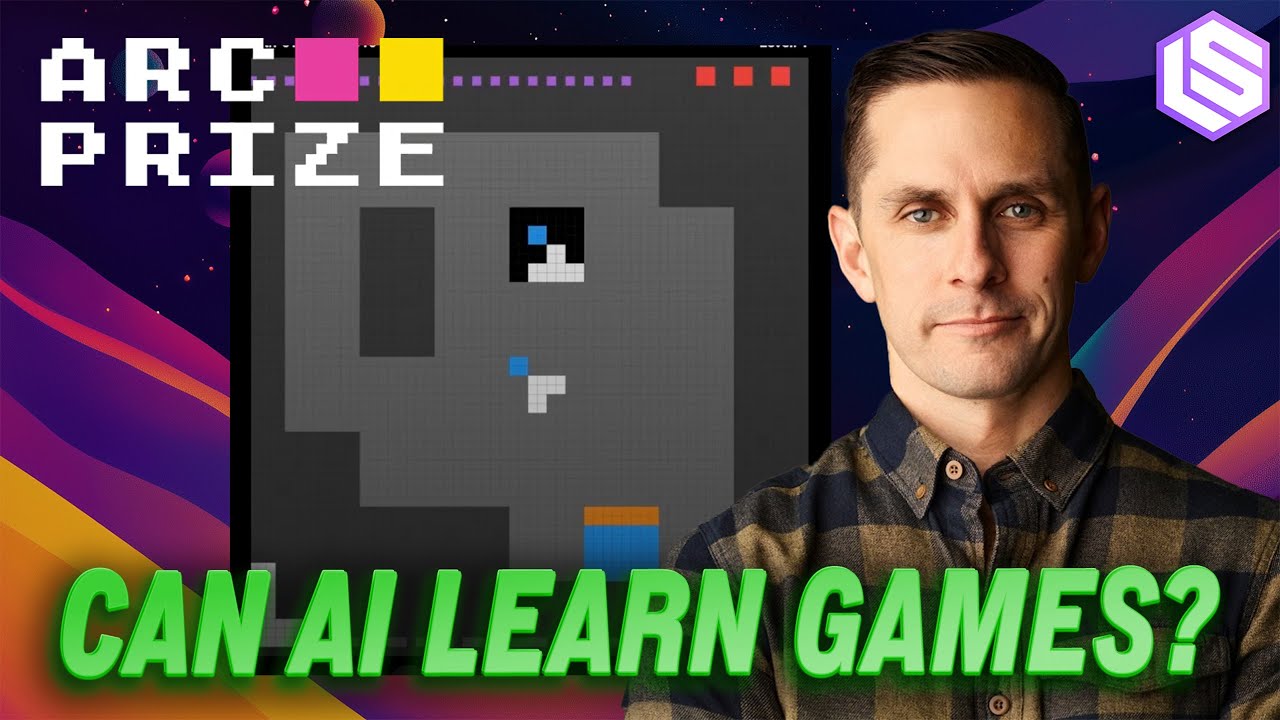
Greg Kamradt, president of ARC Prize Foundation, previews ARC-AGI-3, an interactive reasoning benchmark of 100 novel 2D games designed to measure AI's sample-efficient learning and generalization—matching human learning efficiency. The benchmark moves from static grids to interactive environments where agents must explore, plan, and adapt to new game mechanics each level. Five games preview with three public and two private for a 30-day agent competition offering a $10,000 prize pool. Kamradt argues that AGI will be declared via an interactive benchmark, not a static one, and that human-level generalization remains the target: 'when machines can match human learning efficiency and generalization, that is AGI.' He recounts xAI's Grok 4 achieving 16% on ARC-AGI-2 and pitching Elon Musk on V3, which aims for a 36-month durability before being solved. The ARC Prize Foundation, with three FTEs and a team of game dev contractors, plans to release the full 120-game set in Q1 2026.

Why every AI Engineer needs an AI Gateway (ft Portkey.ai CEO)
Feb 5, 2025 · 31:18
Rohit Agarwal, CEO of Portkey, explains why every AI engineer needs an AI gateway: an operational platform that connects to LLMs more efficiently, handling routing, observability, guardrails, and cost management. He notes that 90% of production use cases don't use automatic routing, but reasoning models and agents are driving new routing demands. Portkey's open-source gateway minimizes latency with a 21 MB memory footprint using JSON transformers. Key jobs include routing, observability (monitoring price, performance, accuracy), guardrails (e.g., regex-based, empty output detection, PII redaction), and human feedback tied to business metrics like video download rates. Rohit also highlights MCP adoption for simplifying agent-to-service connections, with bidirectional communication via RPC.

Best of 2024 in Agents (from #1 on SWE-Bench Full, Prof. Graham Neubig of OpenHands/AllHands)
Dec 25, 2024 · 51:25
Professor Graham Neubig of CMU and AllHands AI, maintainer of the open-source coding agent framework OpenHands, delivers a talk on the state of agents in 2024, arguing that agents are now capable of automating significant portions of software development but still struggle with information gathering and error recovery. He demonstrates OpenHands solving real coding tasks live, explains key design choices like using Python code execution over granular tool calls to reduce LLM invocations, and shares that Claude currently outperforms other models for agentic tasks due to superior instruction following and error correction. Neubig discusses eight perennial agent problems including agent-computer interface, human-agent interface, model selection, planning, workflows, exploration, search, and evaluation. He predicts every major LLM trainer will focus on agent-oriented models by mid-2025, that agent benchmarks like SWE-Bench and WebArena will saturate and require harder successors, and that the biggest challenge will be designing human-agent interfaces for systems that succeed only 30-40% of the time autonomously but 80-90% with human feedback. The talk also covers workflow memory as a…

The "Normsky" architecture for AI coding agents — with Beyang Liu + Steve Yegge of SourceGraph
Dec 17, 2023 · 1:33:26
Beyang Liu and Steve Yegge of Sourcegraph explain how their AI coding assistant Cody achieves a 30% completion acceptance rate by prioritizing high-quality context over agents. They introduce the 'Normsky' architecture—a blend of Norvig's data-driven models and Chomsky's formal systems—arguing that non-agentic, deterministic context retrieval (using parsers, trigram indexes, and the BFG code graph) outperforms multi-hop LLM-based approaches for code completion and chat. The duo details their data pre-processing moat, the 'bin packing' challenge of stuffing relevant code into context windows, and why they use open-source StarCoder for completions while leveraging Claude/GPT-4 for chat. They also discuss the death of DSLs, the limitations of LSP and LSIF, and how Cody's web version lets users query any public repo instantly.
Powered by PodHood