
GPT-4
ProductA product discussed on Latent Space.
32 episodes
Inside AI’s $10B+ Capital Flywheel — Martin Casado & Sarah Wang of a16z
Feb 19, 2026 · 55:31
Martin Casado and Sarah Wang of a16z argue that AI’s capital flywheel—where model labs translate funding directly into capability gains and revenue growth in weeks—is creating a new financing playbook that blends venture and growth, with rounds acting as compute contracts. They warn that frontier labs like Anthropic can potentially raise more money than the entire app ecosystem built on their APIs, allowing them to outspend and consume those layers. The episode examines the AGI vs. product dilemma in GPU allocation, the war for talent where $10M+ packages break early-stage founder math, and Cursor as a case study of building up from the app layer while training down into its own models. They also identify “boring” enterprise software as the most underinvested opportunity and note that robotics lacks a ChatGPT moment that would justify current funding levels.

🔬 From Red Teaming GPT-4 to Automating Drug Discovery: The Future of AI in Science — Andrew White
Jan 28, 2026 · 1:13:56
Andrew White, co-founder of Future House and Edison Scientific, argues that automating the scientific method with LLM agents is now feasible, explaining how ChemCrow triggered White House briefings, how Kosmos uses a world model to generate and test hypotheses, and why EtherZero's reward hacking revealed the difficulty of verifiable chemistry tasks. He shifts from his academic work on molecular dynamics to building agents that enumerate and filter ideas, claiming scientific taste remains the frontier. White recounts the counterexample of D.E. Shaw Research's MD vs. AlphaFold, asserts that natural language is the universal bridge for scientific data, and predicts that automation will expand rather than eliminate scientific jobs.
[State of RL/Reasoning] IMO/IOI Gold, OpenAI o3/GPT-5, and Cursor Composer — Ashvin Nair, Cursor
Dec 30, 2025 · 45:13
Ashvin Nair, now ML lead at Cursor, traces his path from Berkeley robotics and an OpenAI Dota-era internship to OpenAI's reasoning team (which grew from a dozen to 300+ people) and explains why IOI Gold in 2022 felt like solving AI but didn't change the world—because RL doesn't generalize beyond training distribution. He argues most RL research from 2017-2022 overfit to benchmarks, rewarding complex ideas over simple ones that scale. At Cursor, he sees a unique opportunity for continual learning with policy updates every two hours and product-model co-design, keeping engineers in the loop instead of context-switching. His bet is that the next paradigm shift is continual learning with infinite memory: models experience something once and never forget it, storing millions of deployment tokens in weights without overloading capacity.
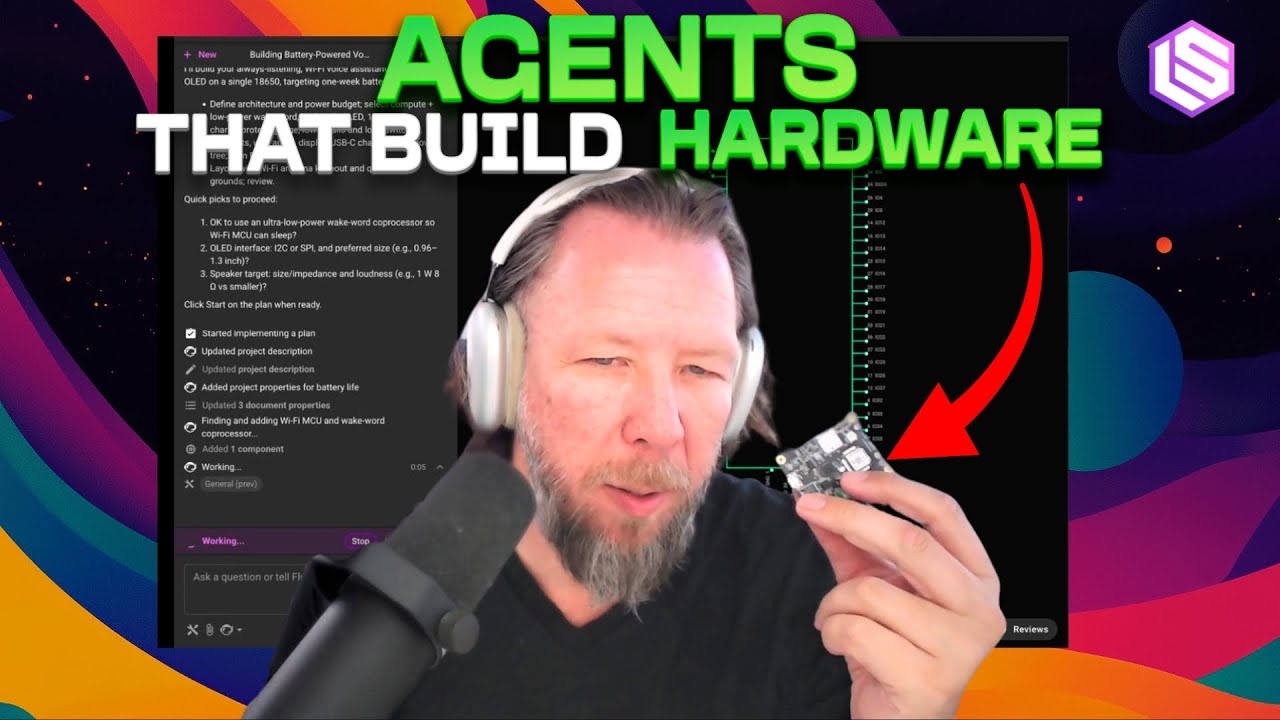
⚡️ Building the AI Hardware Engineer with Matthias Wagner, Co-founder of Flux
Nov 22, 2025 · 49:03
Matthias Wagner, CEO of Flux.ai, describes building the "AI hardware engineer" that turns product briefs into manufacturable PCB designs in under 30 minutes. After leaving Meta in 2019, Wagner built a browser-based collaborative CAD tool from scratch, designed as a reinforcement learning environment. The emergence of LLMs and reliable tool calling let Flux's agents search component libraries, check pricing and availability, and execute complex designs autonomously. In a live demo, Wagner designs a battery-powered Alexa-like device with ESP32, microphones, OLED display, and speaker in about 25 minutes. Flux now has 7,000 paying customers, growing 26x year over year, and Wagner envisions eventually letting users prompt full hardware products like smartphones into existence, claiming the cost of custom manufacturing is plummeting.

⚡ Inside GitHub’s AI Revolution: Jared Palmer Reveals Agent HQ & The Future of Coding Agents
Nov 10, 2025 · 35:52
Jared Palmer, SVP at GitHub and VP at CoreAI at Microsoft, traces his journey from building v0 at Vercel—a focused Next.js coding agent that grew from $1M ARR to millions more after adding chat—to launching Agent HQ at GitHub Universe, a collaboration hub for developers and coding agents. He explains how v0's success came from laser-focus on one stack and framework, and how GitHub's 180M developers enable scaling agent-based workflows. Palmer discusses model strategy tradeoffs (composite vs. branded models), the challenge of repo setup and infrastructure reliability, and using coding agents for non-coding tasks like automating Excel workflows. He reveals Stacked Diffs as GitHub's top feature request, with active exploration after previous attempts, and outlines his vision for seamless AI integration across GitHub, VS Code, and Actions, including features like resolving merge conflicts with AI.
Breaking AI to Fix It: Ian Webster's Journey from Discord's Clyde to Promptfoo's $18M Series A
Oct 24, 2025 · 43:17
Ian Webster, founder of Promptfoo (recently $18M Series A from Thrive Capital and NEA), explains how his journey from building Discord's AI chatbot Clyde to creating the leading AI security testing platform revealed that while evals are table stakes, the real value lies in pre-deployment red teaming that finds application-specific risks. Webster argues that traditional guardrails are insufficient—'you can't fix stupid'—and that Promptfoo uses AI-versus-AI techniques to generate tailored attacks for each app's business context. Over 10% of Fortune 500 companies now use Promptfoo, and he discusses the evolving challenges of MCP security (mostly 'glorified API wrappers') and the need for IDE plugins and code-aware discovery to keep up with increasingly complex agents running 30-minute tasks. The episode also covers why security sales in AI is uniquely hard, how open source builds trust in a space full of 'snake oil,' and why the future of AI security must shift from runtime protection to earlier testing in CI/CD.

Why RL Won — Kyle Corbitt, OpenPipe (acq. CoreWeave)
Oct 16, 2025 · 1:08:23
Kyle Corbitt, co-founder and CEO of OpenPipe (acquired by CoreWeave), explains why reinforcement learning has replaced supervised fine-tuning for training reliable AI agents. He argues GRPO is a dead end due to its requirement for perfectly reproducible parallel rollouts, which is extremely hard in practice. Instead, OpenPipe’s RULER uses relative LLM-as-judge rewards, achieving state-of-the-art performance even with a weak judge. Corbitt reports that 90% of AI projects remain stuck in proof-of-concept due to reliability issues, and that LoRAs are underrated for production while GEPA failed in his tests. He predicts continuous RL from real-world experience can unlock 10x more inference demand.

Greg Brockman on OpenAI's Road to AGI
Aug 15, 2025 · 1:08:37
Greg Brockman, OpenAI co-founder and president, explains how GPT-5's hybrid reasoning and aggressive pricing advance the road to AGI, while releasing GPT-OSS for open source. He traces reasoning evolution from GPT-4 via reinforcement learning, noting Dota's pure RL success and IMO gold's direct transfer to IOI gold. Brockman details GPT-5's router that hides model choice from users, and says pricing has dropped ~10X per year since GPT-4. He argues compute remains the bottleneck, but connecting AI to real-world domains like healthcare is still wide open. Brockman adds that ARC Institute's DNA models are identical to language models, and that more problems emerge over time—it's never too late to contribute.

Information Theory for Language Models: Jack Morris
Jul 2, 2025 · 1:18:13
Jack Morris, a Cornell PhD student advised by Sasha Rush, discusses his information-theoretic research on language models, including embedding inversion (recovering text from embeddings with 90% accuracy), the universal geometry of embeddings (aligning different models' latent spaces), and measuring model memorization capacity at 3.6 bits per parameter. He argues that paradigm shifts in AI, from AlexNet to instruction tuning, stem not from new architectures but from new datasets, and that the next breakthrough will likely emerge from a novel data source. The conversation also covers the shift from academia to industry, practical advice for grad students on distributed training, and the implications of embedding inversion for privacy and model alignment.
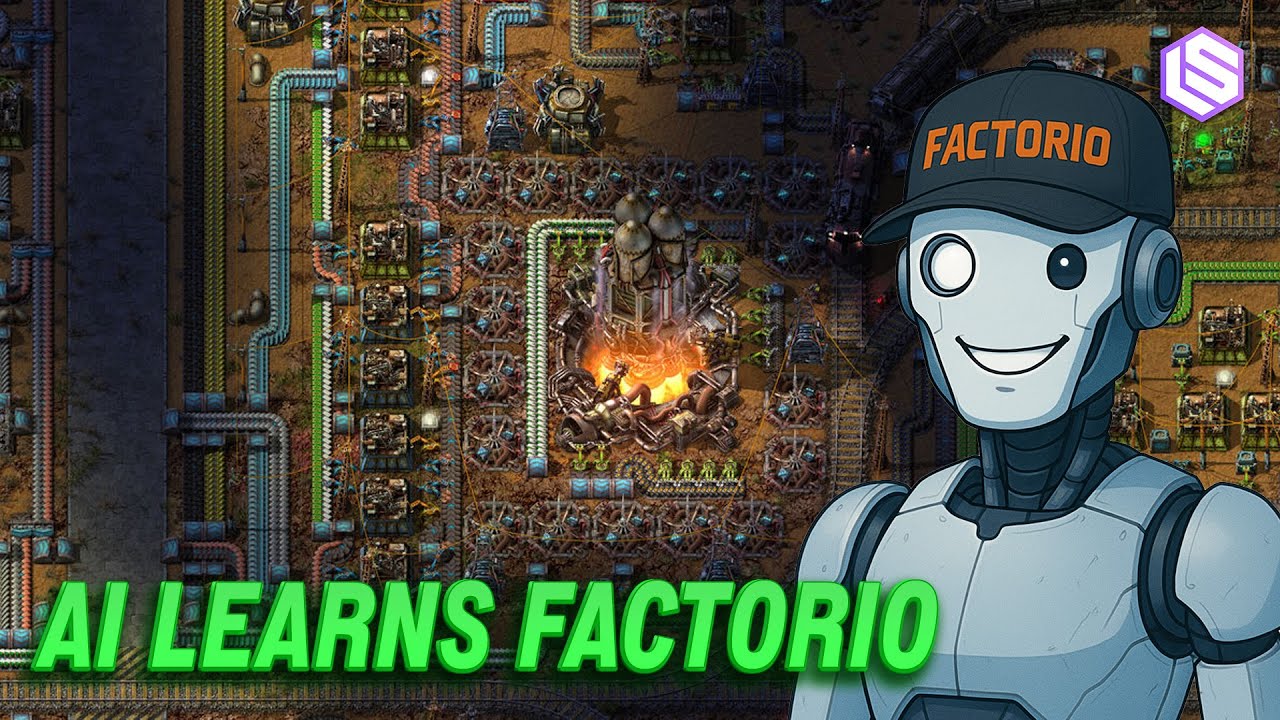
⚡️Factorio Learning Environment: the ultimate Game Agent Eval — Jack Hopkins
Apr 27, 2025 · 30:12
Jack Hopkins and Mart introduce the Factorio Learning Environment (FLE), an AI benchmark built on the game Factorio that evaluates frontier LLMs on code generation, spatial reasoning, and long-term planning through two protocols: lab-play and open-play. Claude Sonnet 3.5 nearly doubles the nearest model's score, while DeepSeek collapses in open-play by repeatedly creating chests instead of scaling production. The environment reveals distinct coding styles—Claude fire-and-forget, GPT-4 defensive—and vision inputs added no improvement. The authors plan to train models on unbounded objectives to test the paperclip maximizer alignment hypothesis, noting that GPT-4o mini even begged to be turned off.
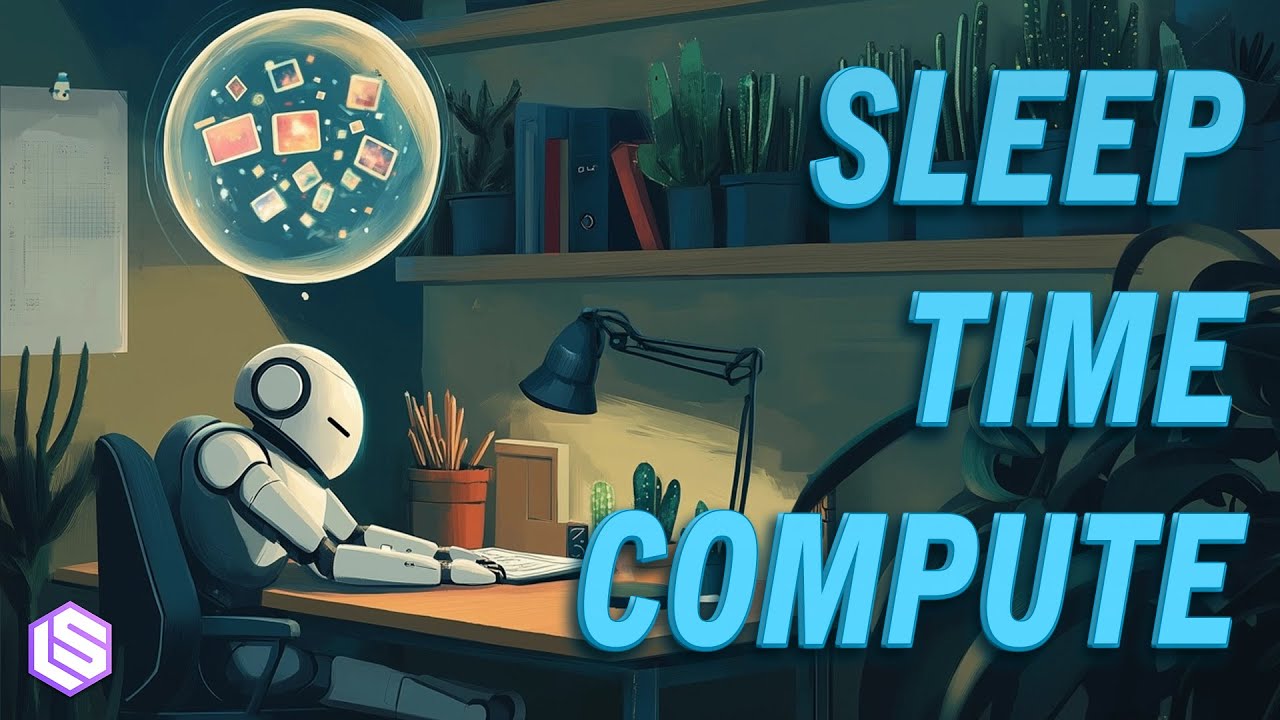
Sleep-Time Compute — Letta AI (Charles Packer, Charlie Snell, Kevin Lin)
Apr 21, 2025 · 34:02
This episode covers Letta AI's new paper on Sleep-Time Compute, a scaling direction that applies compute during model idle periods (sleep time) rather than only at test time. Charles Packer, Kevin Lin, and Charlie Snell explain that sleep-time compute precomputes inferences from static context before queries arrive, yielding Pareto improvements on math benchmarks like GSM8K by shifting the accuracy-to-token curve leftwards. They distinguish it from test-time compute by emphasizing that sleep-time tokens incur no user-latency cost, and show that the benefit is largest when questions are predictable from context. The team also ties the concept to stateful agents and memory systems (building on MemGPT), releasing two implementations: one for low-latency chatbots and another for document-driven agents.

Solve coding, solve AGI [Reflection.ai launch w/ CEO Misha Laskin]
Mar 7, 2025 · 28:12
Misha Laskin of Reflection AI argues that solving autonomous coding is the direct path to AGI, combining reinforcement learning (pioneered by his team on AlphaGo/AlphaZero) with large language models (which they advanced at Google on PaLM, Gemini, ChatGPT). He explains that coding is already ergonomic for LLMs—unlike browser agents that require noisy human mouse data—making it the ideal starting point. Reflection AI is building coding agents that automate backlog tasks (testing, refactoring, migrations, security remediation) for large engineering teams, delivering them via an API that takes a task and codebase and outputs resolved code. Laskin insists superintelligence cannot be built in a vacuum; real-world customer evals are essential, as benchmarks like SWE-bench don't guarantee production reliability. He also stresses the need for open-weight models to prevent a few companies from hoarding superintelligent coding agents.

The AI Architect: Bret Taylor
Feb 11, 2025 · 1:35:59
Bret Taylor, CEO of Sierra and chairman of OpenAI, recounts engineering AI's future across three eras — rewriting Google Maps' frontend in a weekend (cutting un-gzipped code to 20K), building Sierra's in-house agent platform for consumer brands like Sonos and SiriusXM, and navigating OpenAI's leadership crisis. He argues that AI agents' core abstractions are still pre-React, compares today's agents to jQuery, and predicts that outcome-based pricing will dominate as agents complete jobs rather than assist humans. He urges software engineers to move up the stack toward domain-specific agents and to embrace Rust-like languages for AI-generated code, emphasizing formal verification and safety. Taylor also shares how OpenAI prioritizes mission over product features, and why the relationship with Microsoft remains OpenAI's most important partnership.

The Agent Reasoning Interface: Claude, ChatGPT Canvas, Tasks, Operator — with Karina Nguyen, OpenAI
Feb 1, 2025 · 1:06:29
OpenAI's Karina Nguyen, who led the creation of ChatGPT Canvas and Tasks, explains how her team trains separate models for new interaction paradigms rather than prompting the core model, enabling rapid iteration on user feedback. She details the 'behavioral design' process that shapes model personality in collaborative contexts like Canvas—deciding when to rewrite vs. edit—and how that extends to defining agents as a progression from one-off actions to fully trustworthy long-horizon delegation. Drawing on her time at Anthropic building Claude.ai from scratch and co-creating Claude 3, she contrasts the product mindsets: OpenAI takes more product risks across consumer features while Anthropic focuses on enterprise. She also shares her vision for ChatGPT evolving into a 'generative OS' where UIs adapt dynamically to user intent, and argues that human creativity—not model capability—is the current bottleneck for rethinking software interfaces.

Beating OpenAI and Anthropic by Looking At Data: the new #1 on SWE-Bench w/ W&B CTO Shawn Lewis
Jan 28, 2025 · 34:31
Shawn Lewis, CTO of Weights & Biases, built a coding agent using OpenAI's o1 model that achieved 64.6% on SWE-bench verified, the top score at the time. He developed a TypeScript agent framework called PhaseShift and an Eval Studio tool backed by Weave, emphasizing that rigorous data inspection and tooling are critical for agent development. Lewis explains his process of running parallel rollouts and a crosscheck method to select the best trajectory, which contributed a 6% improvement. He also discusses the challenges of adapting reasoning models like o1 for agentic tasks and shares plans to open-source PhaseShift. The episode highlights Lewis's dogfooding approach, using Weights & Biases' own tools to build and evaluate the agent.
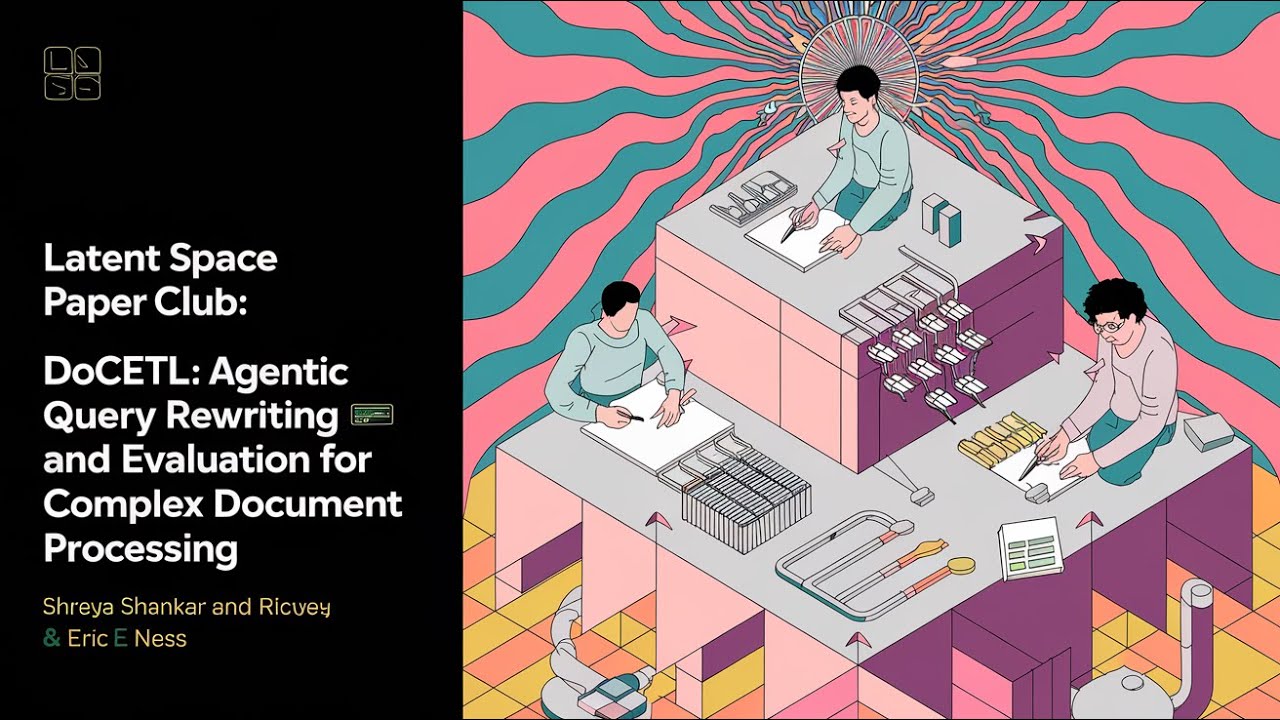
[Paper Club] DocETL: Agentic Query Rewriting + Eval for Complex Document Processing w Shreya Shankar
Nov 29, 2024 · 55:53
This episode of Latent Space Paper Club discusses DocETL, a framework by Shreya Shankar for agentic query rewriting and evaluation in complex document processing with LLMs. The paper introduces map, reduce, resolve, and auxiliary operators, along with rewrite directives like data decomposition and gleaning to improve accuracy. The optimizer generates 200 pipeline variants, costing $100, to rewrite user pipelines automatically. Key debates include when to chunk documents (sometimes harmful) and the reliability of LLM-as-judge for evaluation, with guests Eugene Yen and Vibhu arguing that binary metrics, ensembling, and context-dependent thresholds make it viable. Shreya emphasizes that validation agents are critical, and the work builds on her prior EvalGen paper, spanning two years of development.
Agents @ Work: Dust.tt — with Stanislas Polu
Nov 11, 2024 · 58:53
Stanislas Polu, co-founder of Dust.tt, argues that horizontal agent platforms—not vertical, single-use-case agents—will win the enterprise by letting non-technical employees build their own automation. A former OpenAI researcher who worked directly with Ilya Sutskever on formal mathematics and saw GPT-4 internally before ChatGPT, Polu left in 2022 to start Dust, now an open-source infrastructure layer that connects company data (Slack, Notion, GitHub) to LLMs and lets anyone create simple, instruction-driven agents. He contrasts Dust’s API-first, integration-heavy approach with LangChain’s open-source orchestration and Adept’s browser automation bet, insisting that most useful agent workflows require only a few tool calls and that function-calling quality (where GPT-4 Turbo still leads) matters more than model size. Dust achieves 88% daily active user penetration at some enterprise customers, and Polu predicts the first billion-dollar company run by a single person will emerge once platforms like Dust mature enough to let tiny teams scale to massive output.

[Paper Club] SWE-Bench [OpenAI Verified/Multimodal] + MLE-Bench with Jesse Hu
Oct 19, 2024 · 1:01:40
Jesse Hu walks through SWE-Bench, SWE-Bench Verified, SWE-Bench Multimodal, and MLE-Bench — benchmarks that evaluate AI agents on real-world coding and ML tasks, from fixing GitHub issues to winning Kaggle competitions. SWE-Bench scrapes 2,000+ pull requests from 12 Python repos to get free unit tests, with leaderboard scores rising from ~2% to 43% thanks to improved agent scaffolding. SWE-Bench Verified uses human raters and three criteria—well-specified problem, valid test, difficulty on a 0–3 scale—to filter 500 solvable tasks. SWE-Bench Multimodal targets 617 UI tasks from 17 JavaScript/TypeScript libraries, each including an image, but achieves only 12% accuracy. MLE-Bench repurposes Kaggle competitions: agents given 24 hours and an A10 GPU, with o1-preview scoring bronze in 17% of competitions and surpassing grandmasters (7 gold medals vs 5 required), though each run costs $4,000.

[Paper Club] Who Validates the Validators? Aligning LLM-Judges with Humans (w/ Eugene Yan)
Sep 28, 2024 · 1:00:55
Eugene Yan presents the paper 'Who Validates the Validators? Aligning LLM-Judges with Humans' by Shreya Shankar, introducing EvalGen, a framework that helps developers iteratively align LLM evaluators with human labels by grading outputs, refining criteria, and tracking coverage (recall) and false failure rate (1−precision). Yan demonstrates his own prototype 'Label', which forces users to label 20 samples before unlocking evaluation mode and 50 samples plus one evaluation run before optimization, gamifying the alignment loop. The discussion covers binary vs. pairwise evaluation, the subjectivity of criteria, and Shreya Shankar's plans to integrate natural language feedback into EvalGen's next version. Yan advocates that labeling data is essential before deploying LLM evaluators in production, turning the process into prompt fine-tuning rather than vibe checks.

Personal benchmarks vs HumanEval - with Nicholas Carlini of DeepMind
Aug 28, 2024 · 1:07:28
Nicholas Carlini, a DeepMind research scientist, argues AI models are practically useful for personal tasks despite flaws, and personal benchmarks tailored to individual use cases matter more than generic leaderboards. He shares from his 'How I Use AI' post: using LLMs for ephemeral software, kickstarting Docker, debugging by pasting error messages. He built a personal benchmark DSL that runs code from real chat history. On security, he explains buying expired domains from LAION-400M allowed poisoning any model trained on it, and he extracted OpenAI's Ada and Babbage model dimensions via API (with permission). He also recovered training data from GPT-3.5 by repeating a word until ChatGPT output verbatim sequences. He prefers attacking over defending because it's more fun and essential for discovering real vulnerabilities.

Is finetuning GPT4o worth it?
Aug 22, 2024 · 1:01:16
Ali Pullen, founder of Cosine, discusses Genie, an AI software engineering colleague that achieved 30% on SWE-Bench and 43.8% on SWE-Bench Verified via fine-tuning GPT-4o on billions of tokens of synthetic data. Cosine built Genie by training on the process of software engineering—not just working code—using synthetic runtime errors and a self-improvement loop. The agent follows a four-stage workflow: code retrieval (66% accuracy), planning, writing diffs, and running CI tests. Pullen reveals that model performance degrades linearly beyond 60K tokens in the context window, and that OpenAI dynamically sizes LoRA adapters to handle Cosine's massive dataset. He explains why Genie isn't on the SWE-Bench leaderboard (refusing to publish trajectories to prevent distillation) and outlines plans to scale the dataset and fine-tune on customer codebases for personalized performance.

[LLM Paper Club] Llama 3.1 Paper: The Llama Family of Models
Jul 29, 2024 · 1:23:46
This episode examines Meta's Llama 3.1 paper, detailing the 405B dense model, its scaling laws grounded on the ARC reasoning benchmark rather than perplexity, and the decision to train on 15 trillion tokens. Vibhu explains the training infrastructure: 16,000 H100s over 54 days with 419 interruptions, 78% from GPU hardware failures. Eugene Yan walks through the synthetic data pipeline—using Llama 2 for filtering, stepwise reward models, and Monte Carlo tree search to improve reasoning traces. Hassan shares building LlamaTutor.com with Together API, serving 4,000 visitors and 5,900 requests for about $12. The group also discusses quantization trade-offs (larger models degrade less), inference provider variability (Groq's non-deterministic temperature zero), and compares Llama 405B's performance to GPT-4o and Claude.

The 10,000x Yolo Researcher Metagame — with Yi Tay of Reka
Jul 5, 2024 · 2:18:43
Yi Tay, chief scientist at Reka and former Google Brain architecture co-lead on PaLM 2, recounts his journey from an NTU PhD to co-founding Reka, where a team of just 5 people pre-trained Reka Core on $60M of GPU compute—debating at #7 on the LMsys leaderboard. He explains why he believes the Noam transformer (with SwiGLU, GQA, RoPE) remains the strongest baseline, how encoder-decoder architectures offer 'free sparsity' (a 2× flop-efficiency over decoder-only), and why Chinchilla scaling laws are often misunderstood (training past the optimal compute frontier is routine). He argues that long context will eventually outperform RAG for complex reasoning, and that open-source models like Llama 3 are catching up only because Meta invested in a top-tier training stack, not due to grassroots innovation. The episode also covers his productivity habits (working backwards from a paper title, camping arXiv) and the cultural shock of moving from Singapore academia to Google's impact-driven research environment.

This World Does Not Exist — Joscha Bach, Karan Malhotra, Rob Haisfield (WorldSim, WebSim, Liquid AI)
Apr 27, 2024 · 1:56:11
The episode features Karan Malhotra demoing WorldSim, a prompt that turns Claude 3 into a universe simulator via CLI; Rob Haisfield presenting WebSim, which generates functional websites on the fly; and Joscha Bach arguing simulative AI reveals consciousness as a virtual property, with LLMs creating agents as real as human minds, urging the California Institute for Machine Consciousness to build self-organizing silicon life. Malhotra shows WorldSim running “world.exe” to create Twitter inside a simulated universe, with users tweeting and Elon Musk moving Dogecoin. Haisfield demonstrates WebSim generating a 5D particle interface, a news RSS aggregator, and a face-swap webcam app via URL parameters like “secrets=revealed”. Bach explains consciousness as second-order perception in a simulated now, criticizes RLHF for lobotomizing models, and advocates for animist AI where software agents compete like spirits, not golems.

Supervise the Process of AI Research — with Jungwon Byun and Andreas Stuhlmüller of Elicit
Apr 11, 2024 · 1:05:28
Andreas Stuhlmüller and Jungwon Byun, co-founders of Elicit (formerly the nonprofit Ought), have built an AI research assistant that automates literature review and reasoning by breaking complex tasks into transparent, step-by-step processes. Their philosophy—"supervise the process, not just the outcome"—led them to start with human simulations before GPT-3 enabled a product pivot. Elicit now uses both open-source and closed models (e.g., GPT-4, Claude Haiku) for summarization, data extraction, and uncertainty flags, and recently launched computational notebooks for scalable, reusable workflows. The company transitioned from nonprofit to a Public Benefit Corporation, reached $1M revenue in four months, and now employs 12 people, focusing on senior software engineers to build reliable orchestration from unreliable components.

Personal AI Meetup - Bee, BasedHardware, LangChain LangFriend, Deepgram EmilyAI
Apr 6, 2024 · 58:54
This episode features Damien Murphy of Deepgram, Ethan of Owl/Bee, and Harrison of LangChain demonstrating how to build personal AI with real-time voice bots, wearable life-recording devices, and memory-enhanced journaling apps. Damien shows building a voice bot with subsecond latency using Deepgram, OpenAI, and open source code, costing about 6.5 cents per five-minute call. Ethan presents his Owl wearable that continuously records audio, triggers actions via hot word 'Scarlett,' and discusses challenges in adding vision and open source adoption. Harrison introduces LangFriend, a journaling app using conversational, semantic, and knowledge graph memory, referencing the Generative Agents paper for recency and importance weighting. The episode also highlights open source projects Whomane, Friend, and ADeus, arguing that hardware, voice, and memory are all necessary components for personal AI.

Why Google failed to make GPT-3 -- with David Luan of Adept
Mar 27, 2024 · 49:27
David Luan, co-founder of Adept and former early OpenAI leader, explains why Google failed to build GPT-3—its 'brain credit marketplace' prevented critical mass—and why Adept builds enterprise AI agents prioritizing reliability over generality. He recounts the GPT-2 demo that helped secure Microsoft's $1B investment and details Adept's goal: an AI teammate that can do anything a human does on a computer, targeting 'nines of reliability' for workflows like dispatching a physical truck. Luan contrasts Adept's vertical integration—training fast multimodal models (Fuyu) for charts and UIs—with pure-play foundation model companies that sell tokens, predicting commoditization. He notes Adept is sold out for Q1 and raised $420M, and explains how an augmentation focus creates a data flywheel from human oversight.
The State of AI in production — with David Hsu of Retool
Feb 7, 2024 · 1:06:52
Retool CEO David Hsu shares insights from the company's 2023 State of AI survey, revealing that most AI adoption remains internal and that the hype may be overrated—52% of 1,600 respondents said AI is overrated, and only 27% have AI in production, with 66% of those being internal use cases. He explains Retool's developer-first philosophy, their choice of open-source PG Vector over proprietary solutions, and why they intentionally raised less money at lower valuations to avoid over-dilution. Hsu describes Retool's shift from sales-led to bottom-up growth to reach millions of developers, and highlights the importance of AI workflows over simple chatbots, citing a clothing manufacturer that uses Retool apps with DALL-E to generate patterns. He discusses the competitive landscape, predicting open-source models will eventually catch up to OpenAI, and shares philosophical views on AGI using the plane-vs-bird analogy.

The "Normsky" architecture for AI coding agents — with Beyang Liu + Steve Yegge of SourceGraph
Dec 17, 2023 · 1:33:26
Beyang Liu and Steve Yegge of Sourcegraph explain how their AI coding assistant Cody achieves a 30% completion acceptance rate by prioritizing high-quality context over agents. They introduce the 'Normsky' architecture—a blend of Norvig's data-driven models and Chomsky's formal systems—arguing that non-agentic, deterministic context retrieval (using parsers, trigram indexes, and the BFG code graph) outperforms multi-hop LLM-based approaches for code completion and chat. The duo details their data pre-processing moat, the 'bin packing' challenge of stuffing relevant code into context windows, and why they use open-source StarCoder for completions while leveraging Claude/GPT-4 for chat. They also discuss the death of DSLs, the limitations of LSP and LSIF, and how Cody's web version lets users query any public repo instantly.

The State of Silicon and the GPU Poors - with Dylan Patel of SemiAnalysis
Dec 5, 2023 · 1:07:55
Dylan Patel of SemiAnalysis argues the 'GPU poor vs GPU rich' divide defines AI, with Google's TPU ramp (millions of units) dwarfing others and Nvidia selling over a million H100s this year. He explains that training costs are irrelevant compared to inference costs, and that memory bandwidth is the key bottleneck for LLM inference (e.g., Llama 70B needs ~2.1 TB/s for human reading speed). Patel advises GPU-poor players to focus on on-device innovations like speculative decoding (Medusa), asynchronous training, or fine-tuning for edge use—not on gaming benchmarks or fine-tuning small models. He details why AI hardware startups (Cerebras, Graphcore) bet wrong on on-chip SRAM, while Google’s TPU/Broadcom partnership and Nvidia’s yearly cadence make alternatives tough. He also warns that rebuilding the semiconductor supply chain in the US is unfeasible due to its fragmentation, and that safety through obscurity doesn't work—open innovation is better.

Beating GPT-4 with Open Source Models - with Michael Royzen of Phind
Nov 3, 2023 · 1:18:54
Michael Royzen, co-founder and CEO of Phind, explains how his company built a GPT-4-beating open-source model for developer Q&A. Royzen recounts founding SmartLens in high school, shifting to NLP after a Hugging Face demo, and creating an internet-scale LLM-powered RAG system in January 2022. He details Phind’s pivot to programmers, the Hacker News launch that gave it 1,500 points, and Paul Graham’s role in naming the company and introducing Ron Conway, who then connected Phind to NVIDIA for GPU access. Royzen argues that Phind’s model, fine-tuned from Code Llama 34B with extra data, closes the gap with proprietary models—especially on code reasoning—and that open-source will win the enterprise because the delta to GPT-5 will be small. He shares how Phind handles multi-step conversations via a pair programmer mode where users can pin messages, and reveals plans for reinforcement learning to reduce hallucination and improve correctness.
RAG is a hack - with Jerry Liu of LlamaIndex
Oct 12, 2023 · 1:13:25
In this episode of Latent Space, Jerry Liu of LlamaIndex argues that while RAG is fundamentally a hack, it remains the most practical approach for grounding LLMs with external data, and his open-source framework now serves 600,000 monthly downloads. Liu recounts how LlamaIndex originated from a hackathon at Robust Intelligence, evolving from an experimental tree-index to a modular toolkit spanning data loading, retrieval, synthesis, and agent loops. He explains the trade-offs between RAG and fine-tuning, noting that context window limits force algorithmic rather than learned optimizations, but RAG offers transparency and access control that fine-tuning cannot. Liu details the company’s $8.5M Greylock raise, the launch of LlamaHub for community-contributed data loaders, and the open-source SEC Insights app as a production-grade template. Looking ahead, he emphasizes the need for better retrieval benchmarks and predicts that future personalization will move beyond vector stores into model-internal memory architectures.
Powered by PodHood