
GPT-3
ProductA product discussed on Latent Space.
14 episodes
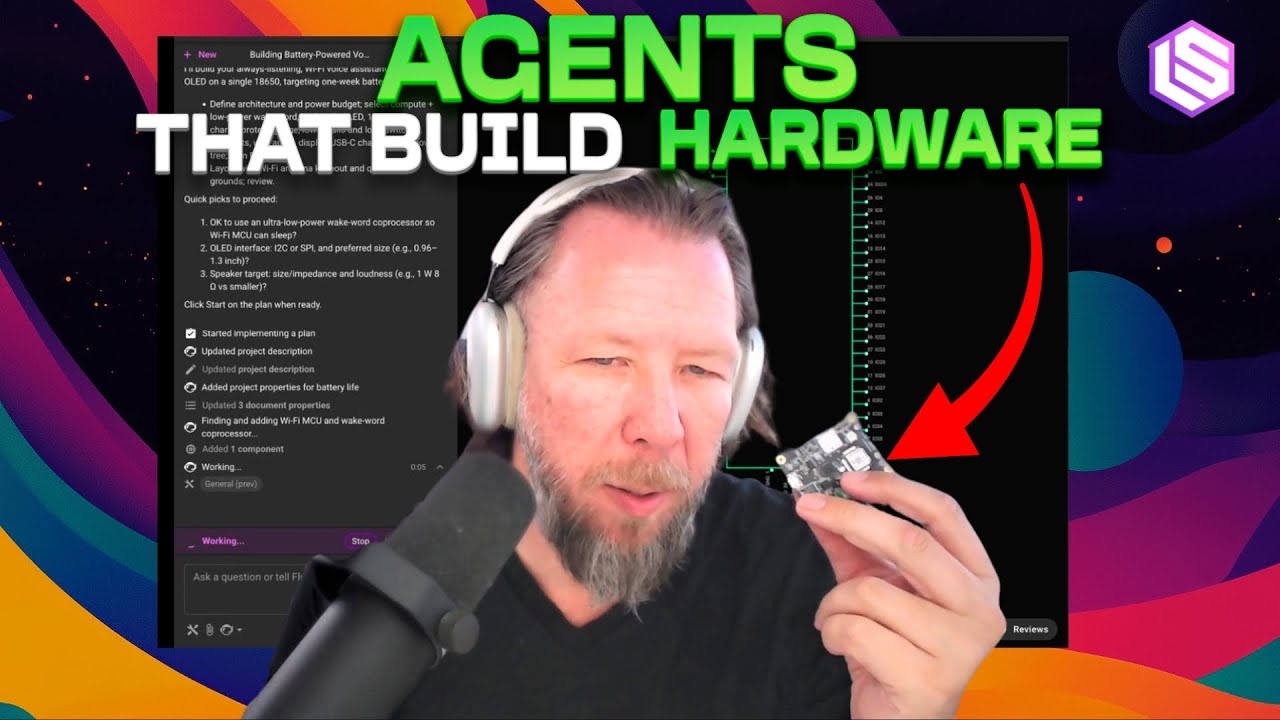
⚡️ Building the AI Hardware Engineer with Matthias Wagner, Co-founder of Flux
Nov 22, 2025 · 49:03
Matthias Wagner, CEO of Flux.ai, describes building the "AI hardware engineer" that turns product briefs into manufacturable PCB designs in under 30 minutes. After leaving Meta in 2019, Wagner built a browser-based collaborative CAD tool from scratch, designed as a reinforcement learning environment. The emergence of LLMs and reliable tool calling let Flux's agents search component libraries, check pricing and availability, and execute complex designs autonomously. In a live demo, Wagner designs a battery-powered Alexa-like device with ESP32, microphones, OLED display, and speaker in about 25 minutes. Flux now has 7,000 paying customers, growing 26x year over year, and Wagner envisions eventually letting users prompt full hardware products like smartphones into existence, claiming the cost of custom manufacturing is plummeting.

Taste is your Moat (Dylan Field of Figma)
Oct 2, 2025 · 1:01:43
Dylan Field, CEO of Figma, argues that as AI accelerates software creation, design becomes the key differentiator—and Figma Make, a prompt-to-app tool, is Figma's bet on lowering the barrier for everyone. Field recounts his first AI-pill moment with Chris Olah in 2014 and later GPT-3 convincing him of exponential progress. He explains Figma's strategy: treat natural language as today's interface (calling it the 'MS-DOS era of AI'), use Figma as a 'context repository for aesthetics' to ground AI outputs in a user's taste, and solve the blank-canvas problem by letting AI generate initial designs. Field pushes back on 'fast fashion' software, arguing complex products like Workday can't be vibe-coded. He shares Thiel Fellowship lessons (start with 'what could this be' before finding flaws), recruiting advice from John Doerr (obsess over the funnel), and caution about get-rich-quick AI hype, drawing parallels to the NFT cycle he exited.

Greg Brockman on OpenAI's Road to AGI
Aug 15, 2025 · 1:08:37
Greg Brockman, OpenAI co-founder and president, explains how GPT-5's hybrid reasoning and aggressive pricing advance the road to AGI, while releasing GPT-OSS for open source. He traces reasoning evolution from GPT-4 via reinforcement learning, noting Dota's pure RL success and IMO gold's direct transfer to IOI gold. Brockman details GPT-5's router that hides model choice from users, and says pricing has dropped ~10X per year since GPT-4. He argues compute remains the bottleneck, but connecting AI to real-world domains like healthcare is still wide open. Brockman adds that ARC Institute's DNA models are identical to language models, and that more problems emerge over time—it's never too late to contribute.

Information Theory for Language Models: Jack Morris
Jul 2, 2025 · 1:18:13
Jack Morris, a Cornell PhD student advised by Sasha Rush, discusses his information-theoretic research on language models, including embedding inversion (recovering text from embeddings with 90% accuracy), the universal geometry of embeddings (aligning different models' latent spaces), and measuring model memorization capacity at 3.6 bits per parameter. He argues that paradigm shifts in AI, from AlexNet to instruction tuning, stem not from new architectures but from new datasets, and that the next breakthrough will likely emerge from a novel data source. The conversation also covers the shift from academia to industry, practical advice for grad students on distributed training, and the implications of embedding inversion for privacy and model alignment.

Building Manus AI (first ever Manus Meetup)
Mar 27, 2025 · 48:59
Tao Zhang, co-founder of Manus, explains how Manus gives LLMs 'hands' to take real-world actions, inspired by MIT's 'mens et manus' (mind and hand). Manus assigns each task its own cloud virtual machine via E2B, provides pre-paid data APIs (stock, social media), and a knowledge system to remember user preferences. Their previous product, Monica.im, grew to 20M monthly active users and $50M ARR before they pivoted from a failed AI browser project to Manus. On the GAIA benchmark, Manus achieves a per-task cost of ~$2, far cheaper than OpenAI's Deep Research (~$20) and prior SOTA. Zhang emphasizes a 'less structure, more intelligence' philosophy, opting not to predefine workflows but to give the model rich context and tools. He also discusses plans to partner with Cloudflare, pay paywalls on behalf of users, and integrate more APIs based on usage patterns, while ruling out building their own foundation model.

The Agent Reasoning Interface: Claude, ChatGPT Canvas, Tasks, Operator — with Karina Nguyen, OpenAI
Feb 1, 2025 · 1:06:29
OpenAI's Karina Nguyen, who led the creation of ChatGPT Canvas and Tasks, explains how her team trains separate models for new interaction paradigms rather than prompting the core model, enabling rapid iteration on user feedback. She details the 'behavioral design' process that shapes model personality in collaborative contexts like Canvas—deciding when to rewrite vs. edit—and how that extends to defining agents as a progression from one-off actions to fully trustworthy long-horizon delegation. Drawing on her time at Anthropic building Claude.ai from scratch and co-creating Claude 3, she contrasts the product mindsets: OpenAI takes more product risks across consumer features while Anthropic focuses on enterprise. She also shares her vision for ChatGPT evolving into a 'generative OS' where UIs adapt dynamically to user intent, and argues that human creativity—not model capability—is the current bottleneck for rethinking software interfaces.

[Paper Club] Weight Streaming on Wafer-Scale Clusters (w/ Sarah Chieng of Cerebras)
Dec 7, 2024 · 43:54
Sarah Chieng of Cerebras presents the weight streaming technique for training giant neural networks on Cerebras wafer-scale clusters, arguing it enables near-linear scaling by separating parameter storage from primary compute. The system uses the Wafer Scale Engine (WSE-2/3) with 900,000 cores and 44 GB on-chip SRAM, avoiding off-chip memory bottlenecks that limit NVIDIA GPUs. MemoryX provides external storage for weights and optimizer states (up to 2.4 petabytes), streaming weights to compute units via the SwarmX interconnect fabric, which aggregates gradients. This design allows training models with up to 120 trillion parameters without complex hybrid parallelism. Cerebras also leverages unstructured weight sparsity to prune 90% of data during transmission and skip zero-value computations on-chip, reducing bandwidth and improving efficiency.
Agents @ Work: Dust.tt — with Stanislas Polu
Nov 11, 2024 · 58:53
Stanislas Polu, co-founder of Dust.tt, argues that horizontal agent platforms—not vertical, single-use-case agents—will win the enterprise by letting non-technical employees build their own automation. A former OpenAI researcher who worked directly with Ilya Sutskever on formal mathematics and saw GPT-4 internally before ChatGPT, Polu left in 2022 to start Dust, now an open-source infrastructure layer that connects company data (Slack, Notion, GitHub) to LLMs and lets anyone create simple, instruction-driven agents. He contrasts Dust’s API-first, integration-heavy approach with LangChain’s open-source orchestration and Adept’s browser automation bet, insisting that most useful agent workflows require only a few tool calls and that function-calling quality (where GPT-4 Turbo still leads) matters more than model size. Dust achieves 88% daily active user penetration at some enterprise customers, and Polu predicts the first billion-dollar company run by a single person will emerge once platforms like Dust mature enough to let tiny teams scale to massive output.

Is finetuning GPT4o worth it?
Aug 22, 2024 · 1:01:16
Ali Pullen, founder of Cosine, discusses Genie, an AI software engineering colleague that achieved 30% on SWE-Bench and 43.8% on SWE-Bench Verified via fine-tuning GPT-4o on billions of tokens of synthetic data. Cosine built Genie by training on the process of software engineering—not just working code—using synthetic runtime errors and a self-improvement loop. The agent follows a four-stage workflow: code retrieval (66% accuracy), planning, writing diffs, and running CI tests. Pullen reveals that model performance degrades linearly beyond 60K tokens in the context window, and that OpenAI dynamically sizes LoRA adapters to handle Cosine's massive dataset. He explains why Genie isn't on the SWE-Bench leaderboard (refusing to publish trajectories to prevent distillation) and outlines plans to scale the dataset and fine-tune on customer codebases for personalized performance.

High Agency Pydantic over VC Backed Frameworks — with Jason Liu of Instructor
Apr 24, 2024 · 1:02:59
Jason Liu, creator of the Instructor library, explains why structured outputs from LLMs are best handled by a simple requests-like wrapper rather than a VC-backed framework, arguing that Pydantic-defined schemas via function calling outperform JSON Mode for typed responses. He details his journey from being bearish on LLMs at StitchFix to building Instructor on a bullet train to Japan after GPT-3 proved him wrong. Liu advocates for workflow-based DAGs over reactive agent loops, recommends using rankers rather than cramming 60+ tools into an API call, and credits high agency—trying many experiments and documenting conditions for revisiting failures—as key to his success. He also critiques the MLE hiring hype, urging startups to empower motivated AI engineers instead.

Supervise the Process of AI Research — with Jungwon Byun and Andreas Stuhlmüller of Elicit
Apr 11, 2024 · 1:05:28
Andreas Stuhlmüller and Jungwon Byun, co-founders of Elicit (formerly the nonprofit Ought), have built an AI research assistant that automates literature review and reasoning by breaking complex tasks into transparent, step-by-step processes. Their philosophy—"supervise the process, not just the outcome"—led them to start with human simulations before GPT-3 enabled a product pivot. Elicit now uses both open-source and closed models (e.g., GPT-4, Claude Haiku) for summarization, data extraction, and uncertainty flags, and recently launched computational notebooks for scalable, reusable workflows. The company transitioned from nonprofit to a Public Benefit Corporation, reached $1M revenue in four months, and now employs 12 people, focusing on senior software engineers to build reliable orchestration from unreliable components.

Why Google failed to make GPT-3 -- with David Luan of Adept
Mar 27, 2024 · 49:27
David Luan, co-founder of Adept and former early OpenAI leader, explains why Google failed to build GPT-3—its 'brain credit marketplace' prevented critical mass—and why Adept builds enterprise AI agents prioritizing reliability over generality. He recounts the GPT-2 demo that helped secure Microsoft's $1B investment and details Adept's goal: an AI teammate that can do anything a human does on a computer, targeting 'nines of reliability' for workflows like dispatching a physical truck. Luan contrasts Adept's vertical integration—training fast multimodal models (Fuyu) for charts and UIs—with pure-play foundation model companies that sell tokens, predicting commoditization. He notes Adept is sold out for Q1 and raised $420M, and explains how an augmentation focus creates a data flywheel from human oversight.

Why AI Agents Don't Work (yet) - with Kanjun Qiu of Imbue
Oct 21, 2023 · 1:12:37
Kanjun Qiu, CEO of Imbue (formerly Generally Intelligent), argues that AI agents remain unreliable because they lack robust reasoning and proper abstractions, which Imbue tackles by training foundation models optimized for reasoning over data like code. With a $200M Series B and $1B+ valuation, Imbue builds internal tools for debugging and inspecting agent decision-making, rejecting pure reinforcement learning after their Avalon environment revealed RL cannot handle planning. Instead, they emphasize natural language reasoning for inspectability, use code as a curriculum for reasoning, and design interfaces that let users fork and modify agents mid-execution. Qiu also discusses lessons from earlier startups (Sorceress in recruiting, Embark in VR), the importance of treating team members as creative agents, and her role in co-founding communal living space The Archive to foster scenius.

RAG is a hack - with Jerry Liu of LlamaIndex
Oct 12, 2023 · 1:13:25
In this episode of Latent Space, Jerry Liu of LlamaIndex argues that while RAG is fundamentally a hack, it remains the most practical approach for grounding LLMs with external data, and his open-source framework now serves 600,000 monthly downloads. Liu recounts how LlamaIndex originated from a hackathon at Robust Intelligence, evolving from an experimental tree-index to a modular toolkit spanning data loading, retrieval, synthesis, and agent loops. He explains the trade-offs between RAG and fine-tuning, noting that context window limits force algorithmic rather than learned optimizations, but RAG offers transparency and access control that fine-tuning cannot. Liu details the company’s $8.5M Greylock raise, the launch of LlamaHub for community-contributed data loaders, and the open-source SEC Insights app as a production-grade template. Looking ahead, he emphasizes the need for better retrieval benchmarks and predicts that future personalization will move beyond vector stores into model-internal memory architectures.
Powered by PodHood