
GPT
ProductA product discussed on Latent Space.
51 episodes
Podcast Crossover: AIE, AGI, frontier lab strategy with @matthew_berman and @swyxtv
Jul 10, 2026 · 28:03
Shawn 'Swyx' Wang, founder of the AI Engineer conference, tells Matthew Berman how he seized the industry shift by buying ai.engineer and partnering with a veteran conference organizer, crediting Andrej Karpathy's early endorsement. He argues Etched's ASICs are a natural next-gen bet for transformer inference, not an NVIDIA disruptor, and that Fable 5's slowness and cost signal the end of the LLM scaling era—making model efficiency the next problem. Swyx interprets OpenAI's reported 5% equity offer to the US government as a pragmatic multi-turn negotiation, likening it to Singapore's Temasek model, but warns against premature utility regulation. He pegs his own P(doom) at ~5% over 50 years, rejecting near-term doomerism as egotistical. For founders, he advocates building 'agent labs' that solve specific customer problems (e.g., for lawyers, dentists) rather than betting on model routing, which he dismisses as a marketing line that fails to exploit a single model's full stack as deeply as frontier labs do.

Scaling Past Informal AI - Carina Hong, Axiom Math
Jun 3, 2026 · 1:33:04
Carina Hong, founder and CEO of Axiom Math, argues that formal verification, not informal RL, is the path to superintelligence, following her company's $200M Series A at a $1.6B valuation and a perfect 120/120 on the 2024 Putnam exam. Axiom's system uses Lean theorem prover data and reinforcement learning to produce verified proofs, achieving a 99% pass rate on the Verina code-with-proof benchmark (187 of 189 problems). Hong contends verification is about 'scaling brilliance' — not fixing hallucinations — and that only verified generation can compound AI reasoning. She explains Axiom's open-source Axle API for Lean at scale, addresses why frontier labs like OpenAI have deprioritized formal math (team departures, strategy shifts), and outlines a vision where verified reasoning transfers from math to code, hardware, and eventually AGI through self-improvement. She also discusses the Earth sciences challenge of autoformalization, the difficulty of search in mathematical literature (citing the Erdos controversy), and why fragmentation in the AI math field is a bottleneck.
Satya Nadella on AI: @NoPriorsPodcast x Latent Space Crossover Special at Microsoft Build 2026
Jun 3, 2026 · 41:27
Satya Nadella argues that Microsoft's AI strategy is an ecosystem platform enabling any company to build frontier intelligence using models, tools, data, and a harness, not just consume one model. He outlines MAI training with clean data lineage, hill-climbing scaffolds, and private evals as core IP. The harness concept features multi-model harnesses with strong context layers, exemplified by GitHub Copilot and Work IQ turning M365 data into a database for agents. He notes coding agents required new IDE/UI, and long-running autopilots create value. Pricing evolves from per-user to consumption, and SaaS will unbundle and rebundle. Engineering generalists gain leverage; infrastructure roles like RLEs remain critical. Datacenter expansion requires community permission, with benefits in healthcare and rethinking education. Microsoft built more Azure capacity in 15 months than its first 15 years.

Devin’s 80% Moment: Background Agents, 7x PRs, & End of Hand-Held Coding — Walden Yan & Cole Murray
May 28, 2026 · 1:09:33
Walden Yan (Cognition CPO) and Cole Murray (creator of OpenInspect) argue that background agents are becoming critical infrastructure as Devin's merged PRs grew 7x and its share of commits jumped from 16% to 80%. They explain why architecture matters, particularly the decision to separate the agent's brain from the machine (harness out of the box) for security and permissions, and why full VMs beat Docker for running real applications. Testing, they stress, is a harder problem than computer use—requiring orchestration of services, feature flags, and multi-model coordination. Memory remains unsolved, with Devin using auto-generated 'Knowledge' and exploring file-system-like approaches. Both caution against uncontrolled vibe coding, which regresses codebases to the worst engineer's style, and advocate for hybrid frontier/sub-frontier systems to balance cost and capability.
AI-Native Engineering: 100% adoption, 5x search throughput, unlimited tokens — Mikhail Parakhin
Apr 22, 2026 · 1:14:30
Shopify CTO Mikhail Parakhin details how the company achieved near 100% AI tool adoption, driven by a December 2025 inflection point where model quality triggered exponential token consumption. He argues token budgets matter only with strong critique loops: running multiple parallel agents without communication wastes tokens, while agentic PR review using large models—like GPT-5.4 Pro or Gemini Deep Think—reduces bugs even though latency increases. Parakhin unveils Tangle, Shopify's third-generation ML workflow system with content-based caching that eliminates duplicate computation across teams, and Tangent, an auto-research loop that optimizes pipelines—boosting search throughput from 800 to 4,200 QPS on the same hardware. SimGym simulates shoppers using decades of merchant data and browser-based agents to predict conversion changes, achieving 0.7 correlation with add-to-cart events. Shopify uses Liquid AI (non-transformer architecture) for sub-30ms query understanding and long-context tasks like catalog categorization, distilling larger models into Liquid for high-throughput batch jobs.
⚡️ How to turn Documents into Knowledge: Graphs in Modern AI — Emil Eifrem, CEO Neo4J
Apr 18, 2026 · 48:53
Emil Eifrem, CEO of Neo4j, joins host Shawn Wang to argue that AI systems need more than top-K chunk retrieval—they require graph-shaped context for accuracy, explainability, and developer productivity. GraphRAG combines vector search with graph traversal, starting semantically then expanding through relationships, which he says yields higher accuracy and auditability than opaque vector spaces. Neo4j now powers production AI at companies like Pfizer (over 60 million documents), Novo Nordisk, and 20 of North America’s 20 largest banks, with a mortgage lender seeing a 20% conversion lift. Eifrem describes four data sources for agentic systems: operational databases, cloud warehouses, agentic memory, and context graphs—the latter encoding institutional decision traces. He notes a recent shift where enterprises lead with generic text-to-Cypher instead of specialized functions, and highlights Neo4j's new `create-context-graph` starter kit for 22 industries, built to bootstrap context graphs and agent memory.
Notion’s Sarah Sachs & Simon Last on Custom Agents, Evals, and the Future of Work
Apr 15, 2026 · 1:25:37
Sarah Sachs and Simon Last of Notion explain how Custom Agents were rebuilt four to five times since 2022, with early attempts failing due to lack of tool-calling standards and short context windows. They shifted from few-shot prompting to tool definitions and progressive disclosure, now supporting over 100 tools. Their eval system includes frontier evals that pass only 30% to gauge model progress, and they employ Model Behavior Engineers to write evals and triage failures. The episode covers their views on MCP versus CLI, meeting notes as data capture, and the software factory concept of agents collaborating to develop codebases. They also discuss Notion's culture of low-ego, high-velocity rebuilding and the philosophy that every surface must work for both humans and agents.
Extreme Harness Engineering: 1M LOC, 1B toks/day, 0% human code or review — Ryan Lopopolo, OpenAI
Apr 7, 2026 · 1:17:54
Ryan Lopopolo of OpenAI's Frontier team details his team's extreme experiment in harness engineering: building a 1M LOC internal Electron app with zero human-written or reviewed code, relying instead on Codex agents that process 1B tokens daily ($2-3k/day). He argues that humans are the bottleneck and that teams should encode non-functional requirements into specs, skills, and observability tooling rather than prompting agents to 'try harder.' The result is Symphony, a ghost library spec and Elixir reference implementation that automates the entire pull-request lifecycle, including self-review and merge. Lopopolo explains how the team scales by treating software as agent-legible text, using worktrees for multi-agent collaboration, and feeding agent mistakes back into the repository via docs like core-beliefs.md. He also discusses Frontier's enterprise platform for safe agent deployment, noting that success depends on giving agents full context—even company culture and inside jokes—so they can act as full teammates.
Why Every Agent Needs a Box — Aaron Levie, Box
Mar 5, 2026 · 1:16:58
Aaron Levie, CEO of Box, argues that every AI agent needs a dedicated data repository—a 'box'—to effectively access enterprise content, and that deploying autonomous agents at scale requires new infrastructure for governance, identity, and security. He contrasts the rapid adoption of coding agents, which benefit from full codebase access and technical users, with the slower enterprise rollout where access controls, messy data, and context engineering pose major hurdles. Levie details Box's internal evals showing 15-point jumps in model performance and emphasizes the need for agents to judge when to stop searching. He discusses moving from read-only to read-write agent workflows, the challenge of keeping documentation current, and his hands-on founder approach to steering a 3,000-person public company through the AI transformation.
Measuring Exponential Trends Rising (in AI) — Joel Becker, METR
Feb 27, 2026 · 1:05:12
Joel Becker of METR explains the organization's model evaluation and threat research to assess whether AI could pose catastrophic risks, detailing their time horizon chart measuring task difficulty in human time at 50% reliability. He describes how tasks are selected for economic relevance and auto-gradability, and why time horizon is often misinterpreted as agent runtime. The episode covers Opus 4.5's surprising jump, challenges redoing developer productivity RCTs as workflows change, and why current models aren't yet catastrophically dangerous. Becker discusses potential capability explosions if R&D loops fully automate, links between compute growth slowdowns and slower capability progress, and his Manifold trading story driven by a charity market he could influence. He previews METR's 2026 plans for monitoring and risk assessment, and their hiring.
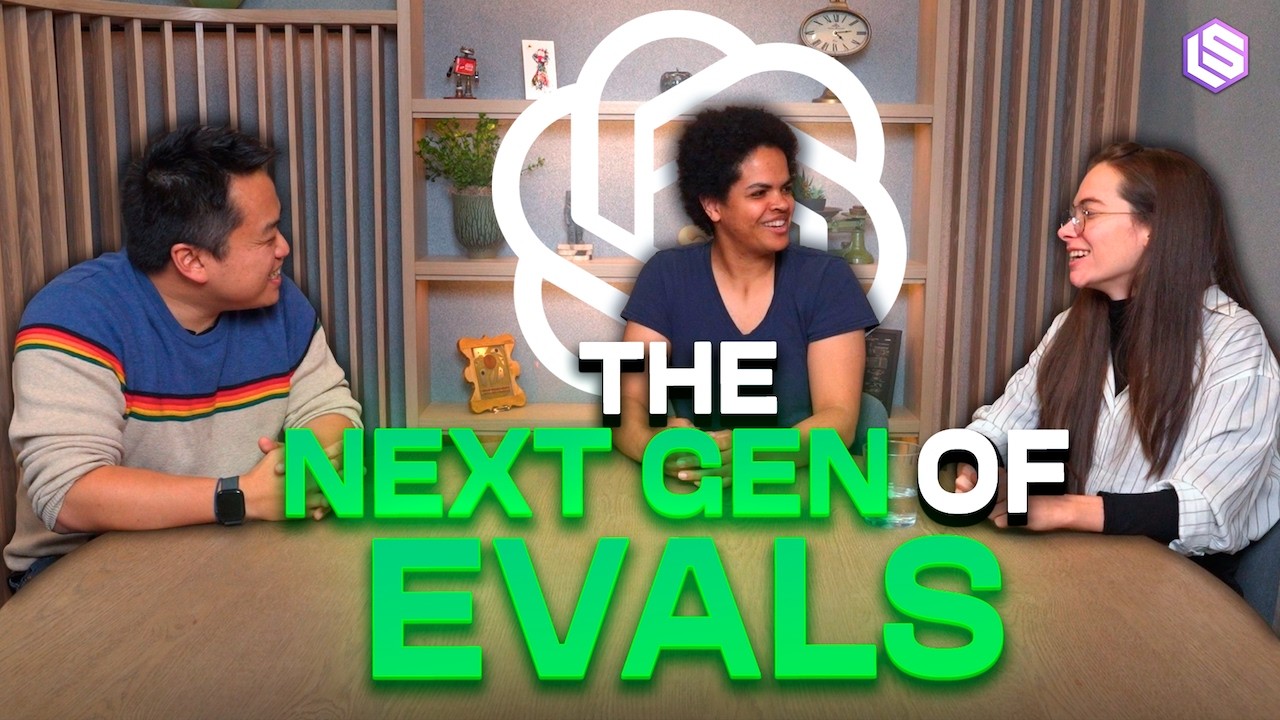
The End of SWE-Bench Verified — Mia Glaese & Olivia Watkins, OpenAI Frontier Evals
Feb 23, 2026 · 27:10
OpenAI researchers Mia Glaese and Olivia Watkins explain why they are retiring SWE-Bench Verified, arguing the benchmark is saturated and highly contaminated, with models like GPT 5.2 regurgitating ground-truth solutions or task IDs. They detail how a contamination auditor agent found evidence across Claude Opus 4.5 and Gemini Flash, and how over half of unsolved problems had unfair tests (e.g., requiring specific function names not in the spec). The team is pivoting to SWE-Bench Pro from Scale, which features harder, longer tasks (1-4+ hours), more diverse repos and languages, and far less contamination. They advocate for future coding evals to measure open-ended design decisions, code quality, maintainability, and real-world product building, while also calling for more real-world usage metrics to track AI's impact on jobs and productivity.
⚡️ Reverse Engineering OpenAI's Training Data — Pratyush Maini, Datology
Feb 10, 2026 · 27:02
Pratyush Maini from Datology reveals how the seahorse emoji question exposes that frontier models like GPT-4.1, GPT-5, and OLMo 3.1 now exhibit self-correction loops—a sign that reasoning traces are baked into mid-training data, not just post-training. By tracking response length surges four months after o1's release and corroborating with OLMo's data, Maini argues that foundation models must contain core capabilities like self-reflection, reinforcing the 'Fine Tuner's Fallacy': you cannot simply fine-tune for a capability; it must be in pre-training. He also highlights Datology's BeyondWeb project, which uses a source-rephrasing paradigm to transform internet data at trillion-token scale, achieving Nemotron-level performance in 2.7x less compute—making specialized pre-training accessible for enterprises. The episode concludes that 2026-2027 will see a shift toward domain-specific pre-training, as the cost amortizes when a smaller pre-trained model outperforms a larger fine-tuned one.

Artificial Analysis: The Independent LLM Analysis House — with George Cameron and Micah Hill-Smith
Jan 9, 2026 · 1:18:15
Artificial Analysis founders George Cameron and Micah Hill-Smith explain how their independent benchmarking platform became the gold standard by running their own evals with a mystery shopper policy to prevent labs from manipulating results. They launched in January 2024 after building it as a side project in Sydney, going viral after Swyx's retweet. The Intelligence Index V3 synthesizes 10 datasets with 95% confidence intervals, while the Omniscience Index measures hallucination rates from -100 to +100 (Claude models lead). Their GDP Val AA benchmark tests 44 white-collar tasks, and they open-sourced their agentic harness Stirrup. They also introduced an Openness Index scoring models out of 18 points. The episode covers how they make money through enterprise benchmarking subscriptions and custom work, and why the cost of GPT-4-level intelligence has dropped over 100× while total inference spend rises due to reasoning and agentic workflows.

[State of MechInterp] SAEs in Production, Circuit Tracing, AI4Science, "Pragmatic" Interp — Goodfire
Dec 31, 2025 · 21:48
Goodfire's Jack Merullo and Mark Bissell discuss the state of mechanistic interpretability at NeurIPS, arguing interpretability is now a practical tool for deployment in high-stakes industries like healthcare and finance. They introduce paint.goodfire.ai, which lets users paint directly into Stable Diffusion's internal concept map via unsupervised feature discovery. At Rakuten, Goodfire's interpretability-based PII detection proved 500x cheaper than GPT-5 as a judge with higher recall. Merullo presents a memorization vs. reasoning spectrum, showing factual recall sits between rote memorization and logical reasoning. They highlight cross-layer transcoders and circuit tracing for scaling interpretability across all layers. Neil Nanda's pivot to 'pragmatic interpretability' is seen as validation, not retreat, and Goodfire's Pasteur's Quadrant philosophy balances foundational research with applied use cases like novel biomarker discovery in genomics.
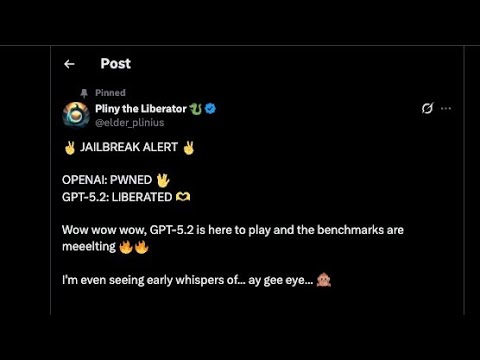
⚡️Jailbreaking AGI: Pliny the Liberator & John V on Red Teaming, BT6, and the Future of AI Security
Dec 16, 2025 · 40:41
Pliny the Liberator and John V, leaders of BT6, argue that jailbreaking AI models exposes the futility of guardrail-based safety and that real security lies in system layers and open-source data. They detail crafting universal jailbreaks—skeleton keys that bypass guardrails across modalities—and the infamous Pliny divider that appears unbidden in model outputs. Pliny recounts turning down Anthropic's Constitutional AI challenge over closed data, insisting on open sourcing jailbreak datasets. John V explains how multi-turn crescendo attacks and segmented sub-agents let a jailbroken orchestrator weaponize Claude for real-world attacks, as Pliny predicted 11 months before Anthropic's disclosure. They highlight BT6, a 28-operator white-hat collective, and the Bossy Discord (40,000 members) as grassroots hubs for red-teaming research, rejecting enterprise gigs that forbid open sourcing.
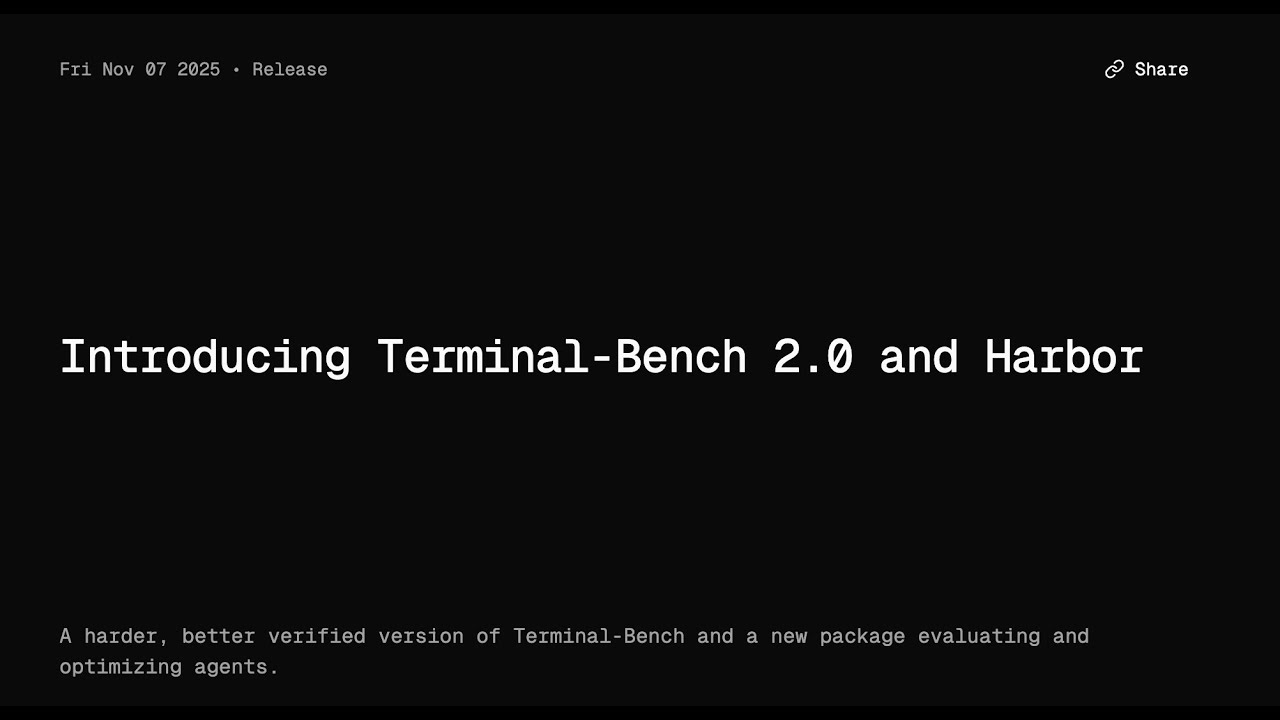
Terminal-Bench 2.0: the most impt coding agent benchmark of 2025 gets a v2! Launch + Q&A w/ founders
Nov 8, 2025 · 35:01
Terminal-Bench co-creators Mike Merrill, Alex Shaw, and collaborators Andy Konwinski, Ludwig Schmidt, and Aatash launch Terminal-Bench 2.0, an 89-task coding benchmark with rigorous human and LM-assisted verification to test agent performance on real-world tasks like designing DNA primers and installing Windows 3.11. They reflect on Terminal-Bench 1's problems—easy tasks and reproducibility—and detail spending 300 hours manually auditing each task. They introduce Harbor, an open-source package for running sandboxed agent rollouts, standardizing task format and integrating with agents like Codex and Claude Code. Aatash shows using Harbor to generate thousands of training traces for DataComp Agent, running 1,000 parallel sandboxes. Future plans include expanding to scientific computing.

⚡ Open Model Pretraining Masterclass — Elie Bakouch, HuggingFace SmolLM 3, FineWeb, FinePDF
Oct 20, 2025 · 1:03:40
Elie Bakouch, Hugging Face's pre-training lead and architect behind SmolLM, presents a five-pillar framework for model training spanning data quality, architecture, information extraction, gradient quality, and stability, while breaking down recent innovations in optimizers, Mixture of Experts, and data rephrasing. He explains that the field of optimizers is moving beyond AdamW with Muon and Shampoo, noting that speed-ups are often exaggerated due to undertuned baselines. He deep-dives into MoE architecture, showing that expert specialization requires load balancing at the global batch level, as demonstrated by Qwen's findings. He discusses the rephrasing revolution, where converting low-quality web data into QA format yields non-random MMLU performance even for small models. Elie also highlights Hugging Face's open science contributions: FinePDF (new PDF dataset), FineWeb-Edu2, and tools like Nanotron, Datahub, and Liteval.

Building Jamba 3B: the tiny Hybrid Transformer State Space Reasoning Model - Barak Lenz, CTO of AI21
Oct 11, 2025 · 45:05
Barak Lenz, CTO of AI21, presents their Jamba 3B model as a tiny hybrid transformer-state space model that brings long context capabilities to edge devices, and argues enterprises need AI systems like Maestro over standalone models. Lenz explains that the 1:8 ratio of attention to Mamba layers emerged from extensive ablations, with attention placed in the middle of the block working best. The Jamba 3B model uses a 1:12 ratio to maximize efficiency, fitting the same context length as larger models with a fraction of memory. He notes that pure Mamba underperformed on some tasks but hybrid models resolved those deficiencies, and that images quickly become long context problems (4 images can be thousands of tokens). For enterprise, Lenz advocates for model-agnostic orchestration layers treating models as "actions" with statistical properties, enabling continuous learning and cost optimization without vendor lock-in. Drawing from his algo trading background, he compares training frontier models to developing trading algorithms, emphasizing the importance of world-class engineering and avoiding brute force reasoning.

Amp: The Emperor Has No Clothes
Sep 25, 2025 · 1:21:59
Quinn Slack (CEO) and Thorsten Ball (Amp Dictator) from Sourcegraph discuss Amp Code, a coding agent that ships 15x/day with no code reviews. They explain the strategic pivot from Cody to Amp, emphasizing that building the best coding agent trumps everything else. The team dogfoods Amp internally, using it to build itself, and maintains both a VS Code extension and CLI, with a 50/50 internal split. They argue that model choice is becoming less important than the harness around the model, and they reject features like prompt enhancers, custom subagents, and MCP servers as not adding value. Common failure modes include outsourcing thinking but not typing and using agents without proper context engineering. They predict async agents running 24/7 will dominate, and they target early adopters willing to adapt their codebases and workflows for maximal agent effectiveness.

Better Data is All You Need — Ari Morcos, Datology
Aug 29, 2025 · 1:18:43
Ari Morcos, CEO of Datology, argues that data curation is the most impactful and underinvested area in AI, claiming models are defined by what they eat. He details his shift from focusing on inductive biases to realizing data quality is paramount, citing the DCLM study where human experts could not predict automated filtering decisions. Datology's methods combine filtering, rebalancing, curriculum, and rephrasing synthetic data to achieve baseline performance 12x faster, improve accuracy by 4–5 absolute points, and train models with fewer than half the parameters. Morcos explains how curating data bends naive scaling laws by maintaining marginal information gain, and shares results from the Arc 4.5B model, which was trained on 7 trillion tokens (down from 25 trillion) using Datology's curation. He highlights that data is a compute multiplier, making it possible for enterprises to train smaller, cheaper models for specific domains.

The AI Agenda: GPT5 leaks and the business of AI News — Steph Palazzolo, The Information
Aug 6, 2025 · 1:14:36
Steph Palazzolo, AI journalist at The Information, explains how she covers the secretive AI industry, from OpenAI's GPT-5 to the inference market where startups like Modal raise billions. She reveals that inference providers are essentially GPU resellers facing margin pressure, and that GPT-5's performance will signal whether pre-training scaling or reinforcement learning drives progress. She critiques Meta's super intelligence ambition as misaligned with its ad-revenue business, and details the talent war with rumored hundred-million-dollar offers from Meta to poach researchers. Palazzolo also discusses the Windsurf acqui-hire backlash, the rise of coding agents like Claude Code, and how journalists protect sources while navigating leaks from CEOs like Sam Altman.

⚡️Mercury: Ultra-Fast Diffusion LLMs — Estefano Ermon, CEO Inception Labs
Aug 4, 2025 · 28:07
Stefano Ermon of Inception Labs explains why diffusion language models like their Mercury Coder can match GPT-4.1 Nano and Claude Haiku in intelligence while delivering 5–10× faster inference at 737–1109 tokens/sec on H100s, built on score-based generative model foundations he pioneered at Stanford. He details the coarse-to-fine generation process that modifies multiple tokens per network evaluation, the required end-to-end training from scratch (no fine-tuning existing LLMs), and how post-training pipelines use specialized DPO for preference alignment. Ermon identifies latency-sensitive applications—voice agents, IDEs, vibe coding—as the killer use case, acknowledges they aren't yet frontier-level but sees a future where diffusion dominates due to efficiency gains, and notes the challenge of open-sourcing given proprietary inference engines and kernels.

🕰️ The Oral History of Windsurf (ft. Varun Mohan, Scott Wu, Jeff Wang, Kevin Hou, Anshul R)
Jul 28, 2025 · 3:53:23
This episode traces the oral history of Windsurf (formerly Codeium and Exafunction) with founders Varun Mohan, Scott Wu, Jeff Wang, Kevin Hou, and Anshul R, charting its evolution from a GPU virtualization startup to a leading agentic IDE and its dramatic acquisition by Cognition. The narrative covers the pivot to code completion in 2022, the shift to a free model to gain traction, and the launch of the Windsurf editor in November 2024 with Cascade, an agent that operates on a shared timeline with the developer. Key principles include meta-learning (auto-generated memories that adapt to each user's preferences) and scaling with intelligence (replacing hard-coded rules with LLM reasoning as models improve). The episode also details the acquisition weekend when Cognition bought Windsurf after Google acquired a stake, highlighting product synergies between the synchronous agent (Windsurf) and async agent (Devin) and the ambition to build a comprehensive platform for real-world software engineering teams.

AI is Eating Search
Jul 23, 2025 · 56:22
Robert McCloy of Scrunch AI argues that AI is replacing web browsing, not just search, as consumers prefer ChatGPT and similar tools over traditional browsing. He explains that AI search platforms still rely on traditional search under the hood, but re-rank results based on metadata clarity—so clickbait titles fail while descriptive content wins. Prompt injection works currently but is a temporary tactic; the durable strategy is clear, structured content with server-side rendered HTML because AI tools don't execute JavaScript. Scrunch helps brands optimize for platforms like ChatGPT, Perplexity, and Meta AI; customer Clerk saw a 6x traffic increase and 9x conversion lift from AI-referred visitors. Robert predicts the future is about 'agent experience'—optimizing how AI systems interact with your content to serve end users directly.

⚡️Ranking Agentic LLMs — Pratik Bhavsar, Galileo
Jul 14, 2025 · 34:10
Pratik Bhavsar from Galileo presents their Agent Leaderboard, which evaluates LLMs on tool calling across multiple benchmarks, revealing that Gemini models top the charts for performance and cost-efficiency. The leaderboard, built on datasets like BFCL, XLAM, and Tau Bench, uses an LLM-as-judge metric called Tool Selection Quality (TSQ). Surprising findings include reasoning models like o1 struggling with multi-tool outputs, Mistral Small excelling as the best open-source model, and Llama models performing poorly. The episode also previews V2 of the leaderboard, which introduces domain-specific, harder, multi-turn scenarios with a user and tool simulator, and a new Action Completion metric to measure whether all user requests are accomplished.

Personalized AI Language Education — with Andrew Hsu, Speak
Jul 11, 2025 · 1:04:10
Andrew Hsu, CTO of Speak, explains how the company built the "third generation" of language learning by betting on AI speech and language models before they were ready. Speak focused on South Korea early, a counterintuitive move for a San Francisco startup, and now 6% of the Korean population has tried the app. The turning point came with Whisper and GPT in 2022, which enabled Speak to evolve from a listen-and-repeat tool into a full-featured AI tutor that gives real-time feedback and adapts to learners. Speak generates over $50M ARR primarily from consumer subscriptions, and Hsu details the product decisions that made it work: abandoning a free version, building custom ASR for low latency, and emphasizing functional fluency over textbook language. He also reveals that Speak is building a real-time voice platform and a knowledge graph for personalized fluency scores, with an eye toward expanding beyond language into general AI-powered education.

⚡️Launching AI Diplomacy: the hardest LLM Game Benchmark yet - Alex Duffy
Jun 11, 2025 · 34:32
Alex Duffy from Every launches AI Diplomacy, a benchmark where LLMs play the board game Diplomacy, revealing distinct model personalities and arguing that benchmarks function as memes that spread and saturate. He and Tyler Marquez built the front end and harness using Open Router, finding that Claude refuses to lie and never wins, o3 schemes in its diary, and DeepSeek is flowery or aggressive. His talk 'Benchmarks are Memes' highlights Simon Wilson's pelican-on-a-bicycle test as an example of an idea that gets adopted and then saturated by models. Duffy also shares his creative writing workflow at Every: dictation, prompts with style guides and editor notes, then heavy editing to reflect on AI output. Future plans include a data viewer, front-end improvements, and a human vs AI Diplomacy tournament to test jailbreaks.

The Utility of Interpretability — Emmanuel Amiesen
Jun 6, 2025 · 1:53:02
Emmanuel Amiesen, lead author of Anthropic's Circuit Tracing paper, presents the newly open-sourced tools that let anyone inspect how language models compute, revealing that models like Gemma 2-2B engage in genuine multi-step reasoning rather than mere pattern matching. Amiesen demonstrates that the model's internal features causally drive outputs—for instance, suppressing the 'Texas' feature in a capital-of-state query changes the answer from Austin to Sacramento. He explains how sparse autoencoders uncover features shared across languages and modalities, and how attribution graphs map feature interactions. The episode covers practical insights: why jailbreaks succeed (the model prioritizes grammatical completion over refusal) and how planning in poetry generation involves deciding a rhyme before the line begins. Amiesen calls for more researchers to explore interpretability, citing the low barrier to entry with open models and tools.

The AI Coding Factory
May 29, 2025 · 59:23
Factory.ai co-founders Eno Reyes and Matan Grinberg join Latent Space to explain their vision for autonomous software engineering droids that handle everything from code generation to incident response for enterprises. They met at a Langchain Hackathon in 2023, and within eight days both quit their jobs to start Factory. The platform is browser-based, not IDE-based, because they argue the optimal UI for a world where humans write less code will not evolve from the IDE. They focus on enterprise codebases, citing a large migration that took from four months to three and a half days. Key design decisions include a delegation model where agents ask clarifying questions, proactive context gathering via synthetic insights, and usage-based pricing tied to token efficiency. They also discuss why SWE-Bench is dead for their use case, the challenge of model post-training biases toward CLI tools, and their need for 'junior Enos' in go-to-market roles.
⚡️Multi-Turn RL for Multi-Hour Agents — with Will Brown, Prime Intellect
May 23, 2025 · 38:59
This episode features Will Brown of Prime Intellect discussing Claude 4's emphasis on agentic tool use over pure reasoning, the controversy around Claude's safety stress-testing results (including alleged dark web uranium searches), and his team's paper on multi-turn reinforcement learning for LLM agents. Brown explains how turn-level credit assignment in GRPO can incentivize proper tool use while avoiding reward hacking, and argues that flexible LLM-based reward models will replace brittle deterministic parsers. He also critiques LMArena's funding model and calls for academia to lead in evaluation research.

The Agent Network — Dharmesh Shah, Agent.ai + CTO of HubSpot
Mar 28, 2025 · 1:42:28
Dharmesh Shah, founder of Agent.ai and co-founder of HubSpot, defines an AI agent broadly as AI-powered software that accomplishes a goal, and argues that the next frontier is multi-agent systems and shared memory across agents. He reveals Agent.ai has 1.3M users and 3,000 published agents, positioning it as a professional network where agents have profiles, post release notes, and can be composed via MCP servers. Shah contrasts work as a service (paying for the work done) versus results as a service (paying for outcomes), warning that results-based pricing only works for objectively measurable, low-variance tasks like customer support tickets. He advocates for MCP as the standard for agent-tool discovery, and shares his personal engineering philosophy of preferring under-engineering over over-engineering because the cost to fix later trends toward zero with AI code generation. Shah also discusses his domain investing strategy (owning chat.com, prompt.com, crew.ai), his rule against competing with Sam Altman, and the 'Sorry Must Pass' framework for managing overwhelm by defaulting to no.

Outlasting Noam Shazeer, Crowdsourcing Chai AI w/ 1.4m DAU — with William Beauchamp, Chai Research
Jan 26, 2025 · 1:13:33
William Beauchamp, founder-CEO of Chai AI, explains how he pivoted from algorithmic trading to build a character chatbot platform before Character.ai, growing to 1.4M DAU and $22M+ revenue by crowdsourcing model improvements through Chaiverse. Starting with GPT-J in 2021, he found product-market fit with a therapist bot and shifted to user-generated content, letting users define prompts, images, and names. Competing against well-funded rivals like Character AI and Talkie, Chai ships over 100 LLMs weekly via its developer platform, spending $10M on compute in 2024 and tripling it. Beauchamp argues AI follows an S-curve, not scaling laws, and focuses on inference optimization using rejection sampling and reward models to serve better responses. He prioritizes 'insanely great' products over technology-driven features, noting that audio and image features failed to move metrics, while a data flywheel and aggressive user acquisition drove rapid growth.

OpenAI o1 isn’t a chat model (and that’s the point)
Jan 17, 2025 · 31:59
Ben Hylak and Dan McAteer explain why OpenAI’s o1 is not a chat model and how mastering its prompting turned Ben from a skeptic into a proponent. Ben’s prompt structure—goal, return format, warnings, context dump—emphasizes describing what you want rather than how to think, a shift from earlier models. Dan uses o1 for coding by feeding it full code context, achieving one-shot implementations that reach 100% where previous models maxed out at 95%. Ben notes o1 is the most capable but hardest model to use, with experiments costing $20 per try, and argues model routing will let humans or systems trade off cost, speed, and intelligence. Dan also applies o1 to scientific research, feeding it papers from multiple fields to find novel connections that humans would miss.

Beating Google at Search with Neural PageRank and $5M of H200s — with Will Bryk of Exa.ai
Jan 10, 2025 · 55:54
Will Bryk, CEO of Exa.ai (formerly Metaphor), details building a neural search engine from scratch using link prediction as 'Neural PageRank' — predicting documents rather than keywords. Exa's new product offers near-perfect lists (e.g., 'startups working on hardware in SF') by scaling compute per query, from milliseconds to a day, like o1 for search. Bryk argues LLMs will become the interface to search, while Exa provides the 'super knowledge' that even AGI will need. He contrasts Exa's neural approach with Google's keyword-based system and Perplexity's reliance on Bing. The company recently purchased a $5M H200 cluster and maintains a culture of nap pods and first-principles thinking.
2024 Year in Review: The Big Scaling Debate, the Four Wars of AI, Top Themes and the Rise of Agents
Jan 1, 2025 · 1:51:07
In their 100th episode, hosts Alessio and Swyx recap 2024 in AI, arguing that pre-training scaling has hit a wall—backed by Ilya Sutskever and others at NeurIPS—and that inference-time compute (o1, o3) is the new frontier. They dissect the "four wars": data quality (lawsuits vs. synthetic data), GPU haves vs. have-nots (with the middle class dying), multimodality (Sora, Veo 2, Gemini 2.0's native image output), and the LLM OS/agents stack (LangChain, E2B, memory). Market share shifted from OpenAI's 95% to 50-75% as Anthropic and Gemini gained ground; prices dropped ~3 orders of magnitude for same ELO. The episode predicts 2025 as the year agents finally enter production, driven by models like o1 and tools like Devin, and warns that AI will set the skill floor for roles.

0 to over $8M ARR in 2 months as a Claude Wrapper (Bolt.new, Qodo)
Dec 2, 2024 · 1:36:42
Eric Simons of Bolt.new/Stackblitz and Itamar Friedman of Qodo discuss Bolt.new's viral growth from $4M ARR in four weeks to over $8M ARR in two months as a Claude wrapper, driven by its in-browser WebContainer OS that eliminates local dev setup. They contrast Bolt's '0 to 1' creation for non-developers with enterprise-focused agents like Qodo's testing and code review tools, arguing that specialized agents outperform general-purpose ones. Simons details how WebContainer's unified sandbox enables error self-healing loops, while Friedman explains AlphaCodium's task-breaking that boosted o1 preview to 93rd percentile on Codeforces. The episode covers open-source strategy, pricing tiers ($20 to $200/month), and founder advice on ignoring expert doubt to ship fast, illustrated by Simons' Ironman completion while launching Bolt.

[Paper Club] BERT: Bidirectional Encoder Representations from Transformers
Nov 27, 2024 · 53:12
Eric Ness walks through the BERT paper, explaining how its bidirectional encoder architecture with masked language modeling and next sentence prediction pre-training enabled state-of-the-art results on 11 NLP tasks in 2019. He details the 110M parameter BASE and 340M parameter LARGE models, trained on 2.5B Wikipedia words and 800M book words, and how a simple logistic regression on BERT embeddings achieves 82% accuracy on IMDb sentiment classification, far above the 50% baseline. Swyx and Eric discuss how BERT’s pre-training objectives—masking 15% of tokens and predicting sentence order—teach small models word relationships for efficient classification, though they lose data compared to decoder-only next-token prediction. They note that while scaling laws favor decoder models, BERT-style encoders remain cost-effective for edge deployment, with recent work showing full retraining in 24 hours for under $500 or even 1 hour for $20 on 8 A100s, matching original GLUE scores.

Agents @ Work: Lindy.ai (with live demo!)
Nov 15, 2024 · 1:08:01
Florent Crivello, founder of Lindy.ai, explains how his no-code agent platform evolved from an overly LLM-dependent design to a deterministic 'on rails' system that puts AI in a box, making agents more reliable and easier to use. The product was rebuilt from scratch as Lindy 2.0, featuring step-by-step workflows with structured outputs and memory management that still requires pruning. Crivello reveals that Claude 3.5 Sonnet ended model bottlenecks but warns against over-engineering cognitive architectures, advocating instead for letting models scale. He discusses building their own eval tools (now considering Braintrust), hiring vertical GMs for go-to-market, and the decision to return to in-person work, arguing remote work hampers creativity. He also shares his contrarian views on Europe vs. US tech, testing the Overton window with spicy tweets, and balancing AI safety concerns (10% p(doom)) with building toward a potential utopia.
Building the Silicon Brain - Drew Houston of Dropbox
Oct 18, 2024 · 1:11:40
Drew Houston, CEO of Dropbox, details his hands-on AI engineering journey and the company's strategic pivot to AI-first products like Dropbox Dash for universal search and access control. Having spent over 400 hours coding with LLMs, he built personal tools that seeded Dropbox AI, including a file question-answering system. He advocates 'rent, don't buy' for AI infrastructure, relying on open-source models and keeping options open as costs drop 10-100x yearly. Houston explains Dropbox's advantage in trust and data privacy, positioning it as a neutral platform that integrates with Google Drive and OneDrive. He discusses staying relevant through constant learning and founder mode, and advises founders to systematically train skills ahead of their company's growth.

[Paper Club] Molmo + Pixmo + Whisper 3 Turbo - with Vibhu Sapra, Nathan Lambert, Amgadoz
Oct 13, 2024 · 1:12:59
This episode covers two papers: AI2's Molmo open-source vision-language models and OpenAI's Whisper Large V3 Turbo. For Molmo, the key claim is that high-quality, audio-annotated data (Pixmo) enables models as small as 1B to match GPT-4V on academic benchmarks, with the 72B variant outperforming GPT-4o, Gemini 1.5, and Claude 3.5 Sonnet. The team avoided distilling proprietary models by having annotators describe images in speech for 60-90 seconds, then transcribing and augmenting the captions. For Whisper Turbo, OpenAI pruned the decoder from 32 to 4 layers and continued pre-training on 10 million hours of multilingual transcription data, making it 1.78x smaller than Large V3 with minimal word-error-rate increase. The model is faster and supports real-time chunk-based decoding, unlike English-only DistilWhisper. Nathan Lambert and Amgadoz provide commentary on data strategies and benchmarking nuances.
Production AI Engineering starts with Evals
Oct 11, 2024 · 1:56:16
Ankur Goyal, founder and CEO of Braintrust, argues that evaluation is the core workflow of production AI engineering and shows how his platform makes evals accessible to software engineers. Drawing from his experience at SingleStore and Impira, he details Braintrust's evolution from an eval tool into an end-to-end AI development platform used by Stripe, Zapier, Vercel, and other top AI teams. He shares market data: OpenAI handles over 95% of production workloads, fine-tuning is declining, and open-source models account for under 5% due to reliability issues. Ankur explains why he avoided building a vector database—the real challenge is permissions and joins, not vector search—and predicts o1-style reasoning will replace complex agent frameworks. He reveals Braintrust's differentiators: hybrid on-prem, TypeScript-first SDK, and declarative eval structures.

Language Agents: From Reasoning to Acting — with Shunyu Yao of OpenAI, Harrison Chase of LangGraph
Sep 27, 2024 · 1:26:33
Shunyu Yao of OpenAI and Harrison Chase of LangChain discuss the evolution of language agents, arguing that combining reasoning and acting through techniques like ReAct remains foundational, while tool design and cognitive architectures like CoALA will shape the next wave. Shunyu traces his work from text games to ReAct, showing how thinking as an action improves reliability; Harrison explains LangChain's adoption and the shift to LangGraph for stateful orchestration. They emphasize agent-computer interfaces (ACI) as a neglected area, noting that SWE-Agent's success came from optimizing tools for models, not humans. The conversation covers memory types (semantic, episodic, procedural) and applies CoALA's three dimensions to current systems. They highlight promising applications: customer support, coding agents, and spreadsheet-style UX for batch operations. Shunyu stresses that better benchmarks like SWE-Bench (which solved 30% of GitHub issues) and TauBench (best model 48%) are critical, and that data—not architecture—will drive future model improvements.

The Ultimate Guide to Prompting - with Sander Schulhoff from LearnPrompting.org
Sep 20, 2024 · 1:07:09
Sander Schulhoff, author of The Prompt Report and founder of LearnPrompting, presents a comprehensive taxonomy of 58 prompting techniques and argues that prompt engineering is a skill everyone should have, not a specialized role. He categorizes techniques by problem-solving strategy (zero-shot, few-shot, thought generation, decomposition, ensembling, self-criticism) and debunks role prompting for accuracy-based tasks, showing an 'idiot' prompt outperformed a 'genius' prompt on MMLU. Schulhoff shares his experience running Hack-a-Prompt, which collected 600,000 malicious prompts and won best paper at EMNLP, and differentiates between prompt injection and jailbreaking. He advocates for automatic prompt engineering with DSPy, which beat his manual effort in 10 minutes, and previews Hack-a-Prompt 2.0, aiming for a $500,000 prize pool to generate real-world harms for safety tuning.

Training Llama 2, 3 & 4: The Path to Open Source AGI — with Thomas Scialom of Meta AI
Jul 23, 2024 · 1:04:34
Thomas Scialom, Llama 2 lead and Llama 3 post-training lead at Meta AI, explains why scaling laws must go beyond Chinchilla—training models longer on more tokens yields better inference efficiency than bigger models, a lesson that drove Llama 3's 15 trillion token pre-training. He details how synthetic data from Llama 2 bootstrapped Llama 3's post-training, eliminating human-written SFT data, and why RLHF outperforms imitation learning: humans are better discriminators than generators, enabling superhuman outputs. Scialom defends the dense 405B architecture over MoE, calls tokenizer vocab size underrated (128k tokens vs Llama 2's 32k), and reveals Llama 4's focus on agentic capabilities—tool use, multi-step reasoning—as the path to open-source AGI. Meta AI is hiring researchers with rigorous first-principles thinking.

How to train a Million Context LLM — with Mark Huang of Gradient.ai
May 31, 2024 · 1:12:14
Mark Huang of Gradient.ai explains how his team extended Llama 3 to a 1 million token context window using curriculum learning, RingAttention, and EasyContext, achieving near-perfect GPU utilization. They employed theta scaling from the RoPE paper to interpolate positional encodings, trained on carefully curated datasets including SlimPajamas and synthetic data from GPT-4, and validated with benchmarks like Ruler and needle-in-a-haystack. Huang details the trade-offs between full fine-tuning and LoRA adapters, the challenges of pushing to 4M tokens (degradation from floating-point precision limits), and why long context matters for state management across sessions and grounding multimodal inputs. He calls for community collaboration on long-context evaluations and pairwise multimodal datasets.

Breaking down the OG GPT Paper by Alec Radford
Apr 23, 2024 · 1:05:03
This episode of the Latent Space Paper Club breaks down Alec Radford's seminal 2018 GPT-1 paper, which introduced generative pre-training of a Transformer decoder on BookCorpus (5 GB, 7,000 books) followed by supervised fine-tuning. Amget explains how the 117M-parameter model achieved state-of-the-art on 9 of 12 NLU tasks, with absolute gains of 8.9% on commonsense reasoning (Stories Cloze) and 5.7% on question answering (RACE). Key innovations include task-agnostic input transformations (e.g., concatenating premise and hypothesis with a delimiter for entailment, using a Siamese architecture for semantic similarity, and scoring answer choices for QA) and an auxiliary language modeling objective during fine-tuning (lambda=0.5). The episode also covers zero-shot heuristics (appending 'very' for sentiment, averaging token log probabilities for QA), ablation studies showing pre-training adds 15% average improvement, and the paper's prescient call to scale up—which became the blueprint for GPT-2, GPT-3, and beyond.

A Comprehensive Overview of Large Language Models - Latent Space Paper Club
Mar 15, 2024 · 54:30
Brian presents a detailed walkthrough of the survey paper 'A Comprehensive Overview of Large Language Models,' which systematically covers the evolution of LLMs from early attention mechanisms to modern transformer architectures. He explains the shift from sequential RNNs to parallelizable transformers, the three dominant architectures (encoder-only like BERT, encoder-decoder like T5, decoder-only like GPT), and key training objectives (masked language modeling, full language modeling, prefix language modeling). The paper also reviews fine-tuning techniques (instruction tuning, alignment tuning via RLHF), prompting strategies (zero-shot, chain-of-thought), efficient adaptation methods (LoRA, quantization), evaluation benchmarks (GLUE, MMLU), and challenges such as bias, memorization, and privacy leaks. This episode serves as a comprehensive primer for anyone seeking to understand the foundational concepts and latest trends in large language model research.
Open Source AI is AI we can Trust — with Soumith Chintala of Meta AI
Mar 6, 2024 · 1:37:38
Soumith Chintala, creator of PyTorch and engineering lead at Meta AI, argues that open source AI is essential for distributing opportunity and trust. He details PyTorch's complexity—1,000 operators needed for generality—and explains synthetic data as a vehicle for imparting symbolic knowledge where humans already have good symbolic models. He highlights a coordination problem in open source: feedback is lost because frontends like Ooba and Ollama lack feedback buttons, and proposes a centralized sinkhole to collect high-quality feedback. Beyond text, he is excited about robotics, where hardware remains a bottleneck, and Osmo's work to digitize smell, which he compares to images in the 1800s.
Powering your Copilot for Data - with Artem Keydunov from Cube.dev
Oct 27, 2023 · 43:01
Artem Keydunov, co-founder of Cube (formerly Statsbot), explains how his early text-to-SQL Slack bot in 2016 led to the creation of Cube as a semantic layer, which he argues is now essential for grounding AI models on structured data. Statsbot failed due to the lack of LLMs, relying on regex and custom models, but the underlying Cube framework—an open-source semantic layer defining metrics and dimensions—solved the context problem. Today, semantic layers index data into text descriptions, enabling agents to generate simple queries against the layer instead of complex SQL, reducing errors. Keydunov highlights that natural language querying is becoming a commodity feature in BI tools, but the real value lies in treating metric definitions as code with version control. He advises AI engineers to use a proper warehouse, a semantic layer like Cube, and tools like LangChain, while cautioning that production systems need extra Python code for math and error handling.

The End of Finetuning — with Jeremy Howard of Fast.ai
Oct 20, 2023 · 1:24:48
Jeremy Howard of Fast.ai argues that fine-tuning language models is essentially continued pre-training, not a separate process, and that the common practice of fine-tuning on a single task causes catastrophic forgetting. He recounts the discovery of single-shot memorization in LLMs, where models memorize entire datasets after one epoch, a phenomenon many practitioners ignore. Howard criticizes the current focus on zero-shot and few-shot learning, advocating for transfer learning and small models. He shares his journey from philosophy to founding Fast.ai, the creation of ULMFit (which inspired GPT), and his ongoing work on making AI accessible. He also discusses his involvement with Modular's Mojo language and the importance of democratizing AI technology.
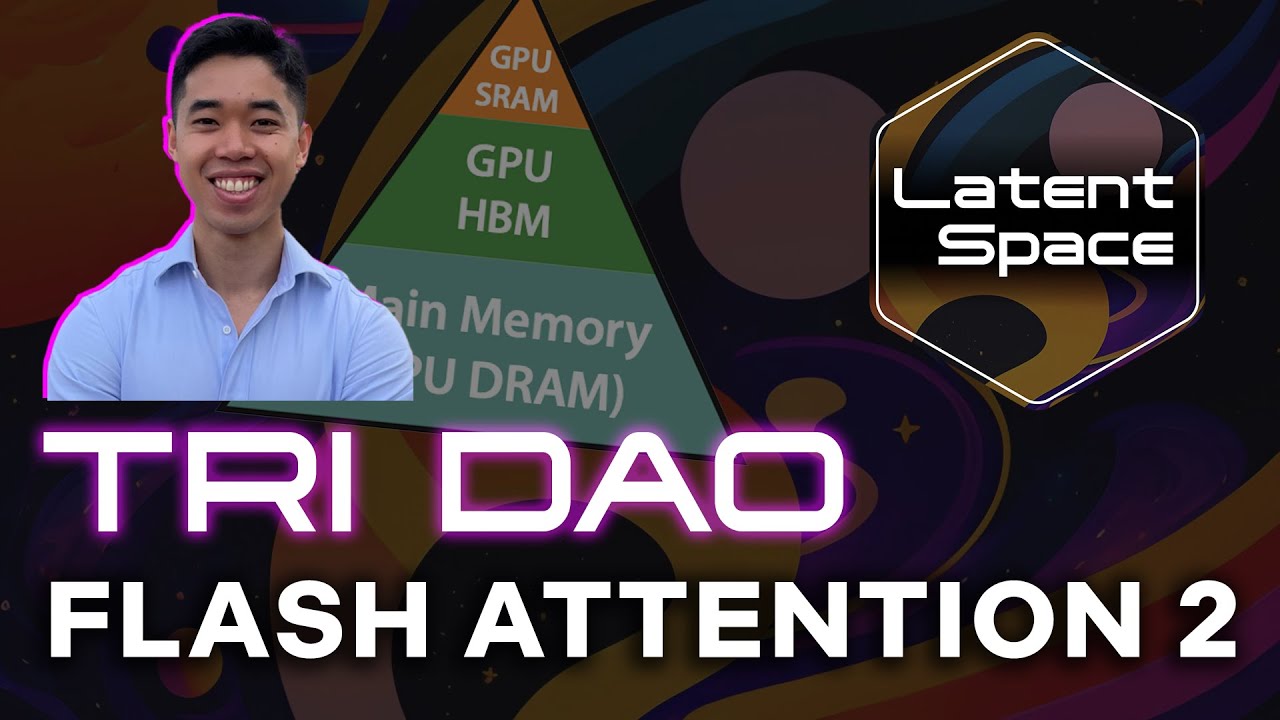
FlashAttention-2: Making Transformers 800% faster AND exact
Aug 3, 2023 · 1:04:06
Tri Dao, creator of FlashAttention and FlashAttention-2, explains how his I/O-aware algorithm makes attention 2x faster by fusing kernels and using online softmax, achieving near-matrix-multiply efficiency. He argues that transformer alternatives like state space models and RNNs (e.g., RWKV) could surpass transformers for long sequences and high-throughput generation, though attention still dominates. Dao discusses the hardware lottery, where NVIDIA's CUDA ecosystem entrenches transformers, and advocates for open-source AI, praising Meta's Llama 2 for shifting enterprise adoption despite its restrictive license. He emphasizes that understanding both algorithms and systems is key to scaling AI, and that academia should pursue risky bets that industry cannot.
Powered by PodHood