
GitHub Copilot
ProductA product discussed on Latent Space.
11 episodes
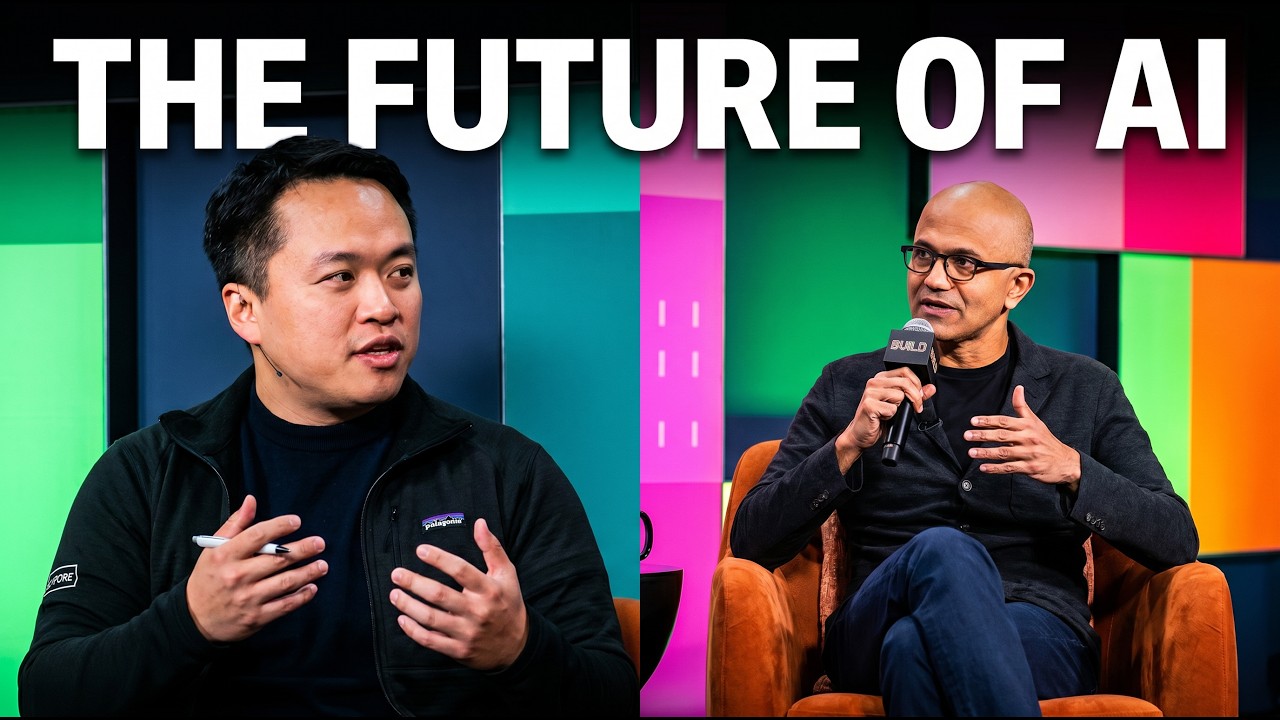
Satya Nadella on AI: @NoPriorsPodcast x Latent Space Crossover Special at Microsoft Build 2026
Jun 3, 2026 · 41:27
Satya Nadella argues that Microsoft's AI strategy is an ecosystem platform enabling any company to build frontier intelligence using models, tools, data, and a harness, not just consume one model. He outlines MAI training with clean data lineage, hill-climbing scaffolds, and private evals as core IP. The harness concept features multi-model harnesses with strong context layers, exemplified by GitHub Copilot and Work IQ turning M365 data into a database for agents. He notes coding agents required new IDE/UI, and long-running autopilots create value. Pricing evolves from per-user to consumption, and SaaS will unbundle and rebundle. Engineering generalists gain leverage; infrastructure roles like RLEs remain critical. Datacenter expansion requires community permission, with benefits in healthcare and rethinking education. Microsoft built more Azure capacity in 15 months than its first 15 years.
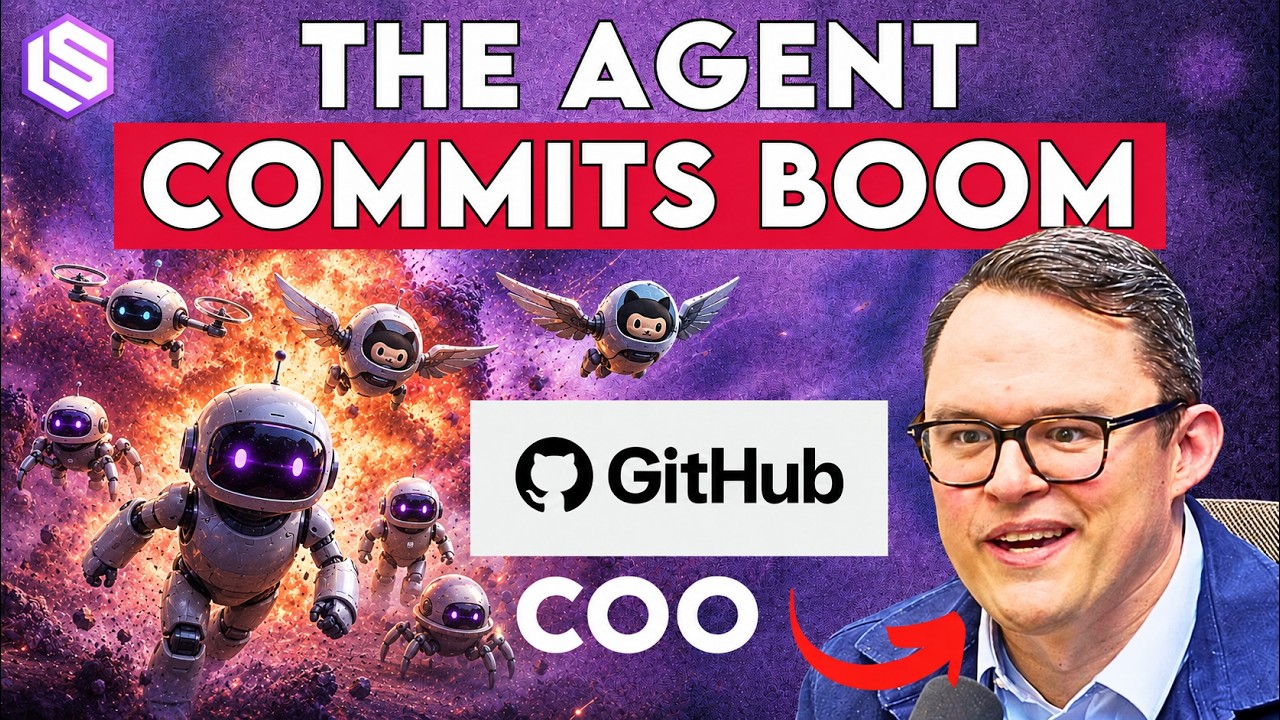
GitHub’s Agent Era: 14x Commits, 200M Developers, Copilot’s Next Act — Kyle Daigle
Jun 2, 2026 · 1:24:44
GitHub COO Kyle Daigle joins Swyx to unpack how the agent era is transforming GitHub's infrastructure and developer workflows, from 14x commit growth to internal AI micro-skills. Daigle describes using WorkIQ, MCP, and Slack/Teams context to retroactively analyze weeks' work and build executive presentations entirely with AI, undetected. He advocates atomic micro-skills over mega-skills and reveals GitHub now hosts 200M developers generating 275M weekly commits, on pace for 14B this year. Scaling issues stem from MySQL1 permissions and monorepo shifts, forcing rewrites of 10-year-old services. Copilot has evolved from code completion to a unified agent SDK powering CLI, desktop, and cloud agents. Microsoft's deep investment in OpenClaw reflects a need for OS-level sandboxing for enterprise agent deployment.

Dylan Patel Explains the AI War While Cooking | In-Context Cooking
Feb 26, 2026 · 55:13
Dylan Patel, CEO of SemiAnalysis, argues hyperscalers like Google, Amazon, and Meta will sacrifice all profits to build AI infrastructure, spending $180–$200 billion in capex this year alone, because the AI adoption explosion—Claude Code driving 4% of GitHub commits in one month, Anthropic adding $2.5 billion monthly revenue—makes it a Pascal's wager: spend or die. He details how Taiwan's semiconductor geopolitics create endgame scenarios, from a KMT win placating China to full invasion, with TSMC's output critical. Patel explains Nvidia's paranoid founder Jensen Huang is responding to vertical integration threats from hyperscalers by diversifying into chips like CPX and Groq, but warns moats are shallow. The real bottleneck in AI progress? Semiconductors themselves: fabs take years to build, and no one can buy enough GPUs through 2028. He also predicts a massive AI backlash from the public and financial markets, as capital consumption outpaces revenue and labor displacement accelerates.

Claude Code for Finance + The Global Memory Shortage: Doug O'Laughlin, SemiAnalysis
Feb 24, 2026 · 2:07:40
Doug O'Laughlin, SemiAnalysis founder, explains his Claude Code awakening in December 2024: Anthropic's Opus 4.5 one-shotted tasks that used to take 24 hours, leading him to predict Claude Code will write 25–50% of all GitHub code by year-end (already 4% of commits in two weeks). He argues this marks the death of Excel and Bloomberg for analysts—'you can just do things'—but warns of a 'hygiene' crisis as junior analysts lose meta-learning. On the semiconductor side, O'Laughlin details a severe memory squeeze: HBM demand consumes 4× the DRAM capacity, DRAM prices could double again, and CXL is reviving as a workaround. He compares AI infrastructure buildout to the railroad boom (25% of U.S. gross fixed capital investment) and says Microsoft faces an innovator's dilemma—renting GPUs to 'barbarians at the gate' while its own office franchise is disrupted by Claude Code. Google's TPU v7 enjoys a temporary TCO advantage, but Nvidia's supply chain dominance (Jensen doing shots with SK and Samsung) will reassert with Rubin. O'Laughlin also reflects on his 2,800-mile Continental Divide Trail hike as essential self-mastery.

Taste is your Moat (Dylan Field of Figma)
Oct 2, 2025 · 1:01:43
Dylan Field, CEO of Figma, argues that as AI accelerates software creation, design becomes the key differentiator—and Figma Make, a prompt-to-app tool, is Figma's bet on lowering the barrier for everyone. Field recounts his first AI-pill moment with Chris Olah in 2014 and later GPT-3 convincing him of exponential progress. He explains Figma's strategy: treat natural language as today's interface (calling it the 'MS-DOS era of AI'), use Figma as a 'context repository for aesthetics' to ground AI outputs in a user's taste, and solve the blank-canvas problem by letting AI generate initial designs. Field pushes back on 'fast fashion' software, arguing complex products like Workday can't be vibe-coded. He shares Thiel Fellowship lessons (start with 'what could this be' before finding flaws), recruiting advice from John Doerr (obsess over the funnel), and caution about get-rich-quick AI hype, drawing parallels to the NFT cycle he exited.

Greg Brockman on OpenAI's Road to AGI
Aug 15, 2025 · 1:08:37
Greg Brockman, OpenAI co-founder and president, explains how GPT-5's hybrid reasoning and aggressive pricing advance the road to AGI, while releasing GPT-OSS for open source. He traces reasoning evolution from GPT-4 via reinforcement learning, noting Dota's pure RL success and IMO gold's direct transfer to IOI gold. Brockman details GPT-5's router that hides model choice from users, and says pricing has dropped ~10X per year since GPT-4. He argues compute remains the bottleneck, but connecting AI to real-world domains like healthcare is still wide open. Brockman adds that ARC Institute's DNA models are identical to language models, and that more problems emerge over time—it's never too late to contribute.

🕰️ The Oral History of Windsurf (ft. Varun Mohan, Scott Wu, Jeff Wang, Kevin Hou, Anshul R)
Jul 28, 2025 · 3:53:23
This episode traces the oral history of Windsurf (formerly Codeium and Exafunction) with founders Varun Mohan, Scott Wu, Jeff Wang, Kevin Hou, and Anshul R, charting its evolution from a GPU virtualization startup to a leading agentic IDE and its dramatic acquisition by Cognition. The narrative covers the pivot to code completion in 2022, the shift to a free model to gain traction, and the launch of the Windsurf editor in November 2024 with Cascade, an agent that operates on a shared timeline with the developer. Key principles include meta-learning (auto-generated memories that adapt to each user's preferences) and scaling with intelligence (replacing hard-coded rules with LLM reasoning as models improve). The episode also details the acquisition weekend when Cognition bought Windsurf after Google acquired a stake, highlighting product synergies between the synchronous agent (Windsurf) and async agent (Devin) and the ambition to build a comprehensive platform for real-world software engineering teams.

Solve coding, solve AGI [Reflection.ai launch w/ CEO Misha Laskin]
Mar 7, 2025 · 28:12
Misha Laskin of Reflection AI argues that solving autonomous coding is the direct path to AGI, combining reinforcement learning (pioneered by his team on AlphaGo/AlphaZero) with large language models (which they advanced at Google on PaLM, Gemini, ChatGPT). He explains that coding is already ergonomic for LLMs—unlike browser agents that require noisy human mouse data—making it the ideal starting point. Reflection AI is building coding agents that automate backlog tasks (testing, refactoring, migrations, security remediation) for large engineering teams, delivering them via an API that takes a task and codebase and outputs resolved code. Laskin insists superintelligence cannot be built in a vacuum; real-world customer evals are essential, as benchmarks like SWE-bench don't guarantee production reliability. He also stresses the need for open-weight models to prevent a few companies from hoarding superintelligent coding agents.

0 to over $8M ARR in 2 months as a Claude Wrapper (Bolt.new, Qodo)
Dec 2, 2024 · 1:36:42
Eric Simons of Bolt.new/Stackblitz and Itamar Friedman of Qodo discuss Bolt.new's viral growth from $4M ARR in four weeks to over $8M ARR in two months as a Claude wrapper, driven by its in-browser WebContainer OS that eliminates local dev setup. They contrast Bolt's '0 to 1' creation for non-developers with enterprise-focused agents like Qodo's testing and code review tools, arguing that specialized agents outperform general-purpose ones. Simons details how WebContainer's unified sandbox enables error self-healing loops, while Friedman explains AlphaCodium's task-breaking that boosted o1 preview to 93rd percentile on Codeforces. The episode covers open-source strategy, pricing tiers ($20 to $200/month), and founder advice on ignoring expert doubt to ship fast, illustrated by Simons' Ironman completion while launching Bolt.
Building the Silicon Brain - Drew Houston of Dropbox
Oct 18, 2024 · 1:11:40
Drew Houston, CEO of Dropbox, details his hands-on AI engineering journey and the company's strategic pivot to AI-first products like Dropbox Dash for universal search and access control. Having spent over 400 hours coding with LLMs, he built personal tools that seeded Dropbox AI, including a file question-answering system. He advocates 'rent, don't buy' for AI infrastructure, relying on open-source models and keeping options open as costs drop 10-100x yearly. Houston explains Dropbox's advantage in trust and data privacy, positioning it as a neutral platform that integrates with Google Drive and OneDrive. He discusses staying relevant through constant learning and founder mode, and advises founders to systematically train skills ahead of their company's growth.
Building AGI with OpenAI's Structured Outputs API
Sep 17, 2024 · 1:12:23
Michelle, OpenAI's API tech lead, explains how the newly launched Structured Outputs feature achieves near-100% reliability for schema-following outputs by combining constrained decoding with model training, moving beyond the limitations of JSON mode and Function Calling. She details the refusal field that allows the model to decline harmful requests while maintaining parseable output, and discusses use cases like dynamic UI generation and mathematical chain-of-thought. The roadmap includes parallel function calling and custom grammars. The episode also covers the GA of GPT-4o fine-tuning, Batch API's 50% cost savings, Vision API integration with structured outputs, the Whisper API's surprising lack of diarization, and the shift toward speech-to-speech APIs. Michelle shares insights from her Waterloo co-op background and what qualities succeed at OpenAI: low ego, user-focused, and driven.
Powered by PodHood