
FlashAttention
ProductA product discussed on Latent Space.
5 episodes

How Zyphra went all-in on AMD + Why Devs feel faster with AI but are slower — with Quentin Anthony
Nov 3, 2025 · 1:00:02
Quentin Anthony, head of model training at Zyphra and advisor at EleutherAI, explains why his company moved all training to AMD MI300X GPUs, outperforming Nvidia H100s on certain workloads thanks to 192GB VRAM and higher memory bandwidth, and describes his kernel development approach of writing directly in ROCm or GPU assembly rather than using Triton. He also shares his experience in the METR study on AI coding productivity, where he was one of the few developers with measurable speedup, and offers tips: timebox AI use, avoid the slot machine effect, maintain context hygiene, and use direct API over tools like Cursor. Additionally, he argues that open source AI research benefits from siloed focused teams with guaranteed funding over grand collaborations, and notes that kernel datasets alone won't solve GPU programming due to evaluation challenges.
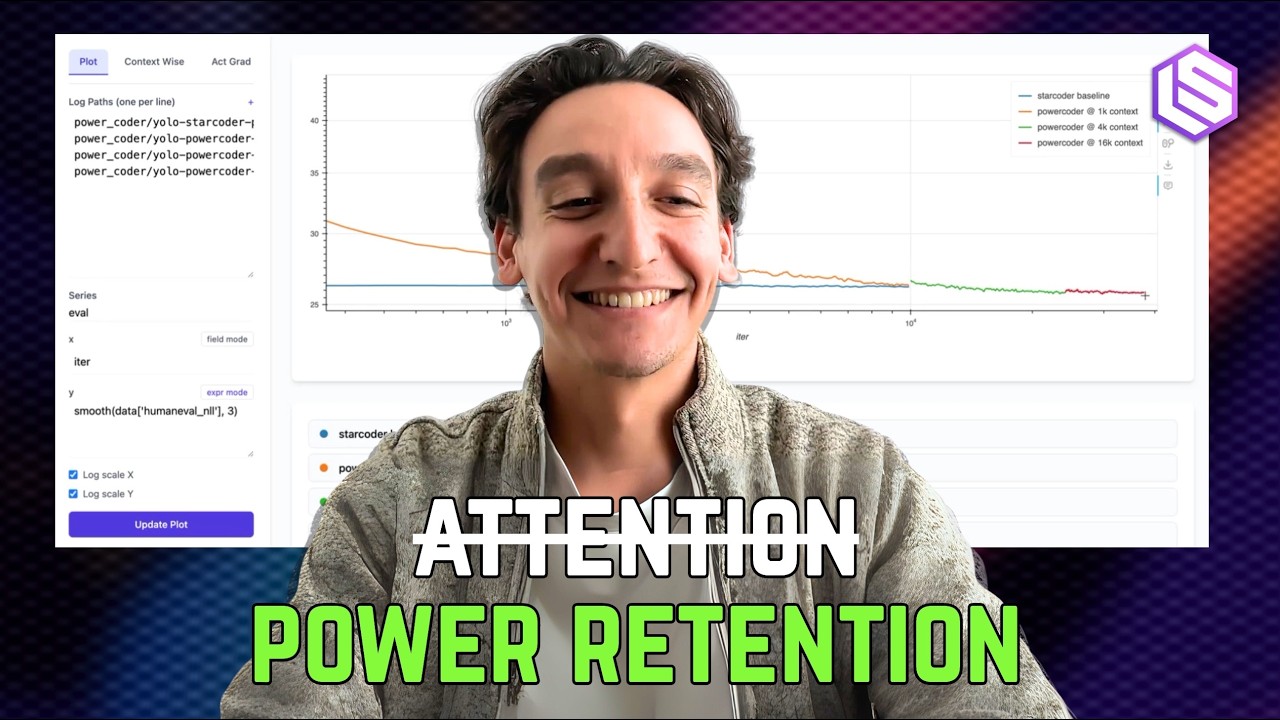
⚡️ Beyond Transformers with Power Retention
Sep 23, 2025 · 32:59
Jacob Buckman, CEO of Manifest AI, discusses their solution to AI's expensive computational bottleneck: the ever-growing KV cache for long context inference. Power Retention replaces attention in transformers with a fixed-size memory, achieving 10X training speedup at 64K tokens and 100X inference speedup over FlashAttention. Manifest releases Vidrial, a just-in-time CUDA kernel framework that finds optimal configurations, and Metamorphosis, a process to convert existing transformers like StarCoder-3B into Power Retention models in just two hours of mid-training. Buckman demonstrates PowerCoder, a 3B code model that matches baseline loss after 10K steps and handles contexts up to 32K and beyond. The open-source release includes kernels and tools, aiming to build community trust and encourage adoption by inference providers. He also highlights the need for genuinely long-context datasets beyond internet text, such as human trajectories.

2024 in Post-Transformer Architectures: State Space Models, RWKV [Latent Space LIVE! @ NeurIPS 2024]
Dec 24, 2024 · 42:45
Dan Fu (Together AI/UCSD) and Eugene Cheah (Featherless) survey post-transformer architectures, arguing that state-space models (SSMs) like Mamba and RWKV can match transformer quality while scaling subquadratically in sequence length, enabling efficient long-context and test-time compute. Fu explains how SSMs evolved from S4 to data-dependent selection mechanisms, while Cheah details RWKV's open-source development, including Q-RWKV6—a 32B model converted from Qwen 32B with linear attention that retains 76% MMLU after just days of training. They discuss hybrid models outperforming pure transformers or SSMs, and challenge RAG's necessity: fixed-state models like RWKV may handle up to 128K context for most enterprise workloads, while truly infinite context requires the model to decide what to forget. Hot takes: long context is overhyped for most use cases, but models that can 'watch forever' could excel in time-series and video generation.

Building an open AI company - with Ce and Vipul of Together AI
Feb 8, 2024 · 1:15:18
Together AI co-founders Vipul Ved Prakash and Ce Zhang explain why openness is core to their mission, detailing their journey from Apple (Vipul) and Stanford research (Ce) to building an open AI platform. They discuss RedPajama’s evolution into a modular dataset with 40 quality signals, the need for 5,000 tokens/second inference speed, and their investment in state space models like Mamba and Hyena as alternatives to transformers. The company, which runs 7,000-8,000 GPUs (mostly H100s), sees training as a larger workload than inference, with fine-tuning driving top models. They advocate for independent inference benchmarks, publish open research like FlashAttention, and keep some software proprietary. With 38 employees and 45% researchers, they are hiring across the stack, from CUDA to DevOps.
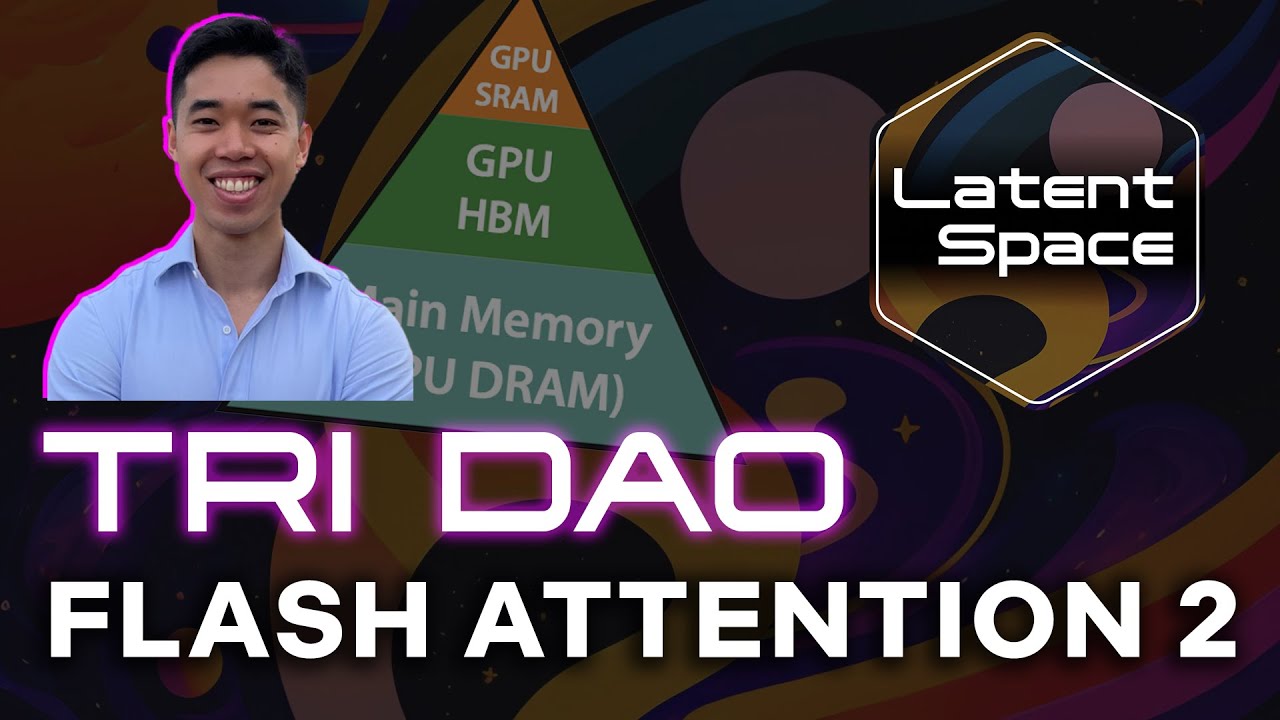
FlashAttention-2: Making Transformers 800% faster AND exact
Aug 3, 2023 · 1:04:06
Tri Dao, creator of FlashAttention and FlashAttention-2, explains how his I/O-aware algorithm makes attention 2x faster by fusing kernels and using online softmax, achieving near-matrix-multiply efficiency. He argues that transformer alternatives like state space models and RNNs (e.g., RWKV) could surpass transformers for long sequences and high-throughput generation, though attention still dominates. Dao discusses the hardware lottery, where NVIDIA's CUDA ecosystem entrenches transformers, and advocates for open-source AI, praising Meta's Llama 2 for shifting enterprise adoption despite its restrictive license. He emphasizes that understanding both algorithms and systems is key to scaling AI, and that academia should pursue risky bets that industry cannot.
Powered by PodHood