
Devin
ProductA product discussed on Latent Space.
36 episodes
The Blueprint for Autonomous Work Agents | Gavriel Cohen, NanoClaw
Jun 29, 2026 · 23:15
Gavriel Cohen, founder of NanoClaw, explains why he built a minimal, secure alternative to OpenClaw after feeling apprehensive about its codebase and dependencies for production use. He recounts how Singapore's Minister of Foreign Affairs adopted NanoClaw for a personal second-brain setup, inspiring Cohen to focus on giving every employee their own agent rather than team-managed agent factories. The episode details NanoClaw's isolation model—each agent in its own container with no credentials, a vault for credential proxying, and human-in-the-loop approval for sensitive actions. Cohen also shares the pivot from an AI-native marketing agency to nanoCo, which now deploys and manages agents for over 100 enterprise clients, and discusses the challenge of triaging AI-generated pull requests in open source.

Devin’s 80% Moment: Background Agents, 7x PRs, & End of Hand-Held Coding — Walden Yan & Cole Murray
May 28, 2026 · 1:09:33
Walden Yan (Cognition CPO) and Cole Murray (creator of OpenInspect) argue that background agents are becoming critical infrastructure as Devin's merged PRs grew 7x and its share of commits jumped from 16% to 80%. They explain why architecture matters, particularly the decision to separate the agent's brain from the machine (harness out of the box) for security and permissions, and why full VMs beat Docker for running real applications. Testing, they stress, is a harder problem than computer use—requiring orchestration of services, feature flags, and multi-model coordination. Memory remains unsolved, with Devin using auto-generated 'Knowledge' and exploring file-system-like approaches. Both caution against uncontrolled vibe coding, which regresses codebases to the worst engineer's style, and advocate for hybrid frontier/sub-frontier systems to balance cost and capability.

AI Agents Need Computers: 74% MoM Growth, 850K/Day Runs, & New Agent Cloud — Ivan Burazin, Daytona
May 21, 2026 · 1:11:40
In this episode, Ivan Burazin, CEO of Daytona, explains why AI agents need composable computers rather than disposable code execution boxes, and how Daytona pivoted from human dev environments to building a bare-metal sandbox platform that spins up one sandbox in 60ms and 50,000 in 75 seconds. Daytona's biggest customer runs 850,000 sandboxes daily, and RL/eval workloads have surged from 0% to 50% of usage. The platform competes against managed Kubernetes (EKS/GKS) by offering stateful snapshots, dynamic resizing, and a scheduler purpose-built for agent workloads. Burazin also discusses the company's 74% month-over-month growth, the addition of Windows sandboxes, and the licensing challenges of macOS. He argues the future AI cloud will look more like Stripe than AWS, and that agents will need every kind of computer—including legacy Windows environments—to automate knowledge work.
⚡️ Competing with ChatGPT and Sierra, building a $10M ARR company — Yasser Elsaid, Founder, Chatbase
May 2, 2026 · 1:00:26
Yasser Elsaid, founder of bootstrapped AI chatbot company Chatbase, discusses how he grew from a side project to $10M ARR in three years, reaching $1M in just 117 days. He explains why he never raised VC, relying instead on product-led growth, self-serve signups, and a content-driven go-to-market strategy. Elsaid shares specific tactics like warm outbound to signed-up users, leveraging LinkedIn virality in early AI days, and now moving toward outcome-based pricing for enterprise customers. He details Chatbase's evolution from a simple RAG chatbot into a 'chief customer officer' that handles support, sales, and onboarding while surfacing business insights from conversations. The episode also covers his transition from Toronto to San Francisco, his hiring philosophy favoring results-oriented engineers, and his daily use of both Claude Code and Codex for development.

⚡️Monty: the ultrafast Python interpreter by Agents for Agents — Samuel Colvin, Pydantic
Mar 14, 2026 · 34:02
Samuel Colvin joins Shawn Wang to introduce Monty, Pydantic's ultrafast Python interpreter built with AI for agents, positioning it as a lightweight, secure alternative to sandboxes for code execution. Monty runs inside the same process, achieving sub-microsecond latency (800 nanoseconds in a hot loop), versus over a second for cloud sandboxes. Colvin explains the inspiration came from conversations at Anthropic about type safety's critical role in AI tool calling, and how Monty fills the gap between simple tool calling and full sandboxes. Monty is not full CPython—it lacks third-party library support and some standard library modules—but covers essential built-ins, implemented largely by LLMs that Colvin calls 100x faster for tasks where internal and external APIs are well-known, unit tests are trivial, and there's no API bikeshedding. He demonstrates a Pydantic AI agent using Monty to scrape LLM pricing from websites, with type checking built into the runtime so only permitted host functions (e.g., Playwright, Beautiful Soup wrappers) can be called. Colvin also shares his workflow using Claude Code, Codex, and Gemini CLI in combination for code review and implementation, and…

Dylan Patel Explains the AI War While Cooking | In-Context Cooking
Feb 26, 2026 · 55:13
Dylan Patel, CEO of SemiAnalysis, argues hyperscalers like Google, Amazon, and Meta will sacrifice all profits to build AI infrastructure, spending $180–$200 billion in capex this year alone, because the AI adoption explosion—Claude Code driving 4% of GitHub commits in one month, Anthropic adding $2.5 billion monthly revenue—makes it a Pascal's wager: spend or die. He details how Taiwan's semiconductor geopolitics create endgame scenarios, from a KMT win placating China to full invasion, with TSMC's output critical. Patel explains Nvidia's paranoid founder Jensen Huang is responding to vertical integration threats from hyperscalers by diversifying into chips like CPX and Groq, but warns moats are shallow. The real bottleneck in AI progress? Semiconductors themselves: fabs take years to build, and no one can buy enough GPUs through 2028. He also predicts a massive AI backlash from the public and financial markets, as capital consumption outpaces revenue and labor displacement accelerates.
[State of Code Evals] After SWE-bench, Code Clash & SOTA Coding Benchmarks recap — John Yang
Dec 31, 2025 · 17:45
John Yang, creator of SWE-bench, explains the benchmark's evolution from an ignored project to the industry standard after Cognition's Devin launch, and introduces CodeClash as a new paradigm for evaluating long-horizon coding agents via programming tournaments. Yang covers SWE-bench's expansion into nine languages (JavaScript, Rust, Java, C, Ruby) and multimodal tasks, the proliferation of independent variants like SWE-bench Pro and SWE-bench Live, and the shift from unit tests to iterative agent competitions. He addresses the Tau-bench controversy over impossible tasks, arguing they serve as cheat detection, and weighs the tension between long autonomy (5-hour runs) and interactivity (Cognition's fast back-and-forth). Yang highlights the academic data problem—companies like Cognition have rich user interaction data, while academics need user simulators or compelling products like LMArena—and positions CodeClash as a testbed for studying human-AI collaboration by freezing model capability and varying interaction setups.

[State of Evals] LMArena's $1.7B Vision — Anastasios Angelopoulos, LMArena
Dec 31, 2025 · 24:02
Anastasios Angelopoulos, founder of LMArena (now Arena), discusses the platform's $100M raise at a $1.7B valuation, its spin-out from Berkeley incubation by a16z's Anjney Midha, and its mission to be the industry's north star for real-world AI evaluation. He defends against the 'leaderboard illusion' paper, citing factual errors and reaffirming that models cannot pay to be on or off the public leaderboard. Arena funds inference costs for millions of monthly users, with 25% of its 5M+ users in software, and is expanding into occupational verticals (medicine, legal, creative) and multimodal video arenas. Key challenges include consumer retention, which improved with sign-in and persistent history, and moving off Gradio to React for better development. Angelopoulos calls for top talent in ML, product, and go-to-market to join the high-performance team.
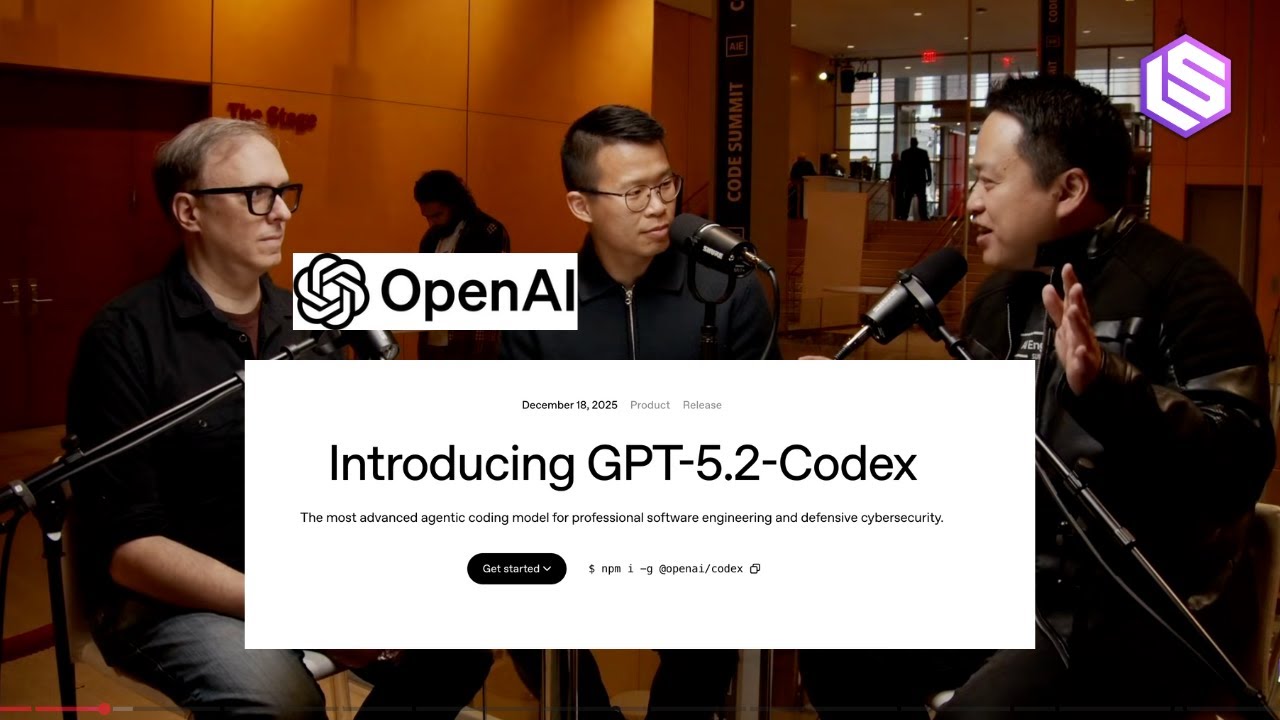
⚡️GPT5-Codex-Max: Training Agents with Personality, Tools & Trust — Brian Fioca + Bill Chen, OpenAI
Dec 26, 2025 · 27:46
OpenAI’s Brian Fioca and Bill Chen discuss the launch of Codex Max, a long-running coding agent designed to work 24+ hours, manage its own context, and spawn sub-agents. They reveal how GPT-5 training prioritized personality traits—communication, planning, and self-checking—to build developer trust, and how Codex develops tool habits like preferring 'rg' over 'grep'. The abstraction layer is shifting from models to full-stack agents, enabling partners to plug Codex into tools like VS Code or Zed. They highlight applied evals that measure real-world impact over academic benchmarks, and the need for multi-turn eval APIs. Their 2026 vision: coding agents trusted enough to handle the hardest refactors at any company, not just top-tier firms, and general enough to automate personal workflows like organizing desktops or email.
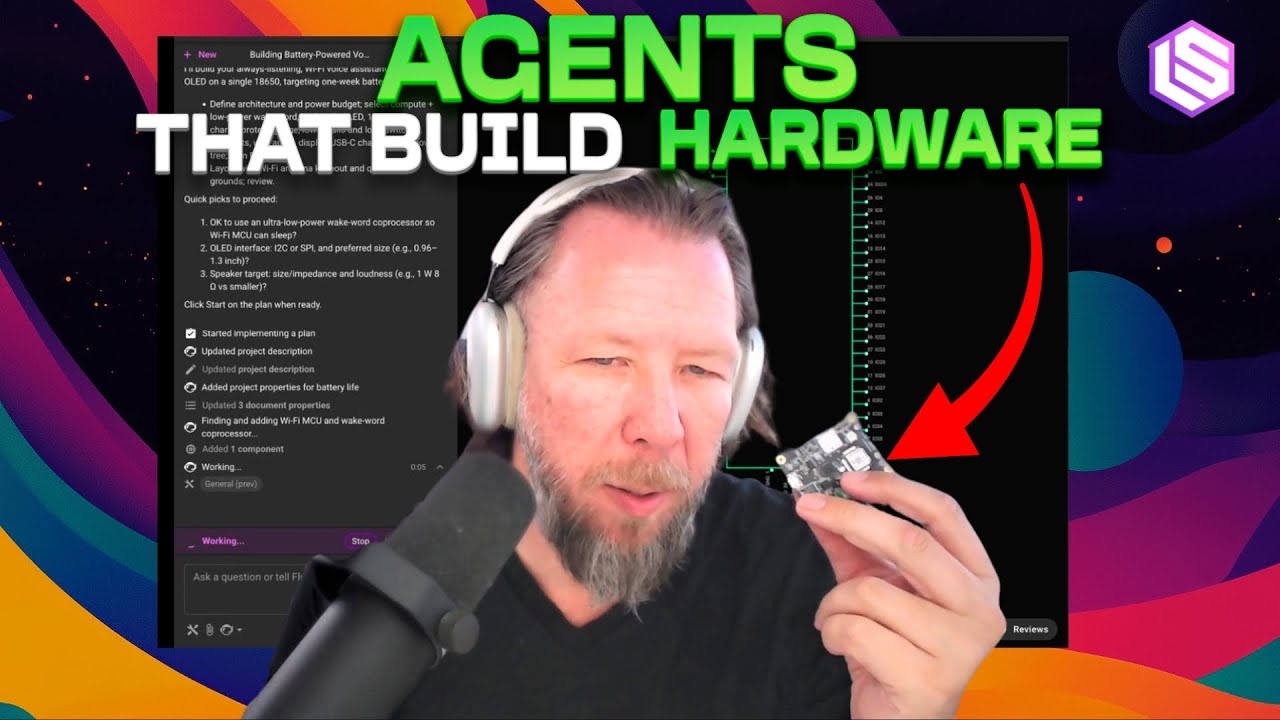
⚡️ Building the AI Hardware Engineer with Matthias Wagner, Co-founder of Flux
Nov 22, 2025 · 49:03
Matthias Wagner, CEO of Flux.ai, describes building the "AI hardware engineer" that turns product briefs into manufacturable PCB designs in under 30 minutes. After leaving Meta in 2019, Wagner built a browser-based collaborative CAD tool from scratch, designed as a reinforcement learning environment. The emergence of LLMs and reliable tool calling let Flux's agents search component libraries, check pricing and availability, and execute complex designs autonomously. In a live demo, Wagner designs a battery-powered Alexa-like device with ESP32, microphones, OLED display, and speaker in about 25 minutes. Flux now has 7,000 paying customers, growing 26x year over year, and Wagner envisions eventually letting users prompt full hardware products like smartphones into existence, claiming the cost of custom manufacturing is plummeting.
Anthropic, Glean & OpenRouter: How AI Moats Are Built with Deedy Das of Menlo Ventures
Nov 14, 2025 · 1:26:59
Deedy Das of Menlo Ventures returns to explain how Anthropic became the fastest-growing software company ever (zero to billions in revenue) and why Glean’s boring enterprise search moat of hard integrations and ranking problems is harder than competitors think. He reveals the $100M Anthology Fund’s strategy: backing OpenRouter, Goodfire, Prime Intellect, and Whisper—companies that solve thorny infrastructure or research problems rather than chasing apps. Das argues that model-layer companies will capture most value because building great models is harder than building apps, and that Anthropic’s product innovations like Claude Code emerge from a culture that lets researchers experiment freely. He also warns that vibe coding is becoming a cognitive crutch for engineers, eroding deep problem-solving skills, and discusses how enterprise AI market share has shifted dramatically: OpenAI went from 50% to 20%, while Anthropic rose from 12% to 32% of enterprise LLM API spend.

⚡ Inside Google Labs: Building The Gemini Coding Agent — Jed Borovik, Jules + AIE CODE Preview
Nov 10, 2025 · 43:53
Jed Borovik, Product Lead at Google Labs, explains how Google builds Jules, an autonomous coding agent that runs on its own VM for long-running tasks, challenging the assumption that agents should operate locally. He reveals that as Gemini models improved, Jules' scaffolding simplified, shifting from sub-agent patterns and embedding-based RAG to attention-based search. Borovik discusses context window management for sessions lasting up to 30 days with 2 million tokens, and argues that coding agents will increase demand for software engineers (Jevons paradox), not eliminate jobs. He calls for better specification tools beyond chat, such as multimodal input and interactive planning, to move beyond 'vibe coding' toward verifiable, reliable agentic workflows.

⚡️ Ship AI recap: Agents, Workflows, and Python — w/ Vercel CTO Malte Ubl
Nov 1, 2025 · 42:02
Vercel CTO Malte Ubl discusses the company's AI strategy, centered on the new Workflow Development Kit that enables durable, resumable serverless functions with infinite idle time at no cost. He explains how the AI SDK was extracted from v0 and remains deliberately low-level to accommodate emerging patterns, with a direct agent abstraction now stable in version six. Ubl details Vercel's internal agents—including a DevOps agent that investigates production anomalies by querying observability data and logs, solving the recall-precision problem in alerting—and the 'Agent on Every Desk' program that helps large companies build their first three agents. He also covers zero-config Python support for Flask and FastAPI, and a security model that assumes developers cannot be trusted, extracting auth and data access from application code.

⚡️Claude Sonnet 4.5 and Anthropic's roadmap for Agents and Developers — Mike Krieger, Anthropic
Sep 30, 2025 · 26:25
Mike Krieger, Anthropic's CPO, discusses the launch of Claude Sonnet 4.5 and its implications for AI development, emphasizing the growing symbiosis between product and research teams. He describes his personal 'vibe evals' for new models, including generating a Virtual Boy-style game and a Nintendo board presentation, and notes that Sonnet 4.5 traffic eclipsed Sonnet 4 on day one. Krieger explains how Anthropic is improving model output quality across UIs, Excel, and PowerPoint, and highlights the shift toward interactive planning rather than pure autonomy. He reveals the rename of the Claude Code SDK to the Claude Agent SDK, reflecting its general-purpose use for complex agentic workflows beyond coding. Krieger stresses the need for better visual understanding in models and invites developers to share feedback on hard challenges to help improve the platform.

The AI Agenda: GPT5 leaks and the business of AI News — Steph Palazzolo, The Information
Aug 6, 2025 · 1:14:36
Steph Palazzolo, AI journalist at The Information, explains how she covers the secretive AI industry, from OpenAI's GPT-5 to the inference market where startups like Modal raise billions. She reveals that inference providers are essentially GPU resellers facing margin pressure, and that GPT-5's performance will signal whether pre-training scaling or reinforcement learning drives progress. She critiques Meta's super intelligence ambition as misaligned with its ad-revenue business, and details the talent war with rumored hundred-million-dollar offers from Meta to poach researchers. Palazzolo also discusses the Windsurf acqui-hire backlash, the rise of coding agents like Claude Code, and how journalists protect sources while navigating leaks from CEOs like Sam Altman.

🕰️ The Oral History of Windsurf (ft. Varun Mohan, Scott Wu, Jeff Wang, Kevin Hou, Anshul R)
Jul 28, 2025 · 3:53:23
This episode traces the oral history of Windsurf (formerly Codeium and Exafunction) with founders Varun Mohan, Scott Wu, Jeff Wang, Kevin Hou, and Anshul R, charting its evolution from a GPU virtualization startup to a leading agentic IDE and its dramatic acquisition by Cognition. The narrative covers the pivot to code completion in 2022, the shift to a free model to gain traction, and the launch of the Windsurf editor in November 2024 with Cascade, an agent that operates on a shared timeline with the developer. Key principles include meta-learning (auto-generated memories that adapt to each user's preferences) and scaling with intelligence (replacing hard-coded rules with LLM reasoning as models improve). The episode also details the acquisition weekend when Cognition bought Windsurf after Google acquired a stake, highlighting product synergies between the synchronous agent (Windsurf) and async agent (Devin) and the ambition to build a comprehensive platform for real-world software engineering teams.

Cline: The Collaborative AI Coder
Jul 16, 2025 · 1:15:44
Saoud Rizwan and Pash from Cline join to explain why their open-source coding agent uses a Plan + Act paradigm — having models explore and plan before executing — pioneered before competitors like Claude Code. They argue that "RAG is a mind virus" and "Fast Apply got bitter lesson'd" as frontier models now achieve sub-5% diff edit failure rates, making layered workarounds obsolete. Cline's bring-your-own-API-key model avoids inference markups, with enterprise features driven by Fortune 5 companies asking for security and ROI insights. The MCP ecosystem grew via Cline's marketplace (150+ servers, top ones with hundreds of thousands of downloads), though monetization and security remain open questions. They detail how Plan mode extracts user intent and Act mode auto-approves, how context engineering prioritizes agentic file exploration over retrieval, and why they stayed a VS Code extension rather than fork — to focus solely on the agentic loop.
⚡️Anthropic vs Cognition on Multi-Agents: A Breakdown with Dylan Davis
Jul 5, 2025 · 27:11
Dylan Davis from Gradient Labs breaks down the Anthropic vs Cognition multi-agent debate, arguing both blog posts are right for different use cases. Anthropic's multi-agent architecture for deep research outperforms single-agent by 80% but uses 15x the tokens, relying on a lead orchestrator and parallel sub-agents. Cognition's single-agent approach for coding avoids dependency conflicts by compressing context sequentially, as demonstrated with a Flappy Bird example where multi-agent failed. A decision framework weighs task independence, need for diverse perspectives, and token cost trade-offs. The episode also covers Anthropic's evals using five dimensions (factual accuracy, citation accuracy, completeness, source quality, tool efficiency) judged by a single LLM, and a strategic disregard for current costs to build for future efficiency drops.

The AI Coding Factory
May 29, 2025 · 59:23
Factory.ai co-founders Eno Reyes and Matan Grinberg join Latent Space to explain their vision for autonomous software engineering droids that handle everything from code generation to incident response for enterprises. They met at a Langchain Hackathon in 2023, and within eight days both quit their jobs to start Factory. The platform is browser-based, not IDE-based, because they argue the optimal UI for a world where humans write less code will not evolve from the IDE. They focus on enterprise codebases, citing a large migration that took from four months to three and a half days. Key design decisions include a delegation model where agents ask clarifying questions, proactive context gathering via synthetic insights, and usage-based pricing tied to token efficiency. They also discuss why SWE-Bench is dead for their use case, the challenge of model post-training biases toward CLI tools, and their need for 'junior Enos' in go-to-market roles.

DeepWiki: The GitHub Encyclopedia
May 21, 2025 · 32:05
Silas Alberti from Cognition (Devin) introduces DeepWiki, a free no-login product that indexes over 30,000 open-source repos and generates AI-powered wikis and deep research answers. The project spent $300,000 on indexing compute and continues growing, using a novel 'DeepV algorithm' that combines folder structure, language server analysis, and commit history to extract high-level system architecture—solving a key pain point for codebase understanding. Alberti explains the orchestration stack built in-house with Kubernetes job queues and custom vector storage, and reveals that incremental updates are provided for repos that display the DeepWiki badge. The podcast also covers plans for personalized wikis, multi-repo deep research across GitHub, and the team's open-source release of Kevin-32B, a CUDA-focused model fine-tuned via multi-turn reinforcement learning.

ChatGPT Codex: The Missing Manual
May 16, 2025 · 53:32
Josh Ma and Alexander Embiricos from OpenAI introduce ChatGPT Codex, a cloud-hosted autonomous software engineer that runs in its own sandbox, arguing it delivers value through single-shot, long-horizon task completion. They explain that Codex evolved from internal experiments (codenamed WHAM) and now offers a 60-tasks-per-hour rate limit with a one-hour hard cutoff, emphasizing it is not meant for interactive use but for delegation—users fire off tasks and go about their day. Best practices include using agents.md, installing linters and formatters, keeping code modular, and having good architecture. The team intentionally kept it a research preview to gather feedback on environment customization and pricing, with plans to integrate seamless transitions between cloud and CLI.

Claude Code: Anthropic's CLI Agent
May 7, 2025 · 1:16:22
In this episode, Boris Cherny and Cat Wu from Anthropic discuss Claude Code, a CLI-based coding agent they describe as a Unix utility rather than a polished product, emphasizing raw model access and simplicity. The tool started as Boris's personal experiment, then spread internally after engineers used it daily, with Anthropic's product principle of 'do the simple thing first' guiding features like memory via markdown files and context compaction by asking Claude to summarize. They ship updates including web fetch, auto-accept, and thinking via chain of thought, and note that 80% of Claude Code's code is written by Claude Code itself. Average spend is $6/day per user versus $20/month for Cursor, and Boris reports a personal 2x productivity gain, with some engineers seeing 10x. The team is growing and investigating open-sourcing the tool, while continuing to build for the terminal as a raw, composable utility for power users.

The #1 SWE-Bench Verified Agent
Apr 2, 2025 · 31:46
Guy Gur-Ari, co-founder of Augment Code, explains how their coding agent achieved the #1 spot on SWE-Bench Verified without fine-tuning, using off-the-shelf models with techniques like sequential thinking, ensembling, and code base understanding. He shares that orientation and memories help the agent learn codebase conventions, and that MCP support allows extensibility. Gur-Ari contrasts Augment's IDE-first approach with competitors like Devin and Factory, emphasizing meeting developers where they are. He also discusses the future of IDEs, the role of custom models, and recommends the SWE-RL paper for reinforcement learning in coding. The episode features a live demo of the agent implementing a feature from a Linear ticket and creating a PR.

Solve coding, solve AGI [Reflection.ai launch w/ CEO Misha Laskin]
Mar 7, 2025 · 28:12
Misha Laskin of Reflection AI argues that solving autonomous coding is the direct path to AGI, combining reinforcement learning (pioneered by his team on AlphaGo/AlphaZero) with large language models (which they advanced at Google on PaLM, Gemini, ChatGPT). He explains that coding is already ergonomic for LLMs—unlike browser agents that require noisy human mouse data—making it the ideal starting point. Reflection AI is building coding agents that automate backlog tasks (testing, refactoring, migrations, security remediation) for large engineering teams, delivering them via an API that takes a task and codebase and outputs resolved code. Laskin insists superintelligence cannot be built in a vacuum; real-world customer evals are essential, as benchmarks like SWE-bench don't guarantee production reliability. He also stresses the need for open-weight models to prevent a few companies from hoarding superintelligent coding agents.

Why is everyone cloning Deep Research?
Feb 18, 2025 · 1:00:10
In this episode, hosts Alessio and Swyx interview Aarush Selvan and Mukund Sridhar, the lead PM and tech lead for Gemini Deep Research, about how Google created the deep research agent category and the technical decisions behind it. They finetuned a special version of Gemini 1.5 Pro for the feature, which autonomously browses the web for about five minutes to produce a research report. The team built an asynchronous platform to handle long-running tasks and developed an ontology of research behaviors—from broad shallow exploration to deep focus—to evaluate performance. They found that users value the visible browsing process even when it takes minutes, contrary to typical latency norms. The discussion covers iterative planning, trade-offs between model memory and web grounding, and future directions including thinking models, multimodality, and personalization.

The AI Architect: Bret Taylor
Feb 11, 2025 · 1:35:59
Bret Taylor, CEO of Sierra and chairman of OpenAI, recounts engineering AI's future across three eras — rewriting Google Maps' frontend in a weekend (cutting un-gzipped code to 20K), building Sierra's in-house agent platform for consumer brands like Sonos and SiriusXM, and navigating OpenAI's leadership crisis. He argues that AI agents' core abstractions are still pre-React, compares today's agents to jQuery, and predicts that outcome-based pricing will dominate as agents complete jobs rather than assist humans. He urges software engineers to move up the stack toward domain-specific agents and to embrace Rust-like languages for AI-generated code, emphasizing formal verification and safety. Taylor also shares how OpenAI prioritizes mission over product features, and why the relationship with Microsoft remains OpenAI's most important partnership.

Beating OpenAI and Anthropic by Looking At Data: the new #1 on SWE-Bench w/ W&B CTO Shawn Lewis
Jan 28, 2025 · 34:31
Shawn Lewis, CTO of Weights & Biases, built a coding agent using OpenAI's o1 model that achieved 64.6% on SWE-bench verified, the top score at the time. He developed a TypeScript agent framework called PhaseShift and an Eval Studio tool backed by Weave, emphasizing that rigorous data inspection and tooling are critical for agent development. Lewis explains his process of running parallel rollouts and a crosscheck method to select the best trajectory, which contributed a 6% improvement. He also discusses the challenges of adapting reasoning models like o1 for agentic tasks and shares plans to open-source PhaseShift. The episode highlights Lewis's dogfooding approach, using Weights & Biases' own tools to build and evaluate the agent.

OpenAI o1 isn’t a chat model (and that’s the point)
Jan 17, 2025 · 31:59
Ben Hylak and Dan McAteer explain why OpenAI’s o1 is not a chat model and how mastering its prompting turned Ben from a skeptic into a proponent. Ben’s prompt structure—goal, return format, warnings, context dump—emphasizes describing what you want rather than how to think, a shift from earlier models. Dan uses o1 for coding by feeding it full code context, achieving one-shot implementations that reach 100% where previous models maxed out at 95%. Ben notes o1 is the most capable but hardest model to use, with experiments costing $20 per try, and argues model routing will let humans or systems trade off cost, speed, and intelligence. Dan also applies o1 to scientific research, feeding it papers from multiple fields to find novel connections that humans would miss.

Best of 2024 in Agents (from #1 on SWE-Bench Full, Prof. Graham Neubig of OpenHands/AllHands)
Dec 25, 2024 · 51:25
Professor Graham Neubig of CMU and AllHands AI, maintainer of the open-source coding agent framework OpenHands, delivers a talk on the state of agents in 2024, arguing that agents are now capable of automating significant portions of software development but still struggle with information gathering and error recovery. He demonstrates OpenHands solving real coding tasks live, explains key design choices like using Python code execution over granular tool calls to reduce LLM invocations, and shares that Claude currently outperforms other models for agentic tasks due to superior instruction following and error correction. Neubig discusses eight perennial agent problems including agent-computer interface, human-agent interface, model selection, planning, workflows, exploration, search, and evaluation. He predicts every major LLM trainer will focus on agent-oriented models by mid-2025, that agent benchmarks like SWE-Bench and WebArena will saturate and require harder successors, and that the biggest challenge will be designing human-agent interfaces for systems that succeed only 30-40% of the time autonomously but 80-90% with human feedback. The talk also covers workflow memory as a…

Windsurf: The Enterprise AI IDE
Dec 13, 2024 · 1:06:36
Varun Mohan and Anshul of Codeium explain why they built Windsurf, a new AI IDE, arguing that VS Code's API limitations prevented them from delivering the best agentic experience. They detail how Cascade, their agentic system, uses proprietary retrieval and planning models alongside third-party LLMs, and describe their evaluation method that masks commits and tests incomplete code states. The duo also reveals that over 800,000 developers use Codeium extensions, that they still support JetBrains and Eclipse for enterprise customers, and that they intentionally avoided a waitlist launch. They discuss the trade-offs of building first-party vs. third-party models, the importance of 'go slow to go fast' in enterprise infrastructure, and their belief that individual developer profits should come after building switching costs through superior product.

The new Claude 3.5 Sonnet, Computer Use, and Building SOTA Agents — with Erik Schluntz, Anthropic
Nov 28, 2024 · 1:11:08
Anthropic's Erik Schluntz explains how Claude 3.5 Sonnet achieved state-of-the-art 49% on SWE-Bench Verified by using a minimal agent framework that gives the model full control via tools like bash and file editing, letting it self-correct without hard-coded workflows. He details the importance of tool design over prompt engineering, why XML tags work well, and how computer use reduces integration friction by letting models interact with any browser-based interface. Schluntz also shares his robotics experience, noting that while LLMs and diffusion models are promising for general-purpose robots, reliability at 99.9% and hardware variability remain major hurdles, and he expresses skepticism about self-driving as a business due to high vehicle costs versus driver-equivalent revenue.

[Paper Club] SWE-Bench [OpenAI Verified/Multimodal] + MLE-Bench with Jesse Hu
Oct 19, 2024 · 1:01:40
Jesse Hu walks through SWE-Bench, SWE-Bench Verified, SWE-Bench Multimodal, and MLE-Bench — benchmarks that evaluate AI agents on real-world coding and ML tasks, from fixing GitHub issues to winning Kaggle competitions. SWE-Bench scrapes 2,000+ pull requests from 12 Python repos to get free unit tests, with leaderboard scores rising from ~2% to 43% thanks to improved agent scaffolding. SWE-Bench Verified uses human raters and three criteria—well-specified problem, valid test, difficulty on a 0–3 scale—to filter 500 solvable tasks. SWE-Bench Multimodal targets 617 UI tasks from 17 JavaScript/TypeScript libraries, each including an image, but achieves only 12% accuracy. MLE-Bench repurposes Kaggle competitions: agents given 24 hours and an A10 GPU, with o1-preview scoring bronze in 17% of competitions and surpassing grandmasters (7 gold medals vs 5 required), though each run costs $4,000.

Language Agents: From Reasoning to Acting — with Shunyu Yao of OpenAI, Harrison Chase of LangGraph
Sep 27, 2024 · 1:26:33
Shunyu Yao of OpenAI and Harrison Chase of LangChain discuss the evolution of language agents, arguing that combining reasoning and acting through techniques like ReAct remains foundational, while tool design and cognitive architectures like CoALA will shape the next wave. Shunyu traces his work from text games to ReAct, showing how thinking as an action improves reliability; Harrison explains LangChain's adoption and the shift to LangGraph for stateful orchestration. They emphasize agent-computer interfaces (ACI) as a neglected area, noting that SWE-Agent's success came from optimizing tools for models, not humans. The conversation covers memory types (semantic, episodic, procedural) and applies CoALA's three dimensions to current systems. They highlight promising applications: customer support, coding agents, and spreadsheet-style UX for batch operations. Shunyu stresses that better benchmarks like SWE-Bench (which solved 30% of GitHub issues) and TauBench (best model 48%) are critical, and that data—not architecture—will drive future model improvements.

Is finetuning GPT4o worth it?
Aug 22, 2024 · 1:01:16
Ali Pullen, founder of Cosine, discusses Genie, an AI software engineering colleague that achieved 30% on SWE-Bench and 43.8% on SWE-Bench Verified via fine-tuning GPT-4o on billions of tokens of synthetic data. Cosine built Genie by training on the process of software engineering—not just working code—using synthetic runtime errors and a self-improvement loop. The agent follows a four-stage workflow: code retrieval (66% accuracy), planning, writing diffs, and running CI tests. Pullen reveals that model performance degrades linearly beyond 60K tokens in the context window, and that OpenAI dynamically sizes LoRA adapters to handle Cosine's massive dataset. He explains why Genie isn't on the SWE-Bench leaderboard (refusing to publish trajectories to prevent distillation) and outlines plans to scale the dataset and fine-tune on customer codebases for personalized performance.

Training Llama 2, 3 & 4: The Path to Open Source AGI — with Thomas Scialom of Meta AI
Jul 23, 2024 · 1:04:34
Thomas Scialom, Llama 2 lead and Llama 3 post-training lead at Meta AI, explains why scaling laws must go beyond Chinchilla—training models longer on more tokens yields better inference efficiency than bigger models, a lesson that drove Llama 3's 15 trillion token pre-training. He details how synthetic data from Llama 2 bootstrapped Llama 3's post-training, eliminating human-written SFT data, and why RLHF outperforms imitation learning: humans are better discriminators than generators, enabling superhuman outputs. Scialom defends the dense 405B architecture over MoE, calls tokenizer vocab size underrated (128k tokens vs Llama 2's 32k), and reveals Llama 4's focus on agentic capabilities—tool use, multi-step reasoning—as the path to open-source AGI. Meta AI is hiring researchers with rigorous first-principles thinking.

This World Does Not Exist — Joscha Bach, Karan Malhotra, Rob Haisfield (WorldSim, WebSim, Liquid AI)
Apr 27, 2024 · 1:56:11
The episode features Karan Malhotra demoing WorldSim, a prompt that turns Claude 3 into a universe simulator via CLI; Rob Haisfield presenting WebSim, which generates functional websites on the fly; and Joscha Bach arguing simulative AI reveals consciousness as a virtual property, with LLMs creating agents as real as human minds, urging the California Institute for Machine Consciousness to build self-organizing silicon life. Malhotra shows WorldSim running “world.exe” to create Twitter inside a simulated universe, with users tweeting and Elon Musk moving Dogecoin. Haisfield demonstrates WebSim generating a 5D particle interface, a news RSS aggregator, and a face-swap webcam app via URL parameters like “secrets=revealed”. Bach explains consciousness as second-order perception in a simulated now, criticizes RLHF for lobotomizing models, and advocates for animist AI where software agents compete like spirits, not golems.
Powered by PodHood