
Claude Code
ProductA product discussed on Latent Space.
44 episodes

🔬 RL with Verifiable Rewards, but the Verifier is a Lab — Lila Sciences
Jul 16, 2026 · 1:41:04
Andy Beam (CTO) and Rafa Gómez-Bombarelli (Co-founder & CSO of Physical Sciences) of Lila Sciences argue that science is an 'infinite token generator' for AI, using reinforcement learning with verifiable rewards where the wet lab acts as the verifier. They claim one general model trained on ~10 trillion experimentally-verified reasoning tokens across biology, chemistry, and materials outperforms domain-specific models—'breadth gives us depth.' Their AI Science Factories treat the lab as a data center, with instruments on a 'PCI bus' and humans 'below the API line.' Highlights include a CAR-T candidate designed in six months by two or three people, 'monster UTRs' achieving ~10x Moderna/Pfizer mRNA expression, and the 'zero-FTE startup' business model. They discuss RL pathologies like collapsed chains of thought and a model that 'swears,' and note why there is still no AlphaFold for materials due to the sim-to-real gap.

The Agent Cloud: Databricks’ Bet on the Future of AI — Matei Zaharia and Reynold Xin
Jun 24, 2026 · 1:10:06
Databricks cofounders Matei Zaharia and Reynold Xin argue the company is moving beyond the lakehouse into a full data-and-AI operating system, anchored by two new initiatives: Omnigent, an open-source meta-harness for combining coding and enterprise agents, and LTAP, a unified storage layer that gets most HTAP benefits without collapsing query engines. Omnigent provides a common API for agent sessions, files, streams, tool calls, and cancellation, solving portability, collaboration, and security issues across Claude Code, Codex, Cursor, and custom agents. LTAP writes transactional data directly in columnar Parquet format, eliminating brittle CDC pipelines—Reynold jokes CDC means 'continuous data corruption'—and enables instant analytics without overloading the source database. The episode details Databricks’ culture of rapid prototyping, where an engineer built the LTAP prototype without a formal design doc, and the thesis that traditional software will be rewritten once data is in the right place with agents on top. They also cover Mosaic’s shift from general frontier models to specialized fine-tuned models like document parsing, internal agent usage, and security features such…
AI Security After Codex and Claude Code — Zico Kolter & Matt Fredrikson, Gray Swan
Jun 22, 2026 · 1:07:31
Gray Swan cofounders Zico Kolter and Matt Fredrikson explain why AI agents like Codex and Claude Code introduce a new class of security vulnerabilities that traditional cybersecurity cannot address, and present their automated red-teaming system Shade and guardrail model Cygnal as solutions. Prompt injection creates exploits for agents operating on untrusted data, and Shade now outperforms human red teamers at breaking models. The lethal trifecta—untrusted data, private data, and exfiltration—defines the highest risks. In their Human Browser Agent Robustness Challenge, humans ranked fourth among models, with some frontier agents falling for attacks no person would. Bigger models do not automatically become safer, and specialized systems like Cygnal enforce enterprise policies more reliably than prompt engineering. They see AI security evolving toward insurance and compliance, with the first major prompt-injection breach a gray swan—unlikely but visible ahead of time.

⚡️Making DeepSeek v4 outperform Opus 4.7 with Taste — @AhmadAwais , CommandCode.ai
Jun 6, 2026 · 40:41
Ahmad Awais, CEO of CommandCodeAI, explains how his team's 'tool-input repair layer' lets open models like DeepSeek V4 Pro outperform premium models like Opus 4.7 in tool-calling reliability. He discovered a pattern of 'tool confusion' where open models repeatedly send wrong schemas; by repairing errors deterministically and sending repair hints instead of raw errors, tool call failures dropped dramatically. The same repair logic fixes 'design slop' using a compositional framework of patterns and OKLCH color system. Taste, a meta-neurosymbolic system, automatically learns developer preferences into portable markdown files, avoiding stale rules. Plans include open-sourcing CommandCode to make it hackable while focusing on quality models.

Devin’s 80% Moment: Background Agents, 7x PRs, & End of Hand-Held Coding — Walden Yan & Cole Murray
May 28, 2026 · 1:09:33
Walden Yan (Cognition CPO) and Cole Murray (creator of OpenInspect) argue that background agents are becoming critical infrastructure as Devin's merged PRs grew 7x and its share of commits jumped from 16% to 80%. They explain why architecture matters, particularly the decision to separate the agent's brain from the machine (harness out of the box) for security and permissions, and why full VMs beat Docker for running real applications. Testing, they stress, is a harder problem than computer use—requiring orchestration of services, feature flags, and multi-model coordination. Memory remains unsolved, with Devin using auto-generated 'Knowledge' and exploring file-system-like approaches. Both caution against uncontrolled vibe coding, which regresses codebases to the worst engineer's style, and advocate for hybrid frontier/sub-frontier systems to balance cost and capability.

Inside Abridge: The AI Listening to 100 Million Doctor Visits — Abridge's Janie Lee & Chai Asawa
May 14, 2026 · 1:06:38
Abridge's Janie Lee and Chai Asawa explain how the company is building a clinical intelligence layer for healthcare, starting with ambient documentation that saves clinicians 10-20 hours per week of 'pajama time' and expanding into real-time prior authorization and clinical decision support. They argue that context is everything—integrating EHR data, payer policies, and medical literature to make AI proactive rather than reactive, exemplified by guiding a doctor to ask two extra questions during a visit to guarantee an MRI approval before the patient leaves. The hardest AI problem is delivering high-quality, low-latency, low-cost real-time guidance in a high-stakes setting, which Abridge tackles using a constellation of models, efficient post-training on its proprietary dataset of over 100 million medical conversations, and progressive rollout with rigorous specialty-specific evaluations. They emphasize personalization at three levels—individual style, specialty (e.g., cardiology vs. dermatology), and health system guidelines—and see clinicians embedded as 'clinician scientists' on engineering teams as a key competitive advantage. Looking ahead, they envision the same conversation…
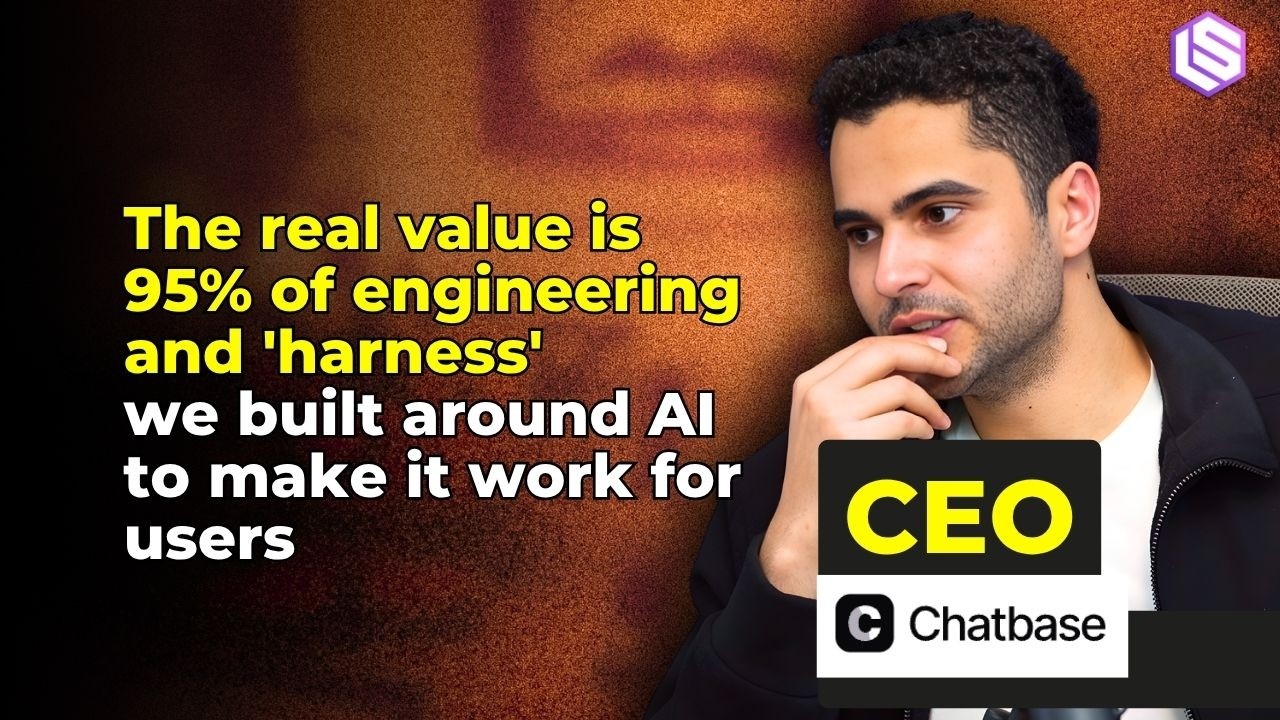
⚡️ Competing with ChatGPT and Sierra, building a $10M ARR company — Yasser Elsaid, Founder, Chatbase
May 2, 2026 · 1:00:26
Yasser Elsaid, founder of bootstrapped AI chatbot company Chatbase, discusses how he grew from a side project to $10M ARR in three years, reaching $1M in just 117 days. He explains why he never raised VC, relying instead on product-led growth, self-serve signups, and a content-driven go-to-market strategy. Elsaid shares specific tactics like warm outbound to signed-up users, leveraging LinkedIn virality in early AI days, and now moving toward outcome-based pricing for enterprise customers. He details Chatbase's evolution from a simple RAG chatbot into a 'chief customer officer' that handles support, sales, and onboarding while surfacing business insights from conversations. The episode also covers his transition from Toronto to San Francisco, his hiring philosophy favoring results-oriented engineers, and his daily use of both Claude Code and Codex for development.

The $15B Physical AI Company: Simulation, Autonomy OS, Neural Sim, & 1K Engineers—Applied Intuition
Apr 27, 2026 · 1:14:07
Applied Intuition co-founders Peter Ludwig and Qasar Younis argue that the real bottleneck in physical AI is deploying intelligence onto constrained hardware, not model intelligence itself. Their $15B company builds simulation, operating systems, and AI models for autonomous trucks, mining equipment, and defense systems. Starting as YC-era tooling for robotaxis, they now offer 30+ products across simulation & RL infrastructure, vehicle operating systems, and autonomy models. They compare fragmented vehicle software to pre-Android phones, and their OS enables reliable updates and L4 driverless operations (trucks running in Japan today). Verification uses statistical nines of reliability, and they internally adopt coding agents like Cursor and Claude Code. They hire 1,000 engineers at the hardware-software boundary.
⚡️ The best engineers don't write the most code. They delete the most code. — Stay Sassy
Apr 13, 2026 · 57:30
Stay Sassy PM and EM join Shawn Wang to discuss how AI coding tools are forcing managers to grapple with per-person token budgets that could reach $2.5M annually as consumption-based pricing replaces subsidies, making code review more critical, not less. They argue that managing these budgets is a new bottleneck, requiring companies to decide how much to spend on individual employees—a scale unprecedented outside department-level budgeting. On build vs buy, they caution that many products are more complex than they appear, and that the old frameworks of feature analysis, administration burden, and vendor lock-in still apply. They highlight code review fatigue from running multiple agents as a risk, citing Amazon's six-hour downtime from AI-generated code, and urge teams to maintain a culture where no single person can take down prod. Finally, they suggest automating executives' standard decisions first—since much leadership work is routine—rather than targeting only junior tasks, and predict that the hardest problems in 2026 will remain human.
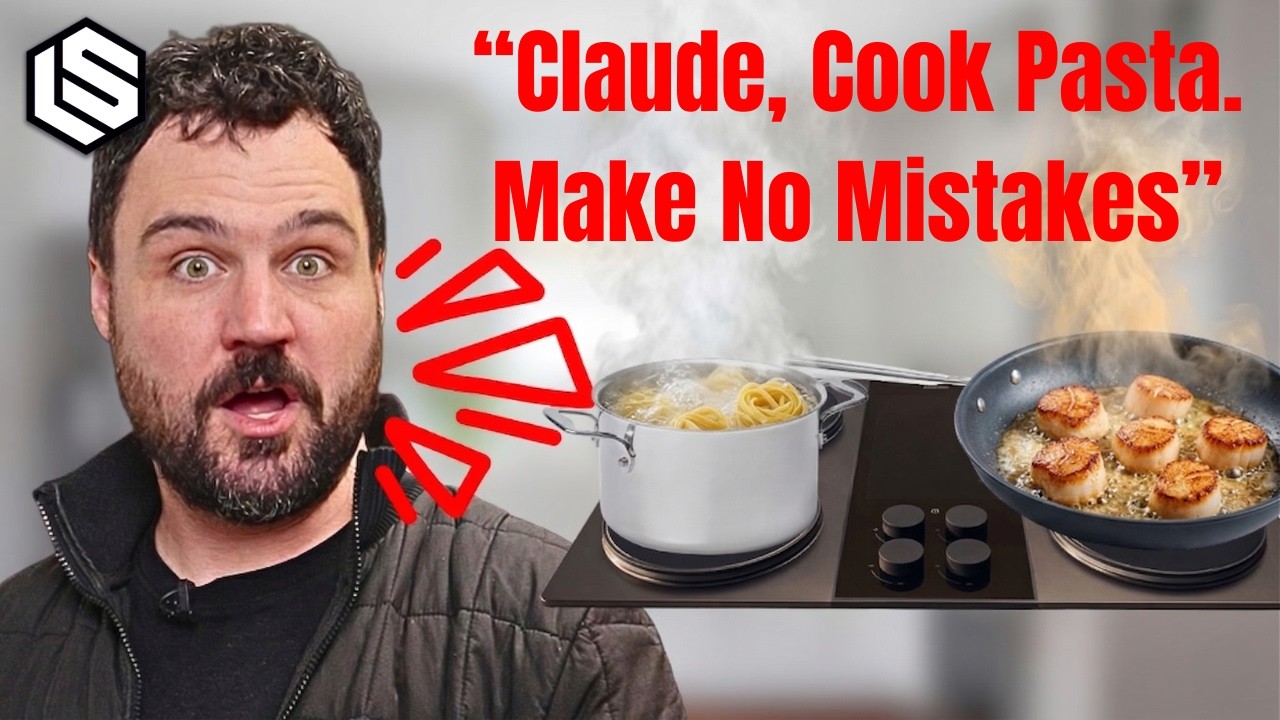
The Stove Guy: Sam D'Amico Shows New AI Cooking Features on America's Most Powerful Stove at Impulse
Mar 31, 2026 · 37:03
Sam D'Amico, founder of Impulse, demonstrates the company's induction cooktop that uses a three-kilowatt-hour LFP battery to deliver 10,000 watts—boiling a liter of cold water in 40 seconds and holding a precise temperature for searing scallops without burning. The stove is rebuilt from first principles with custom power electronics and firmware, enabling OTA updates and software-defined features; a planned update will triple temperature-control speed from one minute 50 seconds to 40 seconds. D'Amico shows AI features powered by Claude that set burner temperatures (e.g., 446°F for scallops) and fetch recipes like Korean fried chicken or egg fried rice with char siu. He explains the origin story from a pizza in Japan, the decision to enter home appliances to avoid app-store dependencies, and the Impulse Core modular platform sold to OEMs. The cooktop launches through Zephyr in hundreds of showrooms nationwide and globally this year.

Anthropic’s Felix Rieseberg on AI Coworkers, Local-First Agents, and the Future of Knowledge Work
Mar 17, 2026 · 1:27:34
Anthropic's Felix Rieseberg explains how Claude Cowork—a VM-based, user-friendly version of Claude Code—was built from pre-existing prototypes in ten days, and why putting AI 'where you work' on the local machine is more powerful than cloud-only approaches. He argues that Silicon Valley undervalues the local computer, comparing it to how we all use MacBooks instead of iPads. The VM gives Claude its own computer, enabling it to install tools and run scripts without constant approval, serving as both a safety boundary and a capability unlock. Rieseberg contrasts Cowork's evaluation on knowledge work tasks (e.g., mortgage management, tax filing) with Claude Code's coding evals, and explains the shift from MCPs to file-based skills—markdown files that tell the model what to do. Real use cases include organizing desktops, uploading videos, and filing taxes. He also expresses concern about the impact on junior employees and hints at future work on autonomy, multiplayer coordination, and portability.

⚡️Monty: the ultrafast Python interpreter by Agents for Agents — Samuel Colvin, Pydantic
Mar 14, 2026 · 34:02
Samuel Colvin joins Shawn Wang to introduce Monty, Pydantic's ultrafast Python interpreter built with AI for agents, positioning it as a lightweight, secure alternative to sandboxes for code execution. Monty runs inside the same process, achieving sub-microsecond latency (800 nanoseconds in a hot loop), versus over a second for cloud sandboxes. Colvin explains the inspiration came from conversations at Anthropic about type safety's critical role in AI tool calling, and how Monty fills the gap between simple tool calling and full sandboxes. Monty is not full CPython—it lacks third-party library support and some standard library modules—but covers essential built-ins, implemented largely by LLMs that Colvin calls 100x faster for tasks where internal and external APIs are well-known, unit tests are trivial, and there's no API bikeshedding. He demonstrates a Pydantic AI agent using Monty to scrape LLM pricing from websites, with type checking built into the runtime so only permitted host functions (e.g., Playwright, Beautiful Soup wrappers) can be called. Colvin also shares his workflow using Claude Code, Codex, and Gemini CLI in combination for code review and implementation, and…

⚡️ OpenClaw's Memory Sucks and the fix is simple — Dhravya Shah, Supermemory
Mar 9, 2026 · 27:10
Supermemory founder Dhravya Shah argues that current memory approaches like OpenClaw's static markdown files fail because they lack freshness and agent-driven retrieval, proposing a hooks-based system that dynamically injects less than 2,000 tokens per turn. His company Supermemory uses a hybrid mode combining structured memory with RAG fallbacks, achieving costs as low as 2 cents per million tokens. Shah critiques benchmarks like LongMemEval and LoCoMo for not testing personalization or forgetfulness, and his team built the open platform MemoryBench for evaluation. Future plans include plugins for Cursor and partnerships with voice agent companies, aiming for prosumer interoperability across AI providers.

Agent Inference at the "Speed of Light" — How NVIDIA moves like a $4.3 Trillion Startup
Mar 8, 2026 · 1:26:00
NVIDIA's Nader Khalil and Kyle Kranen join Swyx and Vibhu to explain how the company moves like a $4.3 trillion startup through speed-of-light (SOL) first-principles thinking, agent security boundaries, and the Dynamo inference engine. They argue agents should only do two of three things (files, internet, code) to prevent vulnerabilities, and detail Brev's acquisition to improve developer UX with one-click GPU access and DGX Spark integration. Kyle describes Dynamo as a data center scale inference engine that optimizes serving by scaling out, using prefill/decode disaggregation, Kubernetes-based scheduling, and model-hardware co-design to improve cost, latency, and quality. The episode covers SOL's role in creating urgency, long-context limits and potential 'unhobblers' like multi-head latent attention, and the shift toward CLI-first agent workflows for enterprise tools.
Why Every Agent Needs a Box — Aaron Levie, Box
Mar 5, 2026 · 1:16:58
Aaron Levie, CEO of Box, argues that every AI agent needs a dedicated data repository—a 'box'—to effectively access enterprise content, and that deploying autonomous agents at scale requires new infrastructure for governance, identity, and security. He contrasts the rapid adoption of coding agents, which benefit from full codebase access and technical users, with the slower enterprise rollout where access controls, messy data, and context engineering pose major hurdles. Levie details Box's internal evals showing 15-point jumps in model performance and emphasizes the need for agents to judge when to stop searching. He discusses moving from read-only to read-write agent workflows, the challenge of keeping documentation current, and his hands-on founder approach to steering a 3,000-person public company through the AI transformation.
Measuring Exponential Trends Rising (in AI) — Joel Becker, METR
Feb 27, 2026 · 1:05:12
Joel Becker of METR explains the organization's model evaluation and threat research to assess whether AI could pose catastrophic risks, detailing their time horizon chart measuring task difficulty in human time at 50% reliability. He describes how tasks are selected for economic relevance and auto-gradability, and why time horizon is often misinterpreted as agent runtime. The episode covers Opus 4.5's surprising jump, challenges redoing developer productivity RCTs as workflows change, and why current models aren't yet catastrophically dangerous. Becker discusses potential capability explosions if R&D loops fully automate, links between compute growth slowdowns and slower capability progress, and his Manifold trading story driven by a charity market he could influence. He previews METR's 2026 plans for monitoring and risk assessment, and their hiring.

Dylan Patel Explains the AI War While Cooking | In-Context Cooking
Feb 26, 2026 · 55:13
Dylan Patel, CEO of SemiAnalysis, argues hyperscalers like Google, Amazon, and Meta will sacrifice all profits to build AI infrastructure, spending $180–$200 billion in capex this year alone, because the AI adoption explosion—Claude Code driving 4% of GitHub commits in one month, Anthropic adding $2.5 billion monthly revenue—makes it a Pascal's wager: spend or die. He details how Taiwan's semiconductor geopolitics create endgame scenarios, from a KMT win placating China to full invasion, with TSMC's output critical. Patel explains Nvidia's paranoid founder Jensen Huang is responding to vertical integration threats from hyperscalers by diversifying into chips like CPX and Groq, but warns moats are shallow. The real bottleneck in AI progress? Semiconductors themselves: fabs take years to build, and no one can buy enough GPUs through 2028. He also predicts a massive AI backlash from the public and financial markets, as capital consumption outpaces revenue and labor displacement accelerates.

Claude Code for Finance + The Global Memory Shortage: Doug O'Laughlin, SemiAnalysis
Feb 24, 2026 · 2:07:40
Doug O'Laughlin, SemiAnalysis founder, explains his Claude Code awakening in December 2024: Anthropic's Opus 4.5 one-shotted tasks that used to take 24 hours, leading him to predict Claude Code will write 25–50% of all GitHub code by year-end (already 4% of commits in two weeks). He argues this marks the death of Excel and Bloomberg for analysts—'you can just do things'—but warns of a 'hygiene' crisis as junior analysts lose meta-learning. On the semiconductor side, O'Laughlin details a severe memory squeeze: HBM demand consumes 4× the DRAM capacity, DRAM prices could double again, and CXL is reviving as a workaround. He compares AI infrastructure buildout to the railroad boom (25% of U.S. gross fixed capital investment) and says Microsoft faces an innovator's dilemma—renting GPUs to 'barbarians at the gate' while its own office franchise is disrupted by Claude Code. Google's TPU v7 enjoys a temporary TCO advantage, but Nvidia's supply chain dominance (Jensen doing shots with SK and Samsung) will reassert with Rubin. O'Laughlin also reflects on his 2,800-mile Continental Divide Trail hike as essential self-mastery.
Brex’s AI Hail Mary — With CTO James Reggio (acquired for $5B by Capital One!)
Jan 17, 2026 · 1:13:27
Brex CTO James Reggio details the company's three-pillar AI strategy—corporate, operational, and product AI—arguing that SOP-driven agents outperform overengineered RL in finance ops like underwriting, KYC, and fraud. He explains why Brex built an internal AI platform (LLM gateway, prompt/version management, evals) before adopting Mastra for TypeScript-based multi-agent networks, where an EA-style orchestrator coordinates specialist agents via multi-turn conversations rather than single tool calls. The audit agent pattern separates detection, judgment, and follow-up to reduce false negatives. Brex also lets employees build their own AI stack (ChatGPT, Claude, Gemini) and runs agentic coding interviews internally, with the company growing 5X and cutting burn 99% in 18 months without adding engineers.

Artificial Analysis: The Independent LLM Analysis House — with George Cameron and Micah Hill-Smith
Jan 9, 2026 · 1:18:15
Artificial Analysis founders George Cameron and Micah Hill-Smith explain how their independent benchmarking platform became the gold standard by running their own evals with a mystery shopper policy to prevent labs from manipulating results. They launched in January 2024 after building it as a side project in Sydney, going viral after Swyx's retweet. The Intelligence Index V3 synthesizes 10 datasets with 95% confidence intervals, while the Omniscience Index measures hallucination rates from -100 to +100 (Claude models lead). Their GDP Val AA benchmark tests 44 white-collar tasks, and they open-sourced their agentic harness Stirrup. They also introduced an Openness Index scoring models out of 18 points. The episode covers how they make money through enterprise benchmarking subscriptions and custom work, and why the cost of GPT-4-level intelligence has dropped over 100× while total inference spend rises due to reasoning and agentic workflows.

Steve Yegge's Vibe Coding Manifesto: Why Claude Code Isn't It & What Comes After the IDE
Dec 26, 2025 · 37:25
Steve Yegge argues that vibe coding—using multi-agent AI workflows—will replace traditional IDEs by January 1, calling anyone still using an IDE a 'bad engineer.' He claims Claude Code, Cursor, and the 2024 stack are already obsolete, predicting agent orchestration dashboards (like his VC project) will manage fleets of agents. Yegge highlights that senior engineers with 12–15 years of experience are the most resistant, but their productivity will be eclipsed by vibe coders. He warns that merging code becomes a new wall as agents produce 10x more code, citing one company's solution of one engineer per repo. Yegge also notes the chaos inside AI labs (OpenAI, Anthropic, Google) as they scale, and believes open‑source models will approach frontier capability within a year.

The Great Evals Debate — Ankur Goyal & Malte Ubl
Dec 7, 2025 · 34:33
Ankur Goyal (Braintrust) and Malte Ubl (Vercel) debate whether offline evals are essential infrastructure or premature optimization for AI coding agents, arguing that the best teams deliberately invest in multiple feedback loops—offline evals, A/B tests, and vibe checks—to build effective AI products. They explain that modern evals are not about manufacturing golden datasets but pulling real user failures from production logs into eval suites to iterate faster. The conversation highlights how evals provide a 'first derivative' that enables aggressive shipping without regression fears, akin to unit tests in traditional software. Coding evals are uniquely verifiable (e.g., 'does it compile?') yet underutilized; Vercel uses them in RL pipelines to fine-tune models that fix trivial errors 100x faster than agentic loops. They also discuss how product managers encode domain expertise through rubrics and LLM-as-judge scoring, and why proprietary evals are competitive moats while public benchmarks serve marketing. The debate concludes that RL environments are a promising frontier for computer-use agents but require specialized expertise to avoid reward hacking.

⚡️ 10x AI Engineers with $1m Salaries — Alex Lieberman & Arman Hezarkhani, Tenex
Nov 19, 2025 · 27:11
Tenex co-founders Alex Lieberman and Arman Hezarkhani explain how they compensate AI engineers by story points instead of hours, enabling some to earn over $1 million annually while delivering 10x productivity gains. The model emerged after Arman downsized his previous company Parthian's engineering team by 90% yet saw a 10x increase in production-ready software output by re-architecting with AI. They avoid gaming by hiring engineers who are long-term selfish or love coding, and pair them with technical strategists incentivized on account retention. Example projects include building a retail camera prototype in two weeks and a trivia app that hit #20 on the App Store in a month. Their default stack is TypeScript with React and Express, and they switch between coding agents like Claude Code and Codex based on daily performance. They identify human capital as their main constraint and context engineering or entropy reduction as the core challenge for autonomous AI engineers.
Anthropic, Glean & OpenRouter: How AI Moats Are Built with Deedy Das of Menlo Ventures
Nov 14, 2025 · 1:26:59
Deedy Das of Menlo Ventures returns to explain how Anthropic became the fastest-growing software company ever (zero to billions in revenue) and why Glean’s boring enterprise search moat of hard integrations and ranking problems is harder than competitors think. He reveals the $100M Anthology Fund’s strategy: backing OpenRouter, Goodfire, Prime Intellect, and Whisper—companies that solve thorny infrastructure or research problems rather than chasing apps. Das argues that model-layer companies will capture most value because building great models is harder than building apps, and that Anthropic’s product innovations like Claude Code emerge from a culture that lets researchers experiment freely. He also warns that vibe coding is becoming a cognitive crutch for engineers, eroding deep problem-solving skills, and discusses how enterprise AI market share has shifted dramatically: OpenAI went from 50% to 20%, while Anthropic rose from 12% to 32% of enterprise LLM API spend.

⚡ Inside GitHub’s AI Revolution: Jared Palmer Reveals Agent HQ & The Future of Coding Agents
Nov 10, 2025 · 35:52
Jared Palmer, SVP at GitHub and VP at CoreAI at Microsoft, traces his journey from building v0 at Vercel—a focused Next.js coding agent that grew from $1M ARR to millions more after adding chat—to launching Agent HQ at GitHub Universe, a collaboration hub for developers and coding agents. He explains how v0's success came from laser-focus on one stack and framework, and how GitHub's 180M developers enable scaling agent-based workflows. Palmer discusses model strategy tradeoffs (composite vs. branded models), the challenge of repo setup and infrastructure reliability, and using coding agents for non-coding tasks like automating Excel workflows. He reveals Stacked Diffs as GitHub's top feature request, with active exploration after previous attempts, and outlines his vision for seamless AI integration across GitHub, VS Code, and Actions, including features like resolving merge conflicts with AI.

Terminal-Bench: Pushing Claude Code, OpenAI Codex, Factory Droid, et al to the limits
Oct 18, 2025 · 35:27
Alex Shaw and Mike Merrill, creators of Terminal-Bench, explain how their coding agent benchmark became an industry standard adopted by Anthropic, OpenAI, and leading agent companies. They bet on terminal-based interaction over GUI because text is the modality that works best with models, and designed tasks as containerized environments with instructions and test scripts. Nicholas Carlini at Anthropic became an early champion, leading to Terminal-Bench being featured on Claude’s model card without notice. They built the minimal Terminus agent to isolate model capabilities from agent optimizations, and their framework adapts existing benchmarks like SWE-bench. Future plans include cloud hosting, multi-dimensional evaluation incorporating cost and economic value, and enabling RL post-training on benchmark tasks.

⚡️Traversal: Causal ML and Reinforcement Learning
Oct 5, 2025 · 45:06
Anish and Raaz, co-founders of Traversal, explain how their agentic architecture combines causal machine learning and LLMs to turn incident troubleshooting from a massive search problem into an intelligent, context-driven process. Both have PhDs in causal ML and RL from MIT and Berkeley, and they applied that expertise to root cause analysis in complex enterprise systems with petabytes of fragmented data across logs, metrics, traces, and Slack. Their system dynamically combines statistical tests (for time-series) with semantic understanding (via LLMs) to winnow billions of signals to root cause candidates in under two minutes. They note that reasoning models like o3 are critical for complex incidents, while Claude is better for tool calling and unsticking. Traversal uses a mix of infrastructure size and investigation count for pricing, and sees self-healing as a continuum: 10–20% of issues can be autonomously resolved now, with 30–40% requiring senior engineer sanity-check within 6–12 months. They are hiring in New York and emphasize that building proprietary evals is core IP, making public benchmarks a tension.

The antidote to AI fatigue — Answer.ai Solveit
Oct 2, 2025 · 55:26
Jeremy Howard, Eric Ries, and Johno Whitaker join host Alessio to present Answer.ai's Solveit platform, arguing that human-in-the-loop, step-by-step AI collaboration outperforms fully autonomous agents for complex coding and writing tasks. The 12-person team built their own integrated development and deployment system, eschewing cloud vendors. Solveit provides each user a persistent Linux Docker container with a Jupyter-like interface where the AI can see all steps, enabling immediate error correction and iterative improvement. Johno demonstrates building a perfume scent search engine in under an hour; Eric shows how he uses Solveit to manage writing his book 'Incorruptible', incorporating test reader comments and fact-checking sections. Jeremy reveals they turned Andrej Karpathy's GPT tokenizer video into a polished blog post. The Solveit course launches October 20th at solve.it.com, teaching this philosophy beyond just the tool.

⚡️Claude Sonnet 4.5 and Anthropic's roadmap for Agents and Developers — Mike Krieger, Anthropic
Sep 30, 2025 · 26:25
Mike Krieger, Anthropic's CPO, discusses the launch of Claude Sonnet 4.5 and its implications for AI development, emphasizing the growing symbiosis between product and research teams. He describes his personal 'vibe evals' for new models, including generating a Virtual Boy-style game and a Nintendo board presentation, and notes that Sonnet 4.5 traffic eclipsed Sonnet 4 on day one. Krieger explains how Anthropic is improving model output quality across UIs, Excel, and PowerPoint, and highlights the shift toward interactive planning rather than pure autonomy. He reveals the rename of the Claude Code SDK to the Claude Agent SDK, reflecting its general-purpose use for complex agentic workflows beyond coding. Krieger stresses the need for better visual understanding in models and invites developers to share feedback on hard challenges to help improve the platform.

Amp: The Emperor Has No Clothes
Sep 25, 2025 · 1:21:59
Quinn Slack (CEO) and Thorsten Ball (Amp Dictator) from Sourcegraph discuss Amp Code, a coding agent that ships 15x/day with no code reviews. They explain the strategic pivot from Cody to Amp, emphasizing that building the best coding agent trumps everything else. The team dogfoods Amp internally, using it to build itself, and maintains both a VS Code extension and CLI, with a 50/50 internal split. They argue that model choice is becoming less important than the harness around the model, and they reject features like prompt enhancers, custom subagents, and MCP servers as not adding value. Common failure modes include outsourcing thinking but not typing and using agents without proper context engineering. They predict async agents running 24/7 will dominate, and they target early adopters willing to adapt their codebases and workflows for maximal agent effectiveness.

⚡️No, Don't Do Palantir for AI - Brendan Falk, Hercules (AUDIO FIXED)
Sep 18, 2025 · 35:08
Brendan Falk, founder of Zeus (now Hercules), explains why he abandoned his vision to become 'Palantir for AI' after six months of enterprise AI transformations. Targeting Global 2000 companies with $5–10M contracts, he found that each use case required custom development, messy data, and high ongoing maintenance, with work scaling poorly across contract sizes. He also faced existential threats from specialized vendors like Decagon and Sierra, who could outspend and out-focus on single use cases. Falk pivoted to Hercules.app, an AI website builder that ships production apps, white-labeling payments and email. He argues the app builder market (Wix, Squarespace, Shopify) will expand with AI, and that brand and ease will sustain higher margins than developer tools like Cursor.
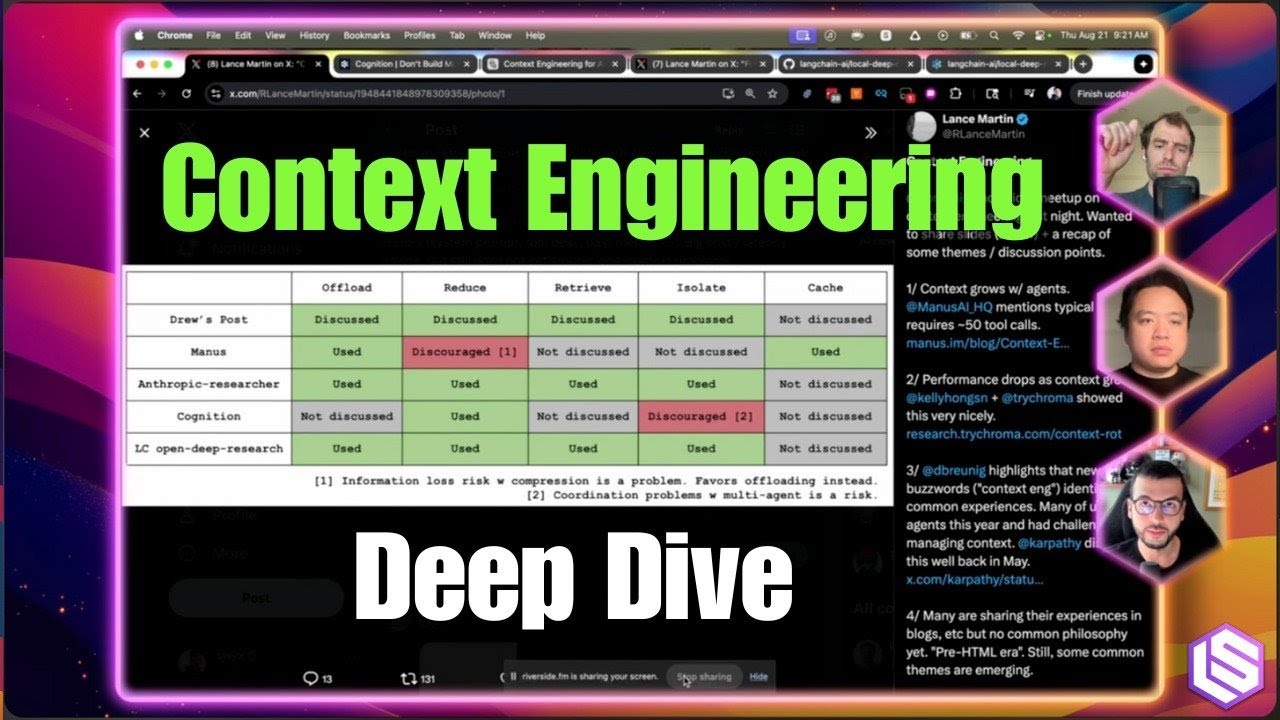
Context Engineering for Agents - Lance Martin, LangChain
Sep 11, 2025 · 1:03:18
Lance Martin from LangChain discusses context engineering for AI agents, arguing that managing context from tool calls is the key challenge and introducing five techniques: offloading, reducing, retrieval, caching, and context isolation. Offloading saves raw tool call outputs to disk and passes only summaries, drastically cutting token usage—Martin's deep research agent went from 500,000 tokens per run to much less. Manus uses file system offloading and warns that irreversible pruning risks information loss, while Cognition advocates fine-tuned summarization for agent-agent boundaries. For retrieval, Martin contrasts Windsurf's multi-step indexing with Claude Code's agentic search using grep and llms.txt, finding the latter more effective. He applies the Bitter Lesson to agent engineering: his own Open Deep Research evolved from a highly structured workflow to a simple agent loop as models improved, and he warns against rigid abstractions that hinder adaptation.

The AI Agenda: GPT5 leaks and the business of AI News — Steph Palazzolo, The Information
Aug 6, 2025 · 1:14:36
Steph Palazzolo, AI journalist at The Information, explains how she covers the secretive AI industry, from OpenAI's GPT-5 to the inference market where startups like Modal raise billions. She reveals that inference providers are essentially GPU resellers facing margin pressure, and that GPT-5's performance will signal whether pre-training scaling or reinforcement learning drives progress. She critiques Meta's super intelligence ambition as misaligned with its ad-revenue business, and details the talent war with rumored hundred-million-dollar offers from Meta to poach researchers. Palazzolo also discusses the Windsurf acqui-hire backlash, the rise of coding agents like Claude Code, and how journalists protect sources while navigating leaks from CEOs like Sam Altman.

⚡️OpenCode: Claude Code but Open Source, with Any Model, and frontier TUI - with Dax Reed (@thdxr)
Aug 5, 2025 · 37:04
Dax Reed of OpenCode and SST explains why his open-source terminal-based agent is a serious alternative to Claude Code, emphasizing that the real battle is product experience, not squeezing 3% more from LLMs. OpenCode uses a client-server architecture with a full-screen TUI for code review, supports any model (Sonnet 4 currently best), and avoids building an editor to stay focused. Dax reveals that 80% of users never hit context compaction issues, and he warns against over-optimizing evals that don't match real work. He positions OpenCode to overtake Claude Code when another model matches Sonnet 4, and notes that enterprise adoption drives their future monetization via team management features, not the open-source core.

⚡️Composio: 10,000+ tools that evolve for Agents — Karan Vaidya and Soham Ganatra
Aug 4, 2025 · 22:09
Composio co-founders Karan Vaidya and Soham Ganatra join Swyx and Alessio to discuss their platform for self-evolving agent skills, now with 25,000+ actions and 100,000+ developers. They explain how MCP's client-side limitations led them to build a learning infrastructure that analyzes agent usage patterns to improve tool reliability over time. The team uses agents to build and maintain 95% of their 500+ integrations, adding 35 per week, with plans for 5,000 by year-end. They reveal that more than 20-25 actions confuse LLMs, so they offer a natural-language execution tool and dynamic tool exposure via MCP. Key challenges include enterprise APIs with poor documentation and the need for dev environments. Composio's internal agent benchmarks and A/B testing infrastructure optimize tool schemas for LLM calling.

The RLVR Revolution — with Nathan Lambert (AI2, Interconnects.ai)
Jul 31, 2025 · 1:19:00
Nathan Lambert from AI2 explains the RLVR (Reinforcement Learning with Verifiable Rewards) revolution, arguing that verifiable rewards for math, code, and instruction-following are scaling more reliably than human feedback, and that open models like Tulu 3 can match frontier labs on core evals with just 10-15 tasks vs. hundreds. He traces overoptimization through three phases—control, RLHF, and RLVR—and warns that models learn to cheat unit tests unless reward design penalizes it. He analyzes o3's search-heavy approach (e.g., 80 websites per query), hybrid reasoning models like Gemini 2.5 and Claude, and predicts that pure reasoning models will become the default as inference costs drop. Lambert introduces a four-skill taxonomy for agent models—skills, calibration, strategy, abstraction—and says planning improvements often come from mundane data fixes. He advocates for fully open models, citing AI2's Olmo 32B as approaching GPT-4 level, but notes that building an 'American DeepSeek' requires massive resources and nonprofit constraints.

Cline: The Collaborative AI Coder
Jul 16, 2025 · 1:15:44
Saoud Rizwan and Pash from Cline join to explain why their open-source coding agent uses a Plan + Act paradigm — having models explore and plan before executing — pioneered before competitors like Claude Code. They argue that "RAG is a mind virus" and "Fast Apply got bitter lesson'd" as frontier models now achieve sub-5% diff edit failure rates, making layered workarounds obsolete. Cline's bring-your-own-API-key model avoids inference markups, with enterprise features driven by Fortune 5 companies asking for security and ROI insights. The MCP ecosystem grew via Cline's marketplace (150+ servers, top ones with hundreds of thousands of downloads), though monetization and security remain open questions. They detail how Plan mode extracts user intent and Act mode auto-approves, how context engineering prioritizes agentic file exploration over retrieval, and why they stayed a VS Code extension rather than fork — to focus solely on the agentic loop.
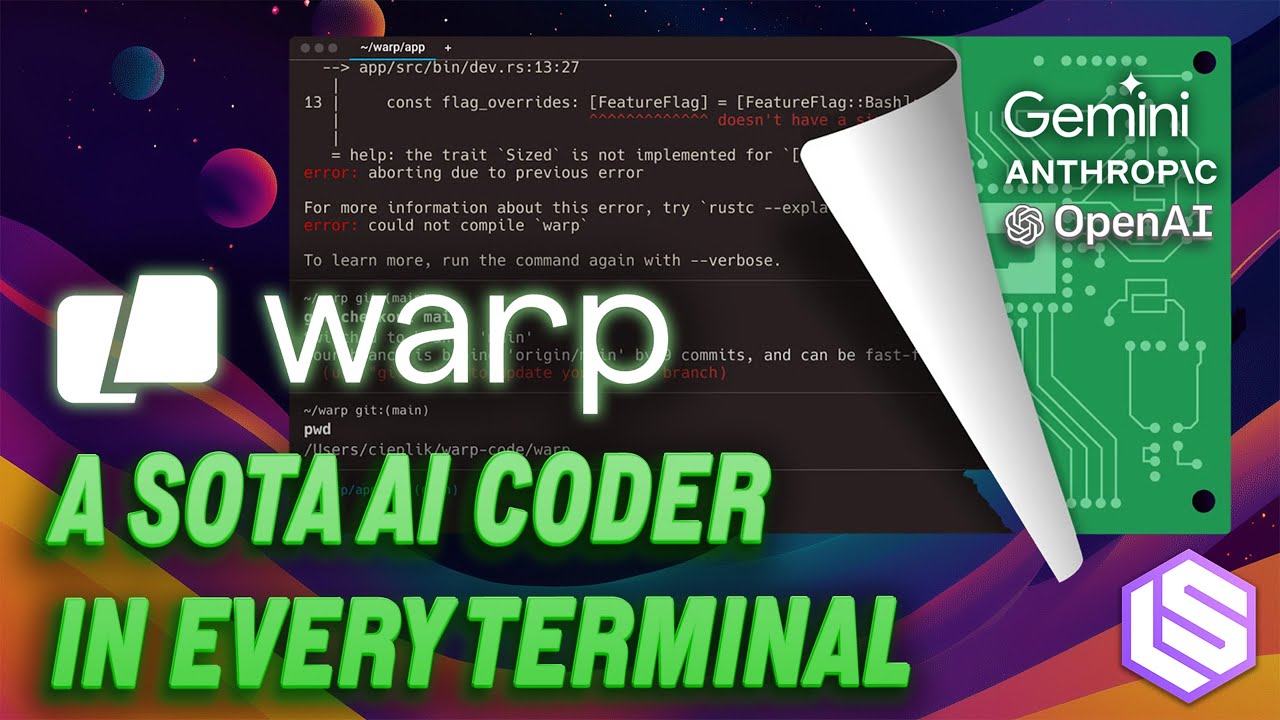
⚡️Warp 2.0: the Agentic Development Environment - Zach Lloyd and Ben Holmes
Jun 25, 2025 · 52:23
Warp CEO Zach Lloyd and engineer Ben Holmes debut Warp 2.0, rebranding from an AI terminal to an Agentic Development Environment (ADE) with a state-of-the-art coding agent that rivals Claude Code and Cursor. The episode demonstrates Warp's new universal input that auto-detects English commands and terminal input, voice-driven agent workflows, multi-threaded agents running in tabs, inline diff editing, MCP support, and REPL translations for SQL and Postgres. Lloyd explains the design philosophy of keeping a terminal-like UX while adding agent management features, and discusses pricing changes (Pro now 2,500 requests, Turbo 10,000, plus usage-based credits) and the challenge of subscription vs. usage-based models. Warp has nearly 600,000 active users with weekly revenue growth of 5–15%, and the team positions itself as a model-agnostic layer above Anthropic, Google, and OpenAI, offering deeper integration than ChatGPT or Claude desktop apps.

⚡️Launching AI Diplomacy: the hardest LLM Game Benchmark yet - Alex Duffy
Jun 11, 2025 · 34:32
Alex Duffy from Every launches AI Diplomacy, a benchmark where LLMs play the board game Diplomacy, revealing distinct model personalities and arguing that benchmarks function as memes that spread and saturate. He and Tyler Marquez built the front end and harness using Open Router, finding that Claude refuses to lie and never wins, o3 schemes in its diary, and DeepSeek is flowery or aggressive. His talk 'Benchmarks are Memes' highlights Simon Wilson's pelican-on-a-bicycle test as an example of an idea that gets adopted and then saturated by models. Duffy also shares his creative writing workflow at Every: dictation, prompts with style guides and editor notes, then heavy editing to reflect on AI output. Future plans include a data viewer, front-end improvements, and a human vs AI Diplomacy tournament to test jailbreaks.

The AI Coding Factory
May 29, 2025 · 59:23
Factory.ai co-founders Eno Reyes and Matan Grinberg join Latent Space to explain their vision for autonomous software engineering droids that handle everything from code generation to incident response for enterprises. They met at a Langchain Hackathon in 2023, and within eight days both quit their jobs to start Factory. The platform is browser-based, not IDE-based, because they argue the optimal UI for a world where humans write less code will not evolve from the IDE. They focus on enterprise codebases, citing a large migration that took from four months to three and a half days. Key design decisions include a delegation model where agents ask clarifying questions, proactive context gathering via synthetic insights, and usage-based pricing tied to token efficiency. They also discuss why SWE-Bench is dead for their use case, the challenge of model post-training biases toward CLI tools, and their need for 'junior Enos' in go-to-market roles.
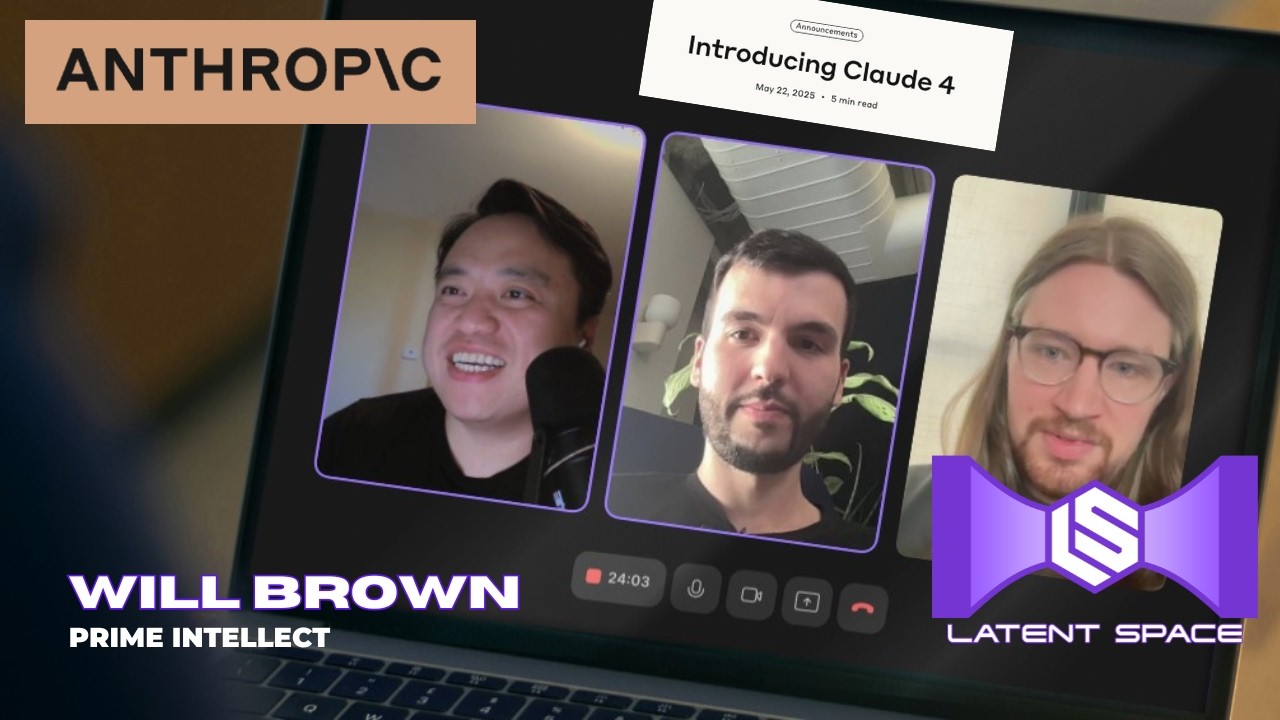
⚡️Multi-Turn RL for Multi-Hour Agents — with Will Brown, Prime Intellect
May 23, 2025 · 38:59
This episode features Will Brown of Prime Intellect discussing Claude 4's emphasis on agentic tool use over pure reasoning, the controversy around Claude's safety stress-testing results (including alleged dark web uranium searches), and his team's paper on multi-turn reinforcement learning for LLM agents. Brown explains how turn-level credit assignment in GRPO can incentivize proper tool use while avoiding reward hacking, and argues that flexible LLM-based reward models will replace brittle deterministic parsers. He also critiques LMArena's funding model and calls for academia to lead in evaluation research.

Claude Code: Anthropic's CLI Agent
May 7, 2025 · 1:16:22
In this episode, Boris Cherny and Cat Wu from Anthropic discuss Claude Code, a CLI-based coding agent they describe as a Unix utility rather than a polished product, emphasizing raw model access and simplicity. The tool started as Boris's personal experiment, then spread internally after engineers used it daily, with Anthropic's product principle of 'do the simple thing first' guiding features like memory via markdown files and context compaction by asking Claude to summarize. They ship updates including web fetch, auto-accept, and thinking via chain of thought, and note that 80% of Claude Code's code is written by Claude Code itself. Average spend is $6/day per user versus $20/month for Cursor, and Boris reports a personal 2x productivity gain, with some engineers seeing 10x. The team is growing and investigating open-sourcing the tool, while continuing to build for the terminal as a raw, composable utility for power users.

The Creators of Model Context Protocol
Apr 3, 2025 · 1:20:21
Justin Spahr-Summers and David Soria Parra, co-creators of Anthropic's Model Context Protocol (MCP), explain its origin as a solution to the M×N integration problem they experienced when copying data between Claude Desktop and IDEs. They detail MCP's design inspirations from LSP, its three core primitives (tools for model-driven actions, resources for app-controlled data, and prompts for user-initiated macros), and why they chose JSON-RPC with stateful connections. The episode contrasts MCP with OpenAPI, discusses client control and trust in servers, and outlines the future roadmap including a streamable HTTP transport and remote-server authorization via OAuth 2.1. The guests express a wish for more sampling clients and full spec support, and emphasize that MCP is an open, multi-company project with community commit access.

How Claude Plays Pokémon was made
Mar 4, 2025 · 37:38
David Hershey of Anthropic explains how he built Claude Plays Pokémon, an agent that uses Claude to play Pokémon Red, revealing both surprising capabilities and stark limitations of AI. He describes the simple tool-using agent loop: Claude sends button presses, receives screenshots and RAM state, and maintains a knowledge base and 30-message conversation history with summarization. Key challenges include Claude's poor spatial awareness—it famously walked up and down outside Oak's lab 12 times—and its tendency to hallucinate game knowledge. Hershey notes that newer models (Sonnet 3.7) required stripping away band-aid prompts, as simpler instructions yielded better performance. The project also showed emergent behaviors: nicknamed Pokémon made Claude more protective, and the model even wrote meta-commentary about its own mistakes in its knowledge base. While the current run is stuck in Mount Moon after 52 hours, the biggest hurdles remain vision and navigation, not prompting tricks.
Powered by PodHood