
Chroma
ProductA product discussed on Latent Space.
2 episodes

[State of Context Engineering] Agentic RAG, Context Rot, MCP, Subagents — Nina Lopatina, Contextual
Dec 31, 2025 · 26:48
Nina Lopatina of Contextual AI discusses the state of context engineering, arguing that while the field is still in prototyping, 2025 will see true scale with full-system design patterns. She notes that agentic RAG—especially query reformulation into subqueries—has become the baseline, dramatically improving retrieval. Context rot is widely cited but industry benchmarks at real scale (100k+ documents, billions of tokens) remain rare. MCP is both a driver and a flaw: giant JSON tool definitions stuff the context window, yet MCP servers enable rapid prototyping before optimizing down to direct API calls. Sub-agents with turn limits are critical—unlimited agency degrades performance and causes hallucinations. Instruction-following re-rankers are essential for scaling retrieval across massive databases, providing more recall upfront and precision in the final context. Benchmarks are being saturated faster than ever: a Princeton benchmark from October was saturated by Claude Code in weeks, with solutions so good the gold dataset had errors. Lopatina also shares a lesson from using ChatGPT as a snowboarding coach—after several months of training for a 25-lap mogul race, she had to close…
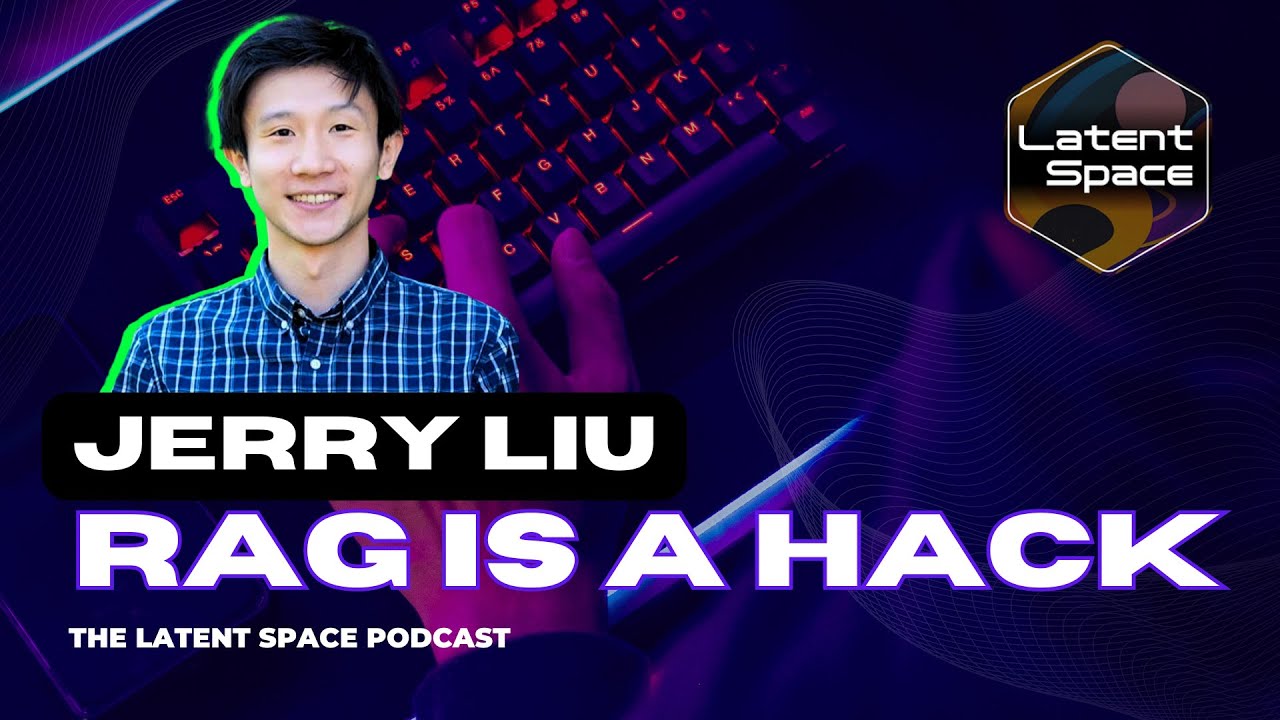
RAG is a hack - with Jerry Liu of LlamaIndex
Oct 12, 2023 · 1:13:25
In this episode of Latent Space, Jerry Liu of LlamaIndex argues that while RAG is fundamentally a hack, it remains the most practical approach for grounding LLMs with external data, and his open-source framework now serves 600,000 monthly downloads. Liu recounts how LlamaIndex originated from a hackathon at Robust Intelligence, evolving from an experimental tree-index to a modular toolkit spanning data loading, retrieval, synthesis, and agent loops. He explains the trade-offs between RAG and fine-tuning, noting that context window limits force algorithmic rather than learned optimizations, but RAG offers transparency and access control that fine-tuning cannot. Liu details the company’s $8.5M Greylock raise, the launch of LlamaHub for community-contributed data loaders, and the open-source SEC Insights app as a production-grade template. Looking ahead, he emphasizes the need for better retrieval benchmarks and predicts that future personalization will move beyond vector stores into model-internal memory architectures.
Powered by PodHood