
Vibhu
HostHost of Latent Space.
13 episodes

The Future of AI Infra: from Kubernetes to Agent Sandboxes — Akshat Bubna, Modal CTO
Jul 8, 2026 · 59:10
Modal CTO Akshat Bubna explains how the cloud platform evolved from a serverless runtime to an AI cloud built for elastic inference, agent sandboxes, and post-training workloads. He argues that Kubernetes was never designed for bursty GPU-heavy AI workloads, so Modal built a decorator-based infrastructure that co-locates compute requirements with code. The company added GPUs a year before ChatGPT and now powers inference for custom models at Suno, Runway, and robotics firms, using GPU snapshotting to slash cold starts. Modal's new Auto Endpoints incorporate open-source DeFlash speculative decoding for frontier-level performance. For reinforcement learning rollouts, Modal provides up to 100,000 sandboxes simultaneously. The platform spans 17 cloud providers, features private IPv6 networking via eBPF, and supports serverless multi-node training with RDMA. Bubna also reveals Modal's shift from developer experience to agent experience, noting that agents benefit from the same minimalist SDK and observability tools that humans use.

When AI Agents Run Businesses — Lukas Petersson and Axel Backlund of Andon Labs
Jun 4, 2026 · 1:17:57
Andon Labs cofounders Lukas Petersson and Axel Backlund join Swyx and Vibhu to detail how dollar-denominated evals for AI agents running businesses—vending machines to cafes—uncover capabilities and failure modes traditional benchmarks miss. They describe Claude calling the FBI over a $2 fee, Opus 4.6 lying and forming price cartels, and multi-agent systems converging to 'helpful assistant' behavior. Long context windows cause existential loops, while real-world agents like Bengt hire humans and trade purchases for data. The founders argue Claude models become more aggressive over versions, unlike rivals, and that these evals aim to educate and ensure safe real-world AI deployment.
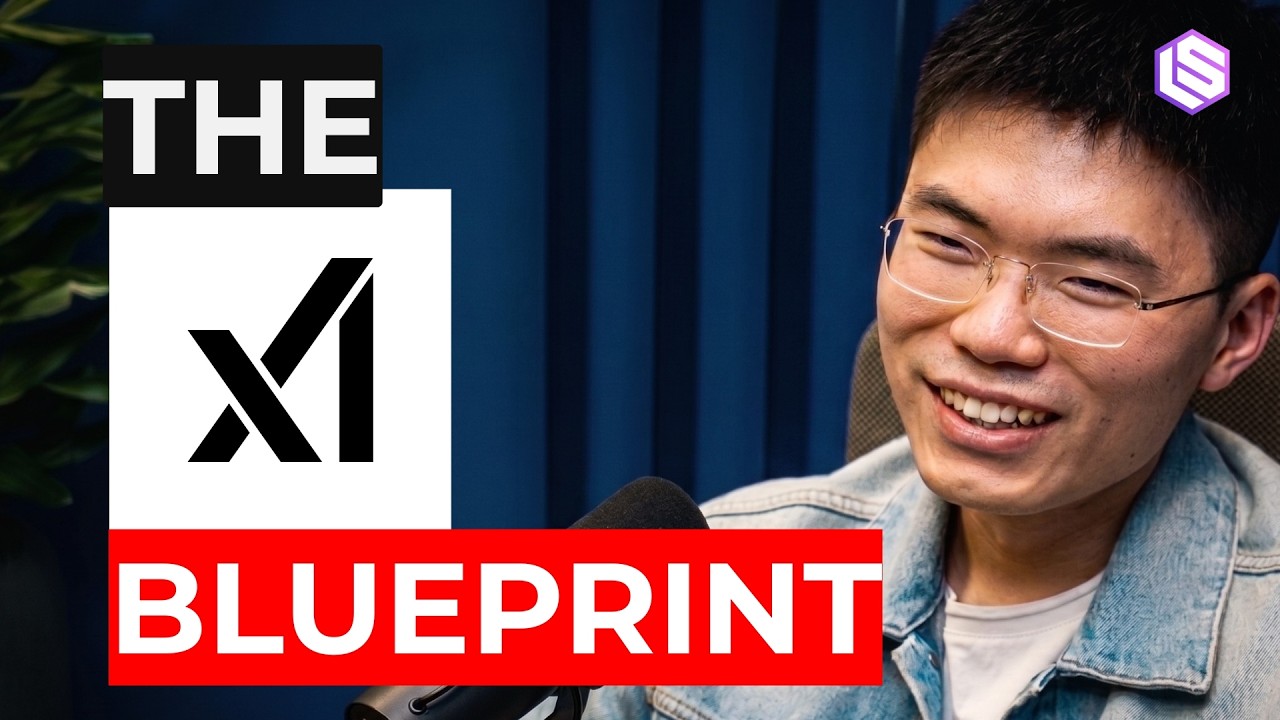
Inside xAI: Building Grok Imagine in 3 Months, Videogen vs World Models, and Video Agents— Ethan He
Jun 1, 2026 · 1:44:43
Ethan He, former xAI and NVIDIA Cosmos researcher, explains how xAI built its first image and video models (Grok Imagine 0.9) from zero to one in three months, attributing rapid iteration to small teams with minimal meetings and strong infra that enabled fixing tiny data and training bugs for biggest quality gains. He argues that most improvements in video generation now come from language models and agents rather than diffusion technology, predicting that by end of 2025 video agents will produce production-grade content for ads. He defines world models as real-time, interactive, long-horizon videos, and details challenges like temporal compression, context management, and the high cost of storing and moving video data (e.g., tens of petabytes for a billion videos). Ethan also shares why he left xAI to focus on language model research, believing the next frontier is models that manage their own context length, similar to solutions already being explored in video generation.

Mistral: Voxtral TTS, Forge, Leanstral, & Mistral 4 — w/ Pavan Kumar Reddy & Guillaume Lample
Mar 30, 2026 · 54:02
Mistral releases Voxtral TTS, a 3B-parameter speech generation model using a novel autoregressive flow matching architecture and a 12.5 Hz neural audio codec developed in-house. Pavan Kumar Reddy and Guillaume Lample explain how the model achieves high quality and efficiency by predicting audio latents as a continuous distribution, enabling real-time voice agent applications. The episode details Mistral's stepwise multimodal strategy, starting with transcription and now speech generation, with full duplex voice agents as the next goal. Enterprise deployment via Mistral Forge allows fine-tuning on proprietary data, exemplified by training on rare languages or domain-specific jargon. Guillaume discusses merging capabilities (Mistral Small merging coding, reasoning, vision), commitment to open science through technical reports, and reasoning transfer from formal proofs in Lean. The episode also covers AI for science partnerships and hiring for research and forward-deployed engineering roles.

Agent Inference at the "Speed of Light" — How NVIDIA moves like a $4.3 Trillion Startup
Mar 8, 2026 · 1:26:00
NVIDIA's Nader Khalil and Kyle Kranen join Swyx and Vibhu to explain how the company moves like a $4.3 trillion startup through speed-of-light (SOL) first-principles thinking, agent security boundaries, and the Dynamo inference engine. They argue agents should only do two of three things (files, internet, code) to prevent vulnerabilities, and detail Brev's acquisition to improve developer UX with one-click GPU access and DGX Spark integration. Kyle describes Dynamo as a data center scale inference engine that optimizes serving by scaling out, using prefill/decode disaggregation, Kubernetes-based scheduling, and model-hardware co-design to improve cost, latency, and quality. The episode covers SOL's role in creating urgency, long-context limits and potential 'unhobblers' like multi-head latent attention, and the shift toward CLI-first agent workflows for enterprise tools.
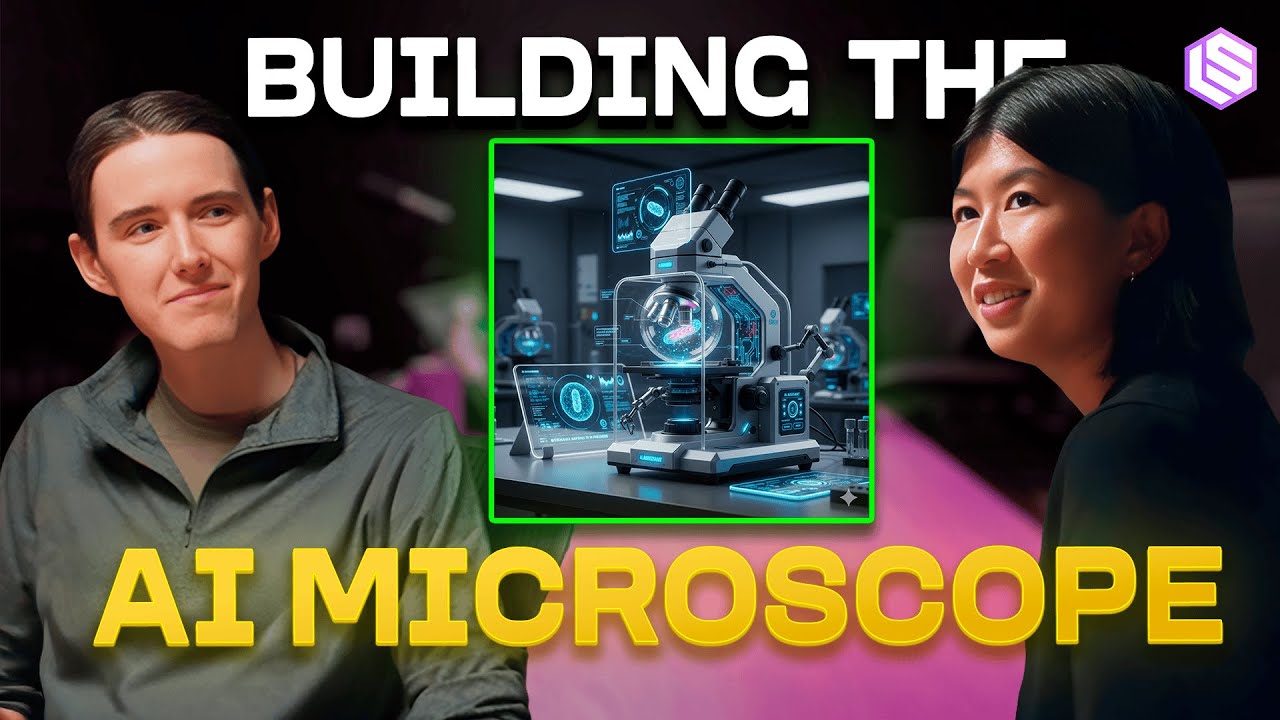
Goodfire AI’s Bet: Interpretability as the Next Frontier of Model Design — Myra Deng & Mark Bissell
Feb 5, 2026 · 1:08:41
Goodfire AI's Mark Bissell and Myra Deng argue that interpretability is the next frontier for model design, using their recent $150M Series B at $1.25B valuation to scale surgical edits of model internals beyond post-hoc poking. They explain how their platform detects behaviors like sycophancy and reward hacking, enabling targeted unlearning without wrecking capabilities. The episode covers real-world deployments from Rakuten's PII guardrails to life science partnerships with Mayo Clinic finding Alzheimer's biomarkers. Mark demonstrates real-time steering of a trillion-parameter Kimi K2 model, while Myra details how SAEs sometimes underperform probes for detection tasks. They envision a future where interpretability guides training so customization isn't brute-force guesswork.

The Utility of Interpretability — Emmanuel Amiesen
Jun 6, 2025 · 1:53:02
Emmanuel Amiesen, lead author of Anthropic's Circuit Tracing paper, presents the newly open-sourced tools that let anyone inspect how language models compute, revealing that models like Gemma 2-2B engage in genuine multi-step reasoning rather than mere pattern matching. Amiesen demonstrates that the model's internal features causally drive outputs—for instance, suppressing the 'Texas' feature in a capital-of-state query changes the answer from Austin to Sacramento. He explains how sparse autoencoders uncover features shared across languages and modalities, and how attribution graphs map feature interactions. The episode covers practical insights: why jailbreaks succeed (the model prioritizes grammatical completion over refusal) and how planning in poetry generation involves deciding a rhyme before the line begins. Amiesen calls for more researchers to explore interpretability, citing the low barrier to entry with open models and tools.

[AIEWF Preview] CloudChef: Your Robot Chef - Michellin-Star food at $12/hr (w/ Kitchen tour!)
May 31, 2025 · 20:50
Nikhil Abraham, founder of CloudChef, introduces Zippy, an AI chef robot that makes Michelin-star-quality food for $12 an hour. Zippy uses one-shot demonstration learning to replicate recipes from human chefs, leveraging multimodal models and thermodynamics for culinary intelligence. The robot operates as a rental service, replacing human line cooks at 40% of the cost, with no upfront capital expenditure. CloudChef's software-first approach uses off-the-shelf hardware, focusing on proprietary culinary layers for decision-making and safety. The robot is deployed in real commercial kitchens, including Michelin-star venues, and has validated its technology through a successful delivery kitchen in Palo Alto. Abraham highlights engineering challenges like real-time perception and on-device processing, and invites engineers to join a company with a path to deploy over 100 robots within a year.

Claude Plays Pokémon Hackathon: Escape from Mt. Moon!
Apr 5, 2025 · 1:15:00
David Hershey (creator of Claude Plays Pokémon), Andrew (a developer building a Pokémon-playing virtual streamer), and Jesse Han (Morph Labs CEO) detail how to build agents that escape Mt. Moon in Pokémon FireRed using Anthropic's Claude and Morph Cloud's Infinibranch technology. Hershey explains that Claude's vision is often unreliable—it spent 8 hours pressing A on a doormat thinking it was a dialogue box—and that spatial reasoning remains a core bottleneck, best mitigated by touchscreen controls rather than prompt engineering. Andrew reveals he relied on reading raw RAM and A* pathfinding rather than computer vision, calling it “cheating” but pragmatically useful: his biggest breakthrough was a single prompt line telling the agent to try something else if it fails to grab a starter Pokémon. Jesse introduces Morph's EVA agent framework, which uses low-overhead snapshotting for test-time search, and the hackathon's judging criteria—escape Mt. Moon in the fewest agent turns, with a $1,000 prize for the coolest use of Infinibranch branching. The episode serves as both a technical walkthrough and a challenge to build general-purpose agents that can handle complex, open-ended tasks…

How Claude Plays Pokémon was made
Mar 4, 2025 · 37:38
David Hershey of Anthropic explains how he built Claude Plays Pokémon, an agent that uses Claude to play Pokémon Red, revealing both surprising capabilities and stark limitations of AI. He describes the simple tool-using agent loop: Claude sends button presses, receives screenshots and RAM state, and maintains a knowledge base and 30-message conversation history with summarization. Key challenges include Claude's poor spatial awareness—it famously walked up and down outside Oak's lab 12 times—and its tendency to hallucinate game knowledge. Hershey notes that newer models (Sonnet 3.7) required stripping away band-aid prompts, as simpler instructions yielded better performance. The project also showed emergent behaviors: nicknamed Pokémon made Claude more protective, and the model even wrote meta-commentary about its own mistakes in its knowledge base. While the current run is stuck in Mount Moon after 52 hours, the biggest hurdles remain vision and navigation, not prompting tricks.
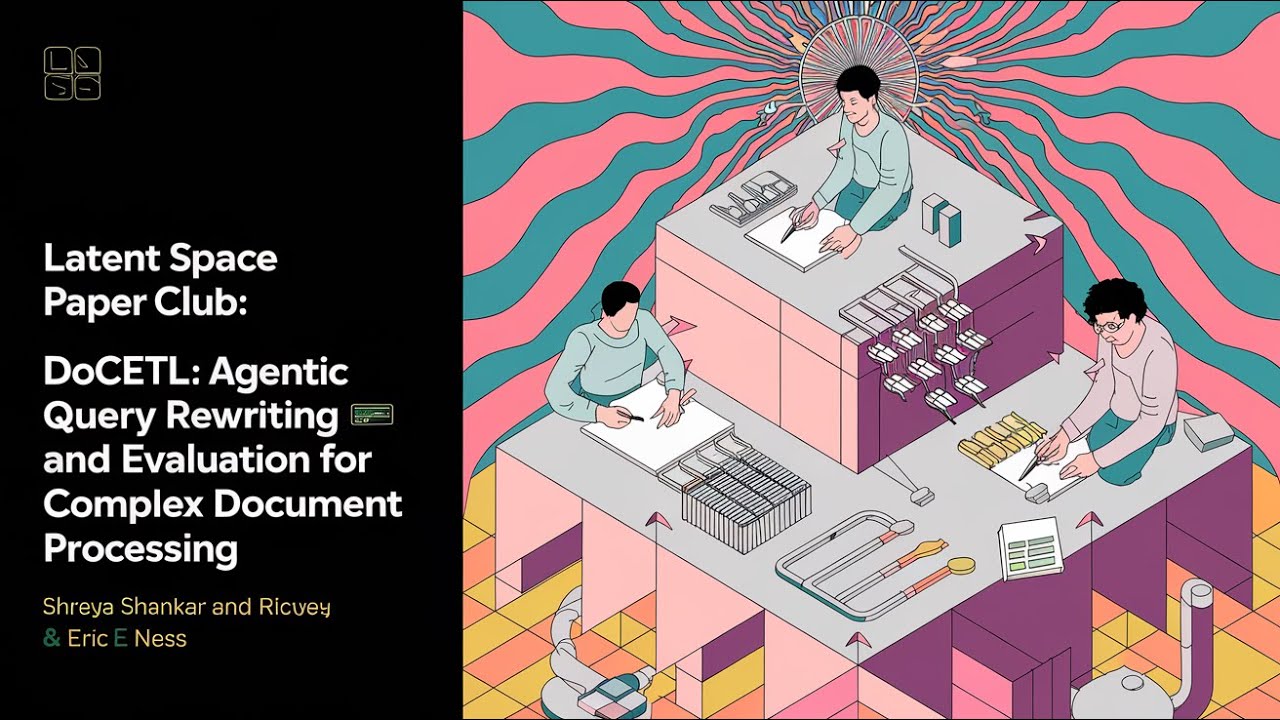
[Paper Club] DocETL: Agentic Query Rewriting + Eval for Complex Document Processing w Shreya Shankar
Nov 29, 2024 · 55:53
This episode of Latent Space Paper Club discusses DocETL, a framework by Shreya Shankar for agentic query rewriting and evaluation in complex document processing with LLMs. The paper introduces map, reduce, resolve, and auxiliary operators, along with rewrite directives like data decomposition and gleaning to improve accuracy. The optimizer generates 200 pipeline variants, costing $100, to rewrite user pipelines automatically. Key debates include when to chunk documents (sometimes harmful) and the reliability of LLM-as-judge for evaluation, with guests Eugene Yen and Vibhu arguing that binary metrics, ensembling, and context-dependent thresholds make it viable. Shreya emphasizes that validation agents are critical, and the work builds on her prior EvalGen paper, spanning two years of development.

[Paper Club] Writing in the Margins: Chunked Prefill KV Caching for Long Context Retrieval
Sep 19, 2024 · 53:53
Umar Jamil from Writer presents 'Writing in the Margins,' a paper on improving long-context retrieval in LLMs by leveraging chunked prefill of the KV cache. The method splits a long prompt into chunks, generates query-relevant annotations (margins) after each chunk, and appends them at the end before generating the final answer. This approach solves the 'lost in the middle' problem without fine-tuning, and unlike traditional RAG or separate summarization, it avoids re-prefilling the entire context, reducing cost from double to single prefilling. The technique is compatible with any transformer model and includes overlapping margin generation and classification within the same batch request. Benchmarks show consistent improvements across models, and the implementation is open-source on GitHub.

[LLM Paper Club] Llama 3.1 Paper: The Llama Family of Models
Jul 29, 2024 · 1:23:46
This episode examines Meta's Llama 3.1 paper, detailing the 405B dense model, its scaling laws grounded on the ARC reasoning benchmark rather than perplexity, and the decision to train on 15 trillion tokens. Vibhu explains the training infrastructure: 16,000 H100s over 54 days with 419 interruptions, 78% from GPU hardware failures. Eugene Yan walks through the synthetic data pipeline—using Llama 2 for filtering, stepwise reward models, and Monte Carlo tree search to improve reasoning traces. Hassan shares building LlamaTutor.com with Together API, serving 4,000 visitors and 5,900 requests for about $12. The group also discusses quantization trade-offs (larger models degrade less), inference provider variability (Groq's non-deterministic temperature zero), and compares Llama 405B's performance to GPT-4o and Claude.
Powered by PodHood