
RJ
HostHost of Latent Space.
3 episodes
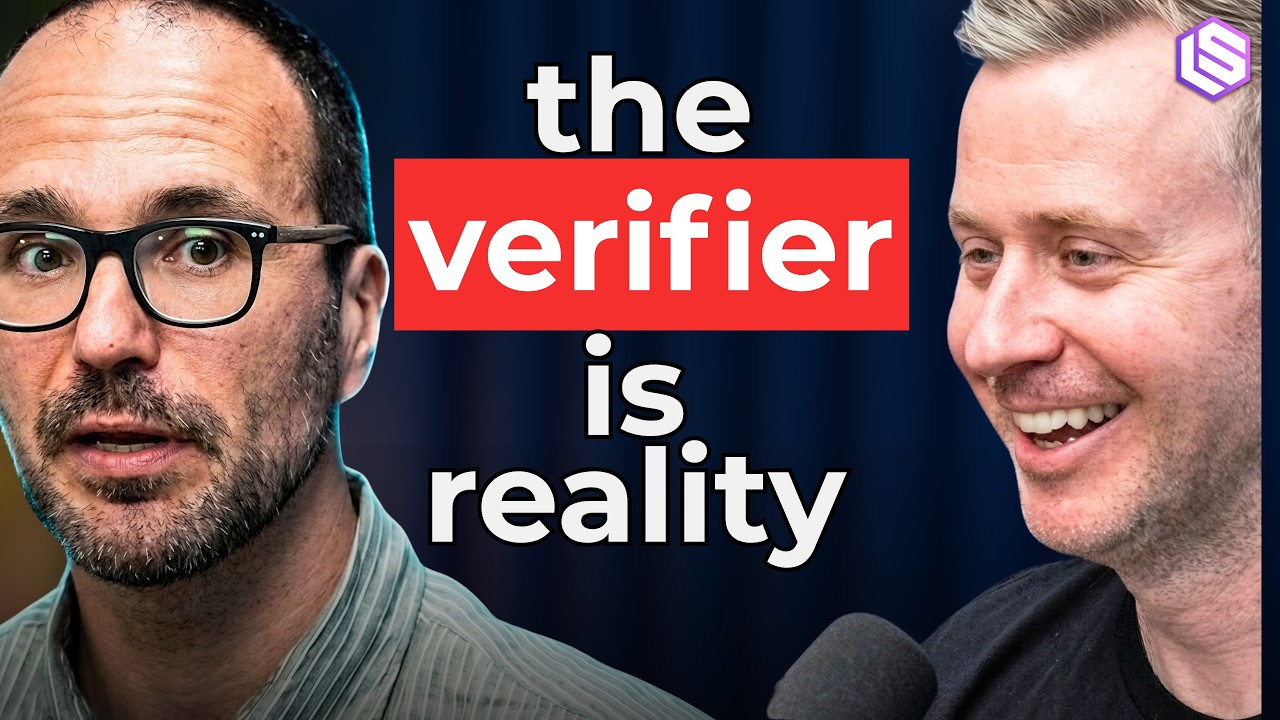
🔬 RL with Verifiable Rewards, but the Verifier is a Lab — Lila Sciences
Jul 16, 2026 · 1:41:04
Andy Beam (CTO) and Rafa Gómez-Bombarelli (Co-founder & CSO of Physical Sciences) of Lila Sciences argue that science is an 'infinite token generator' for AI, using reinforcement learning with verifiable rewards where the wet lab acts as the verifier. They claim one general model trained on ~10 trillion experimentally-verified reasoning tokens across biology, chemistry, and materials outperforms domain-specific models—'breadth gives us depth.' Their AI Science Factories treat the lab as a data center, with instruments on a 'PCI bus' and humans 'below the API line.' Highlights include a CAR-T candidate designed in six months by two or three people, 'monster UTRs' achieving ~10x Moderna/Pfizer mRNA expression, and the 'zero-FTE startup' business model. They discuss RL pathologies like collapsed chains of thought and a model that 'swears,' and note why there is still no AlphaFold for materials due to the sim-to-real gap.

🔬 The Limits of AI in Science - Why We Need Self-Driving Labs — Joseph Krause, Radical AI
Jun 17, 2026 · 1:16:50
Joseph Krause of Radical AI argues that the bottleneck in materials science is experiments, not ideas, and his company's self-driving lab combines AI hypothesis generation with automated synthesis and characterization to produce alloys at unprecedented speed—1,200 in six months, with 300 novel compositions and 10 already in commercial development. Radical's closed-loop system runs research campaigns, not just automated tasks, overcoming challenges like sample manipulation at 3,000°C and tool vendors' software access. Krause details how their AI explores elemental families humans overlooked, why they open-source models like Matrix (the moat is experimental data, not models), and how they plan to compress discovery timelines from decades to 3–5 years for defense and space applications. He addresses the 10-year qualification process for aerospace, supply chain geopolitics (e.g., hafnium price up 10–15x due to Chinese dominance), and the need for public-private partnerships to accelerate U.S. R&D. Finally, he urges ML engineers to lean into their expertise rather than try to become material scientists.

⚡️ Prism: OpenAI's LaTeX "Cursor for Scientists" — Kevin Weil & Victor Powell, OpenAI for Science
Jan 27, 2026 · 36:00
Kevin Weil (VP of OpenAI for Science) and Victor Powell (Prism product lead) launch Prism, a free AI-native LaTeX editor that embeds GPT-5.2 directly into the scientific writing workflow, eliminating copy-pasting between ChatGPT and Overleaf and turning weeks of LaTeX formatting into minutes of natural language instruction. The origin story reveals Kevin discovered Victor's stealth company Cricket on Reddit and DM'd him to bring the team into OpenAI. In the live demo, Prism proofreads papers paragraph by paragraph, converts a whiteboard commutative diagram photo into TikZ code, generates 30 pages of general relativity lecture notes in seconds, and verifies complex symmetry equations in parallel chat sessions. They argue that LaTeX typesetting is the bottleneck diverting scientists from actual research, and that unlimited free collaboration and multi-line diff generation make Prism a 'tool for thought' rather than just a publishing tool. Kevin predicts 2026 will be for AI in science what 2025 was for AI in software engineering — a year when it becomes essential. The discussion also covers OpenAI's approach to accelerating science broadly, including the role of robotic labs and…
Powered by PodHood