
World Labs
CompanyA company discussed on Latent Space.
3 episodes

Moonlake: Interactive, Multimodal World Models — with Chris Manning and Fan-yun Sun
Apr 2, 2026 · 1:06:48
Moonlake AI founders Chris Manning and Fan-yun Sun argue that interactive, multimodal world models require structured symbolic reasoning over pure scale, enabling indefinite multiplayer gameplay and causal consistency that video generation models like Genie and Sora cannot achieve. Their approach uses code engines and physics simulators as cognitive tools, producing reasoning traces that handle geometry, physics, and logic, while a separate diffusion model (Reverie) handles pixel fidelity. They aim to replace traditional rendering and empower creators by allowing human intent to be injected at a symbolic layer. Manning contrasts this with Yann LeCun's JEPA, emphasizing language and abstraction over pixel-level prediction. Moonlake is hiring engineers at the intersection of code generation, computer vision, and graphics.
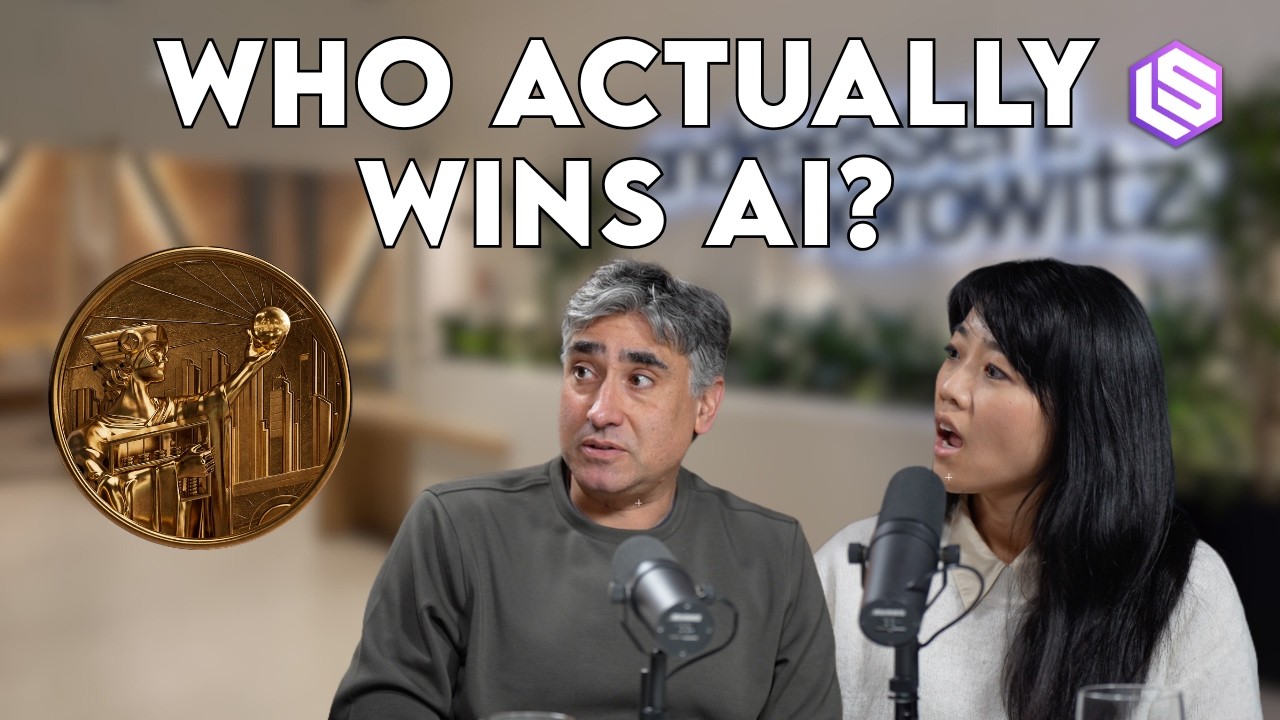
Inside AI’s $10B+ Capital Flywheel — Martin Casado & Sarah Wang of a16z
Feb 19, 2026 · 55:31
Martin Casado and Sarah Wang of a16z argue that AI’s capital flywheel—where model labs translate funding directly into capability gains and revenue growth in weeks—is creating a new financing playbook that blends venture and growth, with rounds acting as compute contracts. They warn that frontier labs like Anthropic can potentially raise more money than the entire app ecosystem built on their APIs, allowing them to outspend and consume those layers. The episode examines the AGI vs. product dilemma in GPU allocation, the war for talent where $10M+ packages break early-stage founder math, and Cursor as a case study of building up from the app layer while training down into its own models. They also identify “boring” enterprise software as the most underinvested opportunity and note that robotics lacks a ChatGPT moment that would justify current funding levels.

After LLMs: Spatial Intelligence and World Models — Fei-Fei Li & Justin Johnson, World Labs
Nov 25, 2025 · 1:00:39
World Labs co-founders Fei-Fei Li and Justin Johnson argue that spatial intelligence is the next frontier beyond LLMs, with their product Marble generating editable 3D worlds from text or images using Gaussian splats. They claim language is a lossy channel for describing the rich 3D/4D world, while spatial intelligence handles everything from picking up a mug to inferring DNA's double helix. Marble already serves gaming, VFX, and film, with precise camera control and real-time rendering on phones and VR headsets. They discuss scaling compute from AlexNet to today's million-fold increase, why world models can 'soak up' modern GPU clusters better than language alone, and the gap between pattern-fitting and causal understanding in physics. Fei-Fei worries more about under-resourced academia than open vs. closed models, advocating for national AI compute clouds and open benchmarks like the BEHAVIOR dataset. Justin notes transformers are natively set models, not sequence models, opening architectural possibilities for new spatial data.
Powered by PodHood