
Thinking Machines
CompanyA company discussed on Latent Space.
3 episodes

Why AI Agents Don't Actually Understand You — Danielle Perszyk, Amazon AGI Lab
Jul 11, 2026 · 48:54
Danielle Perszyk of Amazon's AGI Lab argues that AI agents fail because they don't truly understand users — they model tasks but not the human mind, so reliability must shift from clicking correctly to aligning representations. She explains how Amazon's AGI Lab, seeded by the former Adept team, builds perception agents that perceive digital environments like humans and interact in real time, moving beyond chatbots and coding agents. The lab is exploring new architectures for episodic memory, social world models, and multi-agent systems where agents fluidly negotiate meaning, inspired by human collective intelligence. Perszyk warns that current AI homogenizes thinking, reducing human agency, and advocates for a diverse society of AIs with different biases to augment rather than replace human cognition. She discusses how aligning AI's goals with inferring and matching human representations could unlock generalization and make agents genuinely collaborative, from automating digital drudgery to transforming education with Socratic tutors.

Inside AI’s $10B+ Capital Flywheel — Martin Casado & Sarah Wang of a16z
Feb 19, 2026 · 55:31
Martin Casado and Sarah Wang of a16z argue that AI’s capital flywheel—where model labs translate funding directly into capability gains and revenue growth in weeks—is creating a new financing playbook that blends venture and growth, with rounds acting as compute contracts. They warn that frontier labs like Anthropic can potentially raise more money than the entire app ecosystem built on their APIs, allowing them to outspend and consume those layers. The episode examines the AGI vs. product dilemma in GPU allocation, the war for talent where $10M+ packages break early-stage founder math, and Cursor as a case study of building up from the app layer while training down into its own models. They also identify “boring” enterprise software as the most underinvested opportunity and note that robotics lacks a ChatGPT moment that would justify current funding levels.
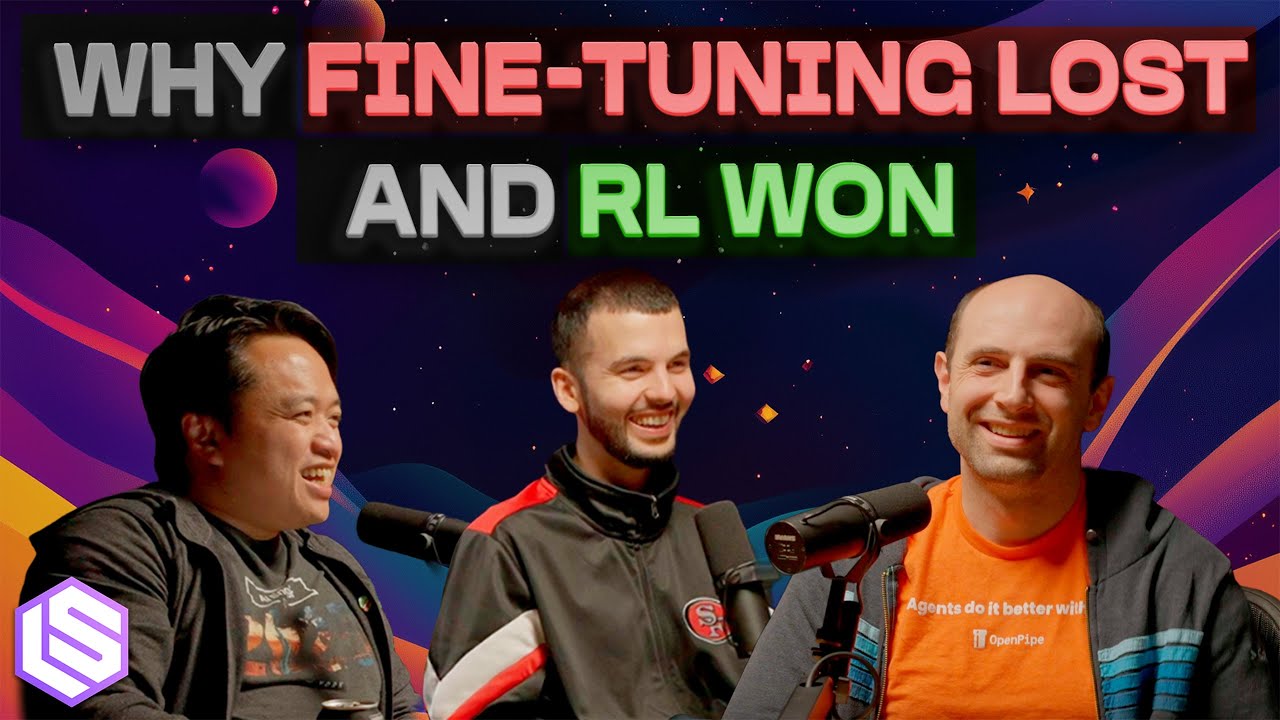
Why RL Won — Kyle Corbitt, OpenPipe (acq. CoreWeave)
Oct 16, 2025 · 1:08:23
Kyle Corbitt, co-founder and CEO of OpenPipe (acquired by CoreWeave), explains why reinforcement learning has replaced supervised fine-tuning for training reliable AI agents. He argues GRPO is a dead end due to its requirement for perfectly reproducible parallel rollouts, which is extremely hard in practice. Instead, OpenPipe’s RULER uses relative LLM-as-judge rewards, achieving state-of-the-art performance even with a weak judge. Corbitt reports that 90% of AI projects remain stuck in proof-of-concept due to reliability issues, and that LoRAs are underrated for production while GEPA failed in his tests. He predicts continuous RL from real-world experience can unlock 10x more inference demand.
Powered by PodHood