
Prime Intellect
CompanyA company discussed on Latent Space.
3 episodes

Anthropic, Glean & OpenRouter: How AI Moats Are Built with Deedy Das of Menlo Ventures
Nov 14, 2025 · 1:26:59
Deedy Das of Menlo Ventures returns to explain how Anthropic became the fastest-growing software company ever (zero to billions in revenue) and why Glean’s boring enterprise search moat of hard integrations and ranking problems is harder than competitors think. He reveals the $100M Anthology Fund’s strategy: backing OpenRouter, Goodfire, Prime Intellect, and Whisper—companies that solve thorny infrastructure or research problems rather than chasing apps. Das argues that model-layer companies will capture most value because building great models is harder than building apps, and that Anthropic’s product innovations like Claude Code emerge from a culture that lets researchers experiment freely. He also warns that vibe coding is becoming a cognitive crutch for engineers, eroding deep problem-solving skills, and discusses how enterprise AI market share has shifted dramatically: OpenAI went from 50% to 20%, while Anthropic rose from 12% to 32% of enterprise LLM API spend.
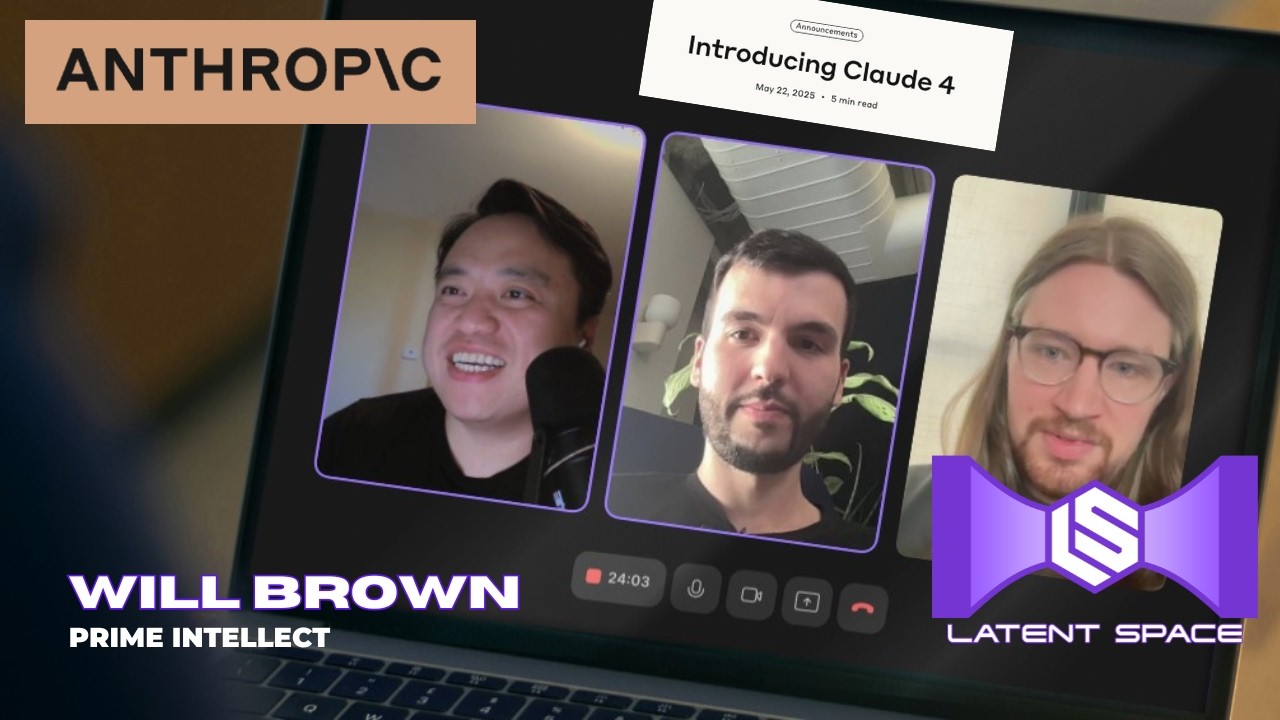
⚡️Multi-Turn RL for Multi-Hour Agents — with Will Brown, Prime Intellect
May 23, 2025 · 38:59
This episode features Will Brown of Prime Intellect discussing Claude 4's emphasis on agentic tool use over pure reasoning, the controversy around Claude's safety stress-testing results (including alleged dark web uranium searches), and his team's paper on multi-turn reinforcement learning for LLM agents. Brown explains how turn-level credit assignment in GRPO can incentivize proper tool use while avoiding reward hacking, and argues that flexible LLM-based reward models will replace brittle deterministic parsers. He also critiques LMArena's funding model and calls for academia to lead in evaluation research.

⚡️Open Questions in Agentic RL — Will Brown (Prime Intellect)
May 9, 2025 · 17:13
Will Brown of Prime Intellect maps the frontier of open-source agentic reinforcement learning, arguing that training models like o3 requires multi-turn tool use, intermediate reward verification, and efficient context management. He outlines challenges such as scaling tool calls to hundreds (e.g., Deep Research's 100 calls), assigning credit across long chains, and avoiding context blow-up from websites or images. Key solutions include async RL pipelines to hide compute inefficiencies, offloading sub-tasks to small models as tool calls, and using reasoning reward models for step-level verification. Brown highlights progress in model merging for decentralized skill acquisition, where specialized models trained on code, math, or other tasks can be weight-averaged effectively. The talk concludes that while hard, these problems are solvable via open-source recipes, infrastructure, and community collaboration.
Powered by PodHood