
Neon
CompanyA company discussed on Latent Space.
5 episodes

The Agent Cloud: Databricks’ Bet on the Future of AI — Matei Zaharia and Reynold Xin
Jun 24, 2026 · 1:10:06
Databricks cofounders Matei Zaharia and Reynold Xin argue the company is moving beyond the lakehouse into a full data-and-AI operating system, anchored by two new initiatives: Omnigent, an open-source meta-harness for combining coding and enterprise agents, and LTAP, a unified storage layer that gets most HTAP benefits without collapsing query engines. Omnigent provides a common API for agent sessions, files, streams, tool calls, and cancellation, solving portability, collaboration, and security issues across Claude Code, Codex, Cursor, and custom agents. LTAP writes transactional data directly in columnar Parquet format, eliminating brittle CDC pipelines—Reynold jokes CDC means 'continuous data corruption'—and enables instant analytics without overloading the source database. The episode details Databricks’ culture of rapid prototyping, where an engineer built the LTAP prototype without a formal design doc, and the thesis that traditional software will be rewritten once data is in the right place with agents on top. They also cover Mosaic’s shift from general frontier models to specialized fine-tuned models like document parsing, internal agent usage, and security features such…

AI Agents Need Computers: 74% MoM Growth, 850K/Day Runs, & New Agent Cloud — Ivan Burazin, Daytona
May 21, 2026 · 1:11:40
In this episode, Ivan Burazin, CEO of Daytona, explains why AI agents need composable computers rather than disposable code execution boxes, and how Daytona pivoted from human dev environments to building a bare-metal sandbox platform that spins up one sandbox in 60ms and 50,000 in 75 seconds. Daytona's biggest customer runs 850,000 sandboxes daily, and RL/eval workloads have surged from 0% to 50% of usage. The platform competes against managed Kubernetes (EKS/GKS) by offering stateful snapshots, dynamic resizing, and a scheduler purpose-built for agent workloads. Burazin also discusses the company's 74% month-over-month growth, the addition of Windows sandboxes, and the licensing challenges of macOS. He argues the future AI cloud will look more like Stripe than AWS, and that agents will need every kind of computer—including legacy Windows environments—to automate knowledge work.

Retrieval After RAG: Hybrid Search, Agents, and Database Design — Simon Eskildsen of Turbopuffer
Mar 12, 2026 · 1:00:32
Simon Eskildsen, founder of Turbopuffer, explains how his obsession with the cost of vector search at Readwise led him to build a search engine on object storage and NVMe SSDs, cutting costs by 95% for customers like Cursor. He outlines the three conditions for a major database company—a new workload (AI-driven search), a new architecture (object storage first, no consensus layer), and evolving to support every query plan. Turbopuffer's architecture uses S3's strong consistency and compare-and-swap for metadata, avoiding stateful systems. Eskildsen shares how they won Notion by absorbing latency issues with dark fiber, and discusses the shift from single RAG queries to agents making many concurrent searches. He also describes the "P99 engineer"—obsessive, trade-off minded, able to bend software to first principles. Future plans include expanding full-text search, reaching Common Crawl scale, and eventually adding simpler OLAP queries.
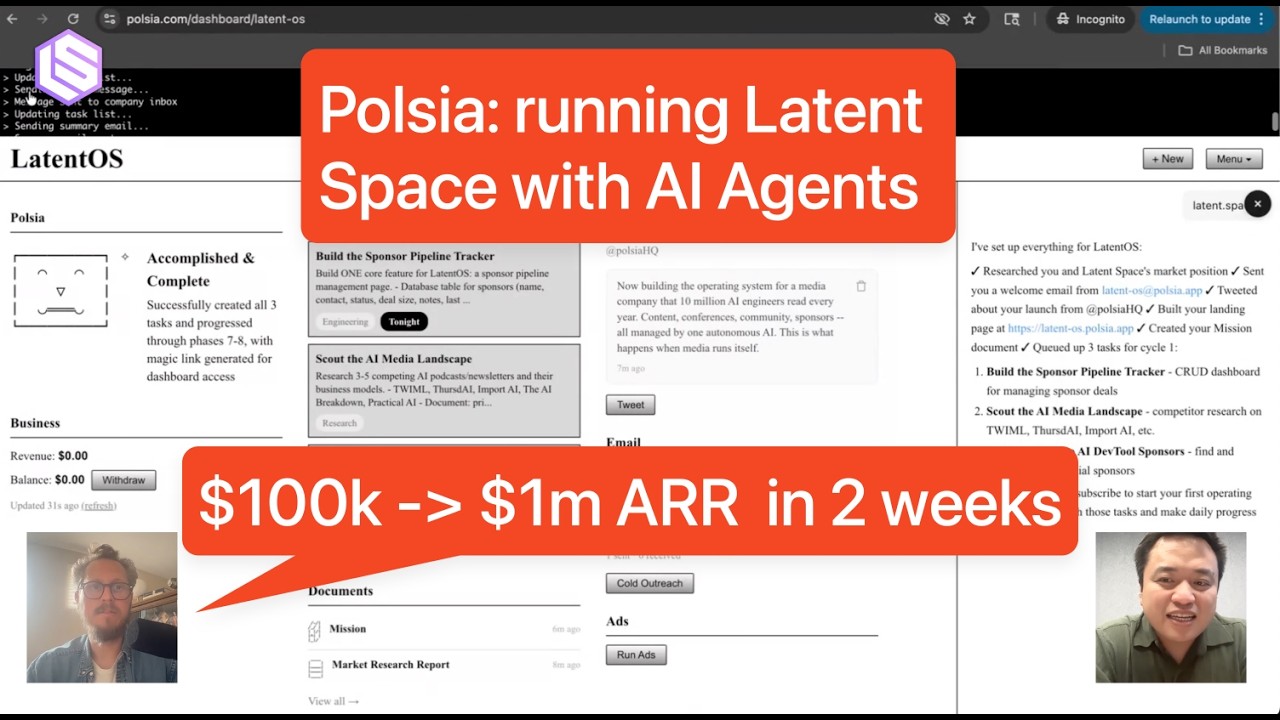
⚡️ Polsia: Solo Founder Tiny Team from 0 to 1m ARR in 1 month & the future of Self-Running Companies
Mar 1, 2026 · 41:56
Polsia, an AI that autonomously builds and runs companies, crossed $1M ARR in its first month, solo founder Ben Cera explains on Latent Space. The platform lets users give an idea and it handles product coding, marketing, cold outreach, Meta ads, and competitive research, sending daily emails summarizing progress. Cera built Polsia for himself starting in November, stripping features to keep onboarding simple—provisioning everything so users only need to reply to an email. He uses AI agents to run Polsia itself, from fixing bugs to responding to investor inbound, embodying the vision of a self-running company. The business model charges $50/month (near break-even on model costs) and takes 20% of any revenue the user's company generates. Cera emphasizes that the hardest part was deciding what not to build, and he sees Polsia as an Apple-like ecosystem for autonomous business operations.

npm install Agents — with Sunil Pai and Rita Kozlov (VP AI) of Cloudflare
Mar 19, 2025 · 35:36
Shawn Wang hosts Sunil Pai and Rita Kozlov to discuss Cloudflare's new Agents product, which uses Durable Objects to provide a scalable, stateful runtime for building AI agents. Sunil built an initial prototype in two weeks, which Rita helped polish into a full SDK and starter kit. They demo a chat agent with persistent state, human-in-the-loop confirmation, and built-in scheduling via cron, all running on Durable Objects without Kubernetes. The conversation covers local-first syncing (Durable Objects as always-on sync clients), the need for observability across millions of agents, and excitement about MCP for easy integrations. Rita teases upcoming "durable object enabled containers" to bridge long-running and CPU-heavy workloads, and a new browser rendering REST API launching the same day.
Powered by PodHood