
Mistral
CompanyA company discussed on Latent Space.
18 episodes
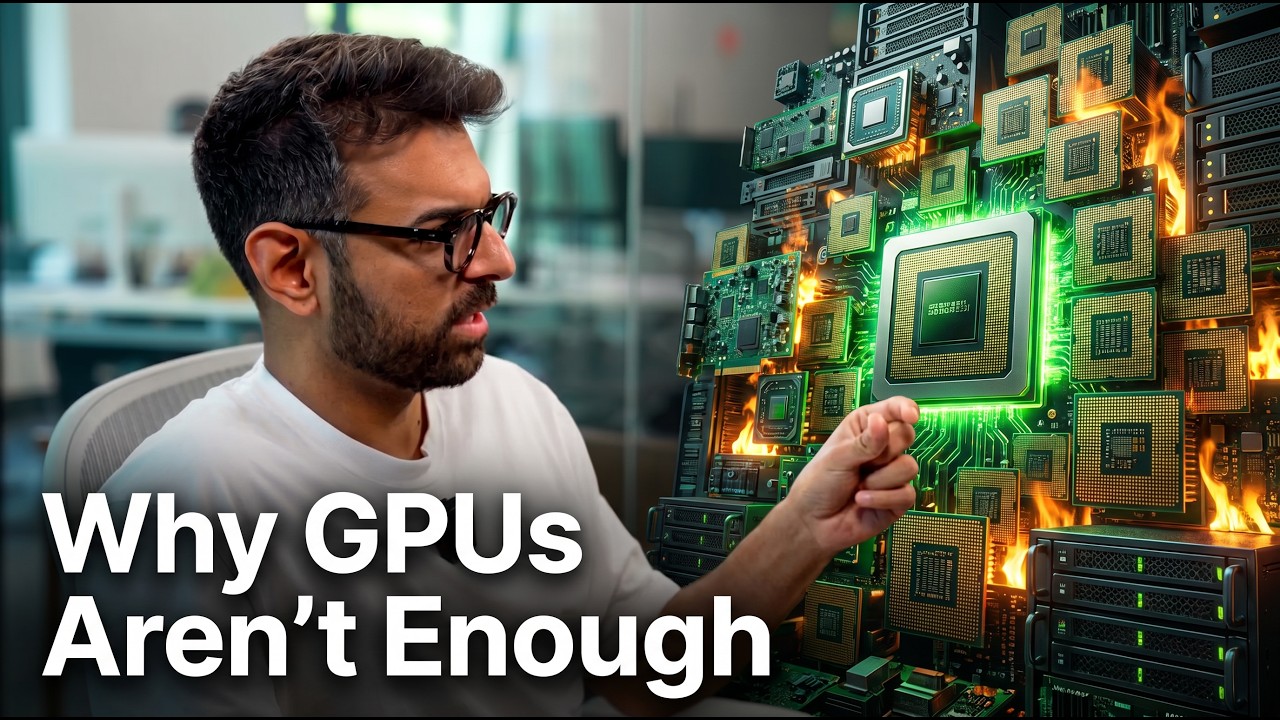
Why AI Labs With Unlimited GPUs Still Fail — Anjney Midha, AMP
Jun 18, 2026 · 1:00:37
Anjney Midha, CEO of AMP, argues that AI labs with unlimited GPUs still fail due to misaligned culture and infrastructure waste, proposing a compute grid modeled on independent system operators to pool demand and supply. At Google, 95% node utilization was considered an outage, yet most clusters today don't reach that, with waste compounding at scale. AMP’s grid, starting at scheduling, aims to make FLOPs flow like megawatts, having secured 1.3 gigawatts of demand. Midha explains Anthropic cracked coding because 'luck favors the prepared mind'—their four years of paranoia and scarcity created a culture that OpenAI’s abundance couldn't replicate. He also shares a 14-year mission in end-of-life prediction, arguing AI can reduce the 30% of Medicare/Medicaid spend on end-of-life care. He warns that too much capital too early makes labs fragile because without hardship they fail to define their P0.

Marc Andreessen introspects on Death of the Browser, Pi + OpenClaw, and Why "This Time Is Different"
Apr 3, 2026 · 1:16:20
Marc Andreessen argues that AI is finally different from past boom-bust cycles because of four compounding breakthroughs: LLMs, reasoning (o1, R1), coding agents (OpenClaw), and recursive self-improvement. He calls this the '80-year overnight success'—decades of neural network research now paying off. Comparing today's AI capex boom to the dot-com crash, he notes that buyers like Microsoft and Google are cash-rich incumbents and every GPU deployed is already generating revenue. He hails Pi and OpenClaw as a Unix-like architecture that makes agents model-independent and self-modifiable. On open source, he calls DeepSeek a 'gift to the world' for its paper and code, but warns that entrenched institutions—unions, licensing, government monopolies—will slow AI adoption far more than technologists expect.

Mistral: Voxtral TTS, Forge, Leanstral, & Mistral 4 — w/ Pavan Kumar Reddy & Guillaume Lample
Mar 30, 2026 · 54:02
Mistral releases Voxtral TTS, a 3B-parameter speech generation model using a novel autoregressive flow matching architecture and a 12.5 Hz neural audio codec developed in-house. Pavan Kumar Reddy and Guillaume Lample explain how the model achieves high quality and efficiency by predicting audio latents as a continuous distribution, enabling real-time voice agent applications. The episode details Mistral's stepwise multimodal strategy, starting with transcription and now speech generation, with full duplex voice agents as the next goal. Enterprise deployment via Mistral Forge allows fine-tuning on proprietary data, exemplified by training on rare languages or domain-specific jargon. Guillaume discusses merging capabilities (Mistral Small merging coding, reasoning, vision), commitment to open science through technical reports, and reasoning transfer from formal proofs in Lean. The episode also covers AI for science partnerships and hiring for research and forward-deployed engineering roles.
Measuring Exponential Trends Rising (in AI) — Joel Becker, METR
Feb 27, 2026 · 1:05:12
Joel Becker of METR explains the organization's model evaluation and threat research to assess whether AI could pose catastrophic risks, detailing their time horizon chart measuring task difficulty in human time at 50% reliability. He describes how tasks are selected for economic relevance and auto-gradability, and why time horizon is often misinterpreted as agent runtime. The episode covers Opus 4.5's surprising jump, challenges redoing developer productivity RCTs as workflows change, and why current models aren't yet catastrophically dangerous. Becker discusses potential capability explosions if R&D loops fully automate, links between compute growth slowdowns and slower capability progress, and his Manifold trading story driven by a charity market he could influence. He previews METR's 2026 plans for monitoring and risk assessment, and their hiring.

[State of AI Papers 2025] Fixing Research with Social Signals, OCR & Implementation — Team AlphaXiv
Dec 31, 2025 · 34:45
AlphaXiv founders Raj and Rayhahn describe building the go-to platform for navigating AI research by obsessing over UI and getting authors like the Laura team to comment directly on papers, then evolving from comments to feeds to benchmarks to AI assistants. They detail how they beat Hugging Face Papers by enabling direct paragraph-level commenting and early traction with high-signal authors, and how they use social signals (views, comments, Twitter) to filter the archive firehose. They discuss the broken academic review process—20% AI-generated reviews at ICLR, quality collapsing under exponential submission growth—and argue papers are becoming less important than implementations, Docker containers, and real-world usability. Their vision: making it trivial to spin up any trending paper's code directly in browser, focusing on the top 0.1% of implementable papers that applied researchers actually care about.

Building Jamba 3B: the tiny Hybrid Transformer State Space Reasoning Model - Barak Lenz, CTO of AI21
Oct 11, 2025 · 45:05
Barak Lenz, CTO of AI21, presents their Jamba 3B model as a tiny hybrid transformer-state space model that brings long context capabilities to edge devices, and argues enterprises need AI systems like Maestro over standalone models. Lenz explains that the 1:8 ratio of attention to Mamba layers emerged from extensive ablations, with attention placed in the middle of the block working best. The Jamba 3B model uses a 1:12 ratio to maximize efficiency, fitting the same context length as larger models with a fraction of memory. He notes that pure Mamba underperformed on some tasks but hybrid models resolved those deficiencies, and that images quickly become long context problems (4 images can be thousands of tokens). For enterprise, Lenz advocates for model-agnostic orchestration layers treating models as "actions" with statistical properties, enabling continuous learning and cost optimization without vendor lock-in. Drawing from his algo trading background, he compares training frontier models to developing trading algorithms, emphasizing the importance of world-class engineering and avoiding brute force reasoning.
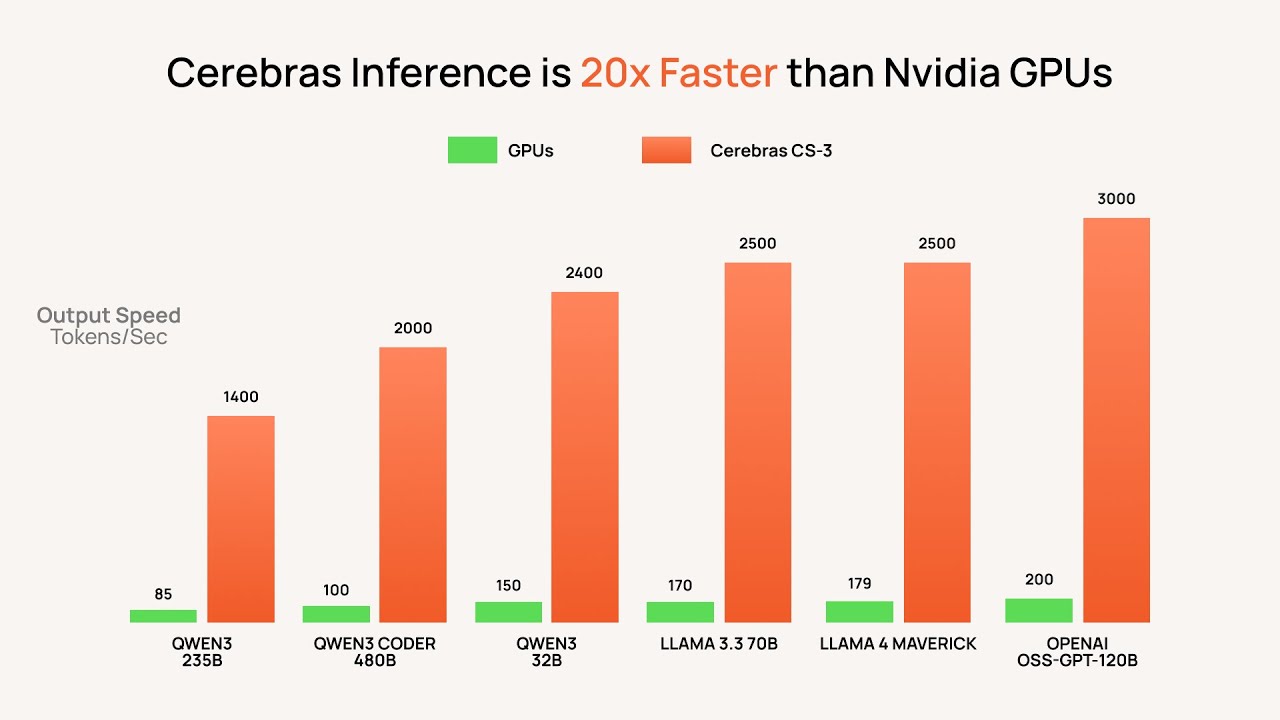
⚡️Raising $1.1b to build the fastest LLM Chips on Earth — Andrew Feldman, Cerebras
Oct 1, 2025 · 29:14
Andrew Feldman, CEO of Cerebras, joins Latent Space to discuss their $1.1B fundraise at an $8.1B valuation and their wafer-scale chip that delivers 20x faster inference than NVIDIA's B200 GPUs. He explains how their architecture uses SRAM instead of HBM, providing 2,625x more memory bandwidth by eliminating the narrow straw between compute and memory. Feldman details the decision to accelerate sparse linear algebra rather than specialized convolutions, enabling support for transformers and diffusion models unseen during design. He discusses the explosive growth in AI inference demand, the shift from closed-source to fast open-source models, and the importance of speed—citing Paul Graham's observation that ChatGPT's slowness drives users away. The conversation covers enterprise trends in the 10-30B parameter space, the complexity of building data centers that pull gigawatts of power, and the often-overlooked routing and caching systems that make AI work seamlessly.

Information Theory for Language Models: Jack Morris
Jul 2, 2025 · 1:18:13
Jack Morris, a Cornell PhD student advised by Sasha Rush, discusses his information-theoretic research on language models, including embedding inversion (recovering text from embeddings with 90% accuracy), the universal geometry of embeddings (aligning different models' latent spaces), and measuring model memorization capacity at 3.6 bits per parameter. He argues that paradigm shifts in AI, from AlexNet to instruction tuning, stem not from new architectures but from new datasets, and that the next breakthrough will likely emerge from a novel data source. The conversation also covers the shift from academia to industry, practical advice for grad students on distributed training, and the implications of embedding inversion for privacy and model alignment.

Best of 2024: Synthetic Data / Smol Models, Loubna Ben Allal, HuggingFace [LS Live! @ NeurIPS 2024]
Dec 24, 2024 · 28:08
Loubna Ben Allal of Hugging Face explains how synthetic data has become ubiquitous in LLM pipelines, moving from post-training to pre-training, with examples like Cosmopedia’s 30B-token synthetic dataset and NVIDIA’s 1.9T-token Nemotron CC. She addresses model collapse fears, showing that web dumps after ChatGPT’s release actually yield better models, and emphasizes diversity through prompt seeds and webpage extracts. For filtering, FineWeb-Edu and DCLM use LLMs to rate educational content, achieving top benchmark scores. In post-training, she highlights AgentInstruct, Tülu3 with PersonaHub, and Cohere’s multilingual arbitrage using multiple teachers. On small models, SmolM2 (1.7B) outperforms Llama 1B and Qwen 2.5 after 11T tokens of pre-training, and on-device inference via frameworks like llama.cpp enables privacy-preserving use cases such as text extraction and structured generation. She predicts a return to fine-tuning specialized small models over costly prompt engineering.

Best of 2024: Open Models [LS LIVE! at NeurIPS 2024]
Dec 23, 2024 · 37:29
Luca Soldani of AI2 and Sophia Yang of Mistral argue that open models in 2024 have exploded in number and performance, closing the gap with closed models, but face growing compute and data-access challenges. Soldani notes 2024 saw models like Qwen and Deepseek rivaling frontier closed-model performance, and fully open models like OLMo release full recipes including data, code, and intermediate checkpoints. He points out that pre-training requires 10K+ GPUs for state-of-the-art, while post-training can be done with as few as eight. Sophia highlights Mistral's release of over a dozen models in 2024, including Pixtral multimodal and Le Chat—a free chat interface with image understanding, canvas code execution, and web search. Soldani warns of data access diminishing due to content owners blocking crawlers and lobbying efforts labeling open source AI as dangerous, emphasizing the need to protect the open ecosystem.

The State of AI Startups in 2024 [LS Live @ NeurIPS]
Dec 21, 2024 · 26:35
Sarah Guo and Pranav Reddy argue that 2024 has become a far friendlier ecosystem for AI startups, with the model landscape shifting from OpenAI's near-monopoly to a competitive field where Google's Gemini now leads LMSys Arena and open-source models like Llama 8B score ten points higher on MMLU than Mistral 7B a year ago. They note that OpenAI's API cost has dropped 80-85% in 18 months, and total OpenAI API share fell from ~90% to ~60% as customers switch. The funding environment is rational, not a bubble, with foundation-model labs raising $30-40B but most startups seeing sane valuations; one portfolio company grew from zero to twenty million in PLG-style spending. Key startup themes include first-wave service automation (Sierra, Decagon, Harvey, EvenUp), better search and new friends (Perplexity, Glean, Character, Replica), and democratized creativity (Midjourney, HeyGen). They argue the 'GPT wrapper' narrative is false—applications capture value—and that incumbents face innovator's dilemma because AI changes business models (outcomes-based pricing) and data needs (reasoning traces rarely saved). The speed of change and new markets (legal, healthcare, defense) structurally favor…

[Paper Club] Upcycling Large Language Models into Mixture of Experts
Oct 29, 2024 · 39:02
NVIDIA's Ethan He presents Megatron-Core MoE and the upcycling of dense LLMs into Mixture-of-Experts models, showing that upcycling a 15B-param dense model into a 64-expert MoE and training on 1T tokens yields 5% lower validation loss and 4% higher MMLU than continued dense training on the same compute. Key techniques include swapping the router order (softmax-then-top-K instead of top-K-then-softmax) with a 4× output scaling to preserve initial forward pass behavior, and initializing fine-grained MoE routers by duplicating half the weights so each shard group selects identically. A high learning rate matching the original pre-training peak is critical; constant low LR causes catastrophic forgetting. The upcycled model matches the compute of a 1.7× larger dense model per scaling laws, but data quality remains paramount—continued dense training still delivered a 20% MMLU jump. Megatron-Core's fused permutation, GroupedGEMM, and expert parallelism are available as a standalone library.
The Winds of AI Winter (Q2 Four Wars of the AI Stack Recap)
Aug 2, 2024 · 1:23:36
Swyx and Alessio recap Q2 2024 through their 'Four Wars' framework, arguing that the AI landscape is shifting from frontier model dominance to commoditization and vertical applications. They highlight Claude 3.5 Sonnet overtaking OpenAI on coding benchmarks, Llama 3.1's synthetic data approach enabling 7B models to rival GPT-4, Mistral Large 2's non-commercial license and lost open-source crown, and on-device models like Gemini Nano and Apple Intelligence. The Quality Data Wars see NYT suing OpenAI, Reddit licensing data for $200M+, and synthetic data proving real for math (AlphaProof near IMO gold) and code. The Multimodality War includes ChatGPT Voice Mode delayed, Meta's Chameleon for native fusion, and Google's PaliGemma for PDF extraction. The renamed LLM OS War covers agent protocols, memory databases, and the collapse of model cost by an order of magnitude every four months, pushing startups toward vertical services like Brightwave and Dropzone that sell labor, not tools. The episode ends with a CrowdStrike joke about agent safety.

Training Llama 2, 3 & 4: The Path to Open Source AGI — with Thomas Scialom of Meta AI
Jul 23, 2024 · 1:04:34
Thomas Scialom, Llama 2 lead and Llama 3 post-training lead at Meta AI, explains why scaling laws must go beyond Chinchilla—training models longer on more tokens yields better inference efficiency than bigger models, a lesson that drove Llama 3's 15 trillion token pre-training. He details how synthetic data from Llama 2 bootstrapped Llama 3's post-training, eliminating human-written SFT data, and why RLHF outperforms imitation learning: humans are better discriminators than generators, enabling superhuman outputs. Scialom defends the dense 405B architecture over MoE, calls tokenizer vocab size underrated (128k tokens vs Llama 2's 32k), and reveals Llama 4's focus on agentic capabilities—tool use, multi-step reasoning—as the path to open-source AGI. Meta AI is hiring researchers with rigorous first-principles thinking.

The 10,000x Yolo Researcher Metagame — with Yi Tay of Reka
Jul 5, 2024 · 2:18:43
Yi Tay, chief scientist at Reka and former Google Brain architecture co-lead on PaLM 2, recounts his journey from an NTU PhD to co-founding Reka, where a team of just 5 people pre-trained Reka Core on $60M of GPU compute—debating at #7 on the LMsys leaderboard. He explains why he believes the Noam transformer (with SwiGLU, GQA, RoPE) remains the strongest baseline, how encoder-decoder architectures offer 'free sparsity' (a 2× flop-efficiency over decoder-only), and why Chinchilla scaling laws are often misunderstood (training past the optimal compute frontier is routine). He argues that long context will eventually outperform RAG for complex reasoning, and that open-source models like Llama 3 are catching up only because Meta invested in a top-tier training stack, not due to grassroots innovation. The episode also covers his productivity habits (working backwards from a paper title, camping arXiv) and the cultural shock of moving from Singapore academia to Google's impact-driven research environment.

How to train a Million Context LLM — with Mark Huang of Gradient.ai
May 31, 2024 · 1:12:14
Mark Huang of Gradient.ai explains how his team extended Llama 3 to a 1 million token context window using curriculum learning, RingAttention, and EasyContext, achieving near-perfect GPU utilization. They employed theta scaling from the RoPE paper to interpolate positional encodings, trained on carefully curated datasets including SlimPajamas and synthetic data from GPT-4, and validated with benchmarks like Ruler and needle-in-a-haystack. Huang details the trade-offs between full fine-tuning and LoRA adapters, the challenges of pushing to 4M tokens (degradation from floating-point precision limits), and why long context matters for state management across sessions and grounding multimodal inputs. He calls for community collaboration on long-context evaluations and pairwise multimodal datasets.
Open Source AI is AI we can Trust — with Soumith Chintala of Meta AI
Mar 6, 2024 · 1:37:38
Soumith Chintala, creator of PyTorch and engineering lead at Meta AI, argues that open source AI is essential for distributing opportunity and trust. He details PyTorch's complexity—1,000 operators needed for generality—and explains synthetic data as a vehicle for imparting symbolic knowledge where humans already have good symbolic models. He highlights a coordination problem in open source: feedback is lost because frontends like Ooba and Ollama lack feedback buttons, and proposes a centralized sinkhole to collect high-quality feedback. Beyond text, he is excited about robotics, where hardware remains a bottleneck, and Osmo's work to digitize smell, which he compares to images in the 1800s.

The Origin and Future of RLHF: the secret ingredient for ChatGPT - with Nathan Lambert
Jan 11, 2024 · 1:35:27
Dr. Nathan Lambert traces the origin and future of Reinforcement Learning from Human Feedback (RLHF), the secret ingredient behind ChatGPT, explaining how it evolved from robotics and early preference learning to become the core alignment technique for large language models. He details the three-phase process (instruction tuning, preference data collection, RL optimization), noting that RLHF's data costs for LLaMA2 were around $6–8 million, and that synthetic data from GPT-4 is cheaper and often more accurate than human labels. Lambert contrasts DPO with PPO, arguing DPO is simpler but may have lower peak performance. He discusses emerging methods like Constitutional AI, which uses AI-generated critiques based on principles, and highlights the challenge of evaluating RLHF models, noting GPT-4 Turbo's lead over earlier versions. The episode covers open questions about data aggregation, reward model agreement (65–75%), and the need for qualitative model interaction.
Powered by PodHood