
Manus
CompanyA company discussed on Latent Space.
2 episodes

[State of Context Engineering] Agentic RAG, Context Rot, MCP, Subagents — Nina Lopatina, Contextual
Dec 31, 2025 · 26:48
Nina Lopatina of Contextual AI discusses the state of context engineering, arguing that while the field is still in prototyping, 2025 will see true scale with full-system design patterns. She notes that agentic RAG—especially query reformulation into subqueries—has become the baseline, dramatically improving retrieval. Context rot is widely cited but industry benchmarks at real scale (100k+ documents, billions of tokens) remain rare. MCP is both a driver and a flaw: giant JSON tool definitions stuff the context window, yet MCP servers enable rapid prototyping before optimizing down to direct API calls. Sub-agents with turn limits are critical—unlimited agency degrades performance and causes hallucinations. Instruction-following re-rankers are essential for scaling retrieval across massive databases, providing more recall upfront and precision in the final context. Benchmarks are being saturated faster than ever: a Princeton benchmark from October was saturated by Claude Code in weeks, with solutions so good the gold dataset had errors. Lopatina also shares a lesson from using ChatGPT as a snowboarding coach—after several months of training for a 25-lap mogul race, she had to close…
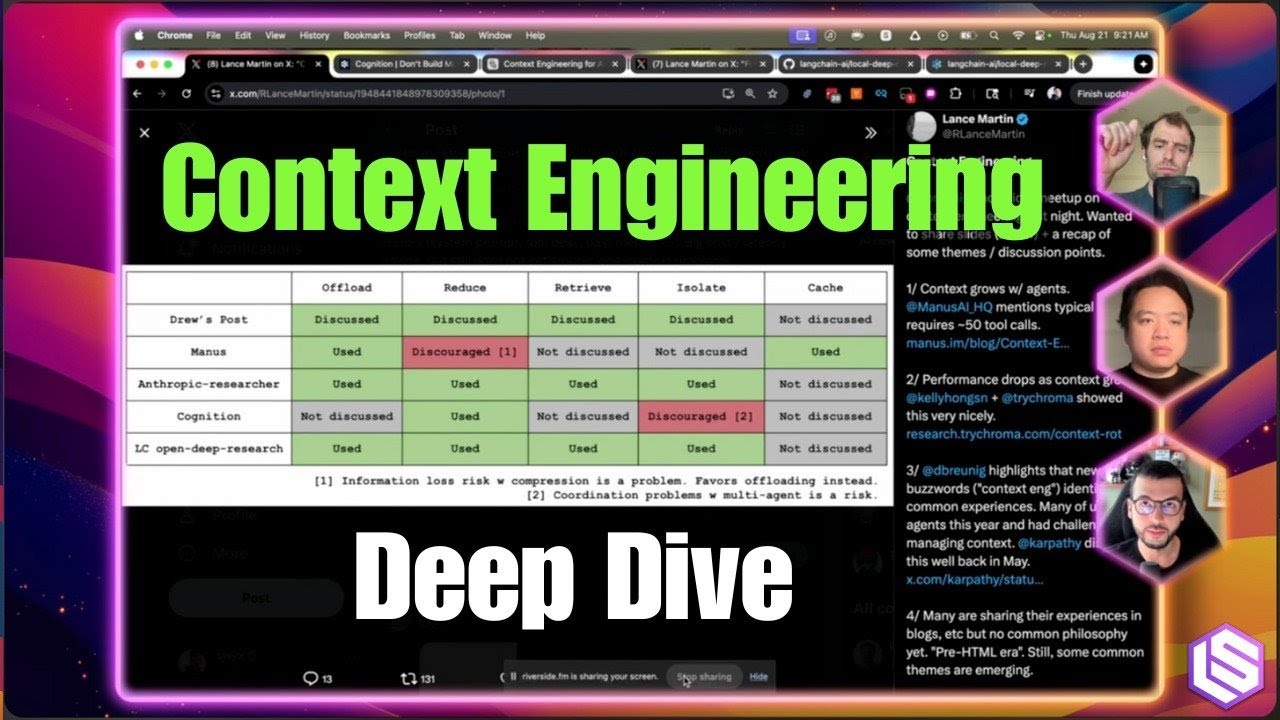
Context Engineering for Agents - Lance Martin, LangChain
Sep 11, 2025 · 1:03:18
Lance Martin from LangChain discusses context engineering for AI agents, arguing that managing context from tool calls is the key challenge and introducing five techniques: offloading, reducing, retrieval, caching, and context isolation. Offloading saves raw tool call outputs to disk and passes only summaries, drastically cutting token usage—Martin's deep research agent went from 500,000 tokens per run to much less. Manus uses file system offloading and warns that irreversible pruning risks information loss, while Cognition advocates fine-tuned summarization for agent-agent boundaries. For retrieval, Martin contrasts Windsurf's multi-step indexing with Claude Code's agentic search using grep and llms.txt, finding the latter more effective. He applies the Bitter Lesson to agent engineering: his own Open Deep Research evolved from a highly structured workflow to a simple agent loop as models improved, and he warns against rigid abstractions that hinder adaptation.
Powered by PodHood