
LangChain
CompanyA company discussed on Latent Space.
6 episodes

⚡️ OpenClaw's Memory Sucks and the fix is simple — Dhravya Shah, Supermemory
Mar 9, 2026 · 27:10
Supermemory founder Dhravya Shah argues that current memory approaches like OpenClaw's static markdown files fail because they lack freshness and agent-driven retrieval, proposing a hooks-based system that dynamically injects less than 2,000 tokens per turn. His company Supermemory uses a hybrid mode combining structured memory with RAG fallbacks, achieving costs as low as 2 cents per million tokens. Shah critiques benchmarks like LongMemEval and LoCoMo for not testing personalization or forgetfulness, and his team built the open platform MemoryBench for evaluation. Future plans include plugins for Cursor and partnerships with voice agent companies, aiming for prosumer interoperability across AI providers.
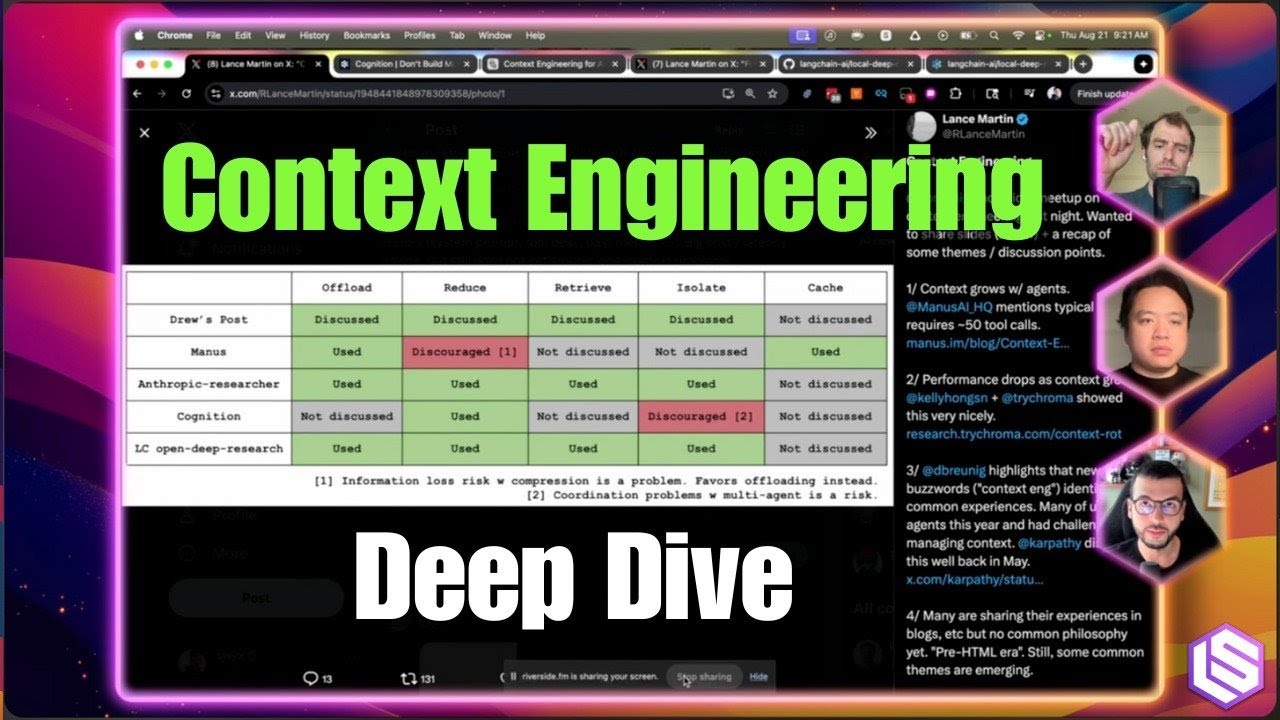
Context Engineering for Agents - Lance Martin, LangChain
Sep 11, 2025 · 1:03:18
Lance Martin from LangChain discusses context engineering for AI agents, arguing that managing context from tool calls is the key challenge and introducing five techniques: offloading, reducing, retrieval, caching, and context isolation. Offloading saves raw tool call outputs to disk and passes only summaries, drastically cutting token usage—Martin's deep research agent went from 500,000 tokens per run to much less. Manus uses file system offloading and warns that irreversible pruning risks information loss, while Cognition advocates fine-tuned summarization for agent-agent boundaries. For retrieval, Martin contrasts Windsurf's multi-step indexing with Claude Code's agentic search using grep and llms.txt, finding the latter more effective. He applies the Bitter Lesson to agent engineering: his own Open Deep Research evolved from a highly structured workflow to a simple agent loop as models improved, and he warns against rigid abstractions that hinder adaptation.

The AI Coding Factory
May 29, 2025 · 59:23
Factory.ai co-founders Eno Reyes and Matan Grinberg join Latent Space to explain their vision for autonomous software engineering droids that handle everything from code generation to incident response for enterprises. They met at a Langchain Hackathon in 2023, and within eight days both quit their jobs to start Factory. The platform is browser-based, not IDE-based, because they argue the optimal UI for a world where humans write less code will not evolve from the IDE. They focus on enterprise codebases, citing a large migration that took from four months to three and a half days. Key design decisions include a delegation model where agents ask clarifying questions, proactive context gathering via synthetic insights, and usage-based pricing tied to token efficiency. They also discuss why SWE-Bench is dead for their use case, the challenge of model post-training biases toward CLI tools, and their need for 'junior Enos' in go-to-market roles.
Sleep-Time Compute — Letta AI (Charles Packer, Charlie Snell, Kevin Lin)
Apr 21, 2025 · 34:02
This episode covers Letta AI's new paper on Sleep-Time Compute, a scaling direction that applies compute during model idle periods (sleep time) rather than only at test time. Charles Packer, Kevin Lin, and Charlie Snell explain that sleep-time compute precomputes inferences from static context before queries arrive, yielding Pareto improvements on math benchmarks like GSM8K by shifting the accuracy-to-token curve leftwards. They distinguish it from test-time compute by emphasizing that sleep-time tokens incur no user-latency cost, and show that the benefit is largest when questions are predictable from context. The team also ties the concept to stateful agents and memory systems (building on MemGPT), releasing two implementations: one for low-latency chatbots and another for document-driven agents.

npm install Agents — with Sunil Pai and Rita Kozlov (VP AI) of Cloudflare
Mar 19, 2025 · 35:36
Shawn Wang hosts Sunil Pai and Rita Kozlov to discuss Cloudflare's new Agents product, which uses Durable Objects to provide a scalable, stateful runtime for building AI agents. Sunil built an initial prototype in two weeks, which Rita helped polish into a full SDK and starter kit. They demo a chat agent with persistent state, human-in-the-loop confirmation, and built-in scheduling via cron, all running on Durable Objects without Kubernetes. The conversation covers local-first syncing (Durable Objects as always-on sync clients), the need for observability across millions of agents, and excitement about MCP for easy integrations. Rita teases upcoming "durable object enabled containers" to bridge long-running and CPU-heavy workloads, and a new browser rendering REST API launching the same day.

Personal AI Meetup - Bee, BasedHardware, LangChain LangFriend, Deepgram EmilyAI
Apr 6, 2024 · 58:54
This episode features Damien Murphy of Deepgram, Ethan of Owl/Bee, and Harrison of LangChain demonstrating how to build personal AI with real-time voice bots, wearable life-recording devices, and memory-enhanced journaling apps. Damien shows building a voice bot with subsecond latency using Deepgram, OpenAI, and open source code, costing about 6.5 cents per five-minute call. Ethan presents his Owl wearable that continuously records audio, triggers actions via hot word 'Scarlett,' and discusses challenges in adding vision and open source adoption. Harrison introduces LangFriend, a journaling app using conversational, semantic, and knowledge graph memory, referencing the Generative Agents paper for recency and importance weighting. The episode also highlights open source projects Whomane, Friend, and ADeus, arguing that hardware, voice, and memory are all necessary components for personal AI.
Powered by PodHood