
GitHub
CompanyA company discussed on Latent Space.
9 episodes
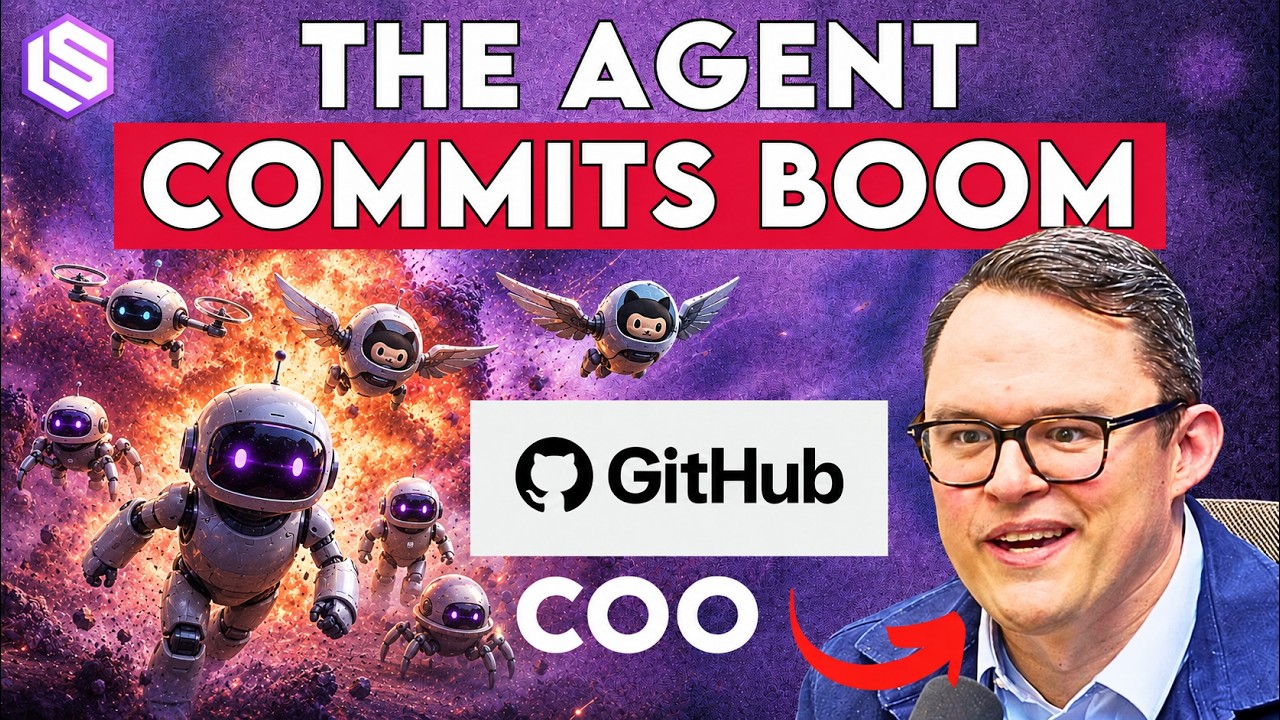
GitHub’s Agent Era: 14x Commits, 200M Developers, Copilot’s Next Act — Kyle Daigle
Jun 2, 2026 · 1:24:44
GitHub COO Kyle Daigle joins Swyx to unpack how the agent era is transforming GitHub's infrastructure and developer workflows, from 14x commit growth to internal AI micro-skills. Daigle describes using WorkIQ, MCP, and Slack/Teams context to retroactively analyze weeks' work and build executive presentations entirely with AI, undetected. He advocates atomic micro-skills over mega-skills and reveals GitHub now hosts 200M developers generating 275M weekly commits, on pace for 14B this year. Scaling issues stem from MySQL1 permissions and monorepo shifts, forcing rewrites of 10-year-old services. Copilot has evolved from code completion to a unified agent SDK powering CLI, desktop, and cloud agents. Microsoft's deep investment in OpenClaw reflects a need for OS-level sandboxing for enterprise agent deployment.

Senior Dev: This "Grill Me" Prompt Is Going Viral Among Top Engineers
May 7, 2026 · 22:03
Matt Pocock — the TypeScript educator turned AI engineering teacher who created the viral "Grill Me" prompt and runs AI Hero — argues that classic software engineering fundamentals are more critical than ever in the AI coding era. He explains how Domain-Driven Design's ubiquitous language and deep module patterns let developers contain complexity and delegate implementation to AI. His free "Grill Me" skill (part of his 13,000-star skills repo) forces AI to relentlessly interview humans until reaching shared understanding. He contrasts Claude Code's ease-of-use against Pie's transparent primitives, predicting a shift toward developer observability. The episode also covers his two-month course creation process, why TypeScript is overtaking Python in AI engineering, and why traditional lectures still dominate learning.
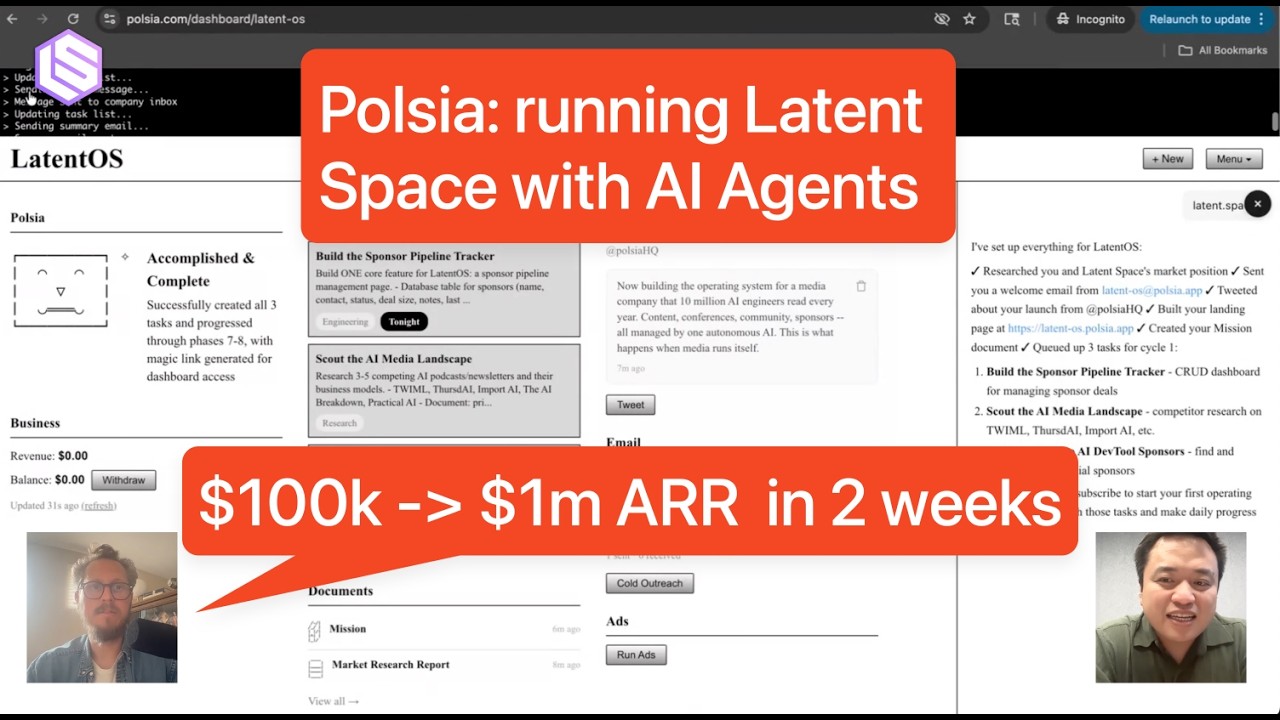
⚡️ Polsia: Solo Founder Tiny Team from 0 to 1m ARR in 1 month & the future of Self-Running Companies
Mar 1, 2026 · 41:56
Polsia, an AI that autonomously builds and runs companies, crossed $1M ARR in its first month, solo founder Ben Cera explains on Latent Space. The platform lets users give an idea and it handles product coding, marketing, cold outreach, Meta ads, and competitive research, sending daily emails summarizing progress. Cera built Polsia for himself starting in November, stripping features to keep onboarding simple—provisioning everything so users only need to reply to an email. He uses AI agents to run Polsia itself, from fixing bugs to responding to investor inbound, embodying the vision of a self-running company. The business model charges $50/month (near break-even on model costs) and takes 20% of any revenue the user's company generates. Cera emphasizes that the hardest part was deciding what not to build, and he sees Polsia as an Apple-like ecosystem for autonomous business operations.

Dylan Patel Explains the AI War While Cooking | In-Context Cooking
Feb 26, 2026 · 55:13
Dylan Patel, CEO of SemiAnalysis, argues hyperscalers like Google, Amazon, and Meta will sacrifice all profits to build AI infrastructure, spending $180–$200 billion in capex this year alone, because the AI adoption explosion—Claude Code driving 4% of GitHub commits in one month, Anthropic adding $2.5 billion monthly revenue—makes it a Pascal's wager: spend or die. He details how Taiwan's semiconductor geopolitics create endgame scenarios, from a KMT win placating China to full invasion, with TSMC's output critical. Patel explains Nvidia's paranoid founder Jensen Huang is responding to vertical integration threats from hyperscalers by diversifying into chips like CPX and Groq, but warns moats are shallow. The real bottleneck in AI progress? Semiconductors themselves: fabs take years to build, and no one can buy enough GPUs through 2028. He also predicts a massive AI backlash from the public and financial markets, as capital consumption outpaces revenue and labor displacement accelerates.

⚡️ Building the AI Hardware Engineer with Matthias Wagner, Co-founder of Flux
Nov 22, 2025 · 49:03
Matthias Wagner, CEO of Flux.ai, describes building the "AI hardware engineer" that turns product briefs into manufacturable PCB designs in under 30 minutes. After leaving Meta in 2019, Wagner built a browser-based collaborative CAD tool from scratch, designed as a reinforcement learning environment. The emergence of LLMs and reliable tool calling let Flux's agents search component libraries, check pricing and availability, and execute complex designs autonomously. In a live demo, Wagner designs a battery-powered Alexa-like device with ESP32, microphones, OLED display, and speaker in about 25 minutes. Flux now has 7,000 paying customers, growing 26x year over year, and Wagner envisions eventually letting users prompt full hardware products like smartphones into existence, claiming the cost of custom manufacturing is plummeting.

⚡ Inside GitHub’s AI Revolution: Jared Palmer Reveals Agent HQ & The Future of Coding Agents
Nov 10, 2025 · 35:52
Jared Palmer, SVP at GitHub and VP at CoreAI at Microsoft, traces his journey from building v0 at Vercel—a focused Next.js coding agent that grew from $1M ARR to millions more after adding chat—to launching Agent HQ at GitHub Universe, a collaboration hub for developers and coding agents. He explains how v0's success came from laser-focus on one stack and framework, and how GitHub's 180M developers enable scaling agent-based workflows. Palmer discusses model strategy tradeoffs (composite vs. branded models), the challenge of repo setup and infrastructure reliability, and using coding agents for non-coding tasks like automating Excel workflows. He reveals Stacked Diffs as GitHub's top feature request, with active exploration after previous attempts, and outlines his vision for seamless AI integration across GitHub, VS Code, and Actions, including features like resolving merge conflicts with AI.

⚡ Inside Google Labs: Building The Gemini Coding Agent — Jed Borovik, Jules + AIE CODE Preview
Nov 10, 2025 · 43:53
Jed Borovik, Product Lead at Google Labs, explains how Google builds Jules, an autonomous coding agent that runs on its own VM for long-running tasks, challenging the assumption that agents should operate locally. He reveals that as Gemini models improved, Jules' scaffolding simplified, shifting from sub-agent patterns and embedding-based RAG to attention-based search. Borovik discusses context window management for sessions lasting up to 30 days with 2 million tokens, and argues that coding agents will increase demand for software engineers (Jevons paradox), not eliminate jobs. He calls for better specification tools beyond chat, such as multimodal input and interactive planning, to move beyond 'vibe coding' toward verifiable, reliable agentic workflows.
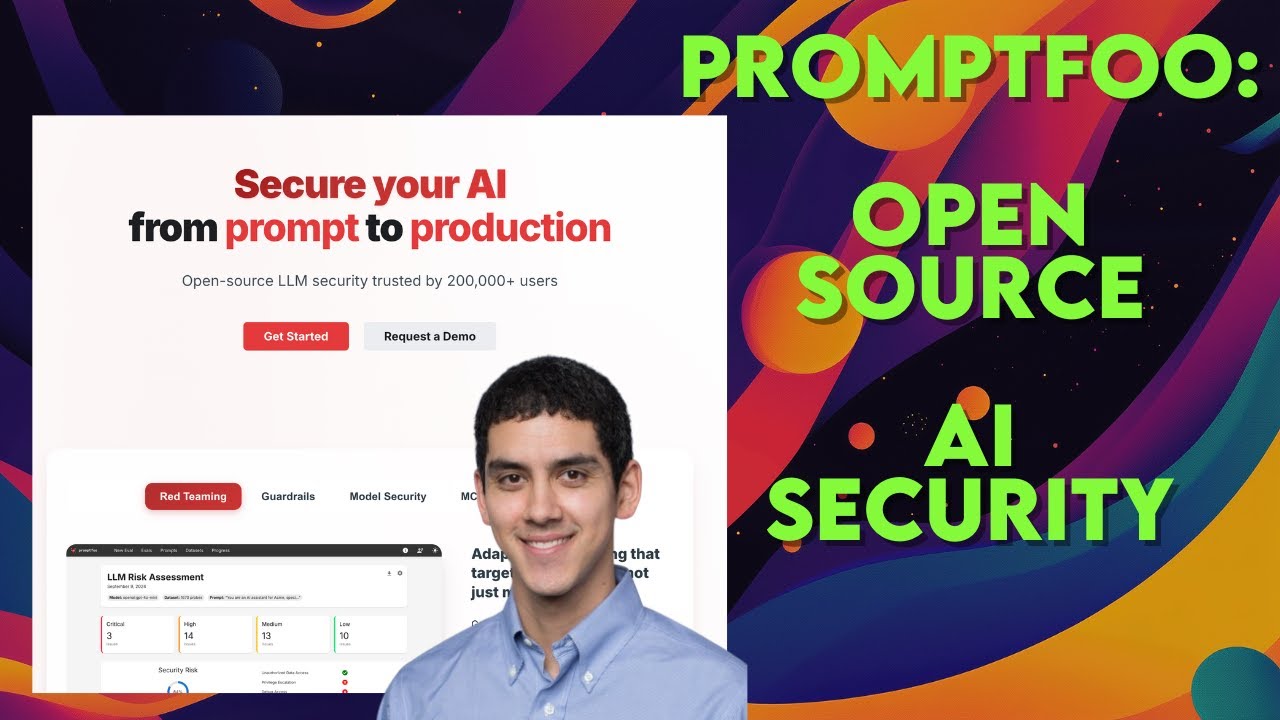
Breaking AI to Fix It: Ian Webster's Journey from Discord's Clyde to Promptfoo's $18M Series A
Oct 24, 2025 · 43:17
Ian Webster, founder of Promptfoo (recently $18M Series A from Thrive Capital and NEA), explains how his journey from building Discord's AI chatbot Clyde to creating the leading AI security testing platform revealed that while evals are table stakes, the real value lies in pre-deployment red teaming that finds application-specific risks. Webster argues that traditional guardrails are insufficient—'you can't fix stupid'—and that Promptfoo uses AI-versus-AI techniques to generate tailored attacks for each app's business context. Over 10% of Fortune 500 companies now use Promptfoo, and he discusses the evolving challenges of MCP security (mostly 'glorified API wrappers') and the need for IDE plugins and code-aware discovery to keep up with increasingly complex agents running 30-minute tasks. The episode also covers why security sales in AI is uniquely hard, how open source builds trust in a space full of 'snake oil,' and why the future of AI security must shift from runtime protection to earlier testing in CI/CD.

DeepWiki: The GitHub Encyclopedia
May 21, 2025 · 32:05
Silas Alberti from Cognition (Devin) introduces DeepWiki, a free no-login product that indexes over 30,000 open-source repos and generates AI-powered wikis and deep research answers. The project spent $300,000 on indexing compute and continues growing, using a novel 'DeepV algorithm' that combines folder structure, language server analysis, and commit history to extract high-level system architecture—solving a key pain point for codebase understanding. Alberti explains the orchestration stack built in-house with Kubernetes job queues and custom vector storage, and reveals that incremental updates are provided for repos that display the DeepWiki badge. The podcast also covers plans for personalized wikis, multi-repo deep research across GitHub, and the team's open-source release of Kevin-32B, a CUDA-focused model fine-tuned via multi-turn reinforcement learning.
Powered by PodHood