
Fireworks
CompanyA company discussed on Latent Space.
10 episodes
AI-Native Engineering: 100% adoption, 5x search throughput, unlimited tokens — Mikhail Parakhin
Apr 22, 2026 · 1:14:30
Shopify CTO Mikhail Parakhin details how the company achieved near 100% AI tool adoption, driven by a December 2025 inflection point where model quality triggered exponential token consumption. He argues token budgets matter only with strong critique loops: running multiple parallel agents without communication wastes tokens, while agentic PR review using large models—like GPT-5.4 Pro or Gemini Deep Think—reduces bugs even though latency increases. Parakhin unveils Tangle, Shopify's third-generation ML workflow system with content-based caching that eliminates duplicate computation across teams, and Tangent, an auto-research loop that optimizes pipelines—boosting search throughput from 800 to 4,200 QPS on the same hardware. SimGym simulates shoppers using decades of merchant data and browser-based agents to predict conversion changes, achieving 0.7 correlation with add-to-cart events. Shopify uses Liquid AI (non-transformer architecture) for sub-30ms query understanding and long-context tasks like catalog categorization, distilling larger models into Liquid for high-throughput batch jobs.
Notion’s Sarah Sachs & Simon Last on Custom Agents, Evals, and the Future of Work
Apr 15, 2026 · 1:25:37
Sarah Sachs and Simon Last of Notion explain how Custom Agents were rebuilt four to five times since 2022, with early attempts failing due to lack of tool-calling standards and short context windows. They shifted from few-shot prompting to tool definitions and progressive disclosure, now supporting over 100 tools. Their eval system includes frontier evals that pass only 30% to gauge model progress, and they employ Model Behavior Engineers to write evals and triage failures. The episode covers their views on MCP versus CLI, meeting notes as data capture, and the software factory concept of agents collaborating to develop codebases. They also discuss Notion's culture of low-ego, high-velocity rebuilding and the philosophy that every surface must work for both humans and agents.
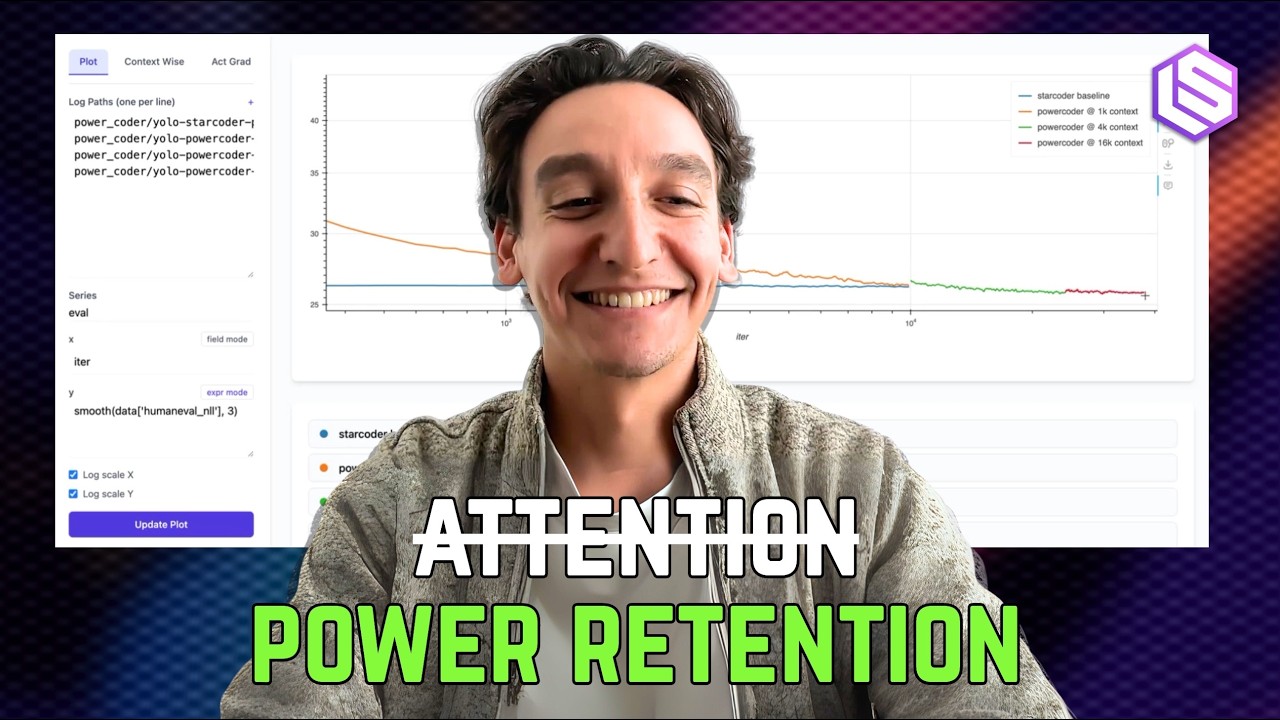
⚡️ Beyond Transformers with Power Retention
Sep 23, 2025 · 32:59
Jacob Buckman, CEO of Manifest AI, discusses their solution to AI's expensive computational bottleneck: the ever-growing KV cache for long context inference. Power Retention replaces attention in transformers with a fixed-size memory, achieving 10X training speedup at 64K tokens and 100X inference speedup over FlashAttention. Manifest releases Vidrial, a just-in-time CUDA kernel framework that finds optimal configurations, and Metamorphosis, a process to convert existing transformers like StarCoder-3B into Power Retention models in just two hours of mid-training. Buckman demonstrates PowerCoder, a 3B code model that matches baseline loss after 10K steps and handles contexts up to 32K and beyond. The open-source release includes kernels and tools, aiming to build community trust and encourage adoption by inference providers. He also highlights the need for genuinely long-context datasets beyond internet text, such as human trajectories.

The AI Agenda: GPT5 leaks and the business of AI News — Steph Palazzolo, The Information
Aug 6, 2025 · 1:14:36
Steph Palazzolo, AI journalist at The Information, explains how she covers the secretive AI industry, from OpenAI's GPT-5 to the inference market where startups like Modal raise billions. She reveals that inference providers are essentially GPU resellers facing margin pressure, and that GPT-5's performance will signal whether pre-training scaling or reinforcement learning drives progress. She critiques Meta's super intelligence ambition as misaligned with its ad-revenue business, and details the talent war with rumored hundred-million-dollar offers from Meta to poach researchers. Palazzolo also discusses the Windsurf acqui-hire backlash, the rise of coding agents like Claude Code, and how journalists protect sources while navigating leaks from CEOs like Sam Altman.

DeepSeek V3, SGLang, and the state of Open Model Inference in 2025 (Quantization, MoEs, Pricing)
Jan 19, 2025 · 57:18
Amir Haghighat and Yineng Zhang from Baseten explain how they serve DeepSeek V3, a 671-billion-parameter MoE model requiring H200 clusters with FP8 support, making it the top open-weights model. They detail Baseten’s dedicated inference model (no shared endpoints) and its reliance on SGLang for performance gains like Radix prefix caching and MLA attention support. Yineng highlights SGLang’s edge over vLLM and TensorRT-LLM in usability and customization, especially for large models. Amir outlines three pillars for mission-critical inference: model-level performance (via frameworks like SGLang), horizontal scaling across regions and clouds, and low-latency multi-model workflows. The episode also covers quantization trends, MoE architecture, and speculative decoding as key enablers for open model deployment.

The new Claude 3.5 Sonnet, Computer Use, and Building SOTA Agents — with Erik Schluntz, Anthropic
Nov 28, 2024 · 1:11:08
Anthropic's Erik Schluntz explains how Claude 3.5 Sonnet achieved state-of-the-art 49% on SWE-Bench Verified by using a minimal agent framework that gives the model full control via tools like bash and file editing, letting it self-correct without hard-coded workflows. He details the importance of tool design over prompt engineering, why XML tags work well, and how computer use reduces integration friction by letting models interact with any browser-based interface. Schluntz also shares his robotics experience, noting that while LLMs and diffusion models are promising for general-purpose robots, reliability at 99.9% and hardware variability remain major hurdles, and he expresses skepticism about self-driving as a business due to high vehicle costs versus driver-equivalent revenue.
Why Compound AI + Open Source will beat Closed AI — with Lin Qiao, CEO of Fireworks AI
Nov 25, 2024 · 55:49
Lin Qiao, CEO of Fireworks AI, argues that compound AI systems combining multiple open-source models will outperform closed monolithic models like OpenAI's. She explains Fireworks' evolution from a PyTorch platform to a full-stack inference and customization engine serving 40+ customers including Cursor. Qiao details their distributed inference engine, Fire Optimizer for quality-latency-cost tradeoffs, and upcoming o1-like model built on open-source foundations. She defends their quantization approach after public criticism from rivals, emphasizes specialization over general intelligence, and invites developers to test their free LoRA adapter hosting.
[LLM Paper Club] Llama 3.1 Paper: The Llama Family of Models
Jul 29, 2024 · 1:23:46
This episode examines Meta's Llama 3.1 paper, detailing the 405B dense model, its scaling laws grounded on the ARC reasoning benchmark rather than perplexity, and the decision to train on 15 trillion tokens. Vibhu explains the training infrastructure: 16,000 H100s over 54 days with 419 interruptions, 78% from GPU hardware failures. Eugene Yan walks through the synthetic data pipeline—using Llama 2 for filtering, stepwise reward models, and Monte Carlo tree search to improve reasoning traces. Hassan shares building LlamaTutor.com with Together API, serving 4,000 visitors and 5,900 requests for about $12. The group also discusses quantization trade-offs (larger models degrade less), inference provider variability (Groq's non-deterministic temperature zero), and compares Llama 405B's performance to GPT-4o and Claude.
Open Source AI is AI we can Trust — with Soumith Chintala of Meta AI
Mar 6, 2024 · 1:37:38
Soumith Chintala, creator of PyTorch and engineering lead at Meta AI, argues that open source AI is essential for distributing opportunity and trust. He details PyTorch's complexity—1,000 operators needed for generality—and explains synthetic data as a vehicle for imparting symbolic knowledge where humans already have good symbolic models. He highlights a coordination problem in open source: feedback is lost because frontends like Ooba and Ollama lack feedback buttons, and proposes a centralized sinkhole to collect high-quality feedback. Beyond text, he is excited about robotics, where hardware remains a bottleneck, and Osmo's work to digitize smell, which he compares to images in the 1800s.

The "Normsky" architecture for AI coding agents — with Beyang Liu + Steve Yegge of SourceGraph
Dec 17, 2023 · 1:33:26
Beyang Liu and Steve Yegge of Sourcegraph explain how their AI coding assistant Cody achieves a 30% completion acceptance rate by prioritizing high-quality context over agents. They introduce the 'Normsky' architecture—a blend of Norvig's data-driven models and Chomsky's formal systems—arguing that non-agentic, deterministic context retrieval (using parsers, trigram indexes, and the BFG code graph) outperforms multi-hop LLM-based approaches for code completion and chat. The duo details their data pre-processing moat, the 'bin packing' challenge of stuffing relevant code into context windows, and why they use open-source StarCoder for completions while leveraging Claude/GPT-4 for chat. They also discuss the death of DSLs, the limitations of LSP and LSIF, and how Cody's web version lets users query any public repo instantly.
Powered by PodHood