
Figma
CompanyA company discussed on Latent Space.
5 episodes
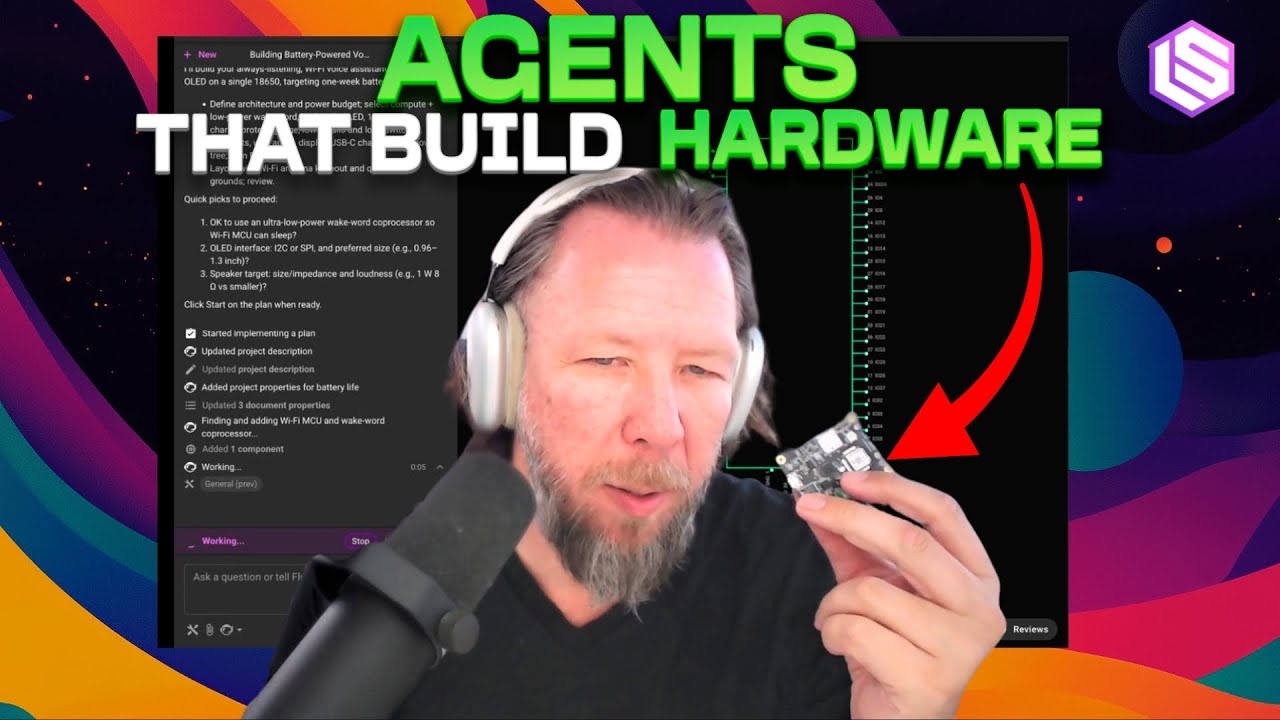
⚡️ Building the AI Hardware Engineer with Matthias Wagner, Co-founder of Flux
Nov 22, 2025 · 49:03
Matthias Wagner, CEO of Flux.ai, describes building the "AI hardware engineer" that turns product briefs into manufacturable PCB designs in under 30 minutes. After leaving Meta in 2019, Wagner built a browser-based collaborative CAD tool from scratch, designed as a reinforcement learning environment. The emergence of LLMs and reliable tool calling let Flux's agents search component libraries, check pricing and availability, and execute complex designs autonomously. In a live demo, Wagner designs a battery-powered Alexa-like device with ESP32, microphones, OLED display, and speaker in about 25 minutes. Flux now has 7,000 paying customers, growing 26x year over year, and Wagner envisions eventually letting users prompt full hardware products like smartphones into existence, claiming the cost of custom manufacturing is plummeting.

Taste is your Moat (Dylan Field of Figma)
Oct 2, 2025 · 1:01:43
Dylan Field, CEO of Figma, argues that as AI accelerates software creation, design becomes the key differentiator—and Figma Make, a prompt-to-app tool, is Figma's bet on lowering the barrier for everyone. Field recounts his first AI-pill moment with Chris Olah in 2014 and later GPT-3 convincing him of exponential progress. He explains Figma's strategy: treat natural language as today's interface (calling it the 'MS-DOS era of AI'), use Figma as a 'context repository for aesthetics' to ground AI outputs in a user's taste, and solve the blank-canvas problem by letting AI generate initial designs. Field pushes back on 'fast fashion' software, arguing complex products like Workday can't be vibe-coded. He shares Thiel Fellowship lessons (start with 'what could this be' before finding flaws), recruiting advice from John Doerr (obsess over the funnel), and caution about get-rich-quick AI hype, drawing parallels to the NFT cycle he exited.

⚡️Claude Sonnet 4.5 and Anthropic's roadmap for Agents and Developers — Mike Krieger, Anthropic
Sep 30, 2025 · 26:25
Mike Krieger, Anthropic's CPO, discusses the launch of Claude Sonnet 4.5 and its implications for AI development, emphasizing the growing symbiosis between product and research teams. He describes his personal 'vibe evals' for new models, including generating a Virtual Boy-style game and a Nintendo board presentation, and notes that Sonnet 4.5 traffic eclipsed Sonnet 4 on day one. Krieger explains how Anthropic is improving model output quality across UIs, Excel, and PowerPoint, and highlights the shift toward interactive planning rather than pure autonomy. He reveals the rename of the Claude Code SDK to the Claude Agent SDK, reflecting its general-purpose use for complex agentic workflows beyond coding. Krieger stresses the need for better visual understanding in models and invites developers to share feedback on hard challenges to help improve the platform.
Production AI Engineering starts with Evals
Oct 11, 2024 · 1:56:16
Ankur Goyal, founder and CEO of Braintrust, argues that evaluation is the core workflow of production AI engineering and shows how his platform makes evals accessible to software engineers. Drawing from his experience at SingleStore and Impira, he details Braintrust's evolution from an eval tool into an end-to-end AI development platform used by Stripe, Zapier, Vercel, and other top AI teams. He shares market data: OpenAI handles over 95% of production workloads, fine-tuning is declining, and open-source models account for under 5% due to reliability issues. Ankur explains why he avoided building a vector database—the real challenge is permissions and joins, not vector search—and predicts o1-style reasoning will replace complex agent frameworks. He reveals Braintrust's differentiators: hybrid on-prem, TypeScript-first SDK, and declarative eval structures.

The Accidental AI Canvas - with Steve Ruiz of tldraw
Jan 5, 2024 · 1:27:49
Steve Ruiz, founder of tldraw, recounts how his open-source whiteboard accidentally became a premier multimodal AI canvas, enabling visual prompting with GPT-4V. Originally built as a personal project with obsessive attention to arrows and ink, tldraw gained traction as a developer SDK for infinite canvas apps. The 'Make It Real' feature, which turns wireframes into working HTML using GPT-4V, exploded with 22 million Twitter views, showcasing iterative design through spatial branching and annotation. Ruiz explains how the canvas supports multiple input layers—UI sketches, state charts, screenshots, even API endpoints—and how his fine arts background guided his taste-driven approach. He argues tldraw's moat lies in its web-native, hackable canvas infrastructure, not ephemeral AI integrations, and positions it as the battlefield for comparing multimodal models like OpenAI's and Gemini.
Powered by PodHood