
Databricks
CompanyA company discussed on Latent Space.
9 episodes
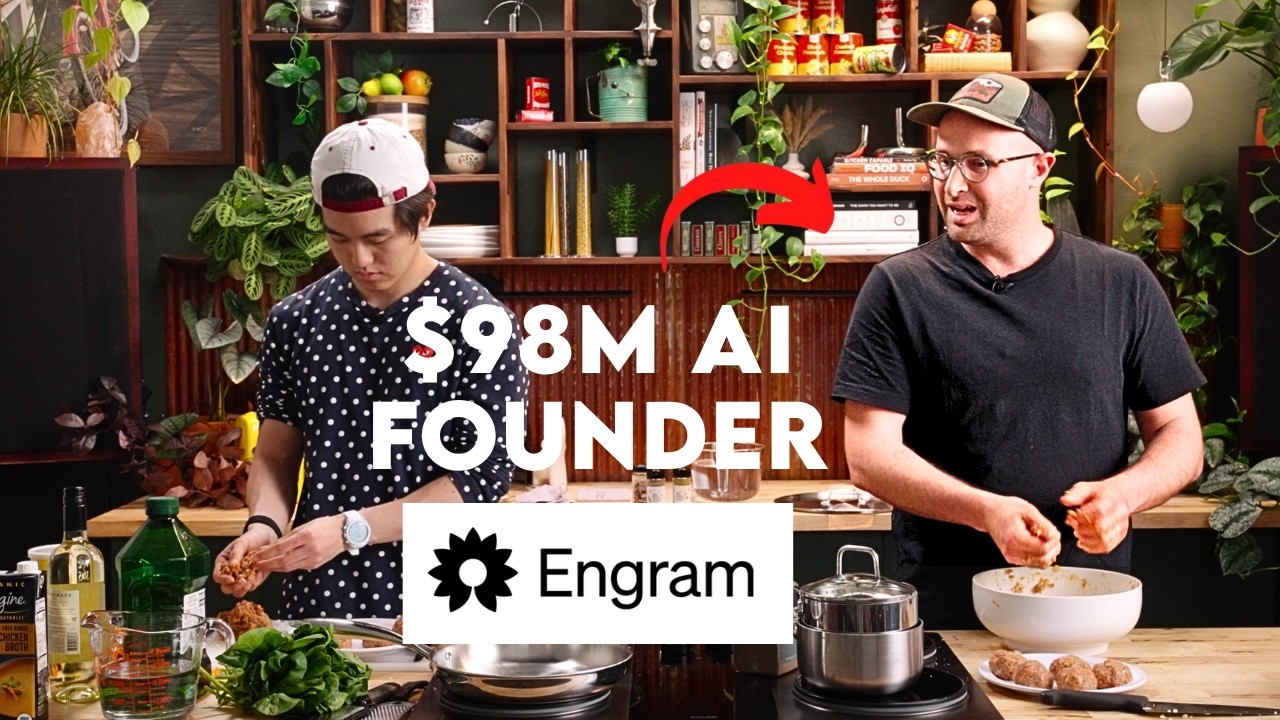
The AI Memory Problem: Why Long Context Isn’t Enough — Dan Biderman, Engram Co-founder & CEO
Jul 13, 2026 · 49:44
Engram co-founder and CEO Dan Biderman tells hosts Allen Park and Sean that long context and RAG aren't enough for AI memory—continual learning and gradient-based weight updates are needed. He argues Engram's approach compresses company knowledge into 'cartridges' that let models reason with far fewer tokens, overcoming 'context rot' and the inefficiency of re-reading massive corpora. Biderman draws on his background in Israeli special forces and computational neuroscience to explain how training creates intuition beyond text retrieval, citing examples like Harvey's legal queries where holistic understanding beats search. He envisions personal AI weights that improve like Tamagotchis, driven by user-specific feedback loops, and stresses that token efficiency and intelligence are inseparable—doing more with less enables harder problems. Engram is hiring infrastructure engineers to deploy millions of continuously updated memories.

The Agent Cloud: Databricks’ Bet on the Future of AI — Matei Zaharia and Reynold Xin
Jun 24, 2026 · 1:10:06
Databricks cofounders Matei Zaharia and Reynold Xin argue the company is moving beyond the lakehouse into a full data-and-AI operating system, anchored by two new initiatives: Omnigent, an open-source meta-harness for combining coding and enterprise agents, and LTAP, a unified storage layer that gets most HTAP benefits without collapsing query engines. Omnigent provides a common API for agent sessions, files, streams, tool calls, and cancellation, solving portability, collaboration, and security issues across Claude Code, Codex, Cursor, and custom agents. LTAP writes transactional data directly in columnar Parquet format, eliminating brittle CDC pipelines—Reynold jokes CDC means 'continuous data corruption'—and enables instant analytics without overloading the source database. The episode details Databricks’ culture of rapid prototyping, where an engineer built the LTAP prototype without a formal design doc, and the thesis that traditional software will be rewritten once data is in the right place with agents on top. They also cover Mosaic’s shift from general frontier models to specialized fine-tuned models like document parsing, internal agent usage, and security features such…

Retrieval After RAG: Hybrid Search, Agents, and Database Design — Simon Eskildsen of Turbopuffer
Mar 12, 2026 · 1:00:32
Simon Eskildsen, founder of Turbopuffer, explains how his obsession with the cost of vector search at Readwise led him to build a search engine on object storage and NVMe SSDs, cutting costs by 95% for customers like Cursor. He outlines the three conditions for a major database company—a new workload (AI-driven search), a new architecture (object storage first, no consensus layer), and evolving to support every query plan. Turbopuffer's architecture uses S3's strong consistency and compare-and-swap for metadata, avoiding stateful systems. Eskildsen shares how they won Notion by absorbing latency issues with dark fiber, and discusses the shift from single RAG queries to agents making many concurrent searches. He also describes the "P99 engineer"—obsessive, trade-off minded, able to bend software to first principles. Future plans include expanding full-text search, reaching Common Crawl scale, and eventually adding simpler OLAP queries.

[State of Research Funding] Beyond NSF, Slingshots, Open Frontiers — Andy Konwinski, Laude Institute
Dec 31, 2025 · 22:34
Andy Konwinski, co-founder of Databricks and Perplexity, launches Laude Institute—a dual venture fund and nonprofit to accelerate the path from open research to breakout companies. At NeurIPS, he explains how Laude's Slingshot program funds projects like DSPy, Terminal Bench, and LMArena, and why the NSF's $1B/year for CS is insufficient, needing $10-100B for frontier AI. He argues Chinese labs (Moonshot, DeepSeek) now outpublish US because OpenAI and others stopped sharing; Open Frontiers, a live-streamed conference in SF, aims to unite top open researchers (Yann LeCun, François Chollet, Jan Leike) to reclaim global leadership. The episode also spotlights the emerging 'post-post-training' layer—prompt optimization, context management, RAG—and why research teams with multiple co-founders (like Databricks' eight) are the new gold standard for AI startups.
Terminal-Bench 2.0: the most impt coding agent benchmark of 2025 gets a v2! Launch + Q&A w/ founders
Nov 8, 2025 · 35:01
Terminal-Bench co-creators Mike Merrill, Alex Shaw, and collaborators Andy Konwinski, Ludwig Schmidt, and Aatash launch Terminal-Bench 2.0, an 89-task coding benchmark with rigorous human and LM-assisted verification to test agent performance on real-world tasks like designing DNA primers and installing Windows 3.11. They reflect on Terminal-Bench 1's problems—easy tasks and reproducibility—and detail spending 300 hours manually auditing each task. They introduce Harbor, an open-source package for running sandboxed agent rollouts, standardizing task format and integrating with agents like Codex and Claude Code. Aatash shows using Harbor to generate thousands of training traces for DataComp Agent, running 1,000 parallel sandboxes. Future plans include expanding to scientific computing.

How NotebookLM Was Made
Oct 25, 2024 · 1:13:57
Raiza Martin (NotebookLM lead PM) and Usama Bin Shafqat (AI engineer) explain how Google's NotebookLM built the viral 'Deep Dive' audio overview feature. They reveal the product evolved from Project Tailwind, using Gemini 1.5's long context and DeepMind speech to create a two-persona dialogue format that transforms documents into engaging podcasts. The team learned from 65,000 Discord members, leaned on best-selling author Steven Johnson for a 'tool for thought' workflow, and prioritized a single format over exposed controls to preserve unpredictability and delight. Humor and tension are not explicitly prompted but emerge from giving personas different angles. Evaulation relied on internal taste ('potatoes for chefs') before formal raters, with a Likert scale on dimensions like entertainment and groundedness. Future plans include multilingual support, API access, real-time chat, and codebase podcasting, while managing non-determinism by accepting occasional bad rolls.
Production AI Engineering starts with Evals
Oct 11, 2024 · 1:56:16
Ankur Goyal, founder and CEO of Braintrust, argues that evaluation is the core workflow of production AI engineering and shows how his platform makes evals accessible to software engineers. Drawing from his experience at SingleStore and Impira, he details Braintrust's evolution from an eval tool into an end-to-end AI development platform used by Stripe, Zapier, Vercel, and other top AI teams. He shares market data: OpenAI handles over 95% of production workloads, fine-tuning is declining, and open-source models account for under 5% due to reliability issues. Ankur explains why he avoided building a vector database—the real challenge is permissions and joins, not vector search—and predicts o1-style reasoning will replace complex agent frameworks. He reveals Braintrust's differentiators: hybrid on-prem, TypeScript-first SDK, and declarative eval structures.

State of the Art: Training 70B LLMs on 10,000 H100 clusters
Jun 25, 2024 · 1:32:05
Josh Albrecht, CTO of Imbue, and Jon Frankle, Chief AI Scientist of Databricks, detail the challenges of training 70B models on 10,000 H100 clusters, from stolen Infiniband cables to GPUs silently returning wrong math. Imbue open-sources infrastructure scripts, health checks, the CARBS hyperparameter optimizer, and cleaned versions of 11 benchmarks plus 450,000 human judgments on ambiguity. Databricks released DBRX, a 132B-parameter mixture-of-experts model with 36B active per token, and a text-to-image model trained exclusively on Shutterstock's curated dataset. They discuss typical 3% weekly hardware failure rates, the difficulty of MoE training pushing network bandwidth, and why eval datasets need human scrutiny—most benchmarks are saturated once ambiguous examples are removed. Both emphasize that success requires deep understanding from firmware to final loss, not just fancy libraries.
How AI is Eating Finance - with Mike Conover of Brightwave
Jun 11, 2024 · 1:05:06
Brightwave founder Mike Conover explains how his vertical AI startup builds a 'partner in thought' for finance professionals, using a systems-of-systems approach that decomposes problems into specialized subsystems rather than relying on large context windows or monolithic agents. He argues that the evolution from DALL-E's 1,024-token context to today's million-token models has not solved synthesis; smaller, focused reasoning units still outperform. Conover emphasizes that the real competitive edge lies in custom training data and human annotation, not pre-training, and that models are converging in capability—so value shifts to fine-tuning data that elicits specific behaviors. He details why Brightwave avoids spreadsheets in favor of conversational analysis, and predicts AI will automate idea generation and second-order derivative bets, but humans must remain the final synthesizers and deciders. The episode also covers hiring for vertical AI, the role of knowledge graphs, and the diminishing economic incentive for companies to train their own foundation models.
Powered by PodHood