
Cognition
CompanyA company discussed on Latent Space.
19 episodes
Podcast Crossover: AIE, AGI, frontier lab strategy with @matthew_berman and @swyxtv
Jul 10, 2026 · 28:03
Shawn 'Swyx' Wang, founder of the AI Engineer conference, tells Matthew Berman how he seized the industry shift by buying ai.engineer and partnering with a veteran conference organizer, crediting Andrej Karpathy's early endorsement. He argues Etched's ASICs are a natural next-gen bet for transformer inference, not an NVIDIA disruptor, and that Fable 5's slowness and cost signal the end of the LLM scaling era—making model efficiency the next problem. Swyx interprets OpenAI's reported 5% equity offer to the US government as a pragmatic multi-turn negotiation, likening it to Singapore's Temasek model, but warns against premature utility regulation. He pegs his own P(doom) at ~5% over 50 years, rejecting near-term doomerism as egotistical. For founders, he advocates building 'agent labs' that solve specific customer problems (e.g., for lawyers, dentists) rather than betting on model routing, which he dismisses as a marketing line that fails to exploit a single model's full stack as deeply as frontier labs do.

The Future of AI Infra: from Kubernetes to Agent Sandboxes — Akshat Bubna, Modal CTO
Jul 8, 2026 · 59:10
Modal CTO Akshat Bubna explains how the cloud platform evolved from a serverless runtime to an AI cloud built for elastic inference, agent sandboxes, and post-training workloads. He argues that Kubernetes was never designed for bursty GPU-heavy AI workloads, so Modal built a decorator-based infrastructure that co-locates compute requirements with code. The company added GPUs a year before ChatGPT and now powers inference for custom models at Suno, Runway, and robotics firms, using GPU snapshotting to slash cold starts. Modal's new Auto Endpoints incorporate open-source DeFlash speculative decoding for frontier-level performance. For reinforcement learning rollouts, Modal provides up to 100,000 sandboxes simultaneously. The platform spans 17 cloud providers, features private IPv6 networking via eBPF, and supports serverless multi-node training with RDMA. Bubna also reveals Modal's shift from developer experience to agent experience, noting that agents benefit from the same minimalist SDK and observability tools that humans use.
⚡️Every product of the future will be a living system — Ronak Malde, Trajectory.ai
Jun 21, 2026 · 33:58
Ronak Malde, CEO of Trajectory.ai, recounts his journey from building AI coding agents at Windsurf (acquired by Google DeepMind in a deal involving Demis Hassabis and Sergey Brin) to launching a platform for continual learning in enterprise AI. He argues that every future product must be a 'living system' that learns from real-world user interactions, not static models. The episode details Trajectory's technical innovations, including Self-Distillation Policy Optimization (SDPO) for learning from corrections, continuous LoRA for parallel training, and open-sourcing a training stack with SkyRL. It covers partnerships with Harvey and NVIDIA to train NeMoTron 3 Super for legal workflows, improving metrics like issue spotting and citation accuracy while cutting costs. Malde explains data curation strategies that capture nuanced user edits beyond binary signals, and outlines Trajectory's roadmap from AI-native companies like Clay and Decagon to Fortune 500 enterprises. He also reveals that the idea for Trajectory emerged after giving up his acquisition equity to pursue this vision.

Devin’s 80% Moment: Background Agents, 7x PRs, & End of Hand-Held Coding — Walden Yan & Cole Murray
May 28, 2026 · 1:09:33
Walden Yan (Cognition CPO) and Cole Murray (creator of OpenInspect) argue that background agents are becoming critical infrastructure as Devin's merged PRs grew 7x and its share of commits jumped from 16% to 80%. They explain why architecture matters, particularly the decision to separate the agent's brain from the machine (harness out of the box) for security and permissions, and why full VMs beat Docker for running real applications. Testing, they stress, is a harder problem than computer use—requiring orchestration of services, feature flags, and multi-model coordination. Memory remains unsolved, with Devin using auto-generated 'Knowledge' and exploring file-system-like approaches. Both caution against uncontrolled vibe coding, which regresses codebases to the worst engineer's style, and advocate for hybrid frontier/sub-frontier systems to balance cost and capability.
[State of Code Evals] After SWE-bench, Code Clash & SOTA Coding Benchmarks recap — John Yang
Dec 31, 2025 · 17:45
John Yang, creator of SWE-bench, explains the benchmark's evolution from an ignored project to the industry standard after Cognition's Devin launch, and introduces CodeClash as a new paradigm for evaluating long-horizon coding agents via programming tournaments. Yang covers SWE-bench's expansion into nine languages (JavaScript, Rust, Java, C, Ruby) and multimodal tasks, the proliferation of independent variants like SWE-bench Pro and SWE-bench Live, and the shift from unit tests to iterative agent competitions. He addresses the Tau-bench controversy over impossible tasks, arguing they serve as cheat detection, and weighs the tension between long autonomy (5-hour runs) and interactivity (Cognition's fast back-and-forth). Yang highlights the academic data problem—companies like Cognition have rich user interaction data, while academics need user simulators or compelling products like LMArena—and positions CodeClash as a testbed for studying human-AI collaboration by freezing model capability and varying interaction setups.

[State of Evals] LMArena's $1.7B Vision — Anastasios Angelopoulos, LMArena
Dec 31, 2025 · 24:02
Anastasios Angelopoulos, founder of LMArena (now Arena), discusses the platform's $100M raise at a $1.7B valuation, its spin-out from Berkeley incubation by a16z's Anjney Midha, and its mission to be the industry's north star for real-world AI evaluation. He defends against the 'leaderboard illusion' paper, citing factual errors and reaffirming that models cannot pay to be on or off the public leaderboard. Arena funds inference costs for millions of monthly users, with 25% of its 5M+ users in software, and is expanding into occupational verticals (medicine, legal, creative) and multimodal video arenas. Key challenges include consumer retention, which improved with sign-in and persistent history, and moving off Gradio to React for better development. Angelopoulos calls for top talent in ML, product, and go-to-market to join the high-performance team.

[State of AI Startups] Memory/Learning, RL Envs & DBT-Fivetran — Sarah Catanzaro, Amplify
Dec 30, 2025 · 28:43
Sarah Catanzaro of Amplify Partners argues that the DBT-Fivetran merger was not the death of the modern data stack but a path to IPO targeting $600M+ combined revenue, that data catalogs failed because they were built for humans rather than machines, and that RL environments are a fad. She notes that frontier labs use dbt and Fivetran for training data curation and agent analytics, and criticizes $100M+ seed rounds raised without near-term roadmaps. For 2026, she identifies personalization via memory and continual learning as the key retention unlock, observing that AI founders are unfamiliar with growth concepts like k-factor. She prefers real-world logs over synthetic RL environments, citing Cursor's use of user activity, and says the most exciting startups combine hard research problems (RAG, rule-following, continual learning) with applications that were previously impossible.

The Great Evals Debate — Ankur Goyal & Malte Ubl
Dec 7, 2025 · 34:33
Ankur Goyal (Braintrust) and Malte Ubl (Vercel) debate whether offline evals are essential infrastructure or premature optimization for AI coding agents, arguing that the best teams deliberately invest in multiple feedback loops—offline evals, A/B tests, and vibe checks—to build effective AI products. They explain that modern evals are not about manufacturing golden datasets but pulling real user failures from production logs into eval suites to iterate faster. The conversation highlights how evals provide a 'first derivative' that enables aggressive shipping without regression fears, akin to unit tests in traditional software. Coding evals are uniquely verifiable (e.g., 'does it compile?') yet underutilized; Vercel uses them in RL pipelines to fine-tune models that fix trivial errors 100x faster than agentic loops. They also discuss how product managers encode domain expertise through rubrics and LLM-as-judge scoring, and why proprietary evals are competitive moats while public benchmarks serve marketing. The debate concludes that RL environments are a promising frontier for computer-use agents but require specialized expertise to avoid reward hacking.

⚡ Inside GitHub’s AI Revolution: Jared Palmer Reveals Agent HQ & The Future of Coding Agents
Nov 10, 2025 · 35:52
Jared Palmer, SVP at GitHub and VP at CoreAI at Microsoft, traces his journey from building v0 at Vercel—a focused Next.js coding agent that grew from $1M ARR to millions more after adding chat—to launching Agent HQ at GitHub Universe, a collaboration hub for developers and coding agents. He explains how v0's success came from laser-focus on one stack and framework, and how GitHub's 180M developers enable scaling agent-based workflows. Palmer discusses model strategy tradeoffs (composite vs. branded models), the challenge of repo setup and infrastructure reliability, and using coding agents for non-coding tasks like automating Excel workflows. He reveals Stacked Diffs as GitHub's top feature request, with active exploration after previous attempts, and outlines his vision for seamless AI integration across GitHub, VS Code, and Actions, including features like resolving merge conflicts with AI.

⚡ Inside Google Labs: Building The Gemini Coding Agent — Jed Borovik, Jules + AIE CODE Preview
Nov 10, 2025 · 43:53
Jed Borovik, Product Lead at Google Labs, explains how Google builds Jules, an autonomous coding agent that runs on its own VM for long-running tasks, challenging the assumption that agents should operate locally. He reveals that as Gemini models improved, Jules' scaffolding simplified, shifting from sub-agent patterns and embedding-based RAG to attention-based search. Borovik discusses context window management for sessions lasting up to 30 days with 2 million tokens, and argues that coding agents will increase demand for software engineers (Jevons paradox), not eliminate jobs. He calls for better specification tools beyond chat, such as multimodal input and interactive planning, to move beyond 'vibe coding' toward verifiable, reliable agentic workflows.
⚡️Raising $1.1b to build the fastest LLM Chips on Earth — Andrew Feldman, Cerebras
Oct 1, 2025 · 29:14
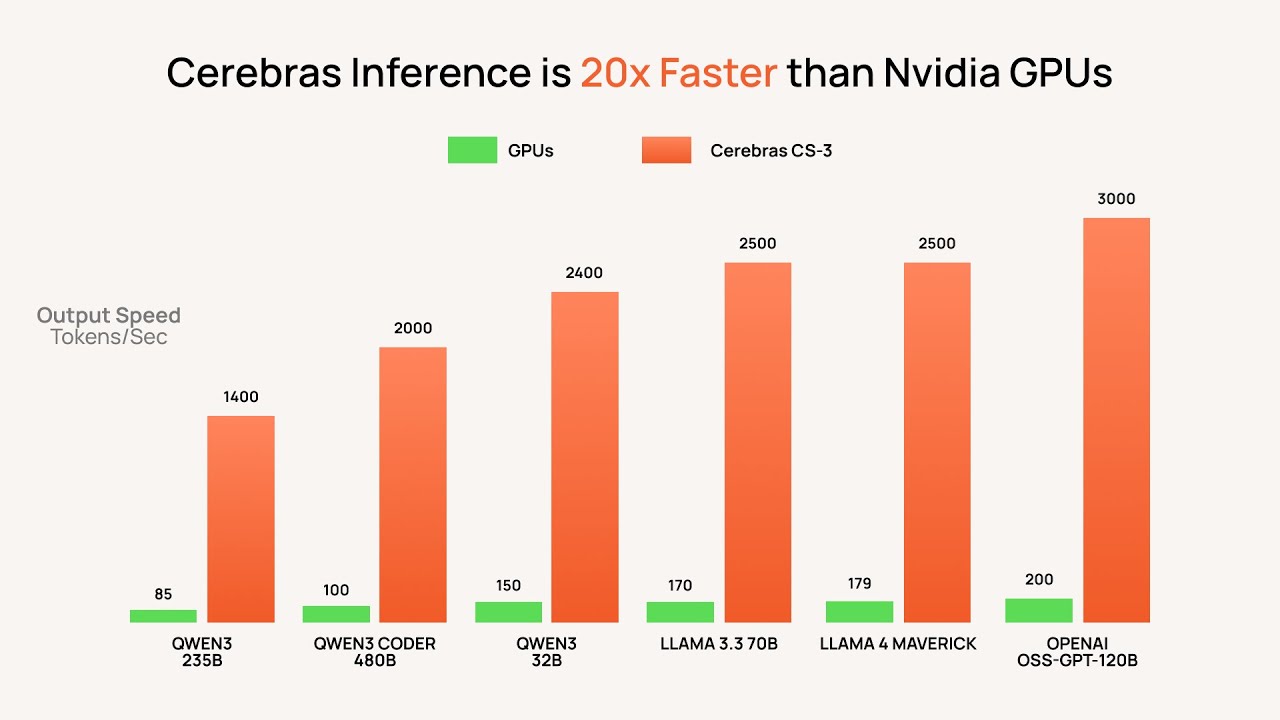
Andrew Feldman, CEO of Cerebras, joins Latent Space to discuss their $1.1B fundraise at an $8.1B valuation and their wafer-scale chip that delivers 20x faster inference than NVIDIA's B200 GPUs. He explains how their architecture uses SRAM instead of HBM, providing 2,625x more memory bandwidth by eliminating the narrow straw between compute and memory. Feldman details the decision to accelerate sparse linear algebra rather than specialized convolutions, enabling support for transformers and diffusion models unseen during design. He discusses the explosive growth in AI inference demand, the shift from closed-source to fast open-source models, and the importance of speed—citing Paul Graham's observation that ChatGPT's slowness drives users away. The conversation covers enterprise trends in the 10-30B parameter space, the complexity of building data centers that pull gigawatts of power, and the often-overlooked routing and caching systems that make AI work seamlessly.

⚡️Claude Sonnet 4.5 and Anthropic's roadmap for Agents and Developers — Mike Krieger, Anthropic
Sep 30, 2025 · 26:25
Mike Krieger, Anthropic's CPO, discusses the launch of Claude Sonnet 4.5 and its implications for AI development, emphasizing the growing symbiosis between product and research teams. He describes his personal 'vibe evals' for new models, including generating a Virtual Boy-style game and a Nintendo board presentation, and notes that Sonnet 4.5 traffic eclipsed Sonnet 4 on day one. Krieger explains how Anthropic is improving model output quality across UIs, Excel, and PowerPoint, and highlights the shift toward interactive planning rather than pure autonomy. He reveals the rename of the Claude Code SDK to the Claude Agent SDK, reflecting its general-purpose use for complex agentic workflows beyond coding. Krieger stresses the need for better visual understanding in models and invites developers to share feedback on hard challenges to help improve the platform.
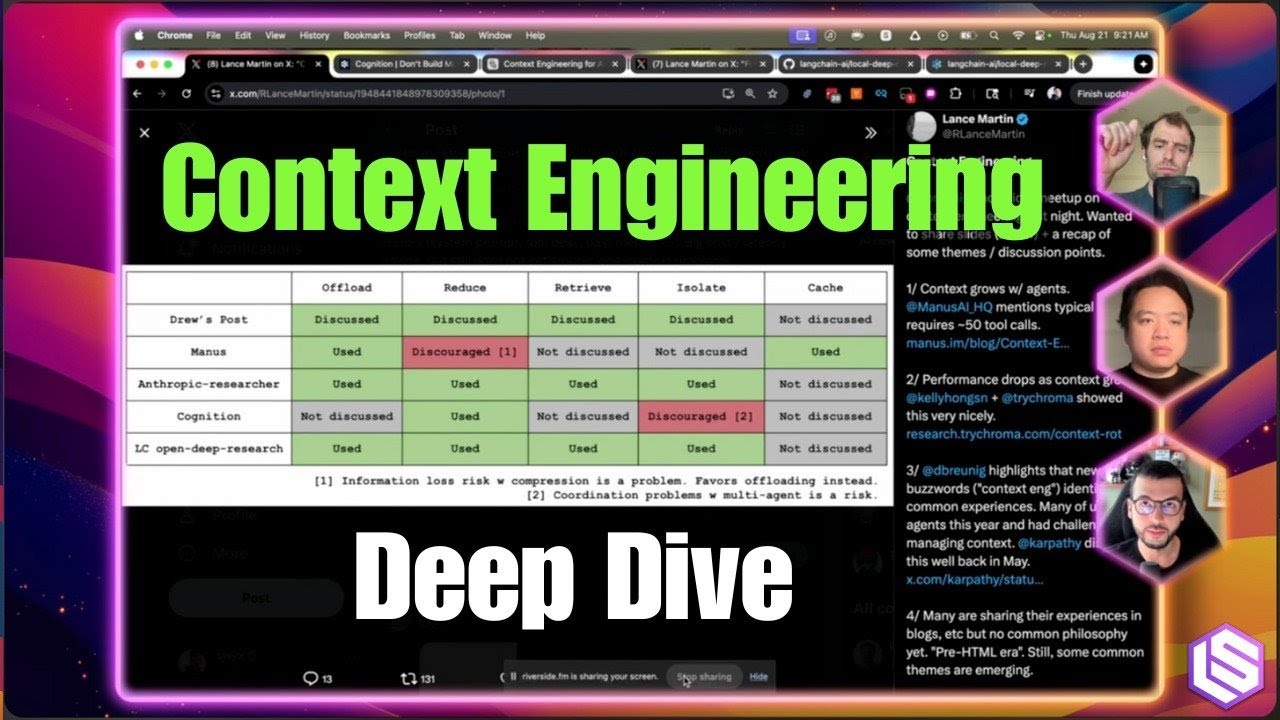
Context Engineering for Agents - Lance Martin, LangChain
Sep 11, 2025 · 1:03:18
Lance Martin from LangChain discusses context engineering for AI agents, arguing that managing context from tool calls is the key challenge and introducing five techniques: offloading, reducing, retrieval, caching, and context isolation. Offloading saves raw tool call outputs to disk and passes only summaries, drastically cutting token usage—Martin's deep research agent went from 500,000 tokens per run to much less. Manus uses file system offloading and warns that irreversible pruning risks information loss, while Cognition advocates fine-tuned summarization for agent-agent boundaries. For retrieval, Martin contrasts Windsurf's multi-step indexing with Claude Code's agentic search using grep and llms.txt, finding the latter more effective. He applies the Bitter Lesson to agent engineering: his own Open Deep Research evolved from a highly structured workflow to a simple agent loop as models improved, and he warns against rigid abstractions that hinder adaptation.

The AI Agenda: GPT5 leaks and the business of AI News — Steph Palazzolo, The Information
Aug 6, 2025 · 1:14:36
Steph Palazzolo, AI journalist at The Information, explains how she covers the secretive AI industry, from OpenAI's GPT-5 to the inference market where startups like Modal raise billions. She reveals that inference providers are essentially GPU resellers facing margin pressure, and that GPT-5's performance will signal whether pre-training scaling or reinforcement learning drives progress. She critiques Meta's super intelligence ambition as misaligned with its ad-revenue business, and details the talent war with rumored hundred-million-dollar offers from Meta to poach researchers. Palazzolo also discusses the Windsurf acqui-hire backlash, the rise of coding agents like Claude Code, and how journalists protect sources while navigating leaks from CEOs like Sam Altman.

🕰️ The Oral History of Windsurf (ft. Varun Mohan, Scott Wu, Jeff Wang, Kevin Hou, Anshul R)
Jul 28, 2025 · 3:53:23
This episode traces the oral history of Windsurf (formerly Codeium and Exafunction) with founders Varun Mohan, Scott Wu, Jeff Wang, Kevin Hou, and Anshul R, charting its evolution from a GPU virtualization startup to a leading agentic IDE and its dramatic acquisition by Cognition. The narrative covers the pivot to code completion in 2022, the shift to a free model to gain traction, and the launch of the Windsurf editor in November 2024 with Cascade, an agent that operates on a shared timeline with the developer. Key principles include meta-learning (auto-generated memories that adapt to each user's preferences) and scaling with intelligence (replacing hard-coded rules with LLM reasoning as models improve). The episode also details the acquisition weekend when Cognition bought Windsurf after Google acquired a stake, highlighting product synergies between the synchronous agent (Windsurf) and async agent (Devin) and the ambition to build a comprehensive platform for real-world software engineering teams.
⚡️Anthropic vs Cognition on Multi-Agents: A Breakdown with Dylan Davis
Jul 5, 2025 · 27:11
Dylan Davis from Gradient Labs breaks down the Anthropic vs Cognition multi-agent debate, arguing both blog posts are right for different use cases. Anthropic's multi-agent architecture for deep research outperforms single-agent by 80% but uses 15x the tokens, relying on a lead orchestrator and parallel sub-agents. Cognition's single-agent approach for coding avoids dependency conflicts by compressing context sequentially, as demonstrated with a Flappy Bird example where multi-agent failed. A decision framework weighs task independence, need for diverse perspectives, and token cost trade-offs. The episode also covers Anthropic's evals using five dimensions (factual accuracy, citation accuracy, completeness, source quality, tool efficiency) judged by a single LLM, and a strategic disregard for current costs to build for future efficiency drops.

DeepWiki: The GitHub Encyclopedia
May 21, 2025 · 32:05
Silas Alberti from Cognition (Devin) introduces DeepWiki, a free no-login product that indexes over 30,000 open-source repos and generates AI-powered wikis and deep research answers. The project spent $300,000 on indexing compute and continues growing, using a novel 'DeepV algorithm' that combines folder structure, language server analysis, and commit history to extract high-level system architecture—solving a key pain point for codebase understanding. Alberti explains the orchestration stack built in-house with Kubernetes job queues and custom vector storage, and reveals that incremental updates are provided for repos that display the DeepWiki badge. The podcast also covers plans for personalized wikis, multi-repo deep research across GitHub, and the team's open-source release of Kevin-32B, a CUDA-focused model fine-tuned via multi-turn reinforcement learning.

⚡️Open Questions in Agentic RL — Will Brown (Prime Intellect)
May 9, 2025 · 17:13
Will Brown of Prime Intellect maps the frontier of open-source agentic reinforcement learning, arguing that training models like o3 requires multi-turn tool use, intermediate reward verification, and efficient context management. He outlines challenges such as scaling tool calls to hundreds (e.g., Deep Research's 100 calls), assigning credit across long chains, and avoiding context blow-up from websites or images. Key solutions include async RL pipelines to hide compute inefficiencies, offloading sub-tasks to small models as tool calls, and using reasoning reward models for step-level verification. Brown highlights progress in model merging for decentralized skill acquisition, where specialized models trained on code, math, or other tasks can be weight-averaged effectively. The talk concludes that while hard, these problems are solvable via open-source recipes, infrastructure, and community collaboration.

Language Agents: From Reasoning to Acting — with Shunyu Yao of OpenAI, Harrison Chase of LangGraph
Sep 27, 2024 · 1:26:33
Shunyu Yao of OpenAI and Harrison Chase of LangChain discuss the evolution of language agents, arguing that combining reasoning and acting through techniques like ReAct remains foundational, while tool design and cognitive architectures like CoALA will shape the next wave. Shunyu traces his work from text games to ReAct, showing how thinking as an action improves reliability; Harrison explains LangChain's adoption and the shift to LangGraph for stateful orchestration. They emphasize agent-computer interfaces (ACI) as a neglected area, noting that SWE-Agent's success came from optimizing tools for models, not humans. The conversation covers memory types (semantic, episodic, procedural) and applies CoALA's three dimensions to current systems. They highlight promising applications: customer support, coding agents, and spreadsheet-style UX for batch operations. Shunyu stresses that better benchmarks like SWE-Bench (which solved 30% of GitHub issues) and TauBench (best model 48%) are critical, and that data—not architecture—will drive future model improvements.
Powered by PodHood