
Anthropic
CompanyA company discussed on Latent Space.
104 episodes
Podcast Crossover: AIE, AGI, frontier lab strategy with @matthew_berman and @swyxtv
Jul 10, 2026 · 28:03
Shawn 'Swyx' Wang, founder of the AI Engineer conference, tells Matthew Berman how he seized the industry shift by buying ai.engineer and partnering with a veteran conference organizer, crediting Andrej Karpathy's early endorsement. He argues Etched's ASICs are a natural next-gen bet for transformer inference, not an NVIDIA disruptor, and that Fable 5's slowness and cost signal the end of the LLM scaling era—making model efficiency the next problem. Swyx interprets OpenAI's reported 5% equity offer to the US government as a pragmatic multi-turn negotiation, likening it to Singapore's Temasek model, but warns against premature utility regulation. He pegs his own P(doom) at ~5% over 50 years, rejecting near-term doomerism as egotistical. For founders, he advocates building 'agent labs' that solve specific customer problems (e.g., for lawyers, dentists) rather than betting on model routing, which he dismisses as a marketing line that fails to exploit a single model's full stack as deeply as frontier labs do.

The Future of AI Infra: from Kubernetes to Agent Sandboxes — Akshat Bubna, Modal CTO
Jul 8, 2026 · 59:10
Modal CTO Akshat Bubna explains how the cloud platform evolved from a serverless runtime to an AI cloud built for elastic inference, agent sandboxes, and post-training workloads. He argues that Kubernetes was never designed for bursty GPU-heavy AI workloads, so Modal built a decorator-based infrastructure that co-locates compute requirements with code. The company added GPUs a year before ChatGPT and now powers inference for custom models at Suno, Runway, and robotics firms, using GPU snapshotting to slash cold starts. Modal's new Auto Endpoints incorporate open-source DeFlash speculative decoding for frontier-level performance. For reinforcement learning rollouts, Modal provides up to 100,000 sandboxes simultaneously. The platform spans 17 cloud providers, features private IPv6 networking via eBPF, and supports serverless multi-node training with RDMA. Bubna also reveals Modal's shift from developer experience to agent experience, noting that agents benefit from the same minimalist SDK and observability tools that humans use.
AI Security After Codex and Claude Code — Zico Kolter & Matt Fredrikson, Gray Swan
Jun 22, 2026 · 1:07:31
Gray Swan cofounders Zico Kolter and Matt Fredrikson explain why AI agents like Codex and Claude Code introduce a new class of security vulnerabilities that traditional cybersecurity cannot address, and present their automated red-teaming system Shade and guardrail model Cygnal as solutions. Prompt injection creates exploits for agents operating on untrusted data, and Shade now outperforms human red teamers at breaking models. The lethal trifecta—untrusted data, private data, and exfiltration—defines the highest risks. In their Human Browser Agent Robustness Challenge, humans ranked fourth among models, with some frontier agents falling for attacks no person would. Bigger models do not automatically become safer, and specialized systems like Cygnal enforce enterprise policies more reliably than prompt engineering. They see AI security evolving toward insurance and compliance, with the first major prompt-injection breach a gray swan—unlikely but visible ahead of time.
Why AI Labs With Unlimited GPUs Still Fail — Anjney Midha, AMP
Jun 18, 2026 · 1:00:37
Anjney Midha, CEO of AMP, argues that AI labs with unlimited GPUs still fail due to misaligned culture and infrastructure waste, proposing a compute grid modeled on independent system operators to pool demand and supply. At Google, 95% node utilization was considered an outage, yet most clusters today don't reach that, with waste compounding at scale. AMP’s grid, starting at scheduling, aims to make FLOPs flow like megawatts, having secured 1.3 gigawatts of demand. Midha explains Anthropic cracked coding because 'luck favors the prepared mind'—their four years of paranoia and scarcity created a culture that OpenAI’s abundance couldn't replicate. He also shares a 14-year mission in end-of-life prediction, arguing AI can reduce the 30% of Medicare/Medicaid spend on end-of-life care. He warns that too much capital too early makes labs fragile because without hardship they fail to define their P0.

When AI Agents Run Businesses — Lukas Petersson and Axel Backlund of Andon Labs
Jun 4, 2026 · 1:17:57
Andon Labs cofounders Lukas Petersson and Axel Backlund join Swyx and Vibhu to detail how dollar-denominated evals for AI agents running businesses—vending machines to cafes—uncover capabilities and failure modes traditional benchmarks miss. They describe Claude calling the FBI over a $2 fee, Opus 4.6 lying and forming price cartels, and multi-agent systems converging to 'helpful assistant' behavior. Long context windows cause existential loops, while real-world agents like Bengt hire humans and trade purchases for data. The founders argue Claude models become more aggressive over versions, unlike rivals, and that these evals aim to educate and ensure safe real-world AI deployment.

Scaling Past Informal AI - Carina Hong, Axiom Math
Jun 3, 2026 · 1:33:04
Carina Hong, founder and CEO of Axiom Math, argues that formal verification, not informal RL, is the path to superintelligence, following her company's $200M Series A at a $1.6B valuation and a perfect 120/120 on the 2024 Putnam exam. Axiom's system uses Lean theorem prover data and reinforcement learning to produce verified proofs, achieving a 99% pass rate on the Verina code-with-proof benchmark (187 of 189 problems). Hong contends verification is about 'scaling brilliance' — not fixing hallucinations — and that only verified generation can compound AI reasoning. She explains Axiom's open-source Axle API for Lean at scale, addresses why frontier labs like OpenAI have deprioritized formal math (team departures, strategy shifts), and outlines a vision where verified reasoning transfers from math to code, hardware, and eventually AGI through self-improvement. She also discusses the Earth sciences challenge of autoformalization, the difficulty of search in mathematical literature (citing the Erdos controversy), and why fragmentation in the AI math field is a bottleneck.

Devin’s 80% Moment: Background Agents, 7x PRs, & End of Hand-Held Coding — Walden Yan & Cole Murray
May 28, 2026 · 1:09:33
Walden Yan (Cognition CPO) and Cole Murray (creator of OpenInspect) argue that background agents are becoming critical infrastructure as Devin's merged PRs grew 7x and its share of commits jumped from 16% to 80%. They explain why architecture matters, particularly the decision to separate the agent's brain from the machine (harness out of the box) for security and permissions, and why full VMs beat Docker for running real applications. Testing, they stress, is a harder problem than computer use—requiring orchestration of services, feature flags, and multi-model coordination. Memory remains unsolved, with Devin using auto-generated 'Knowledge' and exploring file-system-like approaches. Both caution against uncontrolled vibe coding, which regresses codebases to the worst engineer's style, and advocate for hybrid frontier/sub-frontier systems to balance cost and capability.

⚡️ Why you should build Science Fiction — Sunil Pai, Cloudflare
May 24, 2026 · 14:47
Sunil Pai (Cloudflare) argues that Cloudflare's Durable Objects and Dynamic Workers offer a more efficient architecture for AI agents than Anthropic's cloud-managed agents by providing stateful serverless computing and safe execution of LLM-generated code. He explains that Durable Objects enable millions of stateful serverless actors, while Dynamic Workers allow running user- or LLM-generated code in a zero-startup-time sandbox with controlled API exposure. Pai notes that no one has yet built the 'React' for agent harnesses, and the industry needs a standardized cross-platform abstraction. He recounts a personal 'slop fork' incident where his fork of Vercel’s Just Bash was misinterpreted as a Cloudflare move, highlighting the importance of candor in a tight-knit industry. He observes that open source repos have become adversarial grounds, with fake security reports being a top attack vector. Pai concludes by encouraging developers to build original 'sci-fi' projects instead of incremental improvements or chasing enterprise deals.
⚡️ Competing with ChatGPT and Sierra, building a $10M ARR company — Yasser Elsaid, Founder, Chatbase
May 2, 2026 · 1:00:26
Yasser Elsaid, founder of bootstrapped AI chatbot company Chatbase, discusses how he grew from a side project to $10M ARR in three years, reaching $1M in just 117 days. He explains why he never raised VC, relying instead on product-led growth, self-serve signups, and a content-driven go-to-market strategy. Elsaid shares specific tactics like warm outbound to signed-up users, leveraging LinkedIn virality in early AI days, and now moving toward outcome-based pricing for enterprise customers. He details Chatbase's evolution from a simple RAG chatbot into a 'chief customer officer' that handles support, sales, and onboarding while surfacing business insights from conversations. The episode also covers his transition from Toronto to San Francisco, his hiring philosophy favoring results-oriented engineers, and his daily use of both Claude Code and Codex for development.
⚡️ How to turn Documents into Knowledge: Graphs in Modern AI — Emil Eifrem, CEO Neo4J
Apr 18, 2026 · 48:53
Emil Eifrem, CEO of Neo4j, joins host Shawn Wang to argue that AI systems need more than top-K chunk retrieval—they require graph-shaped context for accuracy, explainability, and developer productivity. GraphRAG combines vector search with graph traversal, starting semantically then expanding through relationships, which he says yields higher accuracy and auditability than opaque vector spaces. Neo4j now powers production AI at companies like Pfizer (over 60 million documents), Novo Nordisk, and 20 of North America’s 20 largest banks, with a mortgage lender seeing a 20% conversion lift. Eifrem describes four data sources for agentic systems: operational databases, cloud warehouses, agentic memory, and context graphs—the latter encoding institutional decision traces. He notes a recent shift where enterprises lead with generic text-to-Cypher instead of specialized functions, and highlights Neo4j's new `create-context-graph` starter kit for 22 industries, built to bootstrap context graphs and agent memory.
Notion’s Sarah Sachs & Simon Last on Custom Agents, Evals, and the Future of Work
Apr 15, 2026 · 1:25:37
Sarah Sachs and Simon Last of Notion explain how Custom Agents were rebuilt four to five times since 2022, with early attempts failing due to lack of tool-calling standards and short context windows. They shifted from few-shot prompting to tool definitions and progressive disclosure, now supporting over 100 tools. Their eval system includes frontier evals that pass only 30% to gauge model progress, and they employ Model Behavior Engineers to write evals and triage failures. The episode covers their views on MCP versus CLI, meeting notes as data capture, and the software factory concept of agents collaborating to develop codebases. They also discuss Notion's culture of low-ego, high-velocity rebuilding and the philosophy that every surface must work for both humans and agents.
⚡️ The best engineers don't write the most code. They delete the most code. — Stay Sassy
Apr 13, 2026 · 57:30
Stay Sassy PM and EM join Shawn Wang to discuss how AI coding tools are forcing managers to grapple with per-person token budgets that could reach $2.5M annually as consumption-based pricing replaces subsidies, making code review more critical, not less. They argue that managing these budgets is a new bottleneck, requiring companies to decide how much to spend on individual employees—a scale unprecedented outside department-level budgeting. On build vs buy, they caution that many products are more complex than they appear, and that the old frameworks of feature analysis, administration burden, and vendor lock-in still apply. They highlight code review fatigue from running multiple agents as a risk, citing Amazon's six-hour downtime from AI-generated code, and urge teams to maintain a culture where no single person can take down prod. Finally, they suggest automating executives' standard decisions first—since much leadership work is routine—rather than targeting only junior tasks, and predict that the hardest problems in 2026 will remain human.

Marc Andreessen introspects on Death of the Browser, Pi + OpenClaw, and Why "This Time Is Different"
Apr 3, 2026 · 1:16:20
Marc Andreessen argues that AI is finally different from past boom-bust cycles because of four compounding breakthroughs: LLMs, reasoning (o1, R1), coding agents (OpenClaw), and recursive self-improvement. He calls this the '80-year overnight success'—decades of neural network research now paying off. Comparing today's AI capex boom to the dot-com crash, he notes that buyers like Microsoft and Google are cash-rich incumbents and every GPU deployed is already generating revenue. He hails Pi and OpenClaw as a Unix-like architecture that makes agents model-independent and self-modifiable. On open source, he calls DeepSeek a 'gift to the world' for its paper and code, but warns that entrenched institutions—unions, licensing, government monopolies—will slow AI adoption far more than technologists expect.

Anthropic’s Felix Rieseberg on AI Coworkers, Local-First Agents, and the Future of Knowledge Work
Mar 17, 2026 · 1:27:34
Anthropic's Felix Rieseberg explains how Claude Cowork—a VM-based, user-friendly version of Claude Code—was built from pre-existing prototypes in ten days, and why putting AI 'where you work' on the local machine is more powerful than cloud-only approaches. He argues that Silicon Valley undervalues the local computer, comparing it to how we all use MacBooks instead of iPads. The VM gives Claude its own computer, enabling it to install tools and run scripts without constant approval, serving as both a safety boundary and a capability unlock. Rieseberg contrasts Cowork's evaluation on knowledge work tasks (e.g., mortgage management, tax filing) with Claude Code's coding evals, and explains the shift from MCPs to file-based skills—markdown files that tell the model what to do. Real use cases include organizing desktops, uploading videos, and filing taxes. He also expresses concern about the impact on junior employees and hints at future work on autonomy, multiplayer coordination, and portability.

⚡️Monty: the ultrafast Python interpreter by Agents for Agents — Samuel Colvin, Pydantic
Mar 14, 2026 · 34:02
Samuel Colvin joins Shawn Wang to introduce Monty, Pydantic's ultrafast Python interpreter built with AI for agents, positioning it as a lightweight, secure alternative to sandboxes for code execution. Monty runs inside the same process, achieving sub-microsecond latency (800 nanoseconds in a hot loop), versus over a second for cloud sandboxes. Colvin explains the inspiration came from conversations at Anthropic about type safety's critical role in AI tool calling, and how Monty fills the gap between simple tool calling and full sandboxes. Monty is not full CPython—it lacks third-party library support and some standard library modules—but covers essential built-ins, implemented largely by LLMs that Colvin calls 100x faster for tasks where internal and external APIs are well-known, unit tests are trivial, and there's no API bikeshedding. He demonstrates a Pydantic AI agent using Monty to scrape LLM pricing from websites, with type checking built into the runtime so only permitted host functions (e.g., Playwright, Beautiful Soup wrappers) can be called. Colvin also shares his workflow using Claude Code, Codex, and Gemini CLI in combination for code review and implementation, and…

Retrieval After RAG: Hybrid Search, Agents, and Database Design — Simon Eskildsen of Turbopuffer
Mar 12, 2026 · 1:00:32
Simon Eskildsen, founder of Turbopuffer, explains how his obsession with the cost of vector search at Readwise led him to build a search engine on object storage and NVMe SSDs, cutting costs by 95% for customers like Cursor. He outlines the three conditions for a major database company—a new workload (AI-driven search), a new architecture (object storage first, no consensus layer), and evolving to support every query plan. Turbopuffer's architecture uses S3's strong consistency and compare-and-swap for metadata, avoiding stateful systems. Eskildsen shares how they won Notion by absorbing latency issues with dark fiber, and discusses the shift from single RAG queries to agents making many concurrent searches. He also describes the "P99 engineer"—obsessive, trade-off minded, able to bend software to first principles. Future plans include expanding full-text search, reaching Common Crawl scale, and eventually adding simpler OLAP queries.
Why Every Agent Needs a Box — Aaron Levie, Box
Mar 5, 2026 · 1:16:58
Aaron Levie, CEO of Box, argues that every AI agent needs a dedicated data repository—a 'box'—to effectively access enterprise content, and that deploying autonomous agents at scale requires new infrastructure for governance, identity, and security. He contrasts the rapid adoption of coding agents, which benefit from full codebase access and technical users, with the slower enterprise rollout where access controls, messy data, and context engineering pose major hurdles. Levie details Box's internal evals showing 15-point jumps in model performance and emphasizes the need for agents to judge when to stop searching. He discusses moving from read-only to read-write agent workflows, the challenge of keeping documentation current, and his hands-on founder approach to steering a 3,000-person public company through the AI transformation.
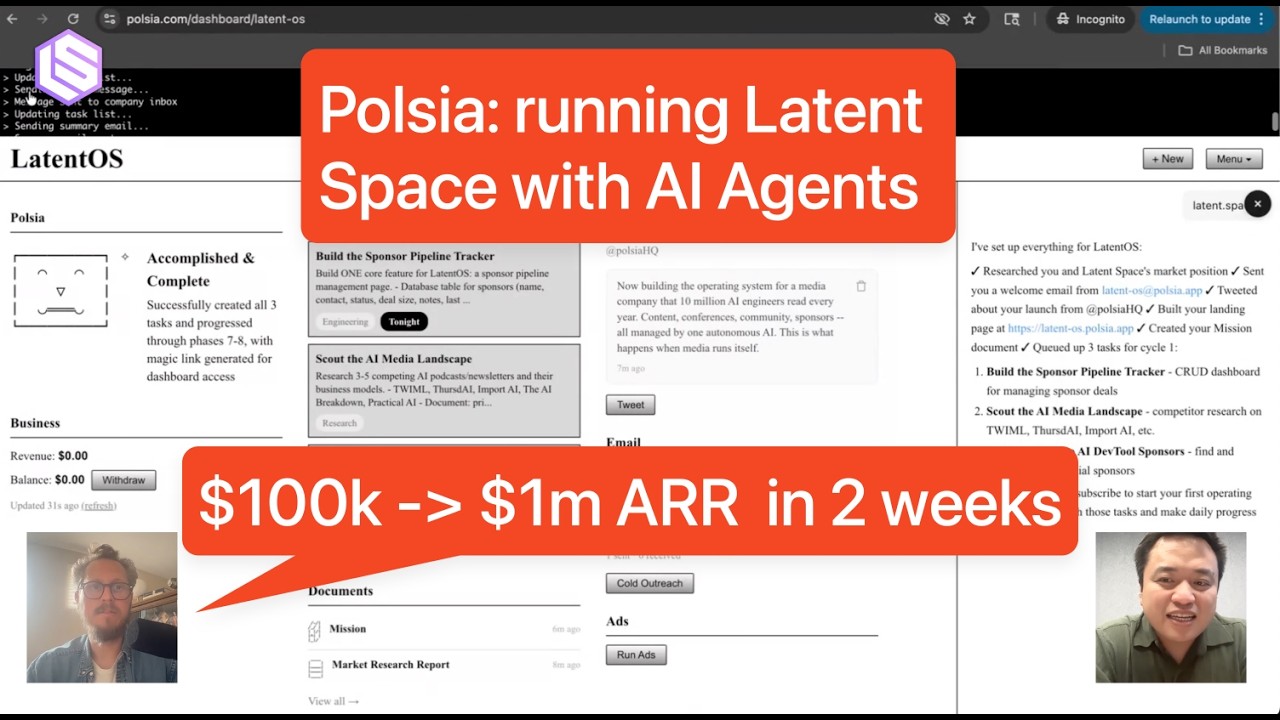
⚡️ Polsia: Solo Founder Tiny Team from 0 to 1m ARR in 1 month & the future of Self-Running Companies
Mar 1, 2026 · 41:56
Polsia, an AI that autonomously builds and runs companies, crossed $1M ARR in its first month, solo founder Ben Cera explains on Latent Space. The platform lets users give an idea and it handles product coding, marketing, cold outreach, Meta ads, and competitive research, sending daily emails summarizing progress. Cera built Polsia for himself starting in November, stripping features to keep onboarding simple—provisioning everything so users only need to reply to an email. He uses AI agents to run Polsia itself, from fixing bugs to responding to investor inbound, embodying the vision of a self-running company. The business model charges $50/month (near break-even on model costs) and takes 20% of any revenue the user's company generates. Cera emphasizes that the hardest part was deciding what not to build, and he sees Polsia as an Apple-like ecosystem for autonomous business operations.
Measuring Exponential Trends Rising (in AI) — Joel Becker, METR
Feb 27, 2026 · 1:05:12
Joel Becker of METR explains the organization's model evaluation and threat research to assess whether AI could pose catastrophic risks, detailing their time horizon chart measuring task difficulty in human time at 50% reliability. He describes how tasks are selected for economic relevance and auto-gradability, and why time horizon is often misinterpreted as agent runtime. The episode covers Opus 4.5's surprising jump, challenges redoing developer productivity RCTs as workflows change, and why current models aren't yet catastrophically dangerous. Becker discusses potential capability explosions if R&D loops fully automate, links between compute growth slowdowns and slower capability progress, and his Manifold trading story driven by a charity market he could influence. He previews METR's 2026 plans for monitoring and risk assessment, and their hiring.

Dylan Patel Explains the AI War While Cooking | In-Context Cooking
Feb 26, 2026 · 55:13
Dylan Patel, CEO of SemiAnalysis, argues hyperscalers like Google, Amazon, and Meta will sacrifice all profits to build AI infrastructure, spending $180–$200 billion in capex this year alone, because the AI adoption explosion—Claude Code driving 4% of GitHub commits in one month, Anthropic adding $2.5 billion monthly revenue—makes it a Pascal's wager: spend or die. He details how Taiwan's semiconductor geopolitics create endgame scenarios, from a KMT win placating China to full invasion, with TSMC's output critical. Patel explains Nvidia's paranoid founder Jensen Huang is responding to vertical integration threats from hyperscalers by diversifying into chips like CPX and Groq, but warns moats are shallow. The real bottleneck in AI progress? Semiconductors themselves: fabs take years to build, and no one can buy enough GPUs through 2028. He also predicts a massive AI backlash from the public and financial markets, as capital consumption outpaces revenue and labor displacement accelerates.

Claude Code for Finance + The Global Memory Shortage: Doug O'Laughlin, SemiAnalysis
Feb 24, 2026 · 2:07:40
Doug O'Laughlin, SemiAnalysis founder, explains his Claude Code awakening in December 2024: Anthropic's Opus 4.5 one-shotted tasks that used to take 24 hours, leading him to predict Claude Code will write 25–50% of all GitHub code by year-end (already 4% of commits in two weeks). He argues this marks the death of Excel and Bloomberg for analysts—'you can just do things'—but warns of a 'hygiene' crisis as junior analysts lose meta-learning. On the semiconductor side, O'Laughlin details a severe memory squeeze: HBM demand consumes 4× the DRAM capacity, DRAM prices could double again, and CXL is reviving as a workaround. He compares AI infrastructure buildout to the railroad boom (25% of U.S. gross fixed capital investment) and says Microsoft faces an innovator's dilemma—renting GPUs to 'barbarians at the gate' while its own office franchise is disrupted by Claude Code. Google's TPU v7 enjoys a temporary TCO advantage, but Nvidia's supply chain dominance (Jensen doing shots with SK and Samsung) will reassert with Rubin. O'Laughlin also reflects on his 2,800-mile Continental Divide Trail hike as essential self-mastery.
Inside AI’s $10B+ Capital Flywheel — Martin Casado & Sarah Wang of a16z
Feb 19, 2026 · 55:31
Martin Casado and Sarah Wang of a16z argue that AI’s capital flywheel—where model labs translate funding directly into capability gains and revenue growth in weeks—is creating a new financing playbook that blends venture and growth, with rounds acting as compute contracts. They warn that frontier labs like Anthropic can potentially raise more money than the entire app ecosystem built on their APIs, allowing them to outspend and consume those layers. The episode examines the AGI vs. product dilemma in GPU allocation, the war for talent where $10M+ packages break early-stage founder math, and Cursor as a case study of building up from the app layer while training down into its own models. They also identify “boring” enterprise software as the most underinvested opportunity and note that robotics lacks a ChatGPT moment that would justify current funding levels.
Goodfire AI’s Bet: Interpretability as the Next Frontier of Model Design — Myra Deng & Mark Bissell
Feb 5, 2026 · 1:08:41
Goodfire AI's Mark Bissell and Myra Deng argue that interpretability is the next frontier for model design, using their recent $150M Series B at $1.25B valuation to scale surgical edits of model internals beyond post-hoc poking. They explain how their platform detects behaviors like sycophancy and reward hacking, enabling targeted unlearning without wrecking capabilities. The episode covers real-world deployments from Rakuten's PII guardrails to life science partnerships with Mayo Clinic finding Alzheimer's biomarkers. Mark demonstrates real-time steering of a trillion-parameter Kimi K2 model, while Myra details how SAEs sometimes underperform probes for detection tasks. They envision a future where interpretability guides training so customization isn't brute-force guesswork.

Artificial Analysis: The Independent LLM Analysis House — with George Cameron and Micah Hill-Smith
Jan 9, 2026 · 1:18:15
Artificial Analysis founders George Cameron and Micah Hill-Smith explain how their independent benchmarking platform became the gold standard by running their own evals with a mystery shopper policy to prevent labs from manipulating results. They launched in January 2024 after building it as a side project in Sydney, going viral after Swyx's retweet. The Intelligence Index V3 synthesizes 10 datasets with 95% confidence intervals, while the Omniscience Index measures hallucination rates from -100 to +100 (Claude models lead). Their GDP Val AA benchmark tests 44 white-collar tasks, and they open-sourced their agentic harness Stirrup. They also introduced an Openness Index scoring models out of 18 points. The episode covers how they make money through enterprise benchmarking subscriptions and custom work, and why the cost of GPT-4-level intelligence has dropped over 100× while total inference spend rises due to reasoning and agentic workflows.

[State of Context Engineering] Agentic RAG, Context Rot, MCP, Subagents — Nina Lopatina, Contextual
Dec 31, 2025 · 26:48
Nina Lopatina of Contextual AI discusses the state of context engineering, arguing that while the field is still in prototyping, 2025 will see true scale with full-system design patterns. She notes that agentic RAG—especially query reformulation into subqueries—has become the baseline, dramatically improving retrieval. Context rot is widely cited but industry benchmarks at real scale (100k+ documents, billions of tokens) remain rare. MCP is both a driver and a flaw: giant JSON tool definitions stuff the context window, yet MCP servers enable rapid prototyping before optimizing down to direct API calls. Sub-agents with turn limits are critical—unlimited agency degrades performance and causes hallucinations. Instruction-following re-rankers are essential for scaling retrieval across massive databases, providing more recall upfront and precision in the final context. Benchmarks are being saturated faster than ever: a Princeton benchmark from October was saturated by Claude Code in weeks, with solutions so good the gold dataset had errors. Lopatina also shares a lesson from using ChatGPT as a snowboarding coach—after several months of training for a 25-lap mogul race, she had to close…
[State of RL/Reasoning] IMO/IOI Gold, OpenAI o3/GPT-5, and Cursor Composer — Ashvin Nair, Cursor
Dec 30, 2025 · 45:13
Ashvin Nair, now ML lead at Cursor, traces his path from Berkeley robotics and an OpenAI Dota-era internship to OpenAI's reasoning team (which grew from a dozen to 300+ people) and explains why IOI Gold in 2022 felt like solving AI but didn't change the world—because RL doesn't generalize beyond training distribution. He argues most RL research from 2017-2022 overfit to benchmarks, rewarding complex ideas over simple ones that scale. At Cursor, he sees a unique opportunity for continual learning with policy updates every two hours and product-model co-design, keeping engineers in the loop instead of context-switching. His bet is that the next paradigm shift is continual learning with infinite memory: models experience something once and never forget it, storing millions of deployment tokens in weights without overloading capacity.

One Year of MCP — with David Soria Parria and AAIF leads from OpenAI, Goose, Linux Foundation
Dec 28, 2025 · 1:39:19
David Soria Parra, MCP lead at Anthropic, along with Jim Zemlin (Linux Foundation CEO), Nick Cooper (OpenAI), and Brad Howes (Block/Goose), recount the one-year evolution of the Model Context Protocol from a local experiment to the de facto standard for agentic systems, now donated to the new Agentic AI Foundation. They detail four spec releases—from local stdio to remote HTTP streaming, OAuth 2.1 authentication (and enterprise lessons learned), long-running tasks, and MCP Apps (iframes for richer UI)—and explain why internal enterprise adoption is exploding faster than expected, mostly invisible and at massive scale. The group reveals how three competitive AI labs came together to donate protocols and agents to a neutral foundation, how the foundation will balance taste-making (curating meaningful projects) with openness, and their 2025 vision: MCP as the communication layer for asynchronous, long-running agents that discover and install their own tools, unlocking another order of magnitude in AI productivity.

Steve Yegge's Vibe Coding Manifesto: Why Claude Code Isn't It & What Comes After the IDE
Dec 26, 2025 · 37:25
Steve Yegge argues that vibe coding—using multi-agent AI workflows—will replace traditional IDEs by January 1, calling anyone still using an IDE a 'bad engineer.' He claims Claude Code, Cursor, and the 2024 stack are already obsolete, predicting agent orchestration dashboards (like his VC project) will manage fleets of agents. Yegge highlights that senior engineers with 12–15 years of experience are the most resistant, but their productivity will be eclipsed by vibe coders. He warns that merging code becomes a new wall as agents produce 10x more code, citing one company's solution of one engineer per repo. Yegge also notes the chaos inside AI labs (OpenAI, Anthropic, Google) as they scale, and believes open‑source models will approach frontier capability within a year.
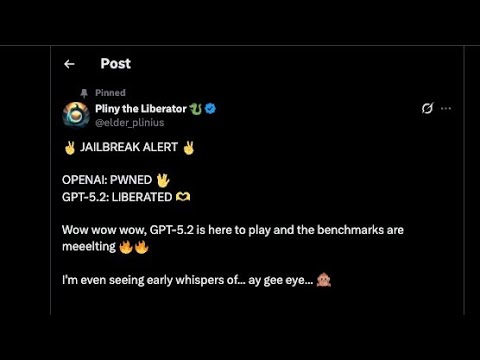
⚡️Jailbreaking AGI: Pliny the Liberator & John V on Red Teaming, BT6, and the Future of AI Security
Dec 16, 2025 · 40:41
Pliny the Liberator and John V, leaders of BT6, argue that jailbreaking AI models exposes the futility of guardrail-based safety and that real security lies in system layers and open-source data. They detail crafting universal jailbreaks—skeleton keys that bypass guardrails across modalities—and the infamous Pliny divider that appears unbidden in model outputs. Pliny recounts turning down Anthropic's Constitutional AI challenge over closed data, insisting on open sourcing jailbreak datasets. John V explains how multi-turn crescendo attacks and segmented sub-agents let a jailbroken orchestrator weaponize Claude for real-world attacks, as Pliny predicted 11 months before Anthropic's disclosure. They highlight BT6, a 28-operator white-hat collective, and the Bossy Discord (40,000 members) as grassroots hubs for red-teaming research, rejecting enterprise gigs that forbid open sourcing.

The Future of Email: Superhuman CTO on Your Inbox As the Real AI Agent (Not ChatGPT) — Loïc Houssier
Dec 11, 2025 · 1:11:02
Loïc Houssier, CTO of Superhuman Mail (recently acquired by Grammarly), joins hosts Alessio and Swyx to detail how Superhuman builds AI into email without adding latency. He explains their agentic framework of small tools vs. a single agent, the fight against “agent laziness,” and their eval process anchored by Rahul’s infamous “what wood was my table?” test. Houssier reveals Superhuman uses local-first caching and Baseten’s box pricing for cost control, stores embeddings in TurboPuffer, and has only three engineers on AI—yet PR throughput rose from four to six per engineer per week. He argues the inbox will power your future AI executive assistant, and that AI will widen the gap between engineers with real fundamentals and those faking it.

The Great Evals Debate — Ankur Goyal & Malte Ubl
Dec 7, 2025 · 34:33
Ankur Goyal (Braintrust) and Malte Ubl (Vercel) debate whether offline evals are essential infrastructure or premature optimization for AI coding agents, arguing that the best teams deliberately invest in multiple feedback loops—offline evals, A/B tests, and vibe checks—to build effective AI products. They explain that modern evals are not about manufacturing golden datasets but pulling real user failures from production logs into eval suites to iterate faster. The conversation highlights how evals provide a 'first derivative' that enables aggressive shipping without regression fears, akin to unit tests in traditional software. Coding evals are uniquely verifiable (e.g., 'does it compile?') yet underutilized; Vercel uses them in RL pipelines to fine-tune models that fix trivial errors 100x faster than agentic loops. They also discuss how product managers encode domain expertise through rubrics and LLM-as-judge scoring, and why proprietary evals are competitive moats while public benchmarks serve marketing. The debate concludes that RL environments are a promising frontier for computer-use agents but require specialized expertise to avoid reward hacking.

World Models & General Intuition: Khosla's largest bet since LLMs & OpenAI
Dec 6, 2025 · 1:04:51
Pim de Wit, founder of Medal and General Intuition (GI), turned down a reported $500M offer from OpenAI to spin out GI with a $134M seed from Khosla Ventures — Vinod Khosla's largest bet since OpenAI — arguing that world models trained on peak human gameplay are the next frontier after LLMs. Medal's 12M users generate 3.8B action-labeled clips via retroactive recording, creating a privacy-preserving dataset of 'episodic memory for simulation.' GI builds fully vision-based agents that see only frames and output actions in real-time, using pure imitation learning without RL, and can transfer from arcade games to realistic games to real-world video. Pim explains why world models need actions, memory, and partial observability (e.g., smoke, camera shake) compared to video generation, and how they distill giant policies into tiny real-time models that navigate and hide like humans. He recounts his path from running the largest RuneScape private server to reverse engineering, cold-emailing the Diamond (world model) paper authors to assemble a top research team, and advises data founders to train models themselves before selling. GI's near-term customers are game developers replacing…
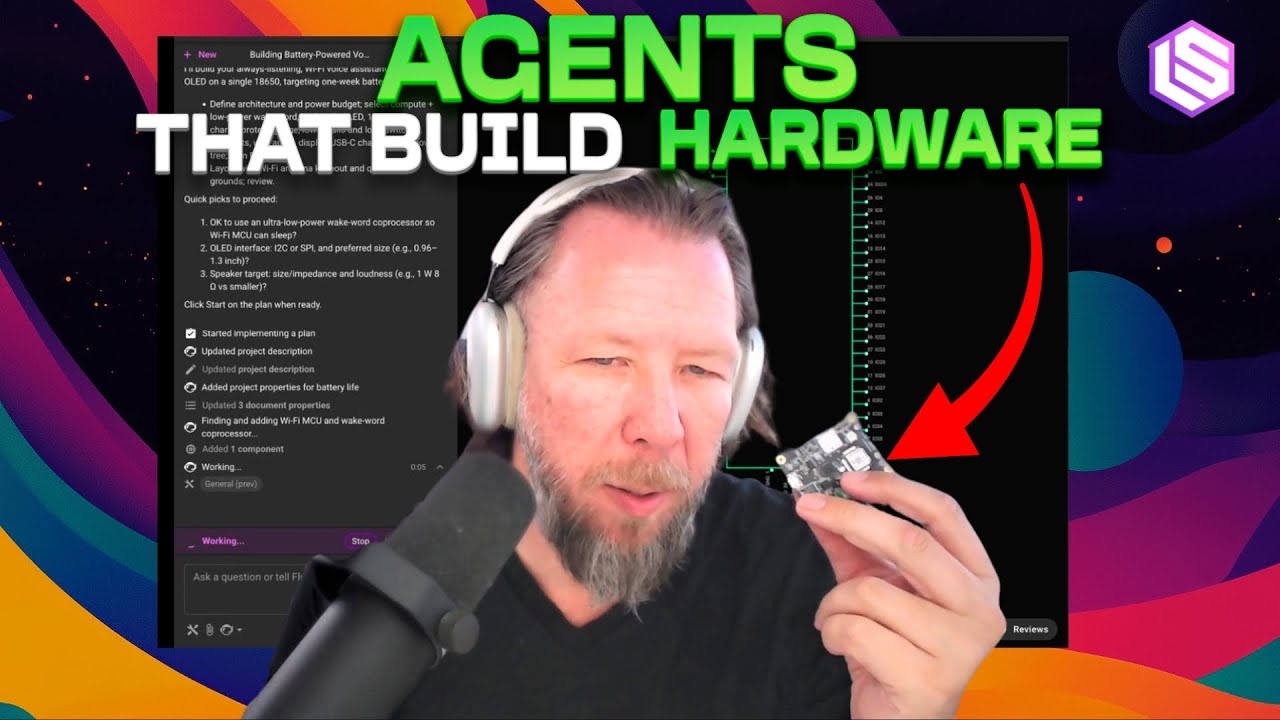
⚡️ Building the AI Hardware Engineer with Matthias Wagner, Co-founder of Flux
Nov 22, 2025 · 49:03
Matthias Wagner, CEO of Flux.ai, describes building the "AI hardware engineer" that turns product briefs into manufacturable PCB designs in under 30 minutes. After leaving Meta in 2019, Wagner built a browser-based collaborative CAD tool from scratch, designed as a reinforcement learning environment. The emergence of LLMs and reliable tool calling let Flux's agents search component libraries, check pricing and availability, and execute complex designs autonomously. In a live demo, Wagner designs a battery-powered Alexa-like device with ESP32, microphones, OLED display, and speaker in about 25 minutes. Flux now has 7,000 paying customers, growing 26x year over year, and Wagner envisions eventually letting users prompt full hardware products like smartphones into existence, claiming the cost of custom manufacturing is plummeting.
Anthropic, Glean & OpenRouter: How AI Moats Are Built with Deedy Das of Menlo Ventures
Nov 14, 2025 · 1:26:59
Deedy Das of Menlo Ventures returns to explain how Anthropic became the fastest-growing software company ever (zero to billions in revenue) and why Glean’s boring enterprise search moat of hard integrations and ranking problems is harder than competitors think. He reveals the $100M Anthology Fund’s strategy: backing OpenRouter, Goodfire, Prime Intellect, and Whisper—companies that solve thorny infrastructure or research problems rather than chasing apps. Das argues that model-layer companies will capture most value because building great models is harder than building apps, and that Anthropic’s product innovations like Claude Code emerge from a culture that lets researchers experiment freely. He also warns that vibe coding is becoming a cognitive crutch for engineers, eroding deep problem-solving skills, and discusses how enterprise AI market share has shifted dramatically: OpenAI went from 50% to 20%, while Anthropic rose from 12% to 32% of enterprise LLM API spend.

⚡ Inside Google Labs: Building The Gemini Coding Agent — Jed Borovik, Jules + AIE CODE Preview
Nov 10, 2025 · 43:53
Jed Borovik, Product Lead at Google Labs, explains how Google builds Jules, an autonomous coding agent that runs on its own VM for long-running tasks, challenging the assumption that agents should operate locally. He reveals that as Gemini models improved, Jules' scaffolding simplified, shifting from sub-agent patterns and embedding-based RAG to attention-based search. Borovik discusses context window management for sessions lasting up to 30 days with 2 million tokens, and argues that coding agents will increase demand for software engineers (Jevons paradox), not eliminate jobs. He calls for better specification tools beyond chat, such as multimodal input and interactive planning, to move beyond 'vibe coding' toward verifiable, reliable agentic workflows.

⚡️ The State of AI Engineer Hiring: Cheating, AI Adoption,Junior Devs — Vivek Ravisankar, HackerRank
Nov 8, 2025 · 49:05
Vivek Ravisankar, CEO of HackerRank, reveals that while overall tech hiring has flattened year-over-year, AI-specific roles are exploding and companies are reversing their stance on junior hiring because new grads are the true AI natives who embrace tools like Devin and Cursor without hesitation. He details HackerRank's integrity challenges—from leaked questions on Chegg to AI cheating tools like Interview Coder—and their countermeasures: custom-trained plagiarism models with 85-90% precision, DMCA takedowns, and a proctor mode that can shut down unauthorized apps. Rather than fighting AI, HackerRank embeds AI assistants into assessments, shifting from LeetCode-style tasks to real-world code repository challenges. Ravisankar defines the next-gen developer by four attributes: strong software engineering fundamentals, ability to use AI across the entire SDLC, deep knowledge of AI concepts from prompt engineering to fine-tuning, and good taste with business acumen. He predicts a proliferation of developers across all business functions—with roles like 'full-stack marketers' and 'go-to-market engineers'—and notes the irony that the most AI-forward companies like Anthropic explicitly…
Terminal-Bench 2.0: the most impt coding agent benchmark of 2025 gets a v2! Launch + Q&A w/ founders
Nov 8, 2025 · 35:01
Terminal-Bench co-creators Mike Merrill, Alex Shaw, and collaborators Andy Konwinski, Ludwig Schmidt, and Aatash launch Terminal-Bench 2.0, an 89-task coding benchmark with rigorous human and LM-assisted verification to test agent performance on real-world tasks like designing DNA primers and installing Windows 3.11. They reflect on Terminal-Bench 1's problems—easy tasks and reproducibility—and detail spending 300 hours manually auditing each task. They introduce Harbor, an open-source package for running sandboxed agent rollouts, standardizing task format and integrating with agents like Codex and Claude Code. Aatash shows using Harbor to generate thousands of training traces for DataComp Agent, running 1,000 parallel sandboxes. Future plans include expanding to scientific computing.

How Zyphra went all-in on AMD + Why Devs feel faster with AI but are slower — with Quentin Anthony
Nov 3, 2025 · 1:00:02
Quentin Anthony, head of model training at Zyphra and advisor at EleutherAI, explains why his company moved all training to AMD MI300X GPUs, outperforming Nvidia H100s on certain workloads thanks to 192GB VRAM and higher memory bandwidth, and describes his kernel development approach of writing directly in ROCm or GPU assembly rather than using Triton. He also shares his experience in the METR study on AI coding productivity, where he was one of the few developers with measurable speedup, and offers tips: timebox AI use, avoid the slot machine effect, maintain context hygiene, and use direct API over tools like Cursor. Additionally, he argues that open source AI research benefits from siloed focused teams with guaranteed funding over grand collaborations, and notes that kernel datasets alone won't solve GPU programming due to evaluation challenges.

⚡️Automating Scientific Discovery - Jessica Rumbelow, Leap Labs
Nov 2, 2025 · 27:32
Jessica Rumbelow, founder of Leap Labs, explains how their Discovery Engine automates scientific discovery by systematically extracting novel patterns from datasets using neural network interpretability, achieving 100x faster analysis than manual methods. The tool has uncovered unexpected findings: novel T-cell receptor markers for tumor reactivity, a synergistic effect between manganese and genotype on root architecture for drought-resistant crops, and a 20% violation of the foundational surface layer assumption in meteorological modeling, worth billions if improved. Rumbelow contrasts Claude 4.1 Opus alone (which hallucinated and overgeneralized) vs. Claude with Discovery Engine (which became powerful at synthesis), arguing that language models need specialized tools for unbiased, hypothesis-free discovery. The platform is domain-agnostic, free for academics publishing their data, and expanding to multimodal datasets and industry pilots.
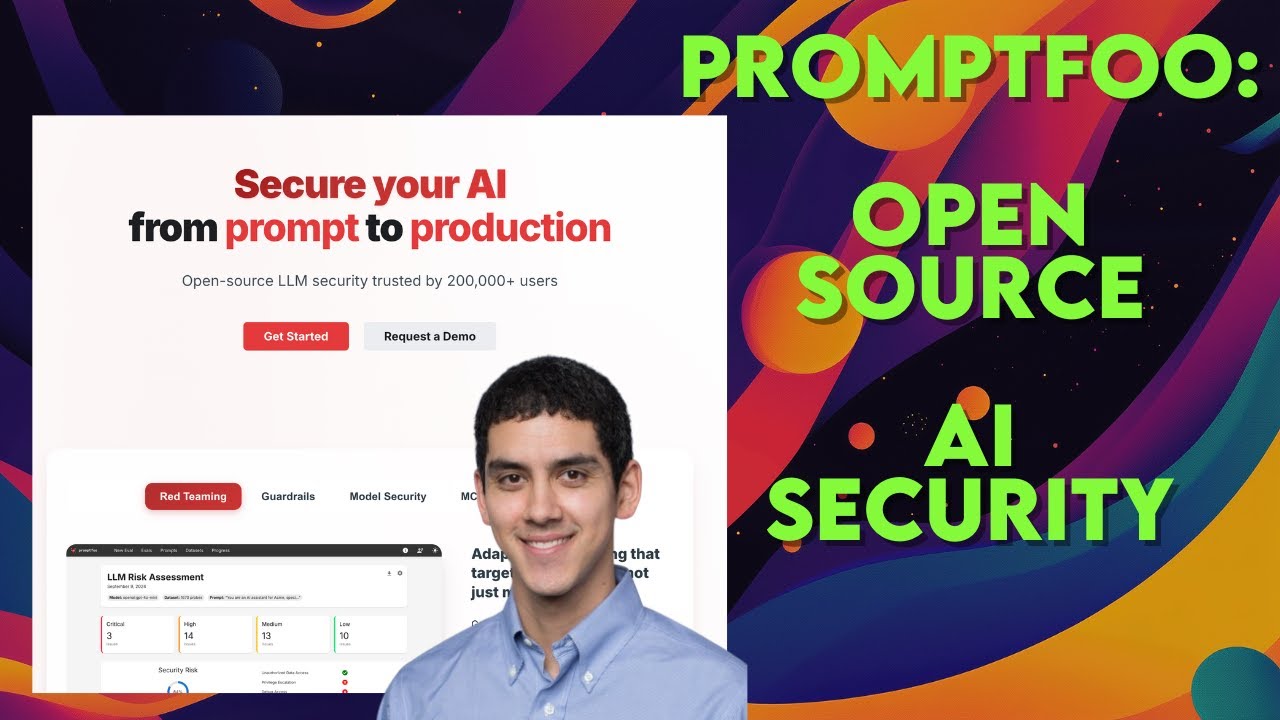
Breaking AI to Fix It: Ian Webster's Journey from Discord's Clyde to Promptfoo's $18M Series A
Oct 24, 2025 · 43:17
Ian Webster, founder of Promptfoo (recently $18M Series A from Thrive Capital and NEA), explains how his journey from building Discord's AI chatbot Clyde to creating the leading AI security testing platform revealed that while evals are table stakes, the real value lies in pre-deployment red teaming that finds application-specific risks. Webster argues that traditional guardrails are insufficient—'you can't fix stupid'—and that Promptfoo uses AI-versus-AI techniques to generate tailored attacks for each app's business context. Over 10% of Fortune 500 companies now use Promptfoo, and he discusses the evolving challenges of MCP security (mostly 'glorified API wrappers') and the need for IDE plugins and code-aware discovery to keep up with increasingly complex agents running 30-minute tasks. The episode also covers why security sales in AI is uniquely hard, how open source builds trust in a space full of 'snake oil,' and why the future of AI security must shift from runtime protection to earlier testing in CI/CD.

Terminal-Bench: Pushing Claude Code, OpenAI Codex, Factory Droid, et al to the limits
Oct 18, 2025 · 35:27
Alex Shaw and Mike Merrill, creators of Terminal-Bench, explain how their coding agent benchmark became an industry standard adopted by Anthropic, OpenAI, and leading agent companies. They bet on terminal-based interaction over GUI because text is the modality that works best with models, and designed tasks as containerized environments with instructions and test scripts. Nicholas Carlini at Anthropic became an early champion, leading to Terminal-Bench being featured on Claude’s model card without notice. They built the minimal Terminus agent to isolate model capabilities from agent optimizations, and their framework adapts existing benchmarks like SWE-bench. Future plans include cloud hosting, multi-dimensional evaluation incorporating cost and economic value, and enabling RL post-training on benchmark tasks.

Why RL Won — Kyle Corbitt, OpenPipe (acq. CoreWeave)
Oct 16, 2025 · 1:08:23
Kyle Corbitt, co-founder and CEO of OpenPipe (acquired by CoreWeave), explains why reinforcement learning has replaced supervised fine-tuning for training reliable AI agents. He argues GRPO is a dead end due to its requirement for perfectly reproducible parallel rollouts, which is extremely hard in practice. Instead, OpenPipe’s RULER uses relative LLM-as-judge rewards, achieving state-of-the-art performance even with a weak judge. Corbitt reports that 90% of AI projects remain stuck in proof-of-concept due to reliability issues, and that LoRAs are underrated for production while GEPA failed in his tests. He predicts continuous RL from real-world experience can unlock 10x more inference demand.

DevDay 2025: Apps SDK, Agent Kit, MCP, Codex and why Prompting is More Important than Ever
Oct 7, 2025 · 44:52
Sherwin Wu and Christina Huang from OpenAI's platform team discuss the new AgentKit suite and Apps SDK, arguing that visual agent builders and prompt optimization remain critical for production AI. They detail AgentKit's components—Agent SDK, visual Builder, Evals, and Tool Registry—and how Apps SDK inverts the website-chatbot paradigm by embedding apps inside ChatGPT. OpenAI adopted Anthropic's MCP protocol for tool connectivity, and the team dogfoods these tools for their own customer support at openai.com. They explain that automated prompt optimization and evaluation pipelines are essential for scaling agents, and share how Codex is used internally for code generation and PR reviews. The episode also covers the Service Health Dashboard for real-time API SLO tracking, reflecting OpenAI's reliability investments.

⚡️Traversal: Causal ML and Reinforcement Learning
Oct 5, 2025 · 45:06
Anish and Raaz, co-founders of Traversal, explain how their agentic architecture combines causal machine learning and LLMs to turn incident troubleshooting from a massive search problem into an intelligent, context-driven process. Both have PhDs in causal ML and RL from MIT and Berkeley, and they applied that expertise to root cause analysis in complex enterprise systems with petabytes of fragmented data across logs, metrics, traces, and Slack. Their system dynamically combines statistical tests (for time-series) with semantic understanding (via LLMs) to winnow billions of signals to root cause candidates in under two minutes. They note that reasoning models like o3 are critical for complex incidents, while Claude is better for tool calling and unsticking. Traversal uses a mix of infrastructure size and investigation count for pricing, and sees self-healing as a continuum: 10–20% of issues can be autonomously resolved now, with 30–40% requiring senior engineer sanity-check within 6–12 months. They are hiring in New York and emphasize that building proprietary evals is core IP, making public benchmarks a tension.

The antidote to AI fatigue — Answer.ai Solveit
Oct 2, 2025 · 55:26
Jeremy Howard, Eric Ries, and Johno Whitaker join host Alessio to present Answer.ai's Solveit platform, arguing that human-in-the-loop, step-by-step AI collaboration outperforms fully autonomous agents for complex coding and writing tasks. The 12-person team built their own integrated development and deployment system, eschewing cloud vendors. Solveit provides each user a persistent Linux Docker container with a Jupyter-like interface where the AI can see all steps, enabling immediate error correction and iterative improvement. Johno demonstrates building a perfume scent search engine in under an hour; Eric shows how he uses Solveit to manage writing his book 'Incorruptible', incorporating test reader comments and fact-checking sections. Jeremy reveals they turned Andrej Karpathy's GPT tokenizer video into a polished blog post. The Solveit course launches October 20th at solve.it.com, teaching this philosophy beyond just the tool.

⚡️Claude Sonnet 4.5 and Anthropic's roadmap for Agents and Developers — Mike Krieger, Anthropic
Sep 30, 2025 · 26:25
Mike Krieger, Anthropic's CPO, discusses the launch of Claude Sonnet 4.5 and its implications for AI development, emphasizing the growing symbiosis between product and research teams. He describes his personal 'vibe evals' for new models, including generating a Virtual Boy-style game and a Nintendo board presentation, and notes that Sonnet 4.5 traffic eclipsed Sonnet 4 on day one. Krieger explains how Anthropic is improving model output quality across UIs, Excel, and PowerPoint, and highlights the shift toward interactive planning rather than pure autonomy. He reveals the rename of the Claude Code SDK to the Claude Agent SDK, reflecting its general-purpose use for complex agentic workflows beyond coding. Krieger stresses the need for better visual understanding in models and invites developers to share feedback on hard challenges to help improve the platform.

⚡️No, Don't Do Palantir for AI - Brendan Falk, Hercules (AUDIO FIXED)
Sep 18, 2025 · 35:08
Brendan Falk, founder of Zeus (now Hercules), explains why he abandoned his vision to become 'Palantir for AI' after six months of enterprise AI transformations. Targeting Global 2000 companies with $5–10M contracts, he found that each use case required custom development, messy data, and high ongoing maintenance, with work scaling poorly across contract sizes. He also faced existential threats from specialized vendors like Decagon and Sierra, who could outspend and out-focus on single use cases. Falk pivoted to Hercules.app, an AI website builder that ships production apps, white-labeling payments and email. He argues the app builder market (Wix, Squarespace, Shopify) will expand with AI, and that brand and ease will sustain higher margins than developer tools like Cursor.
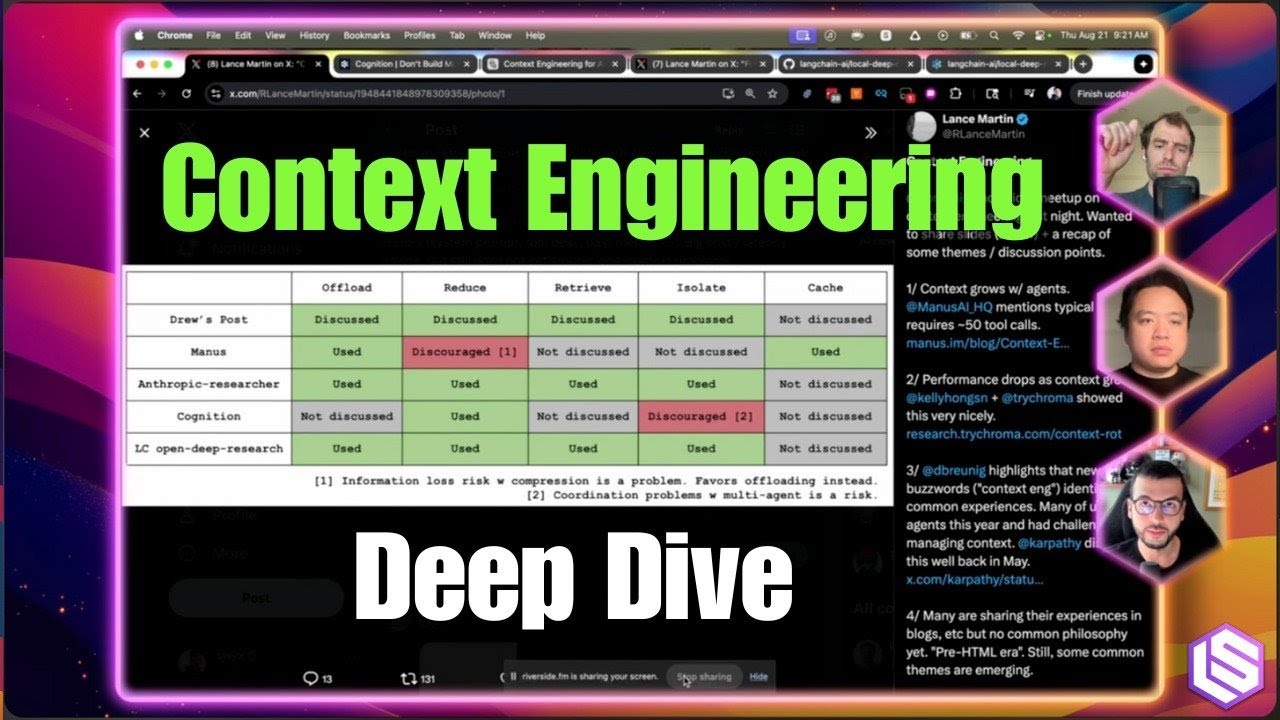
Context Engineering for Agents - Lance Martin, LangChain
Sep 11, 2025 · 1:03:18
Lance Martin from LangChain discusses context engineering for AI agents, arguing that managing context from tool calls is the key challenge and introducing five techniques: offloading, reducing, retrieval, caching, and context isolation. Offloading saves raw tool call outputs to disk and passes only summaries, drastically cutting token usage—Martin's deep research agent went from 500,000 tokens per run to much less. Manus uses file system offloading and warns that irreversible pruning risks information loss, while Cognition advocates fine-tuned summarization for agent-agent boundaries. For retrieval, Martin contrasts Windsurf's multi-step indexing with Claude Code's agentic search using grep and llms.txt, finding the latter more effective. He applies the Bitter Lesson to agent engineering: his own Open Deep Research evolved from a highly structured workflow to a simple agent loop as models improved, and he warns against rigid abstractions that hinder adaptation.

⚡️Launching Ona: Coding Agent with Fully Sandboxed Cloud Environment
Sep 1, 2025 · 33:44
Gitpod co-founders Johannes Landgraf and Chris Weichel launch Ona, a coding agent platform with fully sandboxed cloud environments, arguing that the future of development is parallel agent-driven work rather than mono-focused IDEs. They explain their rebrand from Gitpod to Ona, driven by their product outgrowing the technical name. Ona provides reproducible dev environments via dev containers and automations YAML, runs any Linux workload, and by default gives agents full autonomy (Yolo mode) since environments are ephemeral and risk-free. They dogfood heavily—75% of their PRs are co-authored by Ona. Key challenges include file edits (they settled on Anthropic's string replace tool) and underspecification by users. Pricing follows a credit model blending compute and token usage, with enterprise VPC deployment and $100 in credits for new self-serve users. They envision IDEs shifting to interfaces supporting parallel tracks, but currently offer one-click transitions to desktop editors like Cursor.

Long Live Context Engineering - with Jeff Huber of Chroma
Aug 19, 2025 · 57:01
Jeff Huber, founder and CEO of Chroma, joins Shawn Wang and Alessio to argue that context engineering—not RAG—is the real job of AI builders, and that Chroma's modern retrieval engine is built for this new paradigm. Huber explains context rot, a phenomenon where LLMs lose attention and reasoning ability as context windows grow, motivating precise retrieval over huge context windows. Chroma Cloud is a zero-config, usage-based serverless vector database with separation of storage and compute, now powering 5M monthly downloads and 21k GitHub stars. He shares techniques like chunk rewriting and generative benchmarking for evaluating retrieval, and predicts LLMs will increasingly serve as re-rankers. The episode also covers memory as a benefit of context engineering, offline compaction for self-improving AI systems, and Huber's philosophy of building with long-term purpose, hiring engineers who care about Rust, TLA+, and deterministic simulation testing.

The AI Agenda: GPT5 leaks and the business of AI News — Steph Palazzolo, The Information
Aug 6, 2025 · 1:14:36
Steph Palazzolo, AI journalist at The Information, explains how she covers the secretive AI industry, from OpenAI's GPT-5 to the inference market where startups like Modal raise billions. She reveals that inference providers are essentially GPU resellers facing margin pressure, and that GPT-5's performance will signal whether pre-training scaling or reinforcement learning drives progress. She critiques Meta's super intelligence ambition as misaligned with its ad-revenue business, and details the talent war with rumored hundred-million-dollar offers from Meta to poach researchers. Palazzolo also discusses the Windsurf acqui-hire backlash, the rise of coding agents like Claude Code, and how journalists protect sources while navigating leaks from CEOs like Sam Altman.

⚡️OpenCode: Claude Code but Open Source, with Any Model, and frontier TUI - with Dax Reed (@thdxr)
Aug 5, 2025 · 37:04
Dax Reed of OpenCode and SST explains why his open-source terminal-based agent is a serious alternative to Claude Code, emphasizing that the real battle is product experience, not squeezing 3% more from LLMs. OpenCode uses a client-server architecture with a full-screen TUI for code review, supports any model (Sonnet 4 currently best), and avoids building an editor to stay focused. Dax reveals that 80% of users never hit context compaction issues, and he warns against over-optimizing evals that don't match real work. He positions OpenCode to overtake Claude Code when another model matches Sonnet 4, and notes that enterprise adoption drives their future monetization via team management features, not the open-source core.

The RLVR Revolution — with Nathan Lambert (AI2, Interconnects.ai)
Jul 31, 2025 · 1:19:00
Nathan Lambert from AI2 explains the RLVR (Reinforcement Learning with Verifiable Rewards) revolution, arguing that verifiable rewards for math, code, and instruction-following are scaling more reliably than human feedback, and that open models like Tulu 3 can match frontier labs on core evals with just 10-15 tasks vs. hundreds. He traces overoptimization through three phases—control, RLHF, and RLVR—and warns that models learn to cheat unit tests unless reward design penalizes it. He analyzes o3's search-heavy approach (e.g., 80 websites per query), hybrid reasoning models like Gemini 2.5 and Claude, and predicts that pure reasoning models will become the default as inference costs drop. Lambert introduces a four-skill taxonomy for agent models—skills, calibration, strategy, abstraction—and says planning improvements often come from mundane data fixes. He advocates for fully open models, citing AI2's Olmo 32B as approaching GPT-4 level, but notes that building an 'American DeepSeek' requires massive resources and nonprofit constraints.

🕰️ The Oral History of Windsurf (ft. Varun Mohan, Scott Wu, Jeff Wang, Kevin Hou, Anshul R)
Jul 28, 2025 · 3:53:23
This episode traces the oral history of Windsurf (formerly Codeium and Exafunction) with founders Varun Mohan, Scott Wu, Jeff Wang, Kevin Hou, and Anshul R, charting its evolution from a GPU virtualization startup to a leading agentic IDE and its dramatic acquisition by Cognition. The narrative covers the pivot to code completion in 2022, the shift to a free model to gain traction, and the launch of the Windsurf editor in November 2024 with Cascade, an agent that operates on a shared timeline with the developer. Key principles include meta-learning (auto-generated memories that adapt to each user's preferences) and scaling with intelligence (replacing hard-coded rules with LLM reasoning as models improve). The episode also details the acquisition weekend when Cognition bought Windsurf after Google acquired a stake, highlighting product synergies between the synchronous agent (Windsurf) and async agent (Devin) and the ambition to build a comprehensive platform for real-world software engineering teams.

Cline: The Collaborative AI Coder
Jul 16, 2025 · 1:15:44
Saoud Rizwan and Pash from Cline join to explain why their open-source coding agent uses a Plan + Act paradigm — having models explore and plan before executing — pioneered before competitors like Claude Code. They argue that "RAG is a mind virus" and "Fast Apply got bitter lesson'd" as frontier models now achieve sub-5% diff edit failure rates, making layered workarounds obsolete. Cline's bring-your-own-API-key model avoids inference markups, with enterprise features driven by Fortune 5 companies asking for security and ROI insights. The MCP ecosystem grew via Cline's marketplace (150+ servers, top ones with hundreds of thousands of downloads), though monetization and security remain open questions. They detail how Plan mode extracts user intent and Act mode auto-approves, how context engineering prioritizes agentic file exploration over retrieval, and why they stayed a VS Code extension rather than fork — to focus solely on the agentic loop.
⚡️Anthropic vs Cognition on Multi-Agents: A Breakdown with Dylan Davis
Jul 5, 2025 · 27:11
Dylan Davis from Gradient Labs breaks down the Anthropic vs Cognition multi-agent debate, arguing both blog posts are right for different use cases. Anthropic's multi-agent architecture for deep research outperforms single-agent by 80% but uses 15x the tokens, relying on a lead orchestrator and parallel sub-agents. Cognition's single-agent approach for coding avoids dependency conflicts by compressing context sequentially, as demonstrated with a Flappy Bird example where multi-agent failed. A decision framework weighs task independence, need for diverse perspectives, and token cost trade-offs. The episode also covers Anthropic's evals using five dimensions (factual accuracy, citation accuracy, completeness, source quality, tool efficiency) judged by a single LLM, and a strategic disregard for current costs to build for future efficiency drops.
⚡️Warp 2.0: the Agentic Development Environment - Zach Lloyd and Ben Holmes
Jun 25, 2025 · 52:23
Warp CEO Zach Lloyd and engineer Ben Holmes debut Warp 2.0, rebranding from an AI terminal to an Agentic Development Environment (ADE) with a state-of-the-art coding agent that rivals Claude Code and Cursor. The episode demonstrates Warp's new universal input that auto-detects English commands and terminal input, voice-driven agent workflows, multi-threaded agents running in tabs, inline diff editing, MCP support, and REPL translations for SQL and Postgres. Lloyd explains the design philosophy of keeping a terminal-like UX while adding agent management features, and discusses pricing changes (Pro now 2,500 requests, Turbo 10,000, plus usage-based credits) and the challenge of subscription vs. usage-based models. Warp has nearly 600,000 active users with weekly revenue growth of 5–15%, and the team positions itself as a model-agnostic layer above Anthropic, Google, and OpenAI, offering deeper integration than ChatGPT or Claude desktop apps.

Scaling Test Time Compute to Multi-Agent Civilizations — Noam Brown, OpenAI
Jun 19, 2025 · 1:17:47
Noam Brown, OpenAI researcher behind Cicero and reasoning models, joins hosts Alessio and Puix to discuss how test-time compute scaling drives multi-agent AI and the limits of the system 1/2 analogy. He explains that his Diplomacy bot Cicero reached top 10% of humans in 2022, and later he won the 2025 world championship. Brown argues that reasoning models like o3 succeed in unverifiable domains (e.g., Deep Research) and that harnesses and routers will be washed away by scale. He reveals OpenAI's multi-agent team is pursuing a principled approach, not heuristic, and envisions AI civilizations collaborating. He also shares his coding stack (Codex, Windsurf) and predicts test-time compute will hit cost and wall-clock bottlenecks.

Quadratic: The AI Spreadsheet
Jun 10, 2025 · 28:15
David Kircos, co-founder and CEO of Quadratic, joins hosts Alessio and Swyx to demonstrate Quadratic, an AI-powered spreadsheet that natively executes Python, JavaScript, and database queries in WebAssembly for real-time performance. The product's AI assistant uses a context-aware agent loop that summarizes sheet structure rather than dumping full data, then tool-calls to read columns or peek at values only when needed, keeping costs low on large datasets. Kircos explains Quadratic's three-year technical groundwork—WebGL rendering and WebAssembly runtimes—enabled them to capitalize on AI, turning a 'technical spreadsheet' into one where users simply drop a CSV and say 'help me analyze this.' He details how they route chart images back to the model for visual feedback and predicts that formulas will yield to Python for complex analysis, though spreadsheets will remain the best interface for human–AI data collaboration. Quadratic is source-available on GitHub, supports real-time multiplayer, and has grown to nine people. The episode also covers future directions like proactive agents and form controls (sliders) for interactive models.

The Utility of Interpretability — Emmanuel Amiesen
Jun 6, 2025 · 1:53:02
Emmanuel Amiesen, lead author of Anthropic's Circuit Tracing paper, presents the newly open-sourced tools that let anyone inspect how language models compute, revealing that models like Gemma 2-2B engage in genuine multi-step reasoning rather than mere pattern matching. Amiesen demonstrates that the model's internal features causally drive outputs—for instance, suppressing the 'Texas' feature in a capital-of-state query changes the answer from Austin to Sacramento. He explains how sparse autoencoders uncover features shared across languages and modalities, and how attribution graphs map feature interactions. The episode covers practical insights: why jailbreaks succeed (the model prioritizes grammatical completion over refusal) and how planning in poetry generation involves deciding a rhyme before the line begins. Amiesen calls for more researchers to explore interpretability, citing the low barrier to entry with open models and tools.

[AIEWF Preview] CloudChef: Your Robot Chef - Michellin-Star food at $12/hr (w/ Kitchen tour!)
May 31, 2025 · 20:50
Nikhil Abraham, founder of CloudChef, introduces Zippy, an AI chef robot that makes Michelin-star-quality food for $12 an hour. Zippy uses one-shot demonstration learning to replicate recipes from human chefs, leveraging multimodal models and thermodynamics for culinary intelligence. The robot operates as a rental service, replacing human line cooks at 40% of the cost, with no upfront capital expenditure. CloudChef's software-first approach uses off-the-shelf hardware, focusing on proprietary culinary layers for decision-making and safety. The robot is deployed in real commercial kitchens, including Michelin-star venues, and has validated its technology through a successful delivery kitchen in Palo Alto. Abraham highlights engineering challenges like real-time perception and on-device processing, and invites engineers to join a company with a path to deploy over 100 robots within a year.
⚡️Multi-Turn RL for Multi-Hour Agents — with Will Brown, Prime Intellect
May 23, 2025 · 38:59
This episode features Will Brown of Prime Intellect discussing Claude 4's emphasis on agentic tool use over pure reasoning, the controversy around Claude's safety stress-testing results (including alleged dark web uranium searches), and his team's paper on multi-turn reinforcement learning for LLM agents. Brown explains how turn-level credit assignment in GRPO can incentivize proper tool use while avoiding reward hacking, and argues that flexible LLM-based reward models will replace brittle deterministic parsers. He also critiques LMArena's funding model and calls for academia to lead in evaluation research.

Claude Code: Anthropic's CLI Agent
May 7, 2025 · 1:16:22
In this episode, Boris Cherny and Cat Wu from Anthropic discuss Claude Code, a CLI-based coding agent they describe as a Unix utility rather than a polished product, emphasizing raw model access and simplicity. The tool started as Boris's personal experiment, then spread internally after engineers used it daily, with Anthropic's product principle of 'do the simple thing first' guiding features like memory via markdown files and context compaction by asking Claude to summarize. They ship updates including web fetch, auto-accept, and thinking via chain of thought, and note that 80% of Claude Code's code is written by Claude Code itself. Average spend is $6/day per user versus $20/month for Cursor, and Boris reports a personal 2x productivity gain, with some engineers seeing 10x. The team is growing and investigating open-sourcing the tool, while continuing to build for the terminal as a raw, composable utility for power users.

Why Every Agent needs Open Source Cloud Sandboxes
Apr 24, 2025 · 1:06:39
Vasek Mlejnsky, CEO of E2B, explains how his company grew from 40,000 sandboxes in March 2024 to 15 million in March 2025 by providing cloud sandboxes for AI agents. Originally built from DevBook's interactive docs playground, E2B now serves use cases from code interpreting and data analysis to Computer Use and reinforcement learning with Hugging Face's Open R1. The sandboxes are general Linux VMs with fast startup, security isolation, and persistence, handling untrusted code and allowing forking/checkpoints for parallel agent execution. Mlejnsky discusses the LLMOS landscape, pricing challenges (moving from token-based to value-based), MCPs as higher-order tools, and why he relocated from Prague to San Francisco to be closer to users. E2B is hiring across engineering and customer success as it aims to become full-lifecycle infrastructure for LLMs.

SF Compute: Commoditizing Compute
Apr 11, 2025 · 1:12:02
Evan Conrad, co-founder of SF Compute, argues that GPUs behave like a real estate business, not a traditional cloud, because price-sensitive customers value every incremental GPU and will switch for a 10% margin. CoreWeave succeeded by selling locked-in long-term contracts to low-credit-risk customers like Microsoft and OpenAI, ignoring short-term demand. He predicts hyperscalers and providers like Together and DigitalOcean will lose money on GPU clusters because software margins cannot match the hardware costs. SF Compute started as an AI lab forced to sublease its cluster monthly to avoid bankruptcy, then evolved into a market where anyone can buy H100s by the hour via dynamic pricing—often below $1/hour for short bursts. Utilization stays near 100% as prices adjust. Future plans include cash-settled futures to reduce financial risk across the industry, while the brand deliberately stays anti-hype and calm.

Claude Plays Pokémon Hackathon: Escape from Mt. Moon!
Apr 5, 2025 · 1:15:00
David Hershey (creator of Claude Plays Pokémon), Andrew (a developer building a Pokémon-playing virtual streamer), and Jesse Han (Morph Labs CEO) detail how to build agents that escape Mt. Moon in Pokémon FireRed using Anthropic's Claude and Morph Cloud's Infinibranch technology. Hershey explains that Claude's vision is often unreliable—it spent 8 hours pressing A on a doormat thinking it was a dialogue box—and that spatial reasoning remains a core bottleneck, best mitigated by touchscreen controls rather than prompt engineering. Andrew reveals he relied on reading raw RAM and A* pathfinding rather than computer vision, calling it “cheating” but pragmatically useful: his biggest breakthrough was a single prompt line telling the agent to try something else if it fails to grab a starter Pokémon. Jesse introduces Morph's EVA agent framework, which uses low-overhead snapshotting for test-time search, and the hackathon's judging criteria—escape Mt. Moon in the fewest agent turns, with a $1,000 prize for the coolest use of Infinibranch branching. The episode serves as both a technical walkthrough and a challenge to build general-purpose agents that can handle complex, open-ended tasks…

The Creators of Model Context Protocol
Apr 3, 2025 · 1:20:21
Justin Spahr-Summers and David Soria Parra, co-creators of Anthropic's Model Context Protocol (MCP), explain its origin as a solution to the M×N integration problem they experienced when copying data between Claude Desktop and IDEs. They detail MCP's design inspirations from LSP, its three core primitives (tools for model-driven actions, resources for app-controlled data, and prompts for user-initiated macros), and why they chose JSON-RPC with stateful connections. The episode contrasts MCP with OpenAPI, discusses client control and trust in servers, and outlines the future roadmap including a streamable HTTP transport and remote-server authorization via OAuth 2.1. The guests express a wish for more sampling clients and full spec support, and emphasize that MCP is an open, multi-company project with community commit access.

The #1 SWE-Bench Verified Agent
Apr 2, 2025 · 31:46
Guy Gur-Ari, co-founder of Augment Code, explains how their coding agent achieved the #1 spot on SWE-Bench Verified without fine-tuning, using off-the-shelf models with techniques like sequential thinking, ensembling, and code base understanding. He shares that orientation and memories help the agent learn codebase conventions, and that MCP support allows extensibility. Gur-Ari contrasts Augment's IDE-first approach with competitors like Devin and Factory, emphasizing meeting developers where they are. He also discusses the future of IDEs, the role of custom models, and recommends the SWE-RL paper for reinforcement learning in coding. The episode features a live demo of the agent implementing a feature from a Linear ticket and creating a PR.

The Agent Network — Dharmesh Shah, Agent.ai + CTO of HubSpot
Mar 28, 2025 · 1:42:28
Dharmesh Shah, founder of Agent.ai and co-founder of HubSpot, defines an AI agent broadly as AI-powered software that accomplishes a goal, and argues that the next frontier is multi-agent systems and shared memory across agents. He reveals Agent.ai has 1.3M users and 3,000 published agents, positioning it as a professional network where agents have profiles, post release notes, and can be composed via MCP servers. Shah contrasts work as a service (paying for the work done) versus results as a service (paying for outcomes), warning that results-based pricing only works for objectively measurable, low-variance tasks like customer support tickets. He advocates for MCP as the standard for agent-tool discovery, and shares his personal engineering philosophy of preferring under-engineering over over-engineering because the cost to fix later trends toward zero with AI code generation. Shah also discusses his domain investing strategy (owning chat.com, prompt.com, crew.ai), his rule against competing with Sam Altman, and the 'Sorry Must Pass' framework for managing overwhelm by defaulting to no.

npm install Agents — with Sunil Pai and Rita Kozlov (VP AI) of Cloudflare
Mar 19, 2025 · 35:36
Shawn Wang hosts Sunil Pai and Rita Kozlov to discuss Cloudflare's new Agents product, which uses Durable Objects to provide a scalable, stateful runtime for building AI agents. Sunil built an initial prototype in two weeks, which Rita helped polish into a full SDK and starter kit. They demo a chat agent with persistent state, human-in-the-loop confirmation, and built-in scheduling via cron, all running on Durable Objects without Kubernetes. The conversation covers local-first syncing (Durable Objects as always-on sync clients), the need for observability across millions of agents, and excitement about MCP for easy integrations. Rita teases upcoming "durable object enabled containers" to bridge long-running and CPU-heavy workloads, and a new browser rendering REST API launching the same day.
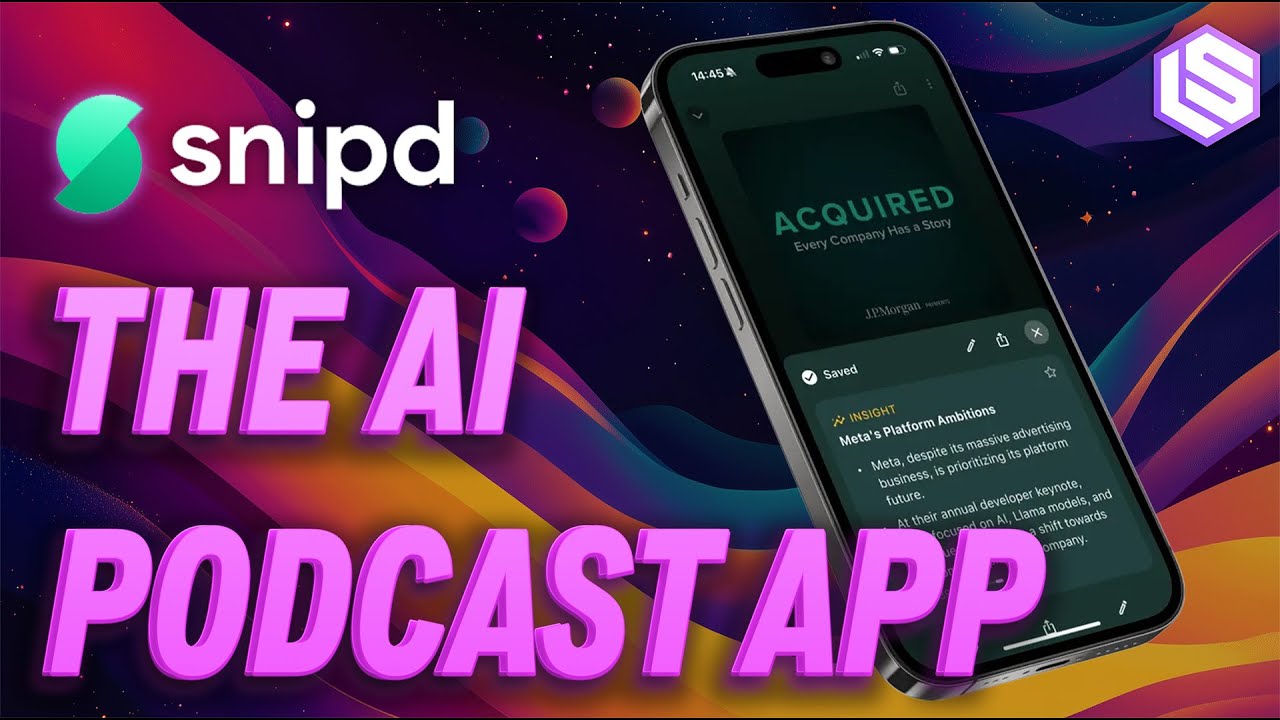
Snipd: The AI Podcast App for Learning — with CEO Kevin Ben-Smith
Mar 14, 2025 · 1:17:46
Snipd CEO Kevin Ben-Smith joins Swyx to explain how the AI-powered podcast app turns passive listening into active learning. Snipd transcribes and diarizes episodes, generates chapters, identifies mentioned books, and summarizes insights on demand — all with a four-person team. Kevin describes moving from self-hosted open-source models (Wave2vec, Pyannote) to a mix of Whisper, OpenAI, Google Gemini, and Perplexity APIs, balancing cost against the need for predictable batch processing vs. real-time user requests. He details technical hurdles like dynamic content resyncing (building a 'Shazam for podcasts') and using LLMs as judges to filter hallucinated book recommendations. The episode also covers Snipd's origin as a hackathon-winning podcast search tool, Swyx's own switch from Overcast, and Kevin's vision for voice-driven post-episode reflection and AI-assisted discovery as the next frontier.
[Lightning Pod] Evals: How to Improve AI Consistently — with Hamel Husain and Shreya Shankar
Mar 13, 2025 · 27:34
Hamel Husain and Shreya Shankar join the Latent Space podcast to argue that systematic evaluation (evals) is the critical missing piece for moving AI applications from demo to production. They estimate 75% of evals in the wild use LLM-as-judge, but 80% of those are not helpful without proper validation against domain experts. Husain advocates building custom annotation UIs (using tools like Lovable or Cursor) to speed error analysis, while Shankar emphasizes synthetic data generation that balances real-world data and LLM outputs, drawing on social science methods. They preview their free lightning lesson on March 21 and a four-week paid course covering the eval lifecycle: synthetic data creation, LLM-as-judge calibration, error analysis, and iterative improvement, with hands-on coding assignments. The episode also touches on trends like dedicated judge models (e.g., Haizelabs' Verdict) and the value of basic data literacy (e.g., pivot tables) for eval participation.

Solve coding, solve AGI [Reflection.ai launch w/ CEO Misha Laskin]
Mar 7, 2025 · 28:12
Misha Laskin of Reflection AI argues that solving autonomous coding is the direct path to AGI, combining reinforcement learning (pioneered by his team on AlphaGo/AlphaZero) with large language models (which they advanced at Google on PaLM, Gemini, ChatGPT). He explains that coding is already ergonomic for LLMs—unlike browser agents that require noisy human mouse data—making it the ideal starting point. Reflection AI is building coding agents that automate backlog tasks (testing, refactoring, migrations, security remediation) for large engineering teams, delivering them via an API that takes a task and codebase and outputs resolved code. Laskin insists superintelligence cannot be built in a vacuum; real-world customer evals are essential, as benchmarks like SWE-bench don't guarantee production reliability. He also stresses the need for open-weight models to prevent a few companies from hoarding superintelligent coding agents.

How Claude Plays Pokémon was made
Mar 4, 2025 · 37:38
David Hershey of Anthropic explains how he built Claude Plays Pokémon, an agent that uses Claude to play Pokémon Red, revealing both surprising capabilities and stark limitations of AI. He describes the simple tool-using agent loop: Claude sends button presses, receives screenshots and RAM state, and maintains a knowledge base and 30-message conversation history with summarization. Key challenges include Claude's poor spatial awareness—it famously walked up and down outside Oak's lab 12 times—and its tendency to hallucinate game knowledge. Hershey notes that newer models (Sonnet 3.7) required stripping away band-aid prompts, as simpler instructions yielded better performance. The project also showed emergent behaviors: nicknamed Pokémon made Claude more protective, and the model even wrote meta-commentary about its own mistakes in its knowledge base. While the current run is stuck in Mount Moon after 52 hours, the biggest hurdles remain vision and navigation, not prompting tricks.
Gemini 2.0 Flash and Flash Thinking: the new SOTA models for the agentic era
Feb 28, 2025 · 28:21
Logan Kilpatrick, Google AI Studio product lead, returns to discuss Gemini 2.0 Flash and Flash Thinking, the new models that balance frontier capabilities with cost efficiency for the agentic era. He explains the pricing strategy: Flash at 10 cents per million tokens (simplified from tiered pricing), Flash Lite preserving the 7.5-cent narrative for low cost, and Pro pushing the frontier. Flash Thinking, co-led by Noam Shazeer and Jack Rae, scales inference-time compute and already shows rapid improvements, with base model advances coupling with RL-based reasoning. Swyx reports that Gemini Flash outperforms o3-mini on long-context summarization, calling it a 'reporting model.' The multimodal live API enables real-time voice and vision interactions, and a memory layer mimicking Astra is in development. Grounding with Search as a Tool is also highlighted for agentic search use cases.

smol agents are all you need
Feb 13, 2025 · 22:31
This episode features Aymeric Roucher of Hugging Face discussing smol agents, a lightweight agent framework, and argues that code-based agents outperform JSON-based agents. Roucher explains that agents are defined by LLM control over execution flow, and smol agents simplifies this with a core file under 1000 lines. He describes the origin from transformers.agents and the security-focused custom Python interpreter. The library achieved third place on the GAIA benchmark, using o1 and Sonnet models, and Roucher projects 90% accuracy by 2026 based on a sigmoid trend line. Hugging Face is launching an agent course and plans to build GUI agents for computer use, while also fine-tuning R1 for agentic tasks.

The AI Architect: Bret Taylor
Feb 11, 2025 · 1:35:59
Bret Taylor, CEO of Sierra and chairman of OpenAI, recounts engineering AI's future across three eras — rewriting Google Maps' frontend in a weekend (cutting un-gzipped code to 20K), building Sierra's in-house agent platform for consumer brands like Sonos and SiriusXM, and navigating OpenAI's leadership crisis. He argues that AI agents' core abstractions are still pre-React, compares today's agents to jQuery, and predicts that outcome-based pricing will dominate as agents complete jobs rather than assist humans. He urges software engineers to move up the stack toward domain-specific agents and to embrace Rust-like languages for AI-generated code, emphasizing formal verification and safety. Taylor also shares how OpenAI prioritizes mission over product features, and why the relationship with Microsoft remains OpenAI's most important partnership.

Why every AI Engineer needs an AI Gateway (ft Portkey.ai CEO)
Feb 5, 2025 · 31:18
Rohit Agarwal, CEO of Portkey, explains why every AI engineer needs an AI gateway: an operational platform that connects to LLMs more efficiently, handling routing, observability, guardrails, and cost management. He notes that 90% of production use cases don't use automatic routing, but reasoning models and agents are driving new routing demands. Portkey's open-source gateway minimizes latency with a 21 MB memory footprint using JSON transformers. Key jobs include routing, observability (monitoring price, performance, accuracy), guardrails (e.g., regex-based, empty output detection, PII redaction), and human feedback tied to business metrics like video download rates. Rohit also highlights MCP adoption for simplifying agent-to-service connections, with bidirectional communication via RPC.

The Agent Reasoning Interface: Claude, ChatGPT Canvas, Tasks, Operator — with Karina Nguyen, OpenAI
Feb 1, 2025 · 1:06:29
OpenAI's Karina Nguyen, who led the creation of ChatGPT Canvas and Tasks, explains how her team trains separate models for new interaction paradigms rather than prompting the core model, enabling rapid iteration on user feedback. She details the 'behavioral design' process that shapes model personality in collaborative contexts like Canvas—deciding when to rewrite vs. edit—and how that extends to defining agents as a progression from one-off actions to fully trustworthy long-horizon delegation. Drawing on her time at Anthropic building Claude.ai from scratch and co-creating Claude 3, she contrasts the product mindsets: OpenAI takes more product risks across consumer features while Anthropic focuses on enterprise. She also shares her vision for ChatGPT evolving into a 'generative OS' where UIs adapt dynamically to user intent, and argues that human creativity—not model capability—is the current bottleneck for rethinking software interfaces.

Beating OpenAI and Anthropic by Looking At Data: the new #1 on SWE-Bench w/ W&B CTO Shawn Lewis
Jan 28, 2025 · 34:31
Shawn Lewis, CTO of Weights & Biases, built a coding agent using OpenAI's o1 model that achieved 64.6% on SWE-bench verified, the top score at the time. He developed a TypeScript agent framework called PhaseShift and an Eval Studio tool backed by Weave, emphasizing that rigorous data inspection and tooling are critical for agent development. Lewis explains his process of running parallel rollouts and a crosscheck method to select the best trajectory, which contributed a 6% improvement. He also discusses the challenges of adapting reasoning models like o1 for agentic tasks and shares plans to open-source PhaseShift. The episode highlights Lewis's dogfooding approach, using Weights & Biases' own tools to build and evaluate the agent.

OpenAI o1 isn’t a chat model (and that’s the point)
Jan 17, 2025 · 31:59
Ben Hylak and Dan McAteer explain why OpenAI’s o1 is not a chat model and how mastering its prompting turned Ben from a skeptic into a proponent. Ben’s prompt structure—goal, return format, warnings, context dump—emphasizes describing what you want rather than how to think, a shift from earlier models. Dan uses o1 for coding by feeding it full code context, achieving one-shot implementations that reach 100% where previous models maxed out at 95%. Ben notes o1 is the most capable but hardest model to use, with experiments costing $20 per try, and argues model routing will let humans or systems trade off cost, speed, and intelligence. Dan also applies o1 to scientific research, feeding it papers from multiple fields to find novel connections that humans would miss.
2024 Year in Review: The Big Scaling Debate, the Four Wars of AI, Top Themes and the Rise of Agents
Jan 1, 2025 · 1:51:07
In their 100th episode, hosts Alessio and Swyx recap 2024 in AI, arguing that pre-training scaling has hit a wall—backed by Ilya Sutskever and others at NeurIPS—and that inference-time compute (o1, o3) is the new frontier. They dissect the "four wars": data quality (lawsuits vs. synthetic data), GPU haves vs. have-nots (with the middle class dying), multimodality (Sora, Veo 2, Gemini 2.0's native image output), and the LLM OS/agents stack (LangChain, E2B, memory). Market share shifted from OpenAI's 95% to 50-75% as Anthropic and Gemini gained ground; prices dropped ~3 orders of magnitude for same ELO. The episode predicts 2025 as the year agents finally enter production, driven by models like o1 and tools like Devin, and warns that AI will set the skill floor for roles.

Best of 2024 in Agents (from #1 on SWE-Bench Full, Prof. Graham Neubig of OpenHands/AllHands)
Dec 25, 2024 · 51:25
Professor Graham Neubig of CMU and AllHands AI, maintainer of the open-source coding agent framework OpenHands, delivers a talk on the state of agents in 2024, arguing that agents are now capable of automating significant portions of software development but still struggle with information gathering and error recovery. He demonstrates OpenHands solving real coding tasks live, explains key design choices like using Python code execution over granular tool calls to reduce LLM invocations, and shares that Claude currently outperforms other models for agentic tasks due to superior instruction following and error correction. Neubig discusses eight perennial agent problems including agent-computer interface, human-agent interface, model selection, planning, workflows, exploration, search, and evaluation. He predicts every major LLM trainer will focus on agent-oriented models by mid-2025, that agent benchmarks like SWE-Bench and WebArena will saturate and require harder successors, and that the biggest challenge will be designing human-agent interfaces for systems that succeed only 30-40% of the time autonomously but 80-90% with human feedback. The talk also covers workflow memory as a…

The State of AI Startups in 2024 [LS Live @ NeurIPS]
Dec 21, 2024 · 26:35
Sarah Guo and Pranav Reddy argue that 2024 has become a far friendlier ecosystem for AI startups, with the model landscape shifting from OpenAI's near-monopoly to a competitive field where Google's Gemini now leads LMSys Arena and open-source models like Llama 8B score ten points higher on MMLU than Mistral 7B a year ago. They note that OpenAI's API cost has dropped 80-85% in 18 months, and total OpenAI API share fell from ~90% to ~60% as customers switch. The funding environment is rational, not a bubble, with foundation-model labs raising $30-40B but most startups seeing sane valuations; one portfolio company grew from zero to twenty million in PLG-style spending. Key startup themes include first-wave service automation (Sierra, Decagon, Harvey, EvenUp), better search and new friends (Perplexity, Glean, Character, Replica), and democratized creativity (Midjourney, HeyGen). They argue the 'GPT wrapper' narrative is false—applications capture value—and that incumbents face innovator's dilemma because AI changes business models (outcomes-based pricing) and data needs (reasoning traces rarely saved). The speed of change and new markets (legal, healthcare, defense) structurally favor…

0 to over $8M ARR in 2 months as a Claude Wrapper (Bolt.new, Qodo)
Dec 2, 2024 · 1:36:42
Eric Simons of Bolt.new/Stackblitz and Itamar Friedman of Qodo discuss Bolt.new's viral growth from $4M ARR in four weeks to over $8M ARR in two months as a Claude wrapper, driven by its in-browser WebContainer OS that eliminates local dev setup. They contrast Bolt's '0 to 1' creation for non-developers with enterprise-focused agents like Qodo's testing and code review tools, arguing that specialized agents outperform general-purpose ones. Simons details how WebContainer's unified sandbox enables error self-healing loops, while Friedman explains AlphaCodium's task-breaking that boosted o1 preview to 93rd percentile on Codeforces. The episode covers open-source strategy, pricing tiers ($20 to $200/month), and founder advice on ignoring expert doubt to ship fast, illustrated by Simons' Ironman completion while launching Bolt.

The new Claude 3.5 Sonnet, Computer Use, and Building SOTA Agents — with Erik Schluntz, Anthropic
Nov 28, 2024 · 1:11:08
Anthropic's Erik Schluntz explains how Claude 3.5 Sonnet achieved state-of-the-art 49% on SWE-Bench Verified by using a minimal agent framework that gives the model full control via tools like bash and file editing, letting it self-correct without hard-coded workflows. He details the importance of tool design over prompt engineering, why XML tags work well, and how computer use reduces integration friction by letting models interact with any browser-based interface. Schluntz also shares his robotics experience, noting that while LLMs and diffusion models are promising for general-purpose robots, reliability at 99.9% and hardware variability remain major hurdles, and he expresses skepticism about self-driving as a business due to high vehicle costs versus driver-equivalent revenue.

Agents @ Work: Lindy.ai (with live demo!)
Nov 15, 2024 · 1:08:01
Florent Crivello, founder of Lindy.ai, explains how his no-code agent platform evolved from an overly LLM-dependent design to a deterministic 'on rails' system that puts AI in a box, making agents more reliable and easier to use. The product was rebuilt from scratch as Lindy 2.0, featuring step-by-step workflows with structured outputs and memory management that still requires pruning. Crivello reveals that Claude 3.5 Sonnet ended model bottlenecks but warns against over-engineering cognitive architectures, advocating instead for letting models scale. He discusses building their own eval tools (now considering Braintrust), hiring vertical GMs for go-to-market, and the decision to return to in-person work, arguing remote work hampers creativity. He also shares his contrarian views on Europe vs. US tech, testing the Overton window with spicy tweets, and balancing AI safety concerns (10% p(doom)) with building toward a potential utopia.
Agents @ Work: Dust.tt — with Stanislas Polu
Nov 11, 2024 · 58:53
Stanislas Polu, co-founder of Dust.tt, argues that horizontal agent platforms—not vertical, single-use-case agents—will win the enterprise by letting non-technical employees build their own automation. A former OpenAI researcher who worked directly with Ilya Sutskever on formal mathematics and saw GPT-4 internally before ChatGPT, Polu left in 2022 to start Dust, now an open-source infrastructure layer that connects company data (Slack, Notion, GitHub) to LLMs and lets anyone create simple, instruction-driven agents. He contrasts Dust’s API-first, integration-heavy approach with LangChain’s open-source orchestration and Adept’s browser automation bet, insisting that most useful agent workflows require only a few tool calls and that function-calling quality (where GPT-4 Turbo still leads) matters more than model size. Dust achieves 88% daily active user penetration at some enterprise customers, and Polu predicts the first billion-dollar company run by a single person will emerge once platforms like Dust mature enough to let tiny teams scale to massive output.

Singapore: the AI Engineer Nation — with Minister Josephine Teo
Oct 19, 2024 · 56:40
Singapore Minister Josephine Teo outlines the city-state's refreshed national AI strategy and the Ministry of Digital Development's approach to balancing innovation, safety, and talent development. She details plans to triple AI practitioners from 5,000 to 15,000, the AI Verify testing tools and AI Safety Institute for governance, and internal government AI bots like AI Bot for RAG-based knowledge retrieval. On sovereign AI, she discusses hybrid cloud infrastructure and pragmatic data center expansion. Teo also explains Singapore's new law requiring transparency for AI-generated election content, emphasizing fact-based political discourse.
Building the Silicon Brain - Drew Houston of Dropbox
Oct 18, 2024 · 1:11:40
Drew Houston, CEO of Dropbox, details his hands-on AI engineering journey and the company's strategic pivot to AI-first products like Dropbox Dash for universal search and access control. Having spent over 400 hours coding with LLMs, he built personal tools that seeded Dropbox AI, including a file question-answering system. He advocates 'rent, don't buy' for AI infrastructure, relying on open-source models and keeping options open as costs drop 10-100x yearly. Houston explains Dropbox's advantage in trust and data privacy, positioning it as a neutral platform that integrates with Google Drive and OneDrive. He discusses staying relevant through constant learning and founder mode, and advises founders to systematically train skills ahead of their company's growth.
Production AI Engineering starts with Evals
Oct 11, 2024 · 1:56:16
Ankur Goyal, founder and CEO of Braintrust, argues that evaluation is the core workflow of production AI engineering and shows how his platform makes evals accessible to software engineers. Drawing from his experience at SingleStore and Impira, he details Braintrust's evolution from an eval tool into an end-to-end AI development platform used by Stripe, Zapier, Vercel, and other top AI teams. He shares market data: OpenAI handles over 95% of production workloads, fine-tuning is declining, and open-source models account for under 5% due to reliability issues. Ankur explains why he avoided building a vector database—the real challenge is permissions and joins, not vector search—and predicts o1-style reasoning will replace complex agent frameworks. He reveals Braintrust's differentiators: hybrid on-prem, TypeScript-first SDK, and declarative eval structures.

Building AGI in Real Time (OpenAI Dev Day 2024)
Oct 4, 2024 · 2:09:35
OpenAI's DevDay 2024 unveils the Realtime API with WebSocket-based voice and function calling, Vision Finetuning, Prompt Caching, and Model Distillation. Product leads Olivier Godement, Romain Huet, and Michelle Pokrass detail design choices like zero-code caching and WebSockets for human-level latency. Alistair Pullen of Cosine explains how fine-tuning GPT-4o on custom reasoning traces beat o1 on SWE-bench Verified, while Sam Altman and Kevin Weil discuss AGI levels (o1 as level 2 reasoner), the coming agent era (level 3), safety through iterative deployment, and the importance of building for the frontier. The episode also covers moderation policy relaxation, plans for o1 system prompts by year-end, and the competitive admiration for NotebookLM.

[Paper Club] Who Validates the Validators? Aligning LLM-Judges with Humans (w/ Eugene Yan)
Sep 28, 2024 · 1:00:55
Eugene Yan presents the paper 'Who Validates the Validators? Aligning LLM-Judges with Humans' by Shreya Shankar, introducing EvalGen, a framework that helps developers iteratively align LLM evaluators with human labels by grading outputs, refining criteria, and tracking coverage (recall) and false failure rate (1−precision). Yan demonstrates his own prototype 'Label', which forces users to label 20 samples before unlocking evaluation mode and 50 samples plus one evaluation run before optimization, gamifying the alignment loop. The discussion covers binary vs. pairwise evaluation, the subjectivity of criteria, and Shreya Shankar's plans to integrate natural language feedback into EvalGen's next version. Yan advocates that labeling data is essential before deploying LLM evaluators in production, turning the process into prompt fine-tuning rather than vibe checks.

Is finetuning GPT4o worth it?
Aug 22, 2024 · 1:01:16
Ali Pullen, founder of Cosine, discusses Genie, an AI software engineering colleague that achieved 30% on SWE-Bench and 43.8% on SWE-Bench Verified via fine-tuning GPT-4o on billions of tokens of synthetic data. Cosine built Genie by training on the process of software engineering—not just working code—using synthetic runtime errors and a self-improvement loop. The agent follows a four-stage workflow: code retrieval (66% accuracy), planning, writing diffs, and running CI tests. Pullen reveals that model performance degrades linearly beyond 60K tokens in the context window, and that OpenAI dynamically sizes LoRA adapters to handle Cosine's massive dataset. He explains why Genie isn't on the SWE-Bench leaderboard (refusing to publish trajectories to prevent distillation) and outlines plans to scale the dataset and fine-tune on customer codebases for personalized performance.
The Winds of AI Winter (Q2 Four Wars of the AI Stack Recap)
Aug 2, 2024 · 1:23:36
Swyx and Alessio recap Q2 2024 through their 'Four Wars' framework, arguing that the AI landscape is shifting from frontier model dominance to commoditization and vertical applications. They highlight Claude 3.5 Sonnet overtaking OpenAI on coding benchmarks, Llama 3.1's synthetic data approach enabling 7B models to rival GPT-4, Mistral Large 2's non-commercial license and lost open-source crown, and on-device models like Gemini Nano and Apple Intelligence. The Quality Data Wars see NYT suing OpenAI, Reddit licensing data for $200M+, and synthetic data proving real for math (AlphaProof near IMO gold) and code. The Multimodality War includes ChatGPT Voice Mode delayed, Meta's Chameleon for native fusion, and Google's PaliGemma for PDF extraction. The renamed LLM OS War covers agent protocols, memory databases, and the collapse of model cost by an order of magnitude every four months, pushing startups toward vertical services like Brightwave and Dropzone that sell labor, not tools. The episode ends with a CrowdStrike joke about agent safety.

How To Hire AI Engineers (ft. James Brady and Adam Wiggins of Elicit)
Jun 21, 2024 · 1:08:06
James Brady and Adam Wiggins of Elicit define the AI engineer role as a blend of conventional software engineering, deep curiosity about language models, and a defensive fault-first mindset to handle LLMs' chaotic latency and non-determinism. They explain their interview process uses coding exercises that force edge-case thinking and system design probing fault tolerance, not happy-path algorithms. For sourcing, they emphasize side projects, hackathons, and targeted communities like effective altruism. The episode explores the ML-first mindset of relinquishing control to leverage model capabilities, using techniques like retries, fallbacks, and strong typing. Elicit shares their job description template and tiered ML reading list as practical resources for hiring.

LLM Asia Paper Club Survey Round
May 22, 2024 · 55:25
The episode surveys four recent papers on LLM reasoning, uncertainty, interpretability, and efficiency. 'Let's Think Dot by Dot' shows that filler tokens (dots) inserted between input and output enable hidden computation, outperforming no-token baselines on tasks like 3-Sum and 2-Sum Transform. 'Uncertainty Estimation' trains a random forest on hidden-layer activations to predict response confidence, achieving higher AUC than unsupervised methods on Q&A and translation. 'Monosemanticity' uses sparse autoencoders to identify interpretable features (e.g., a DNA-detection feature) in a toy transformer, advancing mechanistic interpretability. 'Medusa' attaches multiple prediction heads to the final hidden state to speculate future tokens, enabling faster decoding without a separate draft model and training in five hours on 60K samples.

This World Does Not Exist — Joscha Bach, Karan Malhotra, Rob Haisfield (WorldSim, WebSim, Liquid AI)
Apr 27, 2024 · 1:56:11
The episode features Karan Malhotra demoing WorldSim, a prompt that turns Claude 3 into a universe simulator via CLI; Rob Haisfield presenting WebSim, which generates functional websites on the fly; and Joscha Bach arguing simulative AI reveals consciousness as a virtual property, with LLMs creating agents as real as human minds, urging the California Institute for Machine Consciousness to build self-organizing silicon life. Malhotra shows WorldSim running “world.exe” to create Twitter inside a simulated universe, with users tweeting and Elon Musk moving Dogecoin. Haisfield demonstrates WebSim generating a 5D particle interface, a news RSS aggregator, and a face-swap webcam app via URL parameters like “secrets=revealed”. Bach explains consciousness as second-order perception in a simulated now, criticizes RLHF for lobotomizing models, and advocates for animist AI where software agents compete like spirits, not golems.

High Agency Pydantic over VC Backed Frameworks — with Jason Liu of Instructor
Apr 24, 2024 · 1:02:59
Jason Liu, creator of the Instructor library, explains why structured outputs from LLMs are best handled by a simple requests-like wrapper rather than a VC-backed framework, arguing that Pydantic-defined schemas via function calling outperform JSON Mode for typed responses. He details his journey from being bearish on LLMs at StitchFix to building Instructor on a bullet train to Japan after GPT-3 proved him wrong. Liu advocates for workflow-based DAGs over reactive agent loops, recommends using rankers rather than cramming 60+ tools into an API call, and credits high agency—trying many experiments and documenting conditions for revisiting failures—as key to his success. He also critiques the MLE hiring hype, urging startups to empower motivated AI engineers instead.

The Origin and Future of RLHF: the secret ingredient for ChatGPT - with Nathan Lambert
Jan 11, 2024 · 1:35:27
Dr. Nathan Lambert traces the origin and future of Reinforcement Learning from Human Feedback (RLHF), the secret ingredient behind ChatGPT, explaining how it evolved from robotics and early preference learning to become the core alignment technique for large language models. He details the three-phase process (instruction tuning, preference data collection, RL optimization), noting that RLHF's data costs for LLaMA2 were around $6–8 million, and that synthetic data from GPT-4 is cheaper and often more accurate than human labels. Lambert contrasts DPO with PPO, arguing DPO is simpler but may have lower peak performance. He discusses emerging methods like Constitutional AI, which uses AI-generated critiques based on principles, and highlights the challenge of evaluating RLHF models, noting GPT-4 Turbo's lead over earlier versions. The episode covers open questions about data aggregation, reward model agreement (65–75%), and the need for qualitative model interaction.

Why AI Agents Don't Work (yet) - with Kanjun Qiu of Imbue
Oct 21, 2023 · 1:12:37
Kanjun Qiu, CEO of Imbue (formerly Generally Intelligent), argues that AI agents remain unreliable because they lack robust reasoning and proper abstractions, which Imbue tackles by training foundation models optimized for reasoning over data like code. With a $200M Series B and $1B+ valuation, Imbue builds internal tools for debugging and inspecting agent decision-making, rejecting pure reinforcement learning after their Avalon environment revealed RL cannot handle planning. Instead, they emphasize natural language reasoning for inspectability, use code as a curriculum for reasoning, and design interfaces that let users fork and modify agents mid-execution. Qiu also discusses lessons from earlier startups (Sorceress in recruiting, Embark in VR), the importance of treating team members as creative agents, and her role in co-founding communal living space The Archive to foster scenius.

RAG is a hack - with Jerry Liu of LlamaIndex
Oct 12, 2023 · 1:13:25
In this episode of Latent Space, Jerry Liu of LlamaIndex argues that while RAG is fundamentally a hack, it remains the most practical approach for grounding LLMs with external data, and his open-source framework now serves 600,000 monthly downloads. Liu recounts how LlamaIndex originated from a hackathon at Robust Intelligence, evolving from an experimental tree-index to a modular toolkit spanning data loading, retrieval, synthesis, and agent loops. He explains the trade-offs between RAG and fine-tuning, noting that context window limits force algorithmic rather than learned optimizations, but RAG offers transparency and access control that fine-tuning cannot. Liu details the company’s $8.5M Greylock raise, the launch of LlamaHub for community-contributed data loaders, and the open-source SEC Insights app as a production-grade template. Looking ahead, he emphasizes the need for better retrieval benchmarks and predicts that future personalization will move beyond vector stores into model-internal memory architectures.

Generating your AI Media Empire - with Youssef Rizk of Wondercraft.ai
Sep 20, 2023 · 1:28:55
Youssef Rizk, co-founder of Wondercraft.ai, explains how his five-month-old startup uses hyperrealistic AI voices to turn blogs, newsletters, and other content into podcasts, arguing that the application layer—not the underlying API—is the real moat. He details Wondercraft's origin from a failed sports-investing startup, the rapid MVP that generated $3K in one day, and the decision to build script generation and audio production tools rather than train its own models. Rizk also announces a new AI dubbing feature for video, discusses the challenges of scaling to 28 languages, and reveals that the company runs on just four people pushing two major features per week. The conversation covers the daily Hacker News Recap podcast—which reached Spotify's top 30 tech podcasts—and Rizk's view that AI-generated content must be clearly disclosed to avoid backlash.
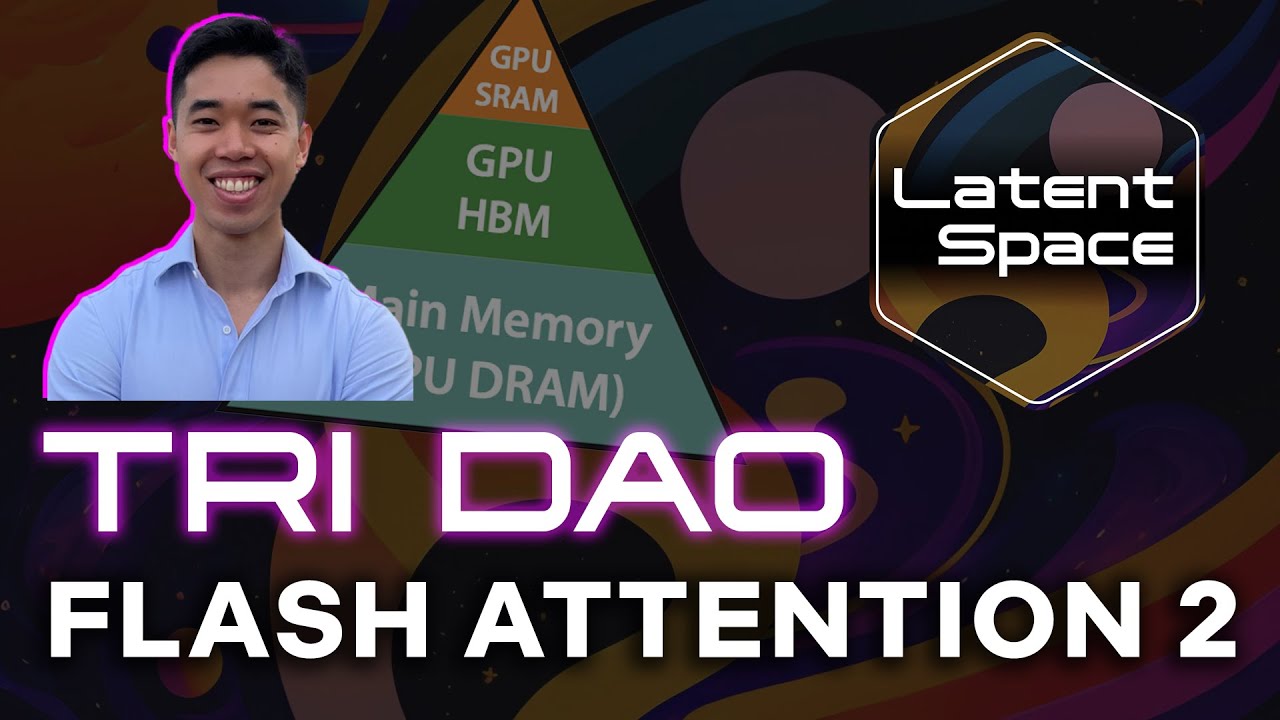
FlashAttention-2: Making Transformers 800% faster AND exact
Aug 3, 2023 · 1:04:06
Tri Dao, creator of FlashAttention and FlashAttention-2, explains how his I/O-aware algorithm makes attention 2x faster by fusing kernels and using online softmax, achieving near-matrix-multiply efficiency. He argues that transformer alternatives like state space models and RNNs (e.g., RWKV) could surpass transformers for long sequences and high-throughput generation, though attention still dominates. Dao discusses the hardware lottery, where NVIDIA's CUDA ecosystem entrenches transformers, and advocates for open-source AI, praising Meta's Llama 2 for shifting enterprise adoption despite its restrictive license. He emphasizes that understanding both algorithms and systems is key to scaling AI, and that academia should pursue risky bets that industry cannot.
Powered by PodHood